4807 Katy Freeway Service Road, Houston, TX 77007
Best Pest Control in Lazybrook / Timbergrove
Lazybrook and Timbergrove's 1950s–1960s brick ranch homes inside the 610 Loop come with original cast-iron drain lines, aging slab or pier-and-beam foundations, and mature oak-and-hackberry canopy that creates ideal conditions for subterranean termites, American cockroaches migrating through old sewer infrastructure, and roof-accessing wildlife year-round. The neighborhood sits close enough to White Oak Bayou that even Zone X blocks see slow-draining clay soil after heavy rain, extending mosquito and moisture-pest pressure well past storm events. If you own or are renovating one of these mid-century ranches, understanding which pests are actually endemic here — and why — will save you from treatments that mask symptoms without fixing the structural pathways.
Verified against Google Business data
Updated 2026
See the 10 Pest Control Serving Lazybrook / Timbergrove 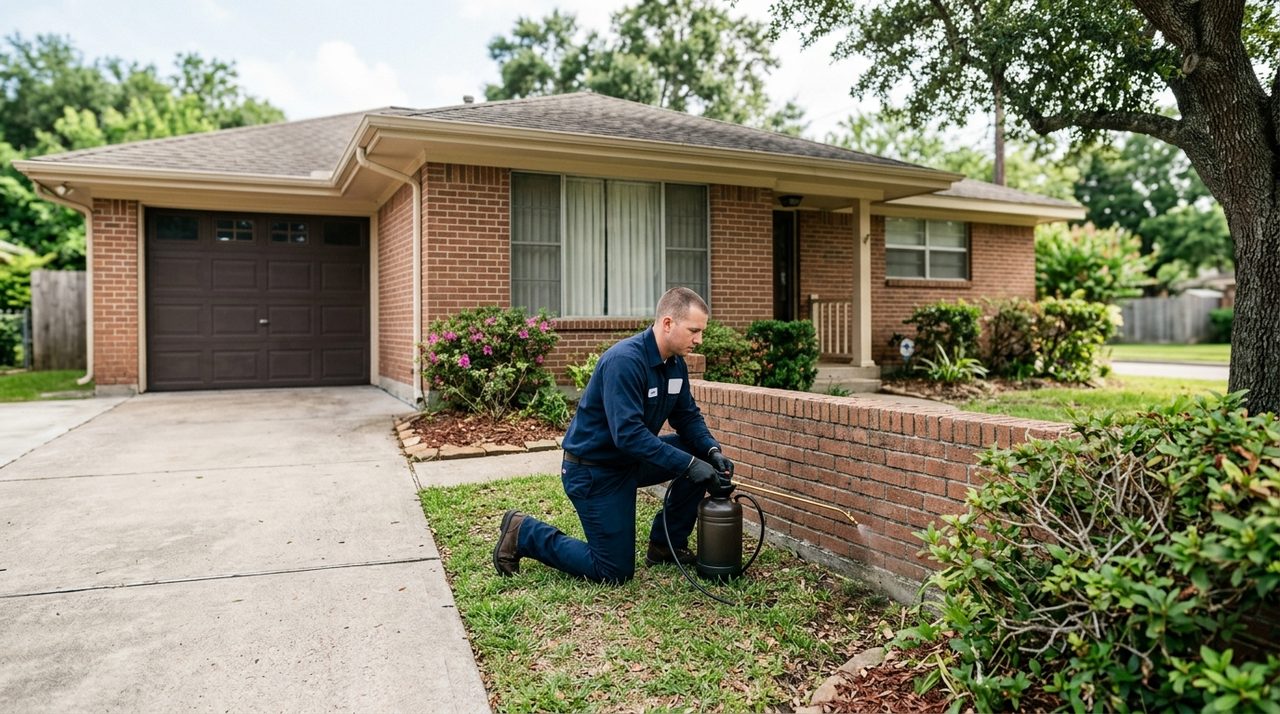
- Median home built
- 1992
- Median home value
- $554,625
- FEMA flood zone
- X (low)
- Typical one-time treatment (est.)
- $150–$300 (interior + exterior perimeter, ~2,000 sq ft)
- Most common local issue
- American cockroach intrusion via aging cast-iron sewer lines in pre-1980 ranch homes
Ranked by verified Google rating × review volume × verification tier. How we rank →
Min rating:
10 results9050 Long Point Rd, Houston, TX 77055
Closed
1946 Lynnview Dr, Houston, TX 77055
6615 Long Point Rd suite E, Houston, TX 77055
Closed
747 W 18th St Suite D, Houston, TX 77008
9050 Long Point Rd, Houston, TX 77055
Closed
4001 N Shepherd Dr, Houston, TX 77018
Closed
1119 W 34th St, Houston, TX 77018
8505 Hammerly Blvd, Houston, TX 77055
Closed
841 W 20th St, Houston, TX 77008
Pest Control in Lazybrook / Timbergrove: What You Should Know
Cast-Iron Drain Lines Are a Cockroach Highway in These 1950s–1960s Ranches
Why it matters to you
The original ranch homes in Lazybrook and Timbergrove almost universally started with cast-iron sanitary drain lines that are now 60–70 years old. As those pipes corrode and crack — a process accelerated by Houston's flat sewer grades and heavy-rain surges — they create direct, warm harborage corridors that Periplaneta americana (the American cockroach, locally called the 'waterbug') uses to move between the city's storm/sanitary sewer system and your kitchen or utility closet. Interior spray treatments alone cannot interrupt this cycle because the pest's primary harborage is underground and inaccessible to standard applications.
What a good pro does
A licensed Texas Structural Pest Control operator (TDLR-certified in the general household pest category) should treat floor drains, cleanout access points, and weep holes with approved residual products, and perform exterior exclusion along the foundation perimeter — sealing plumbing penetrations and weep holes rather than just spraying them. If your home has undergone partial re-plumbing (common in the deep renovations now happening throughout Timbergrove), ask the technician to inspect where new PVC lines meet surviving cast-iron stubs, because those transition joints are a frequent gap point. No City of Houston permit is required for this pest service, but work on drain lines themselves requires a licensed plumber.
Subterranean Termite Pressure Is Heightened by Mature Tree Canopy and Mulched Foundation Beds
Why it matters to you
Houston occupies USDA Termite Infestation Probability Zone 5 — the highest pressure tier in the continental U.S. — and the established oak, pecan, and hackberry canopy throughout Lazybrook and Timbergrove provides both above-ground cellulose and root systems that extend termite foraging activity directly toward foundation edges. Many original 1950s ranches never received a termiticide pre-treatment when built, and the thick mulch beds common in these landscaped lots press moist organic material directly against brick skirting, giving Coptotermes formosanus and Reticulitermes species a moisture-and-food bridge to any wood framing at the sill plate.
What a good pro does
A TDLR-licensed termite operator should perform a thorough slab inspection — including interior expansion joints and plumbing penetrations — before recommending either a liquid barrier (Termidor-type, estimated $800–$1,800 for a typical ranch footprint) or a bait station network (Sentricon-type, estimated $1,200–$2,000 installed plus $300–$500 per year for monitoring). Pull mulch at least six inches from the foundation perimeter regardless of which treatment is chosen; this single step meaningfully reduces moisture retention and termite bridging. Homes currently undergoing renovation through the City of Houston Permitting Center should request a new termite pre-treatment as part of any foundation-adjacent scope.
Sources: Texas Department of Licensing & Regulation, Local HOA / deed restrictions (see area profile)
Clay Soil Slab Movement Creates Recurring Rodent Entry Points After Every Wet-Dry Cycle
Why it matters to you
Houston's Beaumont/Houston Black clay expands and contracts seasonally, and the 1950s–1960s slabs in Lazybrook and Timbergrove have experienced decades of that cyclical movement, reopening gaps around plumbing penetrations, garage thresholds, and brick weep holes each time the soil shifts. Rattus norvegicus (Norway rat) and roof rats readily exploit these gaps — particularly in the blocks closest to White Oak Bayou's vegetated banks, which provide dense harborage and food sources that push rodents toward adjacent residential structures. Post-Uri pipe repairs (2021) and the wave of whole-home renovations now common in Timbergrove have frequently left utility chases and wall penetrations improperly resealed, creating new entry points in homes that were otherwise rodent-resistant.
What a good pro does
Effective rodent management here requires physical exclusion — not just bait stations — because re-entry is nearly guaranteed while soil-movement gaps remain open. A TDLR-licensed operator should probe foundation perimeter, crawlspace access voids (where pier-and-beam exists), and all utility penetrations, then use copper mesh, hydraulic cement, or expanding foam rated for rodent exclusion before placing interior control devices. Full exclusion-plus-treatment programs are estimated at $400–$900 for a typical ranch footprint. Homeowners doing renovation work should specifically ask their general contractor to document how plumbing and electrical penetrations are being sealed, since that scope is often treated as incidental on remodel bids.
Sources: Texas Department of Licensing & Regulation, Harris County Flood Control District
Storm-Damaged Soffits and Mature Canopy Invite Roof Rats and Wildlife Into Attics Year-Round
Why it matters to you
The May 2024 derecho and Hurricane Beryl (July 2024) stripped fascia, soffit panels, and ridge caps across inner-loop neighborhoods, and Lazybrook/Timbergrove's tall tree canopy — the same mature oaks that give the area its character — provides roof rats and Virginia opossums direct branch access to any new opening within days of a storm. The one-story ranch profile that dominates here means attic access is relatively low off the ground, and wood soffit common to mid-century construction degrades faster than modern composite materials, leaving gaps that don't always make it onto insurance adjusters' lists. Texas Parks and Wildlife Department (TPWD) regulations govern handling of certain species, including Mexican free-tailed bats that occasionally roost in older attics.
What a good pro does
After any significant wind event, have a TDLR-licensed wildlife/nuisance pest operator inspect the roofline before re-entry of any animal colony becomes established — exclusion is far simpler and cheaper than eviction plus remediation. Estimated post-storm inspection and wildlife exclusion costs run $500–$1,500 depending on the extent of damage and species involved. Homeowners with TWIA or standard homeowners' coverage should document open roof damage with photos immediately, as wildlife exclusion work may be partially reimbursable when tied to a covered storm event; coordinate with your pest operator before closing up repairs to ensure any existing occupants are confirmed absent.
Sources: Texas Department of Licensing & Regulation, Texas Windstorm Insurance Association (TWIA), Local HOA / deed restrictions (see area profile)
Pest Control in Lazybrook / Timbergrove: What You Should Know
Hiring pest control in Lazybrook / Timbergrove? Lazybrook/Timbergrove is defined by 1950s–1960s ranch-style brick homes inside the 610 Loop, many of which are now reaching the age where major systems need replacement or full renovation. Proximity to White Oak Bayou introduces flood-risk considerations for any ground-level work, and the Timbergrove Manor Civic Club requires design review approval before permitting for new construction and renovations, adding a step contractors must plan for.
- Housing era
- 1950s–1960s, with ongoing infill and teardown rebuilds
- Foundation
- Not confirmed from available sources - both slab-on-grade and pier-and-beam are common in 1950s–1960s…
- Flood zone
- FEMA Zone X (low flood risk) per official NFHL data
- Permits
- City of Houston Permitting Center (neighborhood is within Houston city limits, inside the 610…
Housing stock & systems
Building era
1950s–1960s, with ongoing infill and teardown rebuilds.
Typical style
One-story, mid-century ranch-style brick homes; newer two-story infill construction is increasing.
Foundations
Not confirmed from available sources - both slab-on-grade and pier-and-beam are common in 1950s–1960s Houston construction. Verify on a per-property basis.
Common systems
Original homes likely have galvanized or cast-iron drain lines, copper supply lines, older electrical panels (60–100 amp), and aging central HVAC systems. Many have undergone partial updates over the decades.
What that means for repairs
Teardowns and full rebuilds are common as land values inside the Loop have risen. Whole-home remodels of original ranches are also frequent, including kitchen and bath modernizations, re-plumbing, and electrical panel upgrades. Timbergrove Manor Civic Club requires design review before City of Houston permitting for new construction and major renovations.
Permits & restrictions
Permit jurisdiction
City of Houston Permitting Center (neighborhood is within Houston city limits, inside the 610 Loop).
HOA & deed restrictions
No mandatory master HOA. Governance is through civic clubs: Timbergrove Manor Civic Club (TMCC, 501(c)(4)) and Lazybrook Civic Club. Deed restrictions are enforced at the subdivision level and vary by section. Whether civic club dues are legally mandatory varies by section and is not definitively documented in public-facing materials.
Historic districts
No City of Houston historic district designation confirmed. HAHC Certificates of Appropriateness are not required for exterior work based on available research.
Contractor note
Contractors working in Timbergrove must obtain civic club design review approval before applying for City of Houston permits for new construction and major renovations. Deed restrictions vary by section, so scope of work and exterior modifications should be verified against the specific lot's recorded restrictions.
Flood & weather
FEMA flood zone
FEMA Zone X (low flood risk) per official NFHL data. However, the neighborhood borders White Oak Bayou, and properties closer to the bayou may carry higher effective flood risk. Individual properties should be checked against HCFCD inundation maps and may require elevation certificates.
Hurricane Harvey impact
Specific Harvey 2017 impact data for Lazybrook/Timbergrove is not available from the sources reviewed. The neighborhood's adjacency to White Oak Bayou suggests some homes near the bayou likely experienced flooding, but street-level or block-level inundation data was not confirmed. Check HCFCD Harvey inundation maps and Harris County Repetitive Loss/Severe Repetitive Loss lists for property-specific history.
Heat & humidity load
Original 1950s–1960s homes with aging HVAC systems face heavy summer cooling loads. Older ductwork in attics or crawlspaces may be poorly insulated, driving up energy costs. Pier-and-beam homes (where present) may see moisture-related issues under the house during Houston's humid summers. Bayou-adjacent lots may experience increased mosquito pressure and standing water concerns.
Working with contractors here
The dominant work in Lazybrook/Timbergrove involves either full teardown-and-rebuild projects or deep renovations of 60–70-year-old ranch homes. Re-plumbing (replacing galvanized or cast-iron lines), electrical panel upgrades, and HVAC replacement are among the most common system jobs. Foundation evaluation is important given the age of the housing stock, though the predominant foundation type is not uniformly documented. Contractors should budget time for Timbergrove Manor Civic Club design review when scoping exterior-facing or new construction work, as this approval is required before the City of Houston will issue permits. Flood risk near White Oak Bayou should be assessed before any ground-level or below-grade scope, including foundation work and landscaping drainage.
Local Tip
Always ask for a written estimate before work begins. Texas contractors are required to provide one on jobs over $1,000.
About Lazybrook / Timbergrove
Lazybrook/Timbergrove is defined by 1950s–1960s ranch-style brick homes inside the 610 Loop, many of which are now reaching the age where major systems need replacement or full renovation. Proximity to White Oak Bayou introduces flood-risk considerations for any ground-level work, and the Timbergrove Manor Civic Club requires design review approval before permitting for new construction and renovations, adding a step contractors must plan for.
- Median year built
- 1992
- Median home value
- $554,625
- Owner-occupied
- 53.8%
- Population
- 159,175
- Housing units
- 78,170
- Median income
- $122,578
Source: U.S. Census Bureau, ACS 5-Year 2023
Flood & storm risk
FEMA Zone XLow flood riskMost of Lazybrook / Timbergrove maps to FEMA Zone X (low mapped flood risk), but Houston's flash-flood reality means even low-risk blocks benefit from smart drainage and storm-hardened installs.
Source: FEMA National Flood Hazard Layer (NFHL). Flood zones vary by parcel — verify your individual FIRM panel.
Free Lazybrook / Timbergrove Tools & Calculators
Houston-specific estimators to plan your project before you call a pro. All results are planning estimates — a licensed local pro confirms the details on site.
Houston Subtropical Pest Treatment Planner
Open full tool & FAQ →Your Houston treatment schedule
| Pest | Cadence | Active window |
|---|---|---|
Mosquito control A standard 4-week barrier treatment holds a typical suburban lot through Houston's core mosquito season. | Every 28 days | April – October |
Termite (subterranean) A once-a-year spring inspection is the baseline for a drier, sunnier Houston lot — catch mud tubes and swarmer wings before damage compounds. | Annual inspection | Spring |
General pest guard (roaches, ants, spiders) Houston's year-round warmth means general pests never fully die off — a quarterly perimeter treatment is the standard maintenance rhythm. | Quarterly | Mar · Jun · Sep · Dec |
This is a planning estimate only — actual requirements depend on an on-site assessment by a licensed Houston pro. Texas requires an SPCB-licensed applicator for chemical treatment — ask for the technician's license number.
Frequently Asked Questions
Do pest control companies need a City of Houston permit to treat my Lazybrook ranch home, or just a state license?
No City of Houston Permitting Center permit is required for routine pest control service, including termite liquid barrier or bait station installation. What matters is that the operator holds a current Texas Department of Licensing and Regulation Structural Pest Control license with the appropriate category endorsements for the work being done — termites, general household pests, and rodents each require separate endorsements. The one exception is fumigation (tenting), which requires notification to the local fire marshal and may involve additional municipal coordination. Always ask the company for their TDLR license number before scheduling.
My Timbergrove house was built in the late 1950s and still has original cast-iron drain lines. Will a pest control company coordinate with a plumber, or do I need to hire both separately?
Most licensed pest control operators in Houston handle the pest side — exterior exclusion, drain treatments, and perimeter barriers — but will not camera-inspect or reline your cast-iron pipes; that's a licensed plumber's scope. The practical approach for a 1950s–1960s Timbergrove or Lazybrook ranch is to get a plumber's sewer scope first, since a cracked collar or offset joint is a repeating cockroach entry point that no amount of insecticide will permanently solve. Once the plumber documents the drain condition, your pest control operator can seal penetrations at the slab level and treat drain access points in a coordinated sequence. Bundling both scopes into the same renovation project is increasingly common in this neighborhood given how many full remodels are in progress.
Does the Timbergrove Manor Civic Club have any rules about exterior bait stations or perimeter spray treatment on my property?
The Timbergrove Manor Civic Club's deed restrictions govern exterior aesthetics and construction-related changes, but routine pest control service — including in-ground termite bait stations placed flush at the foundation perimeter — is not a structural modification that triggers their design review process. However, if you are doing a full teardown-rebuild or major renovation that includes foundation pre-treatment as part of permitted construction, the civic club design review approval is required before the City of Houston will issue permits, so coordinate that timing with your general contractor. For existing homes doing standalone pest control, no civic club approval is needed, but it is courteous to place bait stations in unobtrusive locations consistent with the neighborhood's standards.
Sources: Local HOA / deed restrictions (see area profile)
White Oak Bayou is close by — after a heavy rain event like Beryl's remnants in July 2024, how long does mosquito treatment stay effective in Lazybrook's clay yards?
On Houston's heavy Beaumont/Houston Black clay soil, standing water can persist 72 hours or more after a significant rain event, which is enough time for Aedes aegypti to complete an egg cycle. A professional barrier spray applied to vegetation and fence lines typically holds 21–30 days under normal conditions, but direct rainfall or heavy irrigation will reduce that window considerably — expect closer to 10–14 days of residual protection after a soaking event. Harris County Mosquito Control District aerial spraying covers public rights-of-way but does not treat private yards, so a private barrier program is the only way to protect your outdoor space after storms. For yards with chronic slow drainage due to clay compaction, ask operators about larvicide applications in addition to barrier spray, targeting any area holding water more than 48 hours.
Sources: Harris County Flood Control DistrictFEMA National Flood Hazard Layer (NFHL)
I'm renovating a 1960s Lazybrook ranch and the walls have residual moisture from old leaks. Is that going to accelerate a pantry pest or stored-product pest problem, and what's the typical treatment timeline and cost estimate?
Yes — residual moisture in wall cavities and cabinet voids from old leaks creates exactly the humidity excursion above 60% RH that Indianmeal moths, weevils, and cigarette beetles thrive in, and Houston's baseline indoor humidity makes this worse in homes with compromised air sealing. Before pest treatment is effective long-term, the moisture source needs to be addressed, whether that means a dehumidifier, improved ventilation, or full moisture remediation if there is mold-adjacent damage. A professional inspection and initial treatment for stored-product pests in a 1,500–2,000 sq ft ranch typically runs an estimated $150–$300 for the first service, with follow-up visits at an estimated $40–$70 each; if wall void treatments are needed as part of a renovation sequence, expect the scope and cost to increase. Ask the operator whether they can time treatments to coordinate with your contractor's drywall and cabinet reinstall schedule so that wall voids are treated before they are closed up.
After the May 2024 derecho damaged soffit panels on my Timbergrove home, could wildlife already be inside the attic before I can get repairs done — and does homeowners insurance cover pest-related damage from that?
Roof rats and Virginia opossums can move into an open soffit gap within days of storm damage, so if your fascia or soffit was breached in the derecho and repairs have been delayed, a pest control operator should inspect the attic before the carpentry crew seals it up. Texas law through TPWD requires specific handling protocols for bats and certain bird species, so if there is any sign of bat roosting, you need an operator with wildlife endorsement, not just a general pest license. Standard homeowners insurance policies typically cover the storm damage repair itself but exclude pest control costs and damage caused by rodents or wildlife after the fact — review your policy carefully, and if you have TWIA coverage for a coastal or wind-prone property, document the storm damage with photos before any repairs begin. Getting a pest inspection documented before the soffit is closed is also useful evidence if you later need to make a claim or dispute exclusion language.
Sources: Texas Windstorm Insurance Association (TWIA)Texas Department of Licensing & Regulation