Open Now
Serving The Heights Based in Lazybrook / Timbergrove · 1.1 mi away
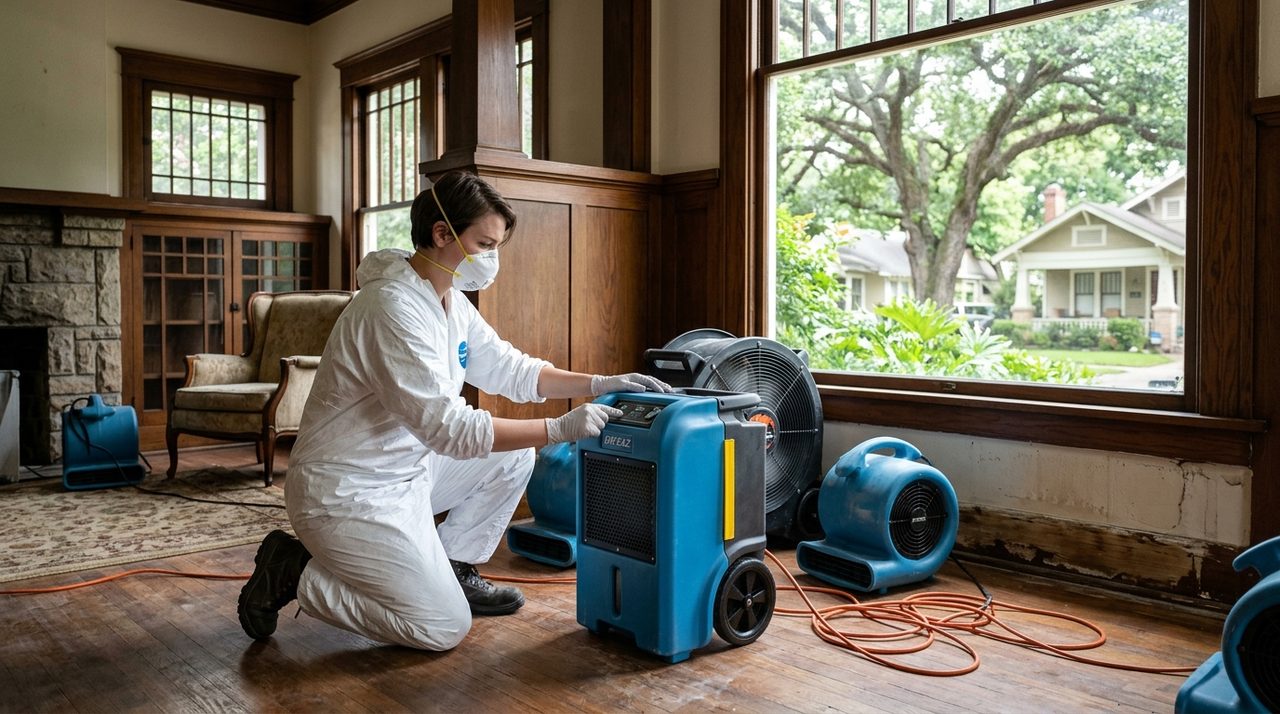
The Heights throws water-damage contractors a curveball that few other Houston neighborhoods can: on a single block you may find a century-old pier-and-beam Craftsman bungalow sitting twenty feet from a 2005 slab-on-grade townhome, each demanding a completely different drying strategy when a roof breach, burst pipe, or White Oak Bayou overflow pushes water inside. Most of the neighborhood maps to FEMA Zone X, so many homeowners carry no flood policy and are caught off guard by the size of an out-of-pocket mitigation bill — estimates for Category 2 losses in a typical Heights home run $3,500–$15,000 before any reconstruction begins. Understanding which foundation type, plumbing era, and permit path applies to your specific structure is the difference between a clean dryout and months of hidden mold.
Ranked by verified Google rating × review volume × verification tier. How we rank →
Some highly-rated pros serve The Heights from nearby and may not keep a The Heights street address. Those are listed under "Also serving The Heights" with their real city and distance, so you always know where each business is based.
Highly-rated pros based nearby who cover The Heights. Distance shown from the The Heights area.
Serving The Heights Based in Lazybrook / Timbergrove · 1.1 mi away
Serving The Heights Based in Lazybrook / Timbergrove · 1.7 mi away
Serving The Heights Based in Midtown · 2.8 mi away
Serving The Heights Based in Spring Branch · 2.9 mi away
Serving The Heights Based in Midtown · 3 mi away
Serving The Heights Based in Midtown · 3.1 mi away
Serving The Heights Based in Midtown · 3.2 mi away
Serving The Heights Based in Midtown · 3.3 mi away
Serving The Heights Based in Midtown · 3.3 mi away
Serving The Heights Based in Midtown · 3.4 mi away
Why it matters to you
The Heights's pre-1950s Craftsman bungalows sit on pier-and-beam foundations rather than the slabs common elsewhere in Houston, which sounds like an advantage — but the wood subfloor assembly between the ground and your living space can absorb and trap floodwater or wind-driven rain for weeks. White Oak Bayou rises fast during stalled Gulf systems, and even blocks mapped FEMA Zone X can take on several inches of sheet-flow water that saturates floor joists, subfloor sheathing, and bottom plates from below, an infiltration path that thermal cameras catch but a simple visual inspection misses.
What a good pro does
A qualified restoration contractor should use penetrating moisture meters and infrared imaging on subfloor assemblies, not just surface readings, to map the full extent of saturation before setting drying equipment. Because the crawl space is accessible, directional drying with desiccant dehumidifiers placed under the home can dramatically shorten drying timelines compared to slab work — but the contractor must pull a demolition permit through the Houston Permitting Center for any structural sheathing removal, and any exposed wiring found during the process must be evaluated by a TDLR-licensed electrician before enclosure.
Sources: IICRC (water/mold restoration standards), City of Houston Permitting Center, Texas Department of Licensing & Regulation
Why it matters to you
Many Heights bungalows went through cosmetic renovations in the 2000s and 2010s — new kitchen cabinets, fresh drywall, updated tile — without full re-plumbing from the original galvanized supply lines. When Winter Storm Uri hit in February 2021, those aging lines in unconditioned attic chases and exterior walls were among the most vulnerable in the city, and numerous Heights homes suffered burst-pipe water damage that was patched at the surface but never fully dried behind the new finishes. Restoration contractors called for an unrelated leak today routinely find Uri-era mold colonies behind otherwise intact drywall in these partially updated homes.
What a good pro does
Before any new repair work closes up a wall cavity in a Heights home with mixed plumbing systems, a contractor should probe for residual moisture with calibrated meters and schedule mold testing if readings exceed IICRC S500 thresholds. Any confirmed mold remediation requires the contractor to hold a TDLR-issued Mold Remediation Contractor (MRC) license, and the homeowner should request documentation of that license number before work begins. If remediation reveals original galvanized lines that were not replaced post-Uri, the restoration scope should flag them for a TSBPE-licensed plumber to evaluate before re-enclosure.
Sources: IICRC (water/mold restoration standards), Texas Department of Licensing & Regulation, Texas State Board of Plumbing Examiners
Why it matters to you
The Heights's wave of 2-to-4-story townhomes built in the late 1990s through 2010s features stucco cladding, rooftop decks, and window flanges that were tested hard by the May 2024 derecho and by Harvey's prolonged winds in 2017. Water forced through improperly flashed rooftop deck drains, stucco cracks at window heads, and weep-less brick or EIFS assemblies tracks down interior sheathing to the bottom plate — often without any standing water ever appearing on the floor. Because these are slab-on-grade townhomes sharing party walls, moisture that enters one unit's wall assembly can migrate laterally into an adjacent owner's structure.
What a good pro does
Wind-driven rain intrusion in Heights townhomes demands thermal imaging from the exterior walls inward, not the bottom-up approach used for flood losses, to trace the exact entry point before any drying or demo begins. The restoration contractor should document the water source path with photo and moisture-reading evidence, which is essential if the loss later involves a scope dispute with an insurer over whether the entry point is a maintenance exclusion or a storm claim. Shared-wall discoveries require written notice to the adjacent unit owner or the townhome's mandatory HOA board before any penetrating work touches the party-wall assembly.
Sources: IICRC (water/mold restoration standards), Local HOA / deed restrictions (see area profile), City of Houston Permitting Center
Why it matters to you
Portions of The Heights — specifically the Heights East, Heights West, and Heights South historic districts — require a Certificate of Appropriateness from the Houston Archaeological and Historical Commission before exterior modifications, and that review process was not designed with 48-hour IICRC S500 drying windows in mind. If wind-driven rain or a roof failure exposes historic wood siding, original wood windows, or character-defining exterior trim on a contributing structure, replacing them with modern materials without HAHC sign-off can result in a stop-work order that freezes the entire restoration mid-project. This is a real risk on the original 1890s–1930s bungalows that still line streets like Heights Boulevard and 19th Street.
What a good pro does
Before quoting any exterior demo or cladding work on a Heights home, the restoration contractor must confirm with the HAHC whether the parcel falls inside a designated historic district boundary — the exact lines are parcel-specific and cannot be assumed from the street address alone. For emergency interior drying work that does not touch the exterior envelope, a Houston Permitting Center demolition permit can typically be obtained without HAHC review, allowing structural drying to begin on schedule while the Certificate of Appropriateness application moves in parallel for any exterior repairs. Document the water intrusion path thoroughly so the HAHC application can demonstrate that exterior material replacement is driven by storm damage, not elective alteration.
Sources: City of Houston Permitting Center, IICRC (water/mold restoration standards), Local HOA / deed restrictions (see area profile)
Hiring water & flood restoration in The Heights? The Heights spans housing from the 1890s through brand-new construction, meaning contractors encounter pier-and-beam Craftsman cottages and modern slab-on-grade townhomes on the same block. Deed restrictions are common across most plats, and dozens of small mandatory HOAs govern newer townhome enclaves, so exterior work often requires checking recorded covenants at the Harris County Clerk's office. The mix of century-old galvanized plumbing and modern PEX systems makes thorough pre-job inspections essential.
Building era
Mixed: original 1890s–1930s bungalows, scattered mid-century infill (1940s–1960s), and a dominant wave of townhome and new single-family construction from the late 1990s through the 2010s.
Typical style
Historic Craftsman bungalows, Victorian/Queen Anne–inspired homes, contemporary 2-to-4-story townhomes with rooftop decks, and transitional new-build single-family homes with traditional exteriors and modern interiors.
Foundations
Mixed — older homes (pre-1950s) are predominantly pier-and-beam; newer townhomes and post-1990s construction are typically slab-on-grade.
Common systems
Older homes: original or retrofitted central HVAC, galvanized or cast-iron drain lines, knob-and-tube or cloth-wrapped wiring that may have been partially updated. Newer construction: modern central HVAC with high-efficiency units, PEX or copper plumbing, 200-amp electrical panels. Many renovated older homes have hybrid systems mixing old and new.
What that means for repairs
Tear-down-and-rebuild of older cottages for new single-family or townhome construction is extremely common. Remaining historic homes frequently undergo full gut renovations including foundation leveling, complete re-plumbing from galvanized to PEX, electrical panel upgrades, and HVAC modernization while preserving Craftsman exterior character.
Permit jurisdiction
Houston Permitting Center (City of Houston).
HOA & deed restrictions
No single neighborhood-wide mandatory HOA. The Houston Heights Association (HHA) is a voluntary civic organization focused on deed restriction enforcement and community events. Numerous small mandatory HOAs/POAs exist for specific townhome and gated developments (e.g., Heights Abbey HOA, Studemont Heights POA). Deed restrictions are common across most original Heights plats and recorded with the Harris County Clerk.
Historic districts
Portions of the Heights fall within City of Houston Historic Districts (Heights East, Heights West, Heights South) subject to Houston Archaeological & Historical Commission (HAHC) review for exterior modifications and demolition. Exact boundaries should be confirmed with the HAHC before any exterior work.
Contractor note
Properties in HAHC-designated historic districts require a Certificate of Appropriateness for exterior changes, including roofing material, siding, windows, and fencing. Contractors should verify historic district status before quoting exterior work, as non-compliant modifications can result in stop-work orders and forced remediation.
FEMA flood zone
FEMA Zone X (low flood risk) per the official NFHL API. However, proximity to White Oak Bayou along the southern and eastern edges of the Heights means localized street flooding and bayou overflow can affect properties near the waterway, particularly south of 11th Street.
Hurricane Harvey impact
Not confirmed with specific damage statistics from research. The Heights generally fared better than many Houston neighborhoods during Hurricane Harvey (2017) due to its slightly elevated terrain — the neighborhood was historically marketed as being higher than downtown Houston. However, areas near White Oak Bayou experienced flooding, and some low-lying streets saw significant water intrusion. Specific property impact should be verified through Harris County Flood Control District records.
Heat & humidity load
Pier-and-beam homes with older insulation and single-pane windows place extreme demands on HVAC systems during Houston summers. Crawl space moisture under pier-and-beam foundations promotes mold, wood rot, and pest issues. Newer townhomes with flat or low-slope roofs and rooftop decks require diligent roof drainage maintenance to prevent ponding and leaks during summer storms.
Working with contractors here
The Heights is one of Houston's most active markets for both renovation and new construction. Contractors most commonly handle foundation leveling and repair on pier-and-beam homes, whole-house re-plumbing to replace aging galvanized lines, and electrical upgrades from outdated panels and wiring to modern 200-amp service. Exterior work on historic district properties requires HAHC approval, adding lead time and material specification constraints that must be factored into bids. Townhome work frequently involves rooftop deck waterproofing, stucco repair, and shared-wall considerations that require coordination with adjacent owners or HOA boards. Given the extreme variation in housing age on a single block, contractors should never assume systems or foundation types based on neighboring properties — each home demands its own inspection.
Local Tip
Always ask for a written estimate before work begins. Texas contractors are required to provide one on jobs over $1,000.
The Heights spans housing from the 1890s through brand-new construction, meaning contractors encounter pier-and-beam Craftsman cottages and modern slab-on-grade townhomes on the same block. Deed restrictions are common across most plats, and dozens of small mandatory HOAs govern newer townhome enclaves, so exterior work often requires checking recorded covenants at the Harris County Clerk's office. The mix of century-old galvanized plumbing and modern PEX systems makes thorough pre-job inspections essential.
Source: U.S. Census Bureau, ACS 5-Year 2023
Most of The Heights maps to FEMA Zone X (low mapped flood risk), but Houston's flash-flood reality means even low-risk blocks benefit from smart drainage and storm-hardened installs; risk climbs sharply on blocks nearest White Oak Bayou, where it varies parcel to parcel.
Source: FEMA National Flood Hazard Layer (NFHL). Flood zones vary by parcel — verify your individual FIRM panel.
Before hurricane season, commission a moisture baseline scan from an IICRC-certified restoration firm so any post-storm water intrusion in The Heights can be quantified and documented for your insurer immediately. Beryl 2024 showed that even low-mapped-risk neighborhoods saw flash flooding that saturated flooring assemblies within hours of peak rainfall. Confirm the current FEMA panel for your The Heights parcel — the area maps to Zone X, but adjacent lots can differ.
Even in low-flood-mapped areas of The Heights, intense thunderstorm rainfall can overwhelm gutter systems and force water through foundation weep holes or into slab expansion joints, creating sub-floor moisture that feeds mold undetected. An IICRC-certified water-restoration technician can use penetrating moisture meters to confirm whether a post-storm inspection is clear or whether targeted structural drying is needed. Confirm the current FEMA panel for your The Heights parcel — the area maps to Zone X, but adjacent lots can differ.
Homes in lower-flood-risk areas of The Heights are not immune to the interior water losses Uri 2021 caused — burst attic supply lines and failed icemaker connections caused extensive drywall and flooring damage regardless of floodplain designation. A water-restoration contractor can extract standing water, remove wet flooring, and place structural drying equipment within the window that prevents a straightforward dryout from escalating to mold remediation. With a median build year of 1978, the older building stock here is more exposed to hard-freeze damage than newer construction. Because The Heights drains toward White Oak Bayou, block-level runoff can differ sharply from the mapped zone.
Sources: FEMA National Flood Hazard Layer (NFHL), Ready.gov -- Hurricanes, CenterPoint Energy -- Storm Center, City of Houston -- Emergency Preparedness, Ready.gov -- Winter Weather, Harris County Flood Control District
Houston-specific estimators to plan your project before you call a pro. All results are planning estimates — a licensed local pro confirms the details on site.
Disconnect & drain every outdoor hose bib
Remove hoses, drain the spigots, and cover each with an insulated faucet sock. Un-drained hose bibs are the #1 burst point in a Houston freeze.
Insulate exposed pipes in the attic & garage
Wrap any pipe in an unconditioned space (attic runs, garage walls) with foam sleeves. Houston homes rarely insulate these because they only matter a few nights a year — which is exactly why they burst.
Open cabinet doors & keep a pencil-width drip
On hard-freeze nights, open kitchen/bath cabinets so warm air reaches the pipes and let faucets on exterior walls drip to relieve pressure.
Protect the attic/garage water heater & its lines
An attic or garage tank sits in unconditioned space. Insulate the cold-inlet and hot-outlet lines and confirm the emergency drain pan is clear so a leak doesn't reach the ceiling.
This is a planning estimate only — actual requirements depend on an on-site assessment by a licensed Houston pro. If a pipe has already burst, shut off your main water supply and call a licensed Houston plumber immediately — freeze bursts flood fast.
Sources: City of Houston Permitting CenterTexas Department of Licensing & Regulation
Sources: City of Houston Permitting CenterIICRC (water/mold restoration standards)
Sources: IICRC (water/mold restoration standards)Texas Commission on Environmental Quality
Sources: EPA Lead Renovation, Repair and Painting (RRP) RuleTexas Commission on Environmental Quality
Sources: IICRC (water/mold restoration standards)FEMA National Flood Hazard Layer (NFHL)