Serving Montrose Based in Midtown · 0.2 mi away
Best Water & Flood Restoration in Montrose
Montrose's block-by-block mix of 1920s pier-and-beam bungalows, mid-century ranches, and post-2000 slab-on-grade townhomes means a single storm event can produce three completely different water-damage scopes on the same street — each requiring a different drying strategy, permit path, and material approach. Although most of Montrose maps to FEMA Zone X, Houston's notorious flash-flood reality and the neighborhood's aging galvanized plumbing and cast-iron drain lines mean water intrusion events are rarely simple. Understanding which failure mode applies to your specific structure — and how City of Houston permitting and possible historic district review factor in — is what separates a thorough restoration from one that leaves hidden moisture behind.
Verified against Google Business data
Updated 2026
See the 10 Water & Flood Restoration Serving Montrose 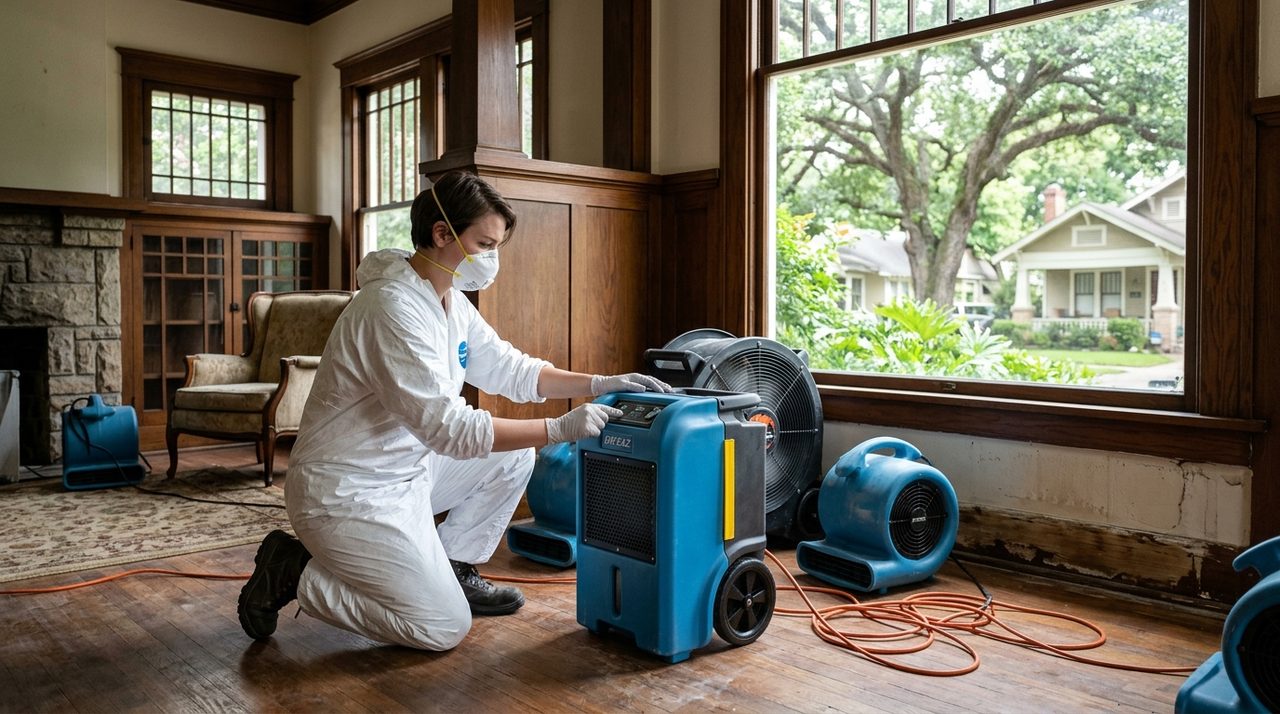
- Median home built
- 1996
- Median home value
- $599,500
- FEMA flood zone
- X (low)
- Typical mitigation cost (est.)
- $3,500–$40,000 depending on water category and affected area
- Most common local issue
- Hidden cavity moisture in pre-war pier-and-beam bungalows after plumbing failures or wind-driven rain
Ranked by verified Google rating × review volume × verification tier. How we rank →
Some highly-rated pros serve Montrose from nearby and may not keep a Montrose street address. Those are listed under "Also serving Montrose" with their real city and distance, so you always know where each business is based.
Min rating:
10 resultsAlso serving Montrose
Highly-rated pros based nearby who cover Montrose. Distance shown from the Montrose area.
Serving Montrose Based in Midtown · 1.2 mi away
Open Now
Serving Montrose Based in Midtown · 1.5 mi away
Open Now
Serving Montrose Based in Midtown · 1.7 mi away
Open Now
Serving Montrose Based in Midtown · 1.8 mi away
Serving Montrose Based in Midtown · 1.9 mi away
Serving Montrose Based in Midtown · 1.9 mi away
Open Now
Serving Montrose Based in Upper Kirby · 1.9 mi away
Open Now
Serving Montrose Based in Lazybrook / Timbergrove · 1.9 mi away
Serving Montrose Based in Midtown · 1.9 mi away
Water & Flood Restoration in Montrose: What You Should Know
Pier-and-Beam Crawl Spaces Trapping Water Under 1920s–1940s Bungalows
Why it matters to you
Unlike the slab-on-grade townhomes replacing them on adjacent lots, Montrose's original Craftsman bungalows and cottages sit on pier-and-beam foundations with true crawl spaces. When a supply line fails — common in homes still running original galvanized plumbing — or when a slow roof leak directs water down interior walls, that crawl space becomes a reservoir. Standing water under the floor system can persist for days undetected, saturating wood joists, subfloor sheathing, and bottom plates while the interior looks dry, and Harris County's high ambient humidity accelerates microbial growth once organic wood framing gets wet.
What a good pro does
A restoration crew working on a Montrose bungalow should deploy moisture meters and thermal imaging across the subfloor and crawl space perimeter before assuming the loss is confined to finished surfaces. Drying equipment placement must address the underfloor cavity, not just interior rooms. Any plumbing line repair uncovered during demo requires a TSBPE-licensed plumber, and the City of Houston Permitting Center requires a trade permit for that work — the restoration contractor typically pulls the demolition permit while the plumber pulls their own.
Sources: IICRC (water/mold restoration standards), Texas State Board of Plumbing Examiners, City of Houston Permitting Center
Uri-Era Pipe Bursts Leaving Residual Mold Behind Untouched Drywall
Why it matters to you
Winter Storm Uri hit Montrose's older homes especially hard because so many of them have supply lines routed through unconditioned attic spaces or exterior wall cavities — areas that were never designed to withstand Houston's rare but severe freeze events. Many homeowners patched the burst line and repainted over water-stained drywall without verifying that the wall cavity had fully dried, a decision that now surfaces as Aspergillus or Cladosporium growth behind otherwise intact surfaces. With a Census median year built of 1996 masking a wide distribution that includes substantial pre-1950 stock, older Montrose properties carry disproportionate Uri-era risk.
What a good pro does
Before any renovation or restoration scope proceeds on a pre-2000 Montrose home, a restoration contractor should use moisture meters and borescope inspection at suspect wall cavities — particularly on north- and west-facing exterior walls where attic plumbing is common. If mold is confirmed, the firm performing remediation must hold a TDLR-issued Mold Remediation Contractor (MRC) license under Texas Occupations Code Chapter 1958. Estimated remediation scopes in the Houston metro for contained wall-cavity mold run $2,500–$10,000 depending on affected square footage, and those figures are estimates that vary with site conditions.
Sources: Texas Department of Licensing & Regulation, IICRC (water/mold restoration standards)
Wind-Driven Rain Breaching Older Window Flanges and Brick Veneer Weep Holes
Why it matters to you
The May 2024 derecho and Harvey's outer bands pushed sustained winds directly into Montrose's varied building envelopes — Victorian-era homes with original single-pane windows, mid-century ranches with brick veneer, and 1970s apartment conversions with aging window flashing all showed wall-cavity moisture intrusion with no visible interior flooding whatsoever. This top-down, outside-in moisture pathway is easy to miss because homeowners typically look for water on the floor, not in the stud bays behind their drywall. Brick veneer weep holes, which are intentionally open to drain, can funnel wind-driven rain directly into the wall assembly if the drainage mat or moisture barrier behind the brick is compromised.
What a good pro does
Restoration on a wind-driven-rain loss requires a fundamentally different inspection protocol than a flood claim: thermal imaging during a temperature differential (early morning in summer) traces moisture from the roof deck downward through wall sheathing to the bottom plate. The drying strategy centers on wall cavity ventilation and dehumidification rather than extraction equipment. The City of Houston Permitting Center requires permits for structural demolition when wall assemblies must be opened; on properties within a locally designated Houston historic district, the Houston Archaeological and Historical Commission (HAHC) must also review any exterior material removal before work begins.
Sources: IICRC (water/mold restoration standards), City of Houston Permitting Center, Municipal permit office (see area profile)
Insurance Category Disputes When Flash Flooding Overwhelms Storm Drains on Low-Risk Blocks
Why it matters to you
Montrose's FEMA Zone X designation means most properties here are not mapped as high flood risk, but Houston's impervious-surface density and the neighborhood's aging combined-sewer infrastructure mean that extreme rainfall events routinely back stormwater — and sewage — up through floor drains and toilet flanges even in homes that have never had bayou floodwater. Once sewage-contaminated water contacts a structure, IICRC S500 standards classify the loss as Category 3 (black water), which mandates full demolition of porous materials at least 12 inches above the flood line. Insurers sometimes push back on this classification for Zone X properties, arguing the water source was clean rainwater rather than sewage.
What a good pro does
Document the water source at the time of loss — photographs of toilet backflow, floor drain surcharging, or street flooding with visible debris are critical evidence. A restoration contractor must conduct water testing if the source is disputed and preserve those results to defend the Category 3 scope with the carrier. Any scope that involves opening walls down to the bottom plate and removing flooring requires a City of Houston demolition permit; plumbing work to repair or cap the affected drain lines requires a separate permit pulled by a TSBPE-licensed plumber. Category 3 full-demo scopes in the Houston metro typically range $15,000–$40,000 before reconstruction — treat that as an estimate, not a firm bid.
Sources: IICRC (water/mold restoration standards), Texas State Board of Plumbing Examiners, City of Houston Permitting Center, FEMA National Flood Hazard Layer (NFHL)
Water & Flood Restoration in Montrose: What You Should Know
Hiring water & flood restoration in Montrose? Montrose is one of Houston's most architecturally diverse inner-loop neighborhoods, with housing stock ranging from early-20th-century bungalows to modern townhomes and mid-rise condos. Homeowners and contractors must navigate a complex overlay of deed restrictions, possible historic district review, and varied foundation types that change block by block. The absence of a single mandatory HOA means individual plat covenants and city codes are the primary regulatory framework.
- Housing era
- Mixed — ranging from 1920s–1940s original bungalows and cottages to 1970s–1980s apartment conversions and…
- Foundation
- Mixed — older homes are frequently pier-and-beam
- Flood zone
- FEMA Zone X (low flood risk) per official NFHL data
- Permits
- City of Houston Permitting Center (Montrose is within Houston city limits)
Housing stock & systems
Building era
Mixed — ranging from 1920s–1940s original bungalows and cottages to 1970s–1980s apartment conversions and 2000s–present new-construction townhomes.
Typical style
Highly heterogeneous: Craftsman bungalows, mid-century ranch, Victorian-era homes, contemporary townhomes, and multi-family conversions coexist within the same blocks.
Foundations
Mixed — older homes are frequently pier-and-beam; newer townhomes and infill construction are typically slab-on-grade.
Common systems
Older pier-and-beam homes often have galvanized or cast-iron plumbing, outdated electrical panels, and window-unit or older central HVAC systems. Newer townhomes feature modern HVAC, PEX plumbing, and updated electrical. The wide era range means system conditions vary dramatically by property.
What that means for repairs
Renovation activity is extremely common due to the prevalence of aging bungalows on high-value lots. Whole-home gut renovations, kitchen and bath modernizations, and foundation leveling on pier-and-beam structures are frequent. New-construction townhome infill on subdivided lots is also a major activity driver.
Permits & restrictions
Permit jurisdiction
City of Houston Permitting Center (Montrose is within Houston city limits).
HOA & deed restrictions
No single mandatory HOA governs all of Montrose. Specific sub-areas and condo regimes (e.g., Montrose Place Townhomes Owners Association, Montrose Place Homeowners Association) have mandatory membership. Deed restrictions are common and vary by plat — buyers and contractors should review recorded covenants at the Harris County Clerk's office.
Historic districts
Parts of Montrose fall within City of Houston locally designated historic districts, requiring HAHC design review and approval for exterior changes, demolitions, and new construction. Specific district names not confirmed in available research — check the City of Houston Historic Preservation Office for parcel-level status.
Contractor note
Contractors must verify whether a property sits within a locally designated historic district before beginning exterior work or demolition, as HAHC approval may be required. Additionally, individual deed restrictions may impose setback, height, or use limitations that differ from adjacent properties on the same street.
Flood & weather
FEMA flood zone
FEMA Zone X (low flood risk) per official NFHL data. However, Montrose's proximity to Buffalo Bayou and various drainage channels means flood risk can vary sharply by block and lot elevation. Property-level flood zone verification is strongly recommended.
Hurricane Harvey impact
Neighborhood-wide Harvey flood impact could not be confirmed from available research. Montrose is an inner-loop area where flooding during Harvey varied significantly by block and proximity to bayous and drainage infrastructure. Homeowners should check individual property flood history through Harris County Flood Control District records and FEMA claim databases.
Heat & humidity load
Older pier-and-beam homes in Montrose are prone to moisture intrusion, subfloor mildew, and HVAC strain during Houston's extreme summer humidity. Aging galvanized plumbing in pre-war homes is susceptible to condensation-related corrosion. Modern townhomes with tight building envelopes benefit from efficient HVAC but may require dehumidification support.
Working with contractors here
Montrose's extreme housing diversity means contractors encounter everything from 1920s pier-and-beam bungalow foundation repair to cutting-edge townhome warranty work. Plumbing repiping is common in pre-war homes still running galvanized or cast-iron lines. Electrical panel upgrades are frequently needed in older homes not designed for modern load demands. Historic district properties require HAHC coordination, which can add weeks to project timelines for exterior work. Contractors should always pull deed restrictions before scoping additions or accessory structures, as setback and height limits vary from lot to lot even on the same block.
Local Tip
Always ask for a written estimate before work begins. Texas contractors are required to provide one on jobs over $1,000.
About Montrose
Montrose is one of Houston's most architecturally diverse inner-loop neighborhoods, with housing stock ranging from early-20th-century bungalows to modern townhomes and mid-rise condos. Homeowners and contractors must navigate a complex overlay of deed restrictions, possible historic district review, and varied foundation types that change block by block. The absence of a single mandatory HOA means individual plat covenants and city codes are the primary regulatory framework.
- Median year built
- 1996
- Median home value
- $599,500
- Owner-occupied
- 34.9%
- Population
- 23,927
- Housing units
- 16,654
- Median income
- $102,003
Source: U.S. Census Bureau, ACS 5-Year 2023
Flood & storm risk
FEMA Zone XLow flood riskMost of Montrose maps to FEMA Zone X (low mapped flood risk), but Houston's flash-flood reality means even low-risk blocks benefit from smart drainage and storm-hardened installs.
Source: FEMA National Flood Hazard Layer (NFHL). Flood zones vary by parcel — verify your individual FIRM panel.
Houston Storm Readiness in Montrose
Hurricane & flooding
Before hurricane season, commission a moisture baseline scan from an IICRC-certified restoration firm so any post-storm water intrusion in Montrose can be quantified and documented for your insurer immediately. Beryl 2024 showed that even low-mapped-risk neighborhoods saw flash flooding that saturated flooring assemblies within hours of peak rainfall. In-city Montrose work falls under City of Houston floodplain and permitting rules.
Severe storms & hail
Straight-line winds exceeding 80 mph, as recorded during the 2024 derecho, broke seals on sliding glass doors and drove water into flooring assemblies throughout Montrose neighborhoods with no prior flood history. Contact a licensed Texas restoration firm — TDLR regulates their mold-assessment and remediation work — to inspect and dry any affected areas before summer humidity accelerates microbial growth. In-city Montrose work falls under City of Houston floodplain and permitting rules.
Ice storms & freezes
Homes in lower-flood-risk areas of Montrose are not immune to the interior water losses Uri 2021 caused — burst attic supply lines and failed icemaker connections caused extensive drywall and flooring damage regardless of floodplain designation. A water-restoration contractor can extract standing water, remove wet flooring, and place structural drying equipment within the window that prevents a straightforward dryout from escalating to mold remediation. In-city Montrose work falls under City of Houston floodplain and permitting rules.
Sources: FEMA National Flood Hazard Layer (NFHL), Ready.gov -- Hurricanes, CenterPoint Energy -- Storm Center, City of Houston -- Emergency Preparedness, Ready.gov -- Winter Weather, Harris County Flood Control District
Free Montrose Tools & Calculators
Houston-specific estimators to plan your project before you call a pro. All results are planning estimates — a licensed local pro confirms the details on site.
Houston Freeze Prep & Pipe Insulation Checklist
Open full tool & FAQ →Your freeze checklist — 4 tasks
- 1
Disconnect & drain every outdoor hose bib
Remove hoses, drain the spigots, and cover each with an insulated faucet sock. Un-drained hose bibs are the #1 burst point in a Houston freeze.
- 2
Insulate exposed pipes in the attic & garage
Wrap any pipe in an unconditioned space (attic runs, garage walls) with foam sleeves. Houston homes rarely insulate these because they only matter a few nights a year — which is exactly why they burst.
- 3
Open cabinet doors & keep a pencil-width drip
On hard-freeze nights, open kitchen/bath cabinets so warm air reaches the pipes and let faucets on exterior walls drip to relieve pressure.
- 4
Protect the attic/garage water heater & its lines
An attic or garage tank sits in unconditioned space. Insulate the cold-inlet and hot-outlet lines and confirm the emergency drain pan is clear so a leak doesn't reach the ceiling.
This is a planning estimate only — actual requirements depend on an on-site assessment by a licensed Houston pro. If a pipe has already burst, shut off your main water supply and call a licensed Houston plumber immediately — freeze bursts flood fast.
Frequently Asked Questions
My Montrose bungalow is in FEMA Zone X — do I still need a restoration contractor to pull permits with the City of Houston after a water loss?
Yes — FEMA flood zone designation has no bearing on City of Houston permit requirements. Any structural demolition, plumbing repair, or electrical work exposed during water damage restoration in Montrose requires trade permits through the City of Houston Permitting Center, regardless of whether the loss was caused by a bayou overflow or a burst galvanized supply line. The restoration contractor typically pulls the demolition permit, while licensed plumbers and electricians pull their own trade permits before touching those systems. Skipping this step can void your certificate of completion and complicate insurance settlement.
Sources: City of Houston Permitting CenterTexas Department of Licensing & Regulation
My 1930s Montrose bungalow sits on pier-and-beam — how does that change the drying timeline compared to a townhome next door?
Pier-and-beam homes in Montrose actually allow better under-floor air movement than slab-on-grade townhomes, but the crawl space itself becomes a moisture reservoir that must be separately dried with directed airflow and dehumidification — a step slab homes skip entirely. Older board subfloor and tongue-and-groove hardwood used in pre-war Montrose bungalows absorb and release moisture much more slowly than modern engineered flooring, so drying timelines for pier-and-beam structures typically run 5–10 days versus 3–5 days for a comparable slab loss, and contractors should verify moisture content with a calibrated meter before closing cavities. The galvanized drain lines common in these older homes also tend to collect debris that can back up during high-volume flash-flood events, adding a secondary contamination concern your contractor should document.
Part of my Montrose block-face may be in a locally designated historic district — can a water restoration crew start emergency demo immediately or does HAHC have to approve it first?
Emergency stabilization work — stopping active water intrusion, extracting standing water, and deploying drying equipment — can begin immediately without Houston Archaeological and Historical Commission (HAHC) review because life-safety and structural stabilization are exempt from standard review timelines. However, any exterior demolition or material replacement that would permanently alter a contributing structure's appearance (removing original siding, window units, or masonry) does require HAHC coordination before work is finalized, even on a flood claim. Your contractor should document the emergency scope separately in writing and flag the historic district status to your insurer early, since HAHC-mandated material matching can affect both timeline and reconstruction costs.
Sources: City of Houston Permitting Center
Montrose gets intense summer thunderstorms — is there a worst time of year to have a water loss go un-remediated here?
June through September is the highest-risk window: Houston's average relative humidity exceeds 74% and outdoor temperatures regularly top 90°F, which means a wet wall cavity or saturated subfloor left unaddressed for even 48–72 hours will almost certainly develop Cladosporium or Aspergillus mold growth. In the older Montrose housing stock — particularly bungalows with dense-pack plaster walls and original wood framing — those species establish faster because the organic substrate holds moisture longer than modern drywall. If you discover a plumbing leak or post-storm intrusion between June and September, initiating drying equipment within 24 hours is especially critical; any firm doing the mold remediation phase must hold a TDLR-issued Mold Remediation Contractor (MRC) license.
Sources: IICRC (water/mold restoration standards)Texas Department of Licensing & Regulation
My Montrose condo or townhome association is asking for documentation before I replace drywall — what should I request from the restoration contractor?
Ask for a written moisture log showing daily psychrometric readings (temperature, relative humidity, and material moisture content) taken throughout the drying phase, plus the final clearance report confirming materials hit dry standard before closure — this is standard IICRC S500 documentation that a reputable contractor should produce automatically. If your unit shares walls or a slab with adjacent units, the contractor should also provide a moisture-mapping diagram showing whether intrusion crossed into neighboring spaces, since Montrose townhome HOA regimes (like Montrose Place) often require that disclosure before authorizing reconstruction. Keep these records: most Houston-area insurers and condominium associations require them to release holdback payments on reconstruction estimates.
Sources: IICRC (water/mold restoration standards)Local HOA / deed restrictions (see area profile)
Montrose has a lot of older cast-iron and galvanized plumbing — if a pipe bursts and soaks a wall, does the plumber or the restoration contractor handle the lead-paint risk in pre-war homes?
These are two separate scopes that must coordinate: the TSBPE-licensed plumber repairs the line, while the water restoration contractor handles structural drying and demolition — but if your Montrose bungalow was built before 1978, any demo disturbing painted surfaces requires the firm doing that work to follow EPA Renovation, Repair, and Painting (RRP) rules, which means using a Certified Renovator and following lead-safe work practices. Neither the plumber nor the restoration contractor can legally skip this step simply because it's a water emergency rather than a planned renovation. Before work begins, ask both firms to confirm their RRP certification status and document it on the project paperwork.
Sources: Texas State Board of Plumbing ExaminersEPA Lead Renovation, Repair and Painting (RRP) Rule