Open Now
Serving Oak Forest Based in Acres Homes · 1.9 mi away
Oak Forest's 1940s–1960s ranch homes sit on a mix of slab and pier-and-beam foundations with original galvanized plumbing, aging electrical panels, and early HVAC systems—a combination that turns even a moderate water event into a multi-system problem long after the visible water is gone. Although most of Oak Forest maps to FEMA Zone X, Houston's flash-flood reality and the May 2024 derecho showed that low-mapped-risk does not mean no-risk, and the neighborhood's heavy renovation activity means restoration contractors frequently work alongside gut-remodel crews uncovering decades of deferred moisture damage. Understanding how Oak Forest's mid-century construction interacts with water intrusion—and how the City of Houston Permitting Center governs the demo and repair work—is what separates a sound restoration from a callback six months later.
Ranked by verified Google rating × review volume × verification tier. How we rank →
Some highly-rated pros serve Oak Forest from nearby and may not keep a Oak Forest street address. Those are listed under "Also serving Oak Forest" with their real city and distance, so you always know where each business is based.
Highly-rated pros based nearby who cover Oak Forest. Distance shown from the Oak Forest area.
Serving Oak Forest Based in Acres Homes · 1.9 mi away
Serving Oak Forest Based in Acres Homes · 1.9 mi away
Serving Oak Forest Based in Lazybrook / Timbergrove · 2.7 mi away
Serving Oak Forest Based in Garden Oaks · 3 mi away
Serving Oak Forest Based in Garden Oaks · 3.4 mi away
Serving Oak Forest Based in Spring Branch · 3.6 mi away
Serving Oak Forest Based in Spring Branch · 4.6 mi away
Serving Oak Forest Based in Spring Branch · 4.8 mi away
Serving Oak Forest Based in Acres Homes · 4.9 mi away
Serving Oak Forest Based in Jersey Village · 4.9 mi away
Why it matters to you
A meaningful share of Oak Forest's original 1940s–1950s homes were built on pier-and-beam foundations, meaning floodwater or heavy groundwater intrusion from a stalled storm collects in the crawl space below the subfloor and stays there—often for weeks. Unlike a slab edge that dries as surface water recedes, a saturated crawl space wicks moisture upward into floor joists, subflooring, and bottom plates, quietly elevating indoor relative humidity and creating conditions for mold growth inside wall cavities that look perfectly dry from the living room.
What a good pro does
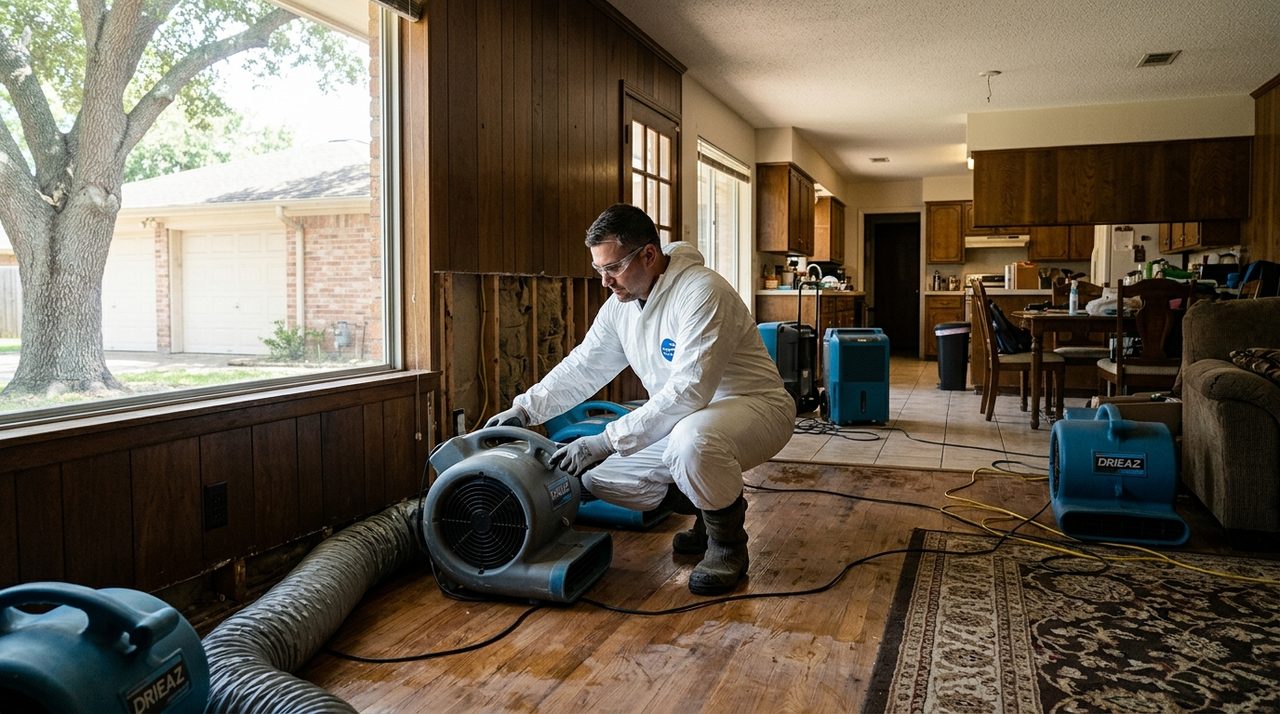
A qualified restoration contractor will deploy moisture meters and thermal imaging throughout the subfloor and lower wall assemblies, not just where standing water was visible. IICRC S500 structural drying protocols call for initiating mechanical drying within 24–48 hours; for pier-and-beam homes this means crawl-space ventilation equipment in addition to interior dehumidifiers. Any plumbing line repairs uncovered during demo require a TSBPE-licensed plumber, and the City of Houston Permitting Center will require a trade permit for that work before the restoration can be fully closed out.
Sources: IICRC (water/mold restoration standards), Texas State Board of Plumbing Examiners, City of Houston Permitting Center
Why it matters to you
Winter Storm Uri in February 2021 hit Oak Forest hard: the neighborhood's original homes commonly have supply lines running through unconditioned attic space or uninsulated interior wall cavities—exactly the configurations that froze and burst. Many owners patched drywall and moved on, but never fully dried the wall cavity. Three-plus years later, renovation crews and restoration contractors working on Oak Forest teardown-adjacent projects routinely pull walls and find gray-green microbial growth behind apparently intact drywall, requiring remediation before any new finishes can go in.
What a good pro does
Before any renovation or restoration scope is finalized on a pre-2000 Oak Forest home, a contractor should use a pin-type moisture meter at regular intervals along exterior and attic-adjacent walls to screen for residual Uri-era saturation. If mold is discovered, the remediation firm must hold a TDLR-issued Mold Remediation Contractor (MRC) license under Texas Occupations Code Chapter 1958; assessment must be performed by a separately licensed Mold Assessment Consultant (MAC). Estimated mold remediation costs in a typical Oak Forest ranch run $2,500–$10,000 depending on cavity extent, separate from any reconstruction costs.
Sources: Texas Department of Licensing & Regulation, IICRC (water/mold restoration standards)
Why it matters to you
Oak Forest's original ranch-style homes often feature low-slope rooflines and large unconditioned attic spaces where air handlers and flex ductwork were retrofitted in the 1970s–1990s. When wind-driven rain from the May 2024 derecho or a tropical system forces water through soffit vents or aging window flanges, that attic moisture saturates flex duct insulation. Houston's average 74% relative humidity and summer temperatures above 90°F create ideal conditions for Cladosporium and Aspergillus growth inside ductwork within 48–72 hours—and the air handler then distributes spores through every room in the house.
What a good pro does
A thorough restoration scope for an Oak Forest home affected by roof or attic intrusion must include a duct inspection using moisture meters and visual access at each flex duct connection, not just a check of the air handler cabinet. Pre-2000 flex duct with saturated insulation batting is typically not salvageable and should be replaced rather than dried in place. The HVAC trade work and any electrical connections disturbed during restoration require a City of Houston permit pulled by the respective licensed sub-trade; the restoration contractor typically holds the demolition permit while the HVAC and electrical subs pull their own.
Sources: IICRC (water/mold restoration standards), City of Houston Permitting Center, Texas Department of Licensing & Regulation
Why it matters to you
Oak Forest's 1950s–1960s homes that have not yet been re-plumbed frequently have galvanized steel supply lines and cast-iron drain stacks still in service. Galvanized pipe corrodes from the inside out; a water event that stresses these lines—whether from pressure surges when utilities are restored after an outage or from physical damage during a wind event—can trigger simultaneous failures at multiple corroded joints. A single burst in a wall cavity during a restoration project can reclassify an otherwise straightforward Category 2 loss into a prolonged multi-room drying event, substantially increasing estimated mitigation costs from the $3,500–$8,000 range toward $15,000 or beyond.
What a good pro does
Restoration contractors scoping an original Oak Forest home should document the plumbing material type during initial inspection and flag any galvanized supply lines for the homeowner's insurer before work begins—both to set accurate expectations and to support a full scope if secondary failures occur. All plumbing repair or replacement work exposed during restoration requires a TSBPE-licensed plumber and a City of Houston trade permit; the permit record is necessary to close the insurance claim and establish a clear chain of completed inspections for future resale.
Sources: Texas State Board of Plumbing Examiners, City of Houston Permitting Center, IICRC (water/mold restoration standards)
Hiring water & flood restoration in Oak Forest? Oak Forest is a large, deed-restricted neighborhood of 1940s–1960s homes experiencing significant renovation and new construction activity. Homeowners here navigate a mix of aging original systems and modern rebuilds, with no mandatory HOA but recorded deed restrictions that vary by section. Contractors should expect a wide range of project scopes, from updating original mid-century infrastructure to full teardown-and-rebuild jobs.
Building era
1940s–1960s, with ongoing new construction infill.
Typical style
Mid-century ranch-style homes predominate among original stock; newer construction varies in style. Specific architectural breakdown not confirmed in available sources.
Foundations
Not confirmed from available sources. Likely a mix of slab-on-grade and pier-and-beam consistent with the era, but homeowners should verify on a per-property basis.
Common systems
Original homes may have galvanized or cast-iron drain plumbing, older electrical panels (60–100 amp), and window-unit or early central HVAC systems. Updated and rebuilt homes typically feature modern systems.
What that means for repairs
Oak Forest sees heavy renovation activity driven by the desirability of the location and the aging of original 1950s–1960s housing stock. Common projects include full kitchen and bathroom remodels, re-plumbing from galvanized to copper or PEX, electrical panel upgrades, and complete teardown-rebuilds on original lots.
Permit jurisdiction
City of Houston Permitting Center (Oak Forest is within Houston city limits).
HOA & deed restrictions
No mandatory HOA. The Oak Forest Homeowners Association (OFHA) is a voluntary, non-mandatory civic association covering 18 sections. Recorded deed restrictions exist across most sections and vary by block/section.
Historic districts
No City of Houston historic district designation confirmed. HAHC Certificates of Appropriateness are not known to be required.
Contractor note
Contractors should review the applicable section's recorded deed restrictions before beginning exterior work or additions, as restrictions vary across Oak Forest's 18 sections and may govern setbacks, outbuildings, and use. No HAHC review is required, but City of Houston permitting rules apply in full.
FEMA flood zone
FEMA Zone X (low flood risk) per official NFHL data. However, buyers and contractors are advised to verify flood zone status on a per-property basis, especially for lots near bayous or drainage channels.
Hurricane Harvey impact
Specific Harvey 2017 flood impact data for Oak Forest was not confirmed in available sources. Neighborhood guides advise verifying flood zone status near bayous, suggesting some pockets may carry elevated risk, but widespread significant flooding was not documented in the research reviewed.
Heat & humidity load
Original 1950s–1960s homes with aging HVAC systems are particularly vulnerable during Houston's extreme summer heat. Contractors should expect seasonal demand spikes for AC repair, attic insulation upgrades, and weatherization projects. Older pier-and-beam foundations may also see moisture-related issues during humid summer months.
Working with contractors here
Oak Forest's mid-century housing stock drives steady demand for whole-house updates including re-plumbing, electrical upgrades, and HVAC replacement. The neighborhood's popularity and rising property values fuel frequent teardown-rebuild projects, requiring contractors to navigate City of Houston permitting for new construction. Renovation jobs on original homes often uncover outdated wiring, galvanized plumbing, and inadequate insulation, so thorough pre-project inspections are essential for accurate scoping. Contractors should also be aware that deed restrictions vary across Oak Forest's 18 sections, potentially affecting fence heights, accessory structures, and exterior modifications. The voluntary nature of the HOA means enforcement of deed restrictions may be driven by individual neighbors or section-level efforts rather than a centralized authority.
Local Tip
Always ask for a written estimate before work begins. Texas contractors are required to provide one on jobs over $1,000.
Oak Forest is a large, deed-restricted neighborhood of 1940s–1960s homes experiencing significant renovation and new construction activity. Homeowners here navigate a mix of aging original systems and modern rebuilds, with no mandatory HOA but recorded deed restrictions that vary by section. Contractors should expect a wide range of project scopes, from updating original mid-century infrastructure to full teardown-and-rebuild jobs.
Source: U.S. Census Bureau, ACS 5-Year 2023
Most of Oak Forest maps to FEMA Zone X (low mapped flood risk), but Houston's flash-flood reality means even low-risk blocks benefit from smart drainage and storm-hardened installs.
Source: FEMA National Flood Hazard Layer (NFHL). Flood zones vary by parcel — verify your individual FIRM panel.
Zone X mapping offers no guarantee in Houston's flat topography, so have a water-restoration contractor identify the fastest flood-entry paths into your Oak Forest home — typically garage thresholds, HVAC closets, and exterior door sweeps — and pre-stage extraction equipment contacts. Acting in the first 24 hours after inundation is the difference between a dryout and a full mold remediation. Much of the housing stock predates modern wind codes (median build year 1967), so retrofits matter more here. Confirm the current FEMA panel for your Oak Forest parcel — the area maps to Zone X, but adjacent lots can differ.
For homeowners in Oak Forest: the May 2024 derecho caused widespread roof-deck separation across Houston, and the subsequent rainfall introduced water into attic insulation that retained moisture for weeks — a restoration contractor with desiccant drying equipment can address these attic assemblies that conventional fans cannot reach. Documenting the drying process with daily moisture logs also supports insurance claims for wind-and-water combined losses. In-city Oak Forest work falls under City of Houston floodplain and permitting rules.
Ice accumulation on exterior pipe chases and uninsulated attic runs caused widespread freeze-and-burst events across Oak Forest during Uri 2021, and the resulting water losses required IICRC-trained technicians with commercial dehumidifiers to dry out wall and ceiling cavities that building materials alone could not off-gas. Confirming you have a preferred restoration contractor's number before a freeze forecast arrives eliminates critical delays when crews are in high demand across the metro. With a median build year of 1967, the older building stock here is more exposed to hard-freeze damage than newer construction. In-city Oak Forest work falls under City of Houston floodplain and permitting rules.
Sources: FEMA National Flood Hazard Layer (NFHL), Ready.gov -- Hurricanes, CenterPoint Energy -- Storm Center, City of Houston -- Emergency Preparedness, Ready.gov -- Winter Weather, Harris County Flood Control District
Houston-specific estimators to plan your project before you call a pro. All results are planning estimates — a licensed local pro confirms the details on site.
Disconnect & drain every outdoor hose bib
Remove hoses, drain the spigots, and cover each with an insulated faucet sock. Un-drained hose bibs are the #1 burst point in a Houston freeze.
Insulate exposed pipes in the attic & garage
Wrap any pipe in an unconditioned space (attic runs, garage walls) with foam sleeves. Houston homes rarely insulate these because they only matter a few nights a year — which is exactly why they burst.
Open cabinet doors & keep a pencil-width drip
On hard-freeze nights, open kitchen/bath cabinets so warm air reaches the pipes and let faucets on exterior walls drip to relieve pressure.
Protect the attic/garage water heater & its lines
An attic or garage tank sits in unconditioned space. Insulate the cold-inlet and hot-outlet lines and confirm the emergency drain pan is clear so a leak doesn't reach the ceiling.
This is a planning estimate only — actual requirements depend on an on-site assessment by a licensed Houston pro. If a pipe has already burst, shut off your main water supply and call a licensed Houston plumber immediately — freeze bursts flood fast.
Sources: City of Houston Permitting Center
Sources: EPA Lead Renovation, Repair and Painting (RRP) Rule
Sources: Local HOA / deed restrictions (see area profile)IICRC (water/mold restoration standards)