Open Now
Serving Fulshear Based in Katy · 6.8 mi away
Fulshear's post-2000 production subdivisions sit on Fort Bend County's expansive Beaumont clay, and while most parcels map to FEMA Zone X, the Brazos River corridor creates sharply elevated risk on certain blocks — and even low-risk slabs take on water during Houston's intense flash-flood events. With mandatory HOA architectural review across virtually every master-planned community here (Weston Lakes, Fulshear Lakes, Pecan Ridge, Polo Ranch), a water loss can stall emergency demo if homeowners don't know which approvals to pursue simultaneously with mitigation. Understanding how Fulshear's modern construction, Fort Bend County permit jurisdiction, and HOA rules interact is what separates a clean insurance close-out from a months-long ordeal.
Ranked by verified Google rating × review volume × verification tier. How we rank →
Some highly-rated pros serve Fulshear from nearby and may not keep a Fulshear street address. Those are listed under "Also serving Fulshear" with their real city and distance, so you always know where each business is based.
Highly-rated pros based nearby who cover Fulshear. Distance shown from the Fulshear area.
Serving Fulshear Based in Katy · 6.8 mi away
Serving Fulshear Based in Katy · 7.7 mi away
Serving Fulshear Based in Rosenberg · 7.8 mi away
Serving Fulshear Based in Katy · 8.5 mi away
Serving Fulshear Based in Richmond · 8.5 mi away
Serving Fulshear Based in Katy · 8.8 mi away
Serving Fulshear Based in Cinco Ranch · 9 mi away
Serving Fulshear Based in Katy · 9 mi away
Serving Fulshear Based in Cinco Ranch · 9.1 mi away
Serving Fulshear Based in Cinco Ranch · 9.6 mi away
Why it matters to you
Nearly every Fulshear subdivision — Weston Lakes, Fulshear Lakes, Polo Ranch, Pecan Ridge, and others — requires written architectural committee approval before exterior modifications, including dumpster placement, exterior wall panel removal, and re-cladding after water damage. IICRC S500 standards call for initiating structural drying within 24–48 hours of a water event to prevent a Category 2 loss from escalating to a Category 3 microbial situation. Waiting on a committee meeting cycle can easily blow past that window, putting your home's brick-and-stone façade repair scope — and your insurance payout — at risk.
What a good pro does
A restoration contractor experienced in Fulshear will submit an emergency notification to the HOA's architectural committee the same day mitigation equipment is deployed, framing the request under the community's emergency provisions (most master-planned HOA governing documents include expedited review clauses for casualty events). Interior demo that stays entirely behind the exterior plane typically does not require HOA approval and should begin immediately while exterior approvals are pursued in parallel — your contractor should know this distinction and not use HOA process as a reason to delay interior work.
Sources: IICRC (water/mold restoration standards), Local HOA / deed restrictions (see area profile)
Why it matters to you
Fulshear's production homes sit on Fort Bend County's Beaumont Black clay, which absorbs and holds water against the slab perimeter for days — sometimes weeks — after a flash-flood event or plumbing failure. Even with post-2000 construction and code-compliant slab design, this means floodwater that entered your garage, laundry room, or back-of-house utility area continues wicking upward into bottom plates and drywall long after the visible water is gone. Homeowners who rely on surface drying alone — wet-vac and fans — consistently see mold appear behind baseboards 3–4 weeks later.
What a good pro does
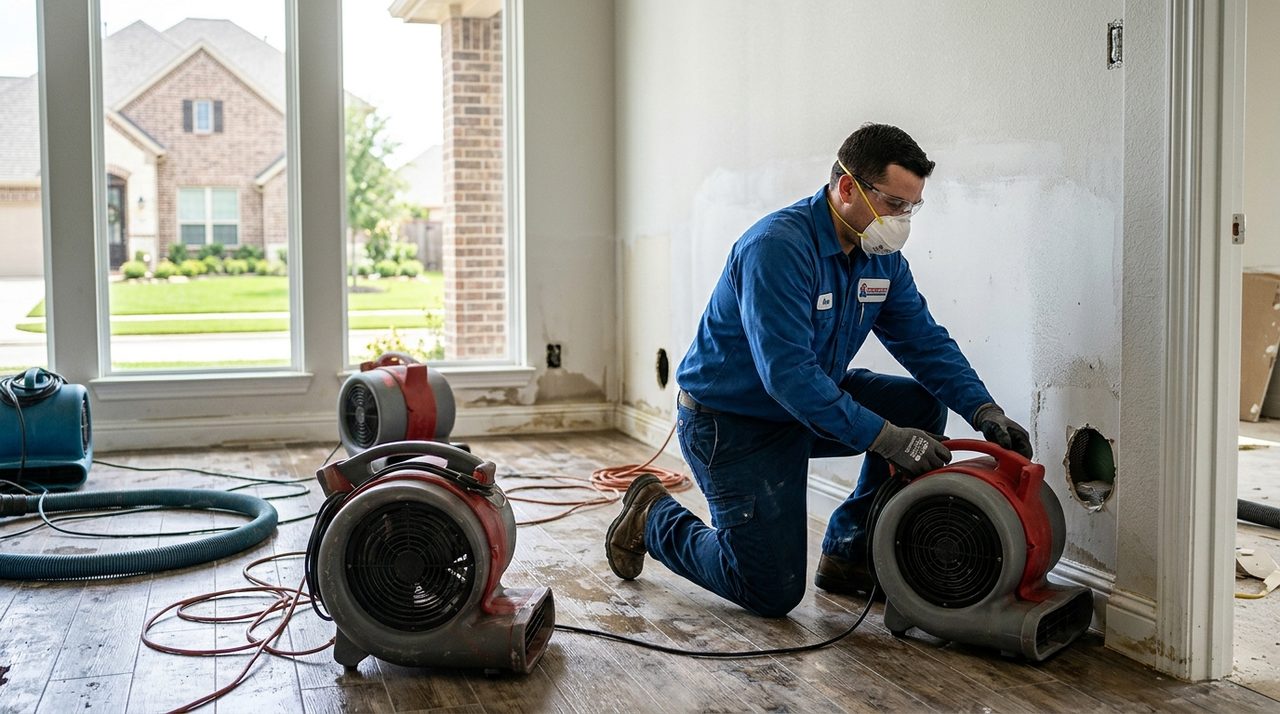
A qualified restoration contractor will use penetrating moisture meters and thermal imaging cameras to map the true wet boundary in your slab-edge walls, not just the visibly affected area. Drying plans for Fulshear homes should include desiccant or refrigerant dehumidifiers staged to address the sustained vapor drive from the clay soil, and drying logs must be maintained daily until meter readings confirm IICRC S500 dry standards are met — typically lower target values than a contractor in a drier climate would accept.
Sources: IICRC (water/mold restoration standards), Harris County Flood Control District
Why it matters to you
Most of Fulshear's master-planned interior blocks carry a FEMA Zone X designation, but properties closest to the Brazos River corridor face materially higher risk — sometimes AE or AE floodway classification on a lot just a street away from Zone X neighbors. Fort Bend County experienced significant Brazos flooding during Harvey (2017), and some Fulshear-area parcels along the river saw inundation depths that qualify as Category 3 black-water events under IICRC S500 due to combined agricultural and sewage contamination in Brazos floodwater. Homeowners on these blocks who accept a Category 2 restoration scope from an insurer are underserving their actual loss.
What a good pro does
Before finalizing any restoration scope on a Fulshear home within a few blocks of the Brazos, a contractor should pull the FEMA Flood Insurance Rate Map panel for the specific parcel address — not rely on a subdivision-wide Zone X assumption. If floodwater source is confirmed or suspected to be Brazos River overflow, the contractor must document water source, obtain water samples if practical, and assert Category 3 classification in writing to the insurer, which triggers the IICRC S500-required demo protocol: full removal of porous materials at least 12 inches above the flood line.
Sources: FEMA National Flood Hazard Layer (NFHL), IICRC (water/mold restoration standards), Harris County Flood Control District
Why it matters to you
Fulshear's rapid annexation history means your street address alone does not reliably tell you which building department governs your restoration permit. Properties inside Fulshear city limits go to the City of Fulshear Building Department; properties in the extraterritorial jurisdiction or unincorporated areas route to Fort Bend County Engineering. Pulling the wrong permit — or skipping the demolition permit entirely because the water loss 'seemed minor' — can result in a failed final inspection, which blocks the Certificate of Completion your insurer needs to close the claim. This is a documented and recurring problem in fast-growth Fort Bend County communities.
What a good pro does
Your restoration contractor's first administrative step, before any permit application is drafted, should be confirming jurisdiction by the property's legal description and Fort Bend County precinct map — not just zip code or mailing address. Once jurisdiction is confirmed, the restoration contractor typically pulls the structural demolition permit, while any TSBPE-licensed plumber and TDLR-licensed electrician whose work is exposed during demo pull their own trade permits under the same project. Mold remediation work — if triggered — requires the performing firm to hold a TDLR Mold Remediation Contractor (MRC) license, which is a separate requirement from the demolition permit.
Sources: Municipal permit office (see area profile), Texas Department of Licensing & Regulation, Texas State Board of Plumbing Examiners
Hiring water & flood restoration in Fulshear? Fulshear is one of the fastest-growing communities in the Houston metro, dominated by post-2000 master-planned subdivisions with mandatory HOAs and rigorous deed restrictions. Homeowners here typically deal with newer construction systems but face strict architectural review for any exterior modifications. The mix of production homes and rural acreage tracts means service needs range from standard warranty-era maintenance to custom work on larger estate properties.
Building era
2000s–2020s (bulk of inventory); limited older housing in original town of Fulshear.
Typical style
Contemporary suburban production homes — brick and stone façades, 1- and 2-story detached single-family, mix of traditional, Texas Hill Country-inspired, and transitional elevations.
Foundations
Slab-on-grade (standard for post-2000 Fort Bend County production homes; older farmhouses or custom acreage homes may use pier-and-beam but are a small minority).
Common systems
Modern high-efficiency HVAC systems (14+ SEER), PEX or copper plumbing, 200-amp electrical panels, tankless or high-efficiency water heaters common in newer builds.
What that means for repairs
Most homes are under 20 years old, so major renovation is limited. Common projects include patio covers, outdoor kitchens, pool installations, and garage conversions — all typically requiring HOA architectural review and approval before work begins.
Permit jurisdiction
City of Fulshear Building Department for properties within city limits; Fort Bend County Engineering for unincorporated ETJ areas. Jurisdiction depends on exact property location.
HOA & deed restrictions
Most master-planned subdivisions (Weston Lakes, Fulshear Lakes, Pecan Ridge, Polo Ranch, and others) have mandatory HOAs with formal architectural review, deed restriction enforcement, and annual assessments (e.g., Fulshear Lakes charges ~$1,850/year including front yard maintenance). Non-HOA parcels exist on acreage tracts and older rural roads but are the minority of housing units.
Historic districts
No historic district designation confirmed. Fulshear is a rapidly growing area with almost entirely modern construction.
Contractor note
Contractors must verify whether a property falls within Fulshear city limits or unincorporated Fort Bend County, as permitting requirements and inspection processes differ. Nearly all subdivision work also requires prior HOA architectural committee approval before permits are pulled.
FEMA flood zone
FEMA Zone X (low flood risk) per official NFHL data. However, the broader Fulshear area sits between bayous and the Brazos River, so flood risk is highly location-specific — some parcels closer to waterways may carry different designations. Always verify FEMA FIRM panels for specific addresses.
Hurricane Harvey impact
No area-wide documentation confirms broad Harvey flooding across Fulshear subdivisions. Regional Harvey impact reports focus on Brazos River flooding near Simonton and Richmond rather than Fulshear master-planned communities. Marketing materials for major Fulshear subdivisions do not disclose Harvey flooding. However, no authoritative source definitively confirms zero impact for all Fulshear properties — for a specific address, check FEMA claims data and Fort Bend County floodplain records.
Heat & humidity load
New slab-on-grade construction on expansive Fort Bend County clay soils is subject to significant seasonal soil movement. Extended summer heat and drought cause soil shrinkage that can stress slab foundations and exterior hardscape. Proper irrigation of foundation perimeters is critical. High-efficiency HVAC systems in these larger homes (many 2,500–4,000+ sq ft) face heavy summer loads and benefit from annual pre-season maintenance.
Working with contractors here
Contractors in Fulshear primarily handle new-home warranty work, HVAC maintenance on modern high-efficiency systems, and outdoor living additions such as pools, covered patios, and outdoor kitchens. Because most homes are under 20 years old, major system replacements are uncommon, but foundation monitoring and minor slab repair due to expansive clay soils is a recurring need. HOA architectural review is a significant factor — contractors should advise homeowners to secure written HOA approval before scheduling exterior work, as non-compliant modifications can result in forced removal. The mix of production subdivisions and rural acreage means job scoping varies widely: subdivision work follows tight lot-line and setback constraints, while acreage properties may involve well/septic systems and longer material delivery logistics.
Local Tip
Always ask for a written estimate before work begins. Texas contractors are required to provide one on jobs over $1,000.
Fulshear is one of the fastest-growing communities in the Houston metro, dominated by post-2000 master-planned subdivisions with mandatory HOAs and rigorous deed restrictions. Homeowners here typically deal with newer construction systems but face strict architectural review for any exterior modifications. The mix of production homes and rural acreage tracts means service needs range from standard warranty-era maintenance to custom work on larger estate properties.
Source: U.S. Census Bureau, ACS 5-Year 2023
Most of Fulshear maps to FEMA Zone X (low mapped flood risk), but Houston's flash-flood reality means even low-risk blocks benefit from smart drainage and storm-hardened installs; risk climbs sharply on blocks nearest the Brazos River, where it varies parcel to parcel.
Source: FEMA National Flood Hazard Layer (NFHL). Flood zones vary by parcel — verify your individual FIRM panel.
Water-restoration companies serving Fulshear, TX can install or recommend backflow prevention add-ons on floor drains and advise on contents-elevation strategies that limit category-2 water contact during a tropical event. The May 2024 derecho reminded Houston homeowners that extreme rain is not exclusive to named hurricanes, making year-round readiness essential. As a Fort Bend County community, Fulshear may follow county rather than City of Houston storm rebuild rules.
For homeowners in Fulshear, TX: the May 2024 derecho caused widespread roof-deck separation across Houston, and the subsequent rainfall introduced water into attic insulation that retained moisture for weeks — a restoration contractor with desiccant drying equipment can address these attic assemblies that conventional fans cannot reach. Documenting the drying process with daily moisture logs also supports insurance claims for wind-and-water combined losses. As a Fort Bend County community, Fulshear may follow county rather than City of Houston storm rebuild rules.
Homes in lower-flood-risk areas of Fulshear, TX are not immune to the interior water losses Uri 2021 caused — burst attic supply lines and failed icemaker connections caused extensive drywall and flooring damage regardless of floodplain designation. A water-restoration contractor can extract standing water, remove wet flooring, and place structural drying equipment within the window that prevents a straightforward dryout from escalating to mold remediation. Because Fulshear drains toward the Brazos River, block-level runoff can differ sharply from the mapped zone.
Sources: FEMA National Flood Hazard Layer (NFHL), Ready.gov -- Hurricanes, CenterPoint Energy -- Storm Center, City of Houston -- Emergency Preparedness, Ready.gov -- Winter Weather, Harris County Flood Control District
Houston-specific estimators to plan your project before you call a pro. All results are planning estimates — a licensed local pro confirms the details on site.
Disconnect & drain every outdoor hose bib
Remove hoses, drain the spigots, and cover each with an insulated faucet sock. Un-drained hose bibs are the #1 burst point in a Houston freeze.
Insulate exposed pipes in the attic & garage
Wrap any pipe in an unconditioned space (attic runs, garage walls) with foam sleeves. Houston homes rarely insulate these because they only matter a few nights a year — which is exactly why they burst.
Open cabinet doors & keep a pencil-width drip
On hard-freeze nights, open kitchen/bath cabinets so warm air reaches the pipes and let faucets on exterior walls drip to relieve pressure.
Protect the attic/garage water heater & its lines
An attic or garage tank sits in unconditioned space. Insulate the cold-inlet and hot-outlet lines and confirm the emergency drain pan is clear so a leak doesn't reach the ceiling.
This is a planning estimate only — actual requirements depend on an on-site assessment by a licensed Houston pro. If a pipe has already burst, shut off your main water supply and call a licensed Houston plumber immediately — freeze bursts flood fast.
Sources: Municipal permit office (see area profile)
Sources: IICRC (water/mold restoration standards)FEMA National Flood Hazard Layer (NFHL)
Sources: IICRC (water/mold restoration standards)Local HOA / deed restrictions (see area profile)