27120 Fulshear Bend Dr Suite 900-133, Fulshear, TX 77441
Best AC Repair in Fulshear, TX
Fulshear's explosion of post-2010 master-planned subdivisions means the vast majority of homes here are running modern high-efficiency split systems that are barely out of warranty age — but Fort Bend County's notorious high-plasticity clay soil, scorching West Houston summers with no coastal sea-breeze relief, and some of the metro's most stringent HOA architectural review processes create a distinct set of AC headaches that newer equipment doesn't automatically solve. Whether your home is in Weston Lakes, Pecan Ridge, or Fulshear Lakes, understanding how local soil movement, extreme cooling loads, and mandatory HOA approval interact with routine HVAC repair decisions can save you a costly misstep.
Verified against Google Business data
Updated 2026
See the 10 AC Repair Serving Fulshear 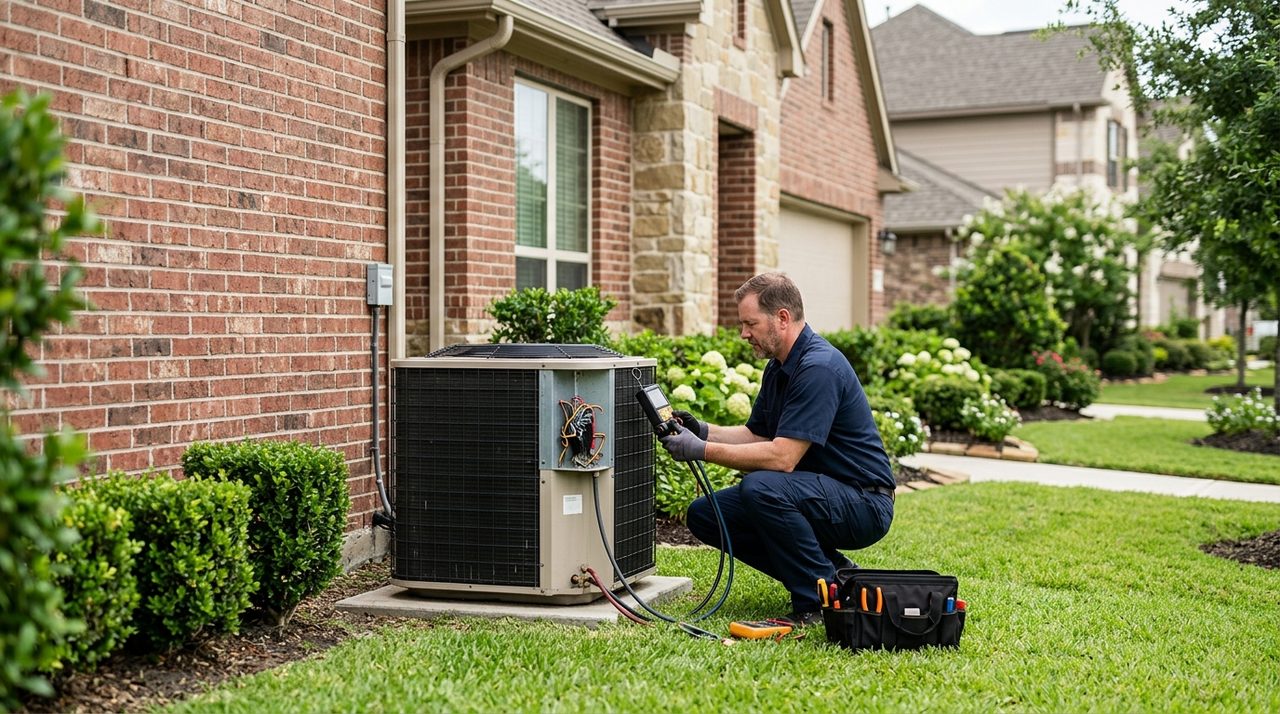
- Median home built
- 2015
- Median home value
- $546,200
- FEMA flood zone
- X (low)
- Typical AC repair cost (est.)
- $180–$650 (component repair); $5,500–$9,500 (full replacement)
- Most common local issue
- Clay soil slab movement stressing line sets and tilting condenser pads on post-2010 production homes
Ranked by verified Google rating × review volume × verification tier. How we rank →
Some highly-rated pros serve Fulshear from nearby and may not keep a Fulshear street address. Those are listed under "Also serving Fulshear" with their real city and distance, so you always know where each business is based.
Min rating:
10 resultsBased in Fulshear
Also serving Fulshear
Highly-rated pros based nearby who cover Fulshear. Distance shown from the Fulshear area.
Open Now
Serving Fulshear Based in Katy · 3.7 mi away
Serving Fulshear Based in Richmond · 3.8 mi away
Open Now
Serving Fulshear Based in Richmond · 3.8 mi away
Closed
Serving Fulshear Based in Richmond · 3.8 mi away
Closed
Serving Fulshear Based in Richmond · 5.2 mi away
Serving Fulshear Based in Katy · 5.3 mi away
Open Now
Serving Fulshear Based in Katy · 6.1 mi away
Closed
Serving Fulshear Based in Katy · 6.4 mi away
Closed
Serving Fulshear Based in Katy · 6.6 mi away
AC Repair in Fulshear: What You Should Know
HOA Architectural Review Adds a Required Step Before Any Exterior AC Work
Why it matters to you
Nearly every production subdivision in Fulshear — Weston Lakes, Fulshear Lakes, Polo Ranch, Pecan Ridge, and others — enforces mandatory HOA architectural review for exterior modifications, and condenser unit placement, screening fences, and line-set routing are all typically covered by those deed restrictions. Skipping HOA approval before scheduling a condenser relocation or replacement can result in a forced removal order, even if the city or county permit is already in hand. With HOA annual assessments running roughly $1,850/year in communities like Fulshear Lakes, these organizations are well-funded and active in enforcement.
What a good pro does
Before any exterior HVAC work begins, your contractor should help you identify your specific subdivision's CC&Rs and submit an architectural review request with equipment specs, placement diagrams, and screening materials. A contractor experienced in Fulshear subdivisions knows to sequence HOA approval before pulling a permit from the City of Fulshear Building Department or Fort Bend County Engineering — not after. Get written HOA approval in hand before any equipment is ordered.
Sources: Local HOA / deed restrictions (see area profile), Municipal permit office (see area profile)
Fort Bend Clay Soil Is Already Shifting Condenser Pads and Line Sets in Homes That Are Only 10–15 Years Old
Why it matters to you
Fulshear sits squarely on Fort Bend County's high-plasticity Beaumont clay, which swells with rainfall and shrinks during drought — and the past several years have delivered both extremes. Even homes built as recently as 2012–2015 are showing concrete condenser pads that have tilted enough to stress refrigerant line sets and put side-loads on compressor mounting brackets. When a condenser pad settles unevenly, the outdoor unit can vibrate excessively, accelerate refrigerant line fatigue at the connection points, and eventually cause slow leaks that won't show up until a summer breakdown.
What a good pro does
A thorough Fulshear service visit should include a bubble-level check of the condenser pad and a visual inspection of line-set connections at both the air handler and outdoor unit. If the pad has settled more than a half-inch out of level, a qualified HVAC contractor can reset or replace the pad and re-secure the line set before a refrigerant leak develops. An R-410A leak test and recharge, if needed, is estimated at $350–$650; catching it early avoids a full compressor replacement.
Sources: Municipal permit office (see area profile), Texas Department of Licensing & Regulation
West Houston's Extreme Cooling Load Is Hammering Modern High-Efficiency Systems Around the Clock
Why it matters to you
Fulshear sits inland with no Gulf sea-breeze relief, making it one of the hotter microclimates in the metro during June through September. Houston's design cooling load regularly exceeds 400 hours above 95°F annually, and Fulshear's dark asphalt-heavy subdivisions — still filling in with new construction that absorbs additional radiant heat — push that load further. Even a correctly sized 14–16 SEER2 system installed new in a 2018 production home will run nearly continuously on peak days, accelerating capacitor and contactor wear far faster than the equipment's design life assumes.
What a good pro does
Ask your HVAC tech to test capacitor microfarad readings and contactor contact condition on every tune-up — these $180–$450 component repairs are the highest-probability failure points in Fulshear's climate and are far cheaper to catch proactively than to replace after a compressor locks up on a 100°F Saturday. Confirm your contractor holds a current TDLR license and that any equipment replacement triggers a mechanical permit, whether through the City of Fulshear or Fort Bend County Engineering depending on your parcel's jurisdiction.
Sources: Texas Department of Licensing & Regulation, Municipal permit office (see area profile), ENERGY STAR / U.S. Dept. of Energy
Slab-on-Grade Air Handlers and High Humidity Create Drain Pan Overflow Risk in Newer Homes
Why it matters to you
Virtually all Fulshear production homes are slab-on-grade, and interior air handlers are typically tucked into closets without floor drains. Houston's sustained 90%+ relative humidity means evaporator coils and condensate drain lines are working constantly — and a clogged primary drain line on a Fulshear home sends overflow directly onto the closet slab, which has nowhere to go except into adjacent flooring and drywall. This is one of the highest-frequency service calls in the area, and even relatively new systems (5–10 years old) are not immune as algae builds up in drain pans over time.
What a good pro does
A preventive condensate drain flush and pan treatment — typically $95–$225 — should be part of every annual tune-up on a Fulshear home. Good contractors will also verify that the secondary float switch (which shuts the system down before overflow occurs) is properly installed and functional; many production-home installs include this switch, but it can fail or be wired incorrectly. If overflow has already occurred, check the closet slab and adjacent baseboards for moisture intrusion before assuming the problem is fully resolved.
Sources: Texas Department of Licensing & Regulation, Municipal permit office (see area profile)
AC Repair in Fulshear: What You Should Know
Hiring ac repair in Fulshear? Fulshear is one of the fastest-growing communities in the Houston metro, dominated by post-2000 master-planned subdivisions with mandatory HOAs and rigorous deed restrictions. Homeowners here typically deal with newer construction systems but face strict architectural review for any exterior modifications. The mix of production homes and rural acreage tracts means service needs range from standard warranty-era maintenance to custom work on larger estate properties.
- Housing era
- 2000s–2020s (bulk of inventory)
- Foundation
- Slab-on-grade (standard for post-2000 Fort Bend County production homes
- Flood zone
- FEMA Zone X (low flood risk) per official NFHL data
- Permits
- City of Fulshear Building Department for properties within city limits
Housing stock & systems
Building era
2000s–2020s (bulk of inventory); limited older housing in original town of Fulshear.
Typical style
Contemporary suburban production homes — brick and stone façades, 1- and 2-story detached single-family, mix of traditional, Texas Hill Country-inspired, and transitional elevations.
Foundations
Slab-on-grade (standard for post-2000 Fort Bend County production homes; older farmhouses or custom acreage homes may use pier-and-beam but are a small minority).
Common systems
Modern high-efficiency HVAC systems (14+ SEER), PEX or copper plumbing, 200-amp electrical panels, tankless or high-efficiency water heaters common in newer builds.
What that means for repairs
Most homes are under 20 years old, so major renovation is limited. Common projects include patio covers, outdoor kitchens, pool installations, and garage conversions — all typically requiring HOA architectural review and approval before work begins.
Permits & restrictions
Permit jurisdiction
City of Fulshear Building Department for properties within city limits; Fort Bend County Engineering for unincorporated ETJ areas. Jurisdiction depends on exact property location.
HOA & deed restrictions
Most master-planned subdivisions (Weston Lakes, Fulshear Lakes, Pecan Ridge, Polo Ranch, and others) have mandatory HOAs with formal architectural review, deed restriction enforcement, and annual assessments (e.g., Fulshear Lakes charges ~$1,850/year including front yard maintenance). Non-HOA parcels exist on acreage tracts and older rural roads but are the minority of housing units.
Historic districts
No historic district designation confirmed. Fulshear is a rapidly growing area with almost entirely modern construction.
Contractor note
Contractors must verify whether a property falls within Fulshear city limits or unincorporated Fort Bend County, as permitting requirements and inspection processes differ. Nearly all subdivision work also requires prior HOA architectural committee approval before permits are pulled.
Flood & weather
FEMA flood zone
FEMA Zone X (low flood risk) per official NFHL data. However, the broader Fulshear area sits between bayous and the Brazos River, so flood risk is highly location-specific — some parcels closer to waterways may carry different designations. Always verify FEMA FIRM panels for specific addresses.
Hurricane Harvey impact
No area-wide documentation confirms broad Harvey flooding across Fulshear subdivisions. Regional Harvey impact reports focus on Brazos River flooding near Simonton and Richmond rather than Fulshear master-planned communities. Marketing materials for major Fulshear subdivisions do not disclose Harvey flooding. However, no authoritative source definitively confirms zero impact for all Fulshear properties — for a specific address, check FEMA claims data and Fort Bend County floodplain records.
Heat & humidity load
New slab-on-grade construction on expansive Fort Bend County clay soils is subject to significant seasonal soil movement. Extended summer heat and drought cause soil shrinkage that can stress slab foundations and exterior hardscape. Proper irrigation of foundation perimeters is critical. High-efficiency HVAC systems in these larger homes (many 2,500–4,000+ sq ft) face heavy summer loads and benefit from annual pre-season maintenance.
Working with contractors here
Contractors in Fulshear primarily handle new-home warranty work, HVAC maintenance on modern high-efficiency systems, and outdoor living additions such as pools, covered patios, and outdoor kitchens. Because most homes are under 20 years old, major system replacements are uncommon, but foundation monitoring and minor slab repair due to expansive clay soils is a recurring need. HOA architectural review is a significant factor — contractors should advise homeowners to secure written HOA approval before scheduling exterior work, as non-compliant modifications can result in forced removal. The mix of production subdivisions and rural acreage means job scoping varies widely: subdivision work follows tight lot-line and setback constraints, while acreage properties may involve well/septic systems and longer material delivery logistics.
Local Tip
Always ask for a written estimate before work begins. Texas contractors are required to provide one on jobs over $1,000.
About Fulshear
Fulshear is one of the fastest-growing communities in the Houston metro, dominated by post-2000 master-planned subdivisions with mandatory HOAs and rigorous deed restrictions. Homeowners here typically deal with newer construction systems but face strict architectural review for any exterior modifications. The mix of production homes and rural acreage tracts means service needs range from standard warranty-era maintenance to custom work on larger estate properties.
- Median year built
- 2015
- Median home value
- $546,200
- Owner-occupied
- 91.1%
- Population
- 26,986
- Housing units
- 8,191
- Median income
- $178,398
Source: U.S. Census Bureau, ACS 5-Year 2023
Flood & storm risk
FEMA Zone XLow flood riskMost of Fulshear maps to FEMA Zone X (low mapped flood risk), but Houston's flash-flood reality means even low-risk blocks benefit from smart drainage and storm-hardened installs; risk climbs sharply on blocks nearest the Brazos River, where it varies parcel to parcel.
Source: FEMA National Flood Hazard Layer (NFHL). Flood zones vary by parcel — verify your individual FIRM panel.
Houston Storm Readiness in Fulshear
Hurricane & flooding
After a hurricane passes through Fulshear, TX, clear debris from condenser coil fins with a gentle water rinse before restoring power — compressed leaf litter and shingle granules restrict airflow and can overheat the compressor on a first cooling call during the post-storm heat spike. A TDLR-licensed technician can also inspect the refrigerant charge, which can shift if the unit was significantly jostled. As a Fort Bend County community, Fulshear may follow county rather than City of Houston storm rebuild rules.
Severe storms & hail
The May 2024 derecho proved that even lower-risk areas like Fulshear, TX are not immune to structural damage: flying debris punctured condenser coil cabinets on streets with no flooding history at all. Inspect your condenser cabinet panels for dents or breaches after any significant storm, and cover exposed refrigerant components with UV-stable foam insulation before a technician can arrive. As a Fort Bend County community, Fulshear may follow county rather than City of Houston storm rebuild rules.
Ice storms & freezes
Heat-pump outdoor units in Fulshear, TX are vulnerable to ice bridging under the base pan during sleet events like Uri 2021, which blocks airflow and triggers safety lockouts — elevating the unit on a taller pad with drainage channels keeps the base clear and lets the defrost cycle do its job. A TDLR-licensed HVAC technician can assess whether your current pad height is adequate before the next winter freeze. Because Fulshear drains toward the Brazos River, block-level runoff can differ sharply from the mapped zone.
Sources: FEMA National Flood Hazard Layer (NFHL), Ready.gov -- Hurricanes, CenterPoint Energy -- Storm Center, City of Houston -- Emergency Preparedness, Ready.gov -- Winter Weather, Harris County Flood Control District
Free Fulshear Tools & Calculators
Houston-specific estimators to plan your project before you call a pro. All results are planning estimates — a licensed local pro confirms the details on site.
Houston AC Tonnage & Sizing Estimator
Open full tool & FAQ →Living space you want cooled (400–10,000 sq ft).
5.0tons
Recommended nominal size
60,000 BTU/hr
Estimated cooling load
This is a planning estimate only — actual requirements depend on an on-site assessment by a licensed Houston pro. Houston's humidity and long cooling season make an oversized unit a common, costly mistake — it short-cycles and never dehumidifies. A licensed contractor confirms sizing with a full Manual J calculation.
Houston Freeze Prep & Pipe Insulation Checklist
Open full tool & FAQ →Your freeze checklist — 4 tasks
- 1
Disconnect & drain every outdoor hose bib
Remove hoses, drain the spigots, and cover each with an insulated faucet sock. Un-drained hose bibs are the #1 burst point in a Houston freeze.
- 2
Insulate exposed pipes in the attic & garage
Wrap any pipe in an unconditioned space (attic runs, garage walls) with foam sleeves. Houston homes rarely insulate these because they only matter a few nights a year — which is exactly why they burst.
- 3
Open cabinet doors & keep a pencil-width drip
On hard-freeze nights, open kitchen/bath cabinets so warm air reaches the pipes and let faucets on exterior walls drip to relieve pressure.
- 4
Protect the attic/garage water heater & its lines
An attic or garage tank sits in unconditioned space. Insulate the cold-inlet and hot-outlet lines and confirm the emergency drain pan is clear so a leak doesn't reach the ceiling.
This is a planning estimate only — actual requirements depend on an on-site assessment by a licensed Houston pro. If a pipe has already burst, shut off your main water supply and call a licensed Houston plumber immediately — freeze bursts flood fast.
Frequently Asked Questions
Do I need a permit to replace my AC system in Fulshear, and who actually issues it — the City of Fulshear or Fort Bend County?
It depends on your exact address: homes inside Fulshear city limits go through the City of Fulshear Building Department, while properties in the unincorporated ETJ pull permits through Fort Bend County Engineering — and the two offices have different fee schedules and inspection timelines. Your TDLR-licensed HVAC contractor is required to pull the mechanical permit; you cannot self-pull HVAC work in either jurisdiction. Before scheduling installation, confirm your jurisdiction by looking up your property on the Fort Bend County Appraisal District site or asking your contractor to verify. Permit fees are estimated at $75–$250 depending on jurisdiction, on top of equipment costs.
Sources: Municipal permit office (see area profile)Texas Department of Licensing & Regulation
My Fulshear home was built in 2017 — is the original AC system still under any manufacturer warranty if it needs a major repair now?
Most major manufacturers (Carrier, Trane, Lennox) offer 5-year base parts warranties and 10-year extended parts warranties on equipment registered within 90 days of installation, so a 2017 system may still have parts coverage through 2027 if the original owner registered it. However, labor is almost never covered after year one or two, and warranty coverage is voided if the equipment was not installed by a TDLR-licensed contractor or if a non-authorized repair was performed. Pull your original closing documents or contact the builder's HVAC subcontractor to confirm registration status before authorizing any paid repair on a covered component.
What is the realistic timeline for a full AC replacement in a Weston Lakes or Pecan Ridge home once I decide to move forward?
Plan for a minimum of one to two weeks from decision to cooling, not a single day: your HOA architectural committee review alone can take 5–10 business days in most Fulshear master-planned communities, and that approval must come before the contractor pulls the mechanical permit from the City of Fulshear or Fort Bend County. Equipment lead times for high-efficiency units (16+ SEER2) that meet current federal minimum standards add another 1–3 business days in normal supply conditions, though post-storm demand spikes can extend that. Rushing past the HOA step risks a forced-removal notice, so budget the full timeline from the start.
Sources: Local HOA / deed restrictions (see area profile)ENERGY STAR / U.S. Dept. of Energy
Fulshear is in FEMA Zone X, so do I really need to worry about elevating or protecting my condenser unit from flood damage?
Zone X means your parcel is outside the mapped 100-year floodplain, so federally mandated flood-elevation rules for equipment do not apply here, but Houston's flash-flood reality means even low-risk blocks in Fulshear can see sheet-flow water from extreme rainfall events that locally overtops drainage — particularly on lots nearest the Brazos River corridor where flood risk varies parcel to parcel. A simple precaution is confirming your condenser pad sits at least 3–4 inches above finished grade and that lot drainage directs runoff away from the unit, which costs nothing extra during a standard install. Flood insurance is generally not required by lenders for Zone X properties, but it remains available.
Should I schedule AC maintenance before summer or after — and is there a slow season in Fulshear where I can actually get a quick appointment?
Schedule in March or early April before the June–September peak cooling season locks technicians into emergency dispatch queues; in a market where West Houston design temperatures regularly push systems to run continuously for days at a stretch, contractors are fully booked by May and routine tune-up slots disappear. October and November are the other realistic window — cooling load has dropped, contractors have availability, and any latent refrigerant or drain-line issues found then can be addressed without the emergency-rate pressure. Avoid scheduling non-emergency work in June through August unless you are already without cooling, as you will typically wait longer and may pay a premium.
My Fulshear home still has R-410A equipment installed around 2020 — do I need to worry about the new refrigerant rules affecting future repairs?
R-410A systems installed around 2020 are not immediately obsolete, but EPA regulations effective January 2025 prohibit manufacturing new R-410A equipment, meaning if your system ever needs a full replacement rather than a component repair, you will be moving to R-454B or another lower-GWP refrigerant — which uses different compressor oil and is not backward-compatible with your existing line set in some configurations. For now, R-410A refrigerant for recharging existing systems remains available, with recharge costs estimated at $350–$650 including a leak test; that is unlikely to change dramatically in the near term since the phaseout targets new equipment, not service refrigerant. Ask your technician to perform a thorough leak diagnosis rather than a straight top-off, so you are not paying for refrigerant that will simply escape again.
Sources: ENERGY STAR / U.S. Dept. of Energy