Closed
565 S Mason Rd #347, Katy, TX 77450
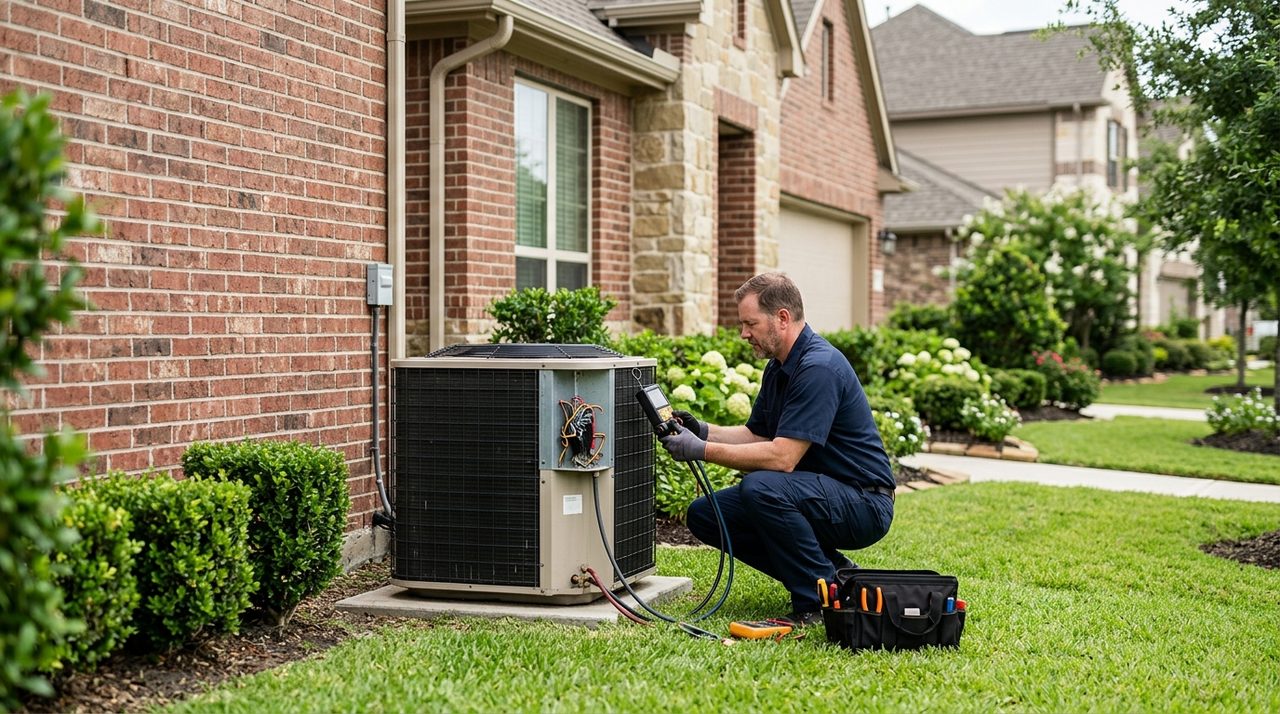
Cinco Ranch's production-built homes from the 1990s and early 2000s are now 20–30 years old, putting a large share of original HVAC equipment squarely in the replacement window — and Fort Bend County's high-plasticity clay soils add stress to refrigerant line sets and condenser pads that most homeowners never anticipate. Every equipment swap here runs through two separate approval tracks: a mechanical permit from Fort Bend County (not the City of Houston) and pre-approval from one of the community's two mandatory HOA Architectural Control Committees before any exterior work touches the ground.
Ranked by verified Google rating × review volume × verification tier. How we rank →
565 S Mason Rd #347, Katy, TX 77450
7225 N Park Dr, Richmond, TX 77407
21819 Katy Fwy Ste B103, Katy, TX 77450
535 E Fernhurst Dr Suite 312, Katy, TX 77450
21830 Kingsland Blvd #101a, Katy, TX 77450
21030 Somerset Park Ln, Katy, TX 77450
1023 Park Meadow Dr, Katy, TX 77450
22136 Westheimer Pkwy, Katy, TX 77450
19911 Shore Meadows Ln, Richmond, TX 77407
1539 S Mason Rd, Katy, TX 77450
Why it matters to you
With a Census median year built of 1997, a large portion of Cinco Ranch homes are on their first or second HVAC system, and units installed in the early 2000s are now past the 15–20 year typical lifespan for Houston's extreme cooling season — which regularly logs over 400 hours above 95°F annually. Compressors, TXVs, and condenser coils on equipment of this age have absorbed decades of continuous summer runtime, and the repair-vs-replace math shifts sharply once a system crosses the 15-year mark. Many Cinco Ranch units still running R-22 refrigerant face an additional dead end: reclaimed R-22 spot prices have exceeded $80–$150 per pound in the Houston market, making a leak repair on a 20-year-old system economically irrational.
What a good pro does
A qualified contractor will perform a full system evaluation — checking refrigerant type, static pressure, and SEER rating — before recommending repair or replacement. If your unit is pre-2010 and using R-22, ask for a written cost comparison between a retrofit and full replacement with a current R-410A or R-454B system; TDLR-licensed contractors are required to pull a Fort Bend County mechanical permit for any full system changeout, which includes an inspection that confirms proper sizing and installation.
Sources: Texas Department of Licensing & Regulation, Municipal permit office (see area profile), ENERGY STAR / U.S. Dept. of Energy
Why it matters to you
Cinco Ranch sits on Fort Bend County's high-plasticity Beaumont/Houston Black clay, and the slab-on-grade construction that dominates the community means refrigerant line sets often run through or along the slab where seasonal soil shrink-swell cycles can kink copper tubing and pull flare fittings loose over time. Condenser units mounted on concrete pads are especially vulnerable: as the pad settles unevenly, the unit tilts, stressing the refrigerant connections and potentially shorting the electrical disconnect. Homeowners in the western sections of Cinco Ranch — built out in the mid-2000s — are now seeing the cumulative effect of 15–20 years of clay movement on original line sets.
What a good pro does
During any service visit, ask the technician to inspect the condenser pad level and visually trace the line set for visible kinks or oil staining (a sign of a slow refrigerant leak at a stressed fitting). If the pad has settled more than half an inch out of level, a proper repair includes re-leveling or replacing the pad before installing new equipment. A TDLR-licensed contractor should document the line-set condition on the permit application submitted to Fort Bend County.
Sources: Texas Department of Licensing & Regulation, Municipal permit office (see area profile)
Why it matters to you
Houston averages 90% or higher relative humidity for much of the year, and Cinco Ranch's interior-closet air handler installations — standard in the community's two-story and single-story production floor plans — have condensate drain lines that run horizontally for several feet before reaching a standpipe, making them prone to algae and debris blockage. On slab-on-grade construction, an overflowing secondary drain pan has nowhere to drain except onto the slab, which can cause moisture intrusion into drywall, flooring, and — in closet installations — the surrounding walls before the homeowner notices. This is one of the highest-volume summer service calls across West Houston.
What a good pro does
Budget $95–$225 (estimated) once a year for a preventive drain flush and pan treatment with algaecide tablets — it is far cheaper than the drywall repair that follows a pan overflow. A thorough technician will also verify that the secondary float switch (which shuts the system off if the primary drain clogs) is functional and wired correctly. Fort Bend County mechanical permits are not required for routine maintenance, but a full air-handler replacement does require a county permit pulled by a TDLR-licensed contractor.
Sources: Texas Department of Licensing & Regulation, Municipal permit office (see area profile)
Why it matters to you
Cinco Ranch operates under a dual HOA structure — Cinco Ranch HOA I (east of Katy-Gaston Road) and Cinco Ranch Residential Association II, Inc. (west), both under the Cinco Residential Property Association master association — and the Architectural Control Committee for your specific sub-association must grant written approval before exterior equipment is installed or relocated. Condenser screening, placement setbacks, and fence or lattice materials are all governed by deed restrictions that are legally enforceable; the HOA can require removal of non-compliant work at the homeowner's expense, and ACC review typically takes 2–4 weeks.
What a good pro does
Before scheduling an HVAC replacement, confirm which of the two sub-associations governs your address and submit an ACC application with a site plan showing condenser placement, screening materials, and equipment dimensions. Do not schedule the installation until written ACC approval is in hand — run the HOA track and the Fort Bend County mechanical permit process in parallel to avoid delays. A contractor familiar with Cinco Ranch will know that county permit approval and ACC approval are separate processes and will not start exterior work on the strength of one without the other.
Sources: Local HOA / deed restrictions (see area profile), Municipal permit office (see area profile), Texas Department of Licensing & Regulation
Hiring ac repair in Cinco Ranch? Cinco Ranch is one of Houston's largest master-planned communities, featuring production-built suburban homes from the 1990s and 2000s now reaching the age where major system replacements become routine. Homeowners must navigate mandatory HOA architectural review alongside Fort Bend County permitting for exterior modifications, roofing, and additions. The predominantly slab-on-grade construction on Fort Bend County clay soils means foundation monitoring and drainage management are ongoing concerns.
Building era
Primarily 1990s–2000s, with continued build-out into the early 2010s.
Typical style
Conventional suburban traditional — brick and brick/stone two-story and single-story homes, with some Mediterranean/stucco accents.
Foundations
Likely predominantly slab-on-grade (consistent with 1990s–2000s Houston-area production building; not explicitly documented in sources reviewed).
Common systems
Central forced-air HVAC (typically 15–25 years old, many nearing or past replacement age), copper or CPVC supply plumbing, PVC drain lines, 200-amp electrical panels. Original HVAC units in 1990s-era sections are likely already replaced or due for replacement.
What that means for repairs
Kitchen and bathroom remodels are common as homes reach 20–30 years. HVAC replacements and roof replacements (composition shingle, 20-year cycle) are the most frequent major projects. All exterior modifications require HOA Architectural Control Committee approval before work begins.
Permit jurisdiction
Fort Bend County engineering and development services (unincorporated area — not City of Houston or any incorporated municipality). MUD districts may also apply for certain infrastructure items.
HOA & deed restrictions
Mandatory dual HOA system: Cinco Ranch HOA I (east of Katy-Gaston Road) and Cinco Ranch Residential Association II, Inc. (west of Katy-Gaston Road), under the Cinco Residential Property Association master association. Deed restrictions and architectural guidelines are legally enforceable. ACC approval required for most exterior changes.
Historic districts
No City of Houston historic district designation confirmed. Cinco Ranch is in unincorporated Fort Bend County and is not subject to HAHC oversight.
Contractor note
Contractors must obtain Fort Bend County permits for structural, electrical, plumbing, and mechanical work, and homeowners must separately secure HOA ACC approval before exterior work begins. Failing to obtain ACC pre-approval can result in required removal of completed work at the homeowner's expense.
FEMA flood zone
FEMA Zone X (low flood risk) — source: fema_nfhl. Cinco Ranch is largely outside FEMA special flood hazard areas. Some sections near Buffalo Bayou tributaries or detention basins may carry higher risk at the lot level; buyers should verify individual parcels with Fort Bend County floodplain data.
Hurricane Harvey impact
Cinco Ranch is characterized as mostly outside special flood hazard areas and is generally marketed as low flood risk. Broader Harvey-era media coverage referenced Katy-area and Barker Reservoir impacts, but sourced research did not identify specific Cinco Ranch streets or subsections with confirmed significant or recurring Harvey flooding. Lot-level flood history should be verified through Fort Bend County records and individual seller disclosures.
Heat & humidity load
Extreme summer heat drives heavy HVAC demand; aging 1990s-era systems in older sections are particularly vulnerable to compressor failure during sustained 95°F+ stretches. Slab foundations on expansive clay soils can shift during drought cycles, requiring foundation inspections and watering programs. Composition shingle roofs degrade faster under intense UV exposure, and 20-year replacements often come due at 15–18 years.
Working with contractors here
The most common contractor work in Cinco Ranch centers on aging-system replacements: HVAC changeouts, roof replacements, and water heater swaps for homes now 20–30 years old. Foundation repair and drainage improvement are steady demand drivers given the clay soil conditions and slab-on-grade construction. Kitchen and bathroom remodels are the leading interior renovation category as homeowners update original 1990s finishes. Contractors should factor HOA ACC review timelines into project schedules — exterior work proposals can take 2–4 weeks for approval, and non-compliant work may need to be undone. Permitting through Fort Bend County rather than the City of Houston means different inspection scheduling processes and fee structures than inner-loop Houston work.
Local Tip
Always ask for a written estimate before work begins. Texas contractors are required to provide one on jobs over $1,000.
Cinco Ranch is one of Houston's largest master-planned communities, featuring production-built suburban homes from the 1990s and 2000s now reaching the age where major system replacements become routine. Homeowners must navigate mandatory HOA architectural review alongside Fort Bend County permitting for exterior modifications, roofing, and additions. The predominantly slab-on-grade construction on Fort Bend County clay soils means foundation monitoring and drainage management are ongoing concerns.
Source: U.S. Census Bureau, ACS 5-Year 2023
Most of Cinco Ranch maps to FEMA Zone X (low mapped flood risk), but Houston's flash-flood reality means even low-risk blocks benefit from smart drainage and storm-hardened installs.
Source: FEMA National Flood Hazard Layer (NFHL). Flood zones vary by parcel — verify your individual FIRM panel.
Even in lower-risk Cinco Ranch, TX, hurricane-force winds from a storm like Beryl 2024 can topple or shift outdoor condenser units — verify that all condenser pad anchor bolts are torqued to manufacturer spec and that refrigerant line sets have enough slack to absorb minor movement. Post-storm, check that the unit is level before restarting, since a tilted compressor loses lubrication and fails prematurely. As a Fort Bend County community, Cinco Ranch may follow county rather than City of Houston storm rebuild rules.
Severe thunderstorm hail in Cinco Ranch, TX often leaves small dents on condenser fins that don't look serious but reduce airflow enough to raise head pressure and shorten compressor life — file an insurance claim promptly and have a licensed HVAC contractor perform a fin-comb restoration or recommend coil replacement before summer peak demand. Delaying this repair through a Houston summer can turn a covered hail claim into an uncovered compressor failure. As a Fort Bend County community, Cinco Ranch may follow county rather than City of Houston storm rebuild rules.
Heat-pump outdoor units in Cinco Ranch, TX are vulnerable to ice bridging under the base pan during sleet events like Uri 2021, which blocks airflow and triggers safety lockouts — elevating the unit on a taller pad with drainage channels keeps the base clear and lets the defrost cycle do its job. A TDLR-licensed HVAC technician can assess whether your current pad height is adequate before the next winter freeze. Confirm the current FEMA panel for your Cinco Ranch parcel — the area maps to Zone X, but adjacent lots can differ.
Sources: FEMA National Flood Hazard Layer (NFHL), Ready.gov -- Hurricanes, CenterPoint Energy -- Storm Center, City of Houston -- Emergency Preparedness, Ready.gov -- Winter Weather, Harris County Flood Control District
Houston-specific estimators to plan your project before you call a pro. All results are planning estimates — a licensed local pro confirms the details on site.
Living space you want cooled (400–10,000 sq ft).
Recommended nominal size
Estimated cooling load
This is a planning estimate only — actual requirements depend on an on-site assessment by a licensed Houston pro. Houston's humidity and long cooling season make an oversized unit a common, costly mistake — it short-cycles and never dehumidifies. A licensed contractor confirms sizing with a full Manual J calculation.
Disconnect & drain every outdoor hose bib
Remove hoses, drain the spigots, and cover each with an insulated faucet sock. Un-drained hose bibs are the #1 burst point in a Houston freeze.
Insulate exposed pipes in the attic & garage
Wrap any pipe in an unconditioned space (attic runs, garage walls) with foam sleeves. Houston homes rarely insulate these because they only matter a few nights a year — which is exactly why they burst.
Open cabinet doors & keep a pencil-width drip
On hard-freeze nights, open kitchen/bath cabinets so warm air reaches the pipes and let faucets on exterior walls drip to relieve pressure.
Protect the attic/garage water heater & its lines
An attic or garage tank sits in unconditioned space. Insulate the cold-inlet and hot-outlet lines and confirm the emergency drain pan is clear so a leak doesn't reach the ceiling.
This is a planning estimate only — actual requirements depend on an on-site assessment by a licensed Houston pro. If a pipe has already burst, shut off your main water supply and call a licensed Houston plumber immediately — freeze bursts flood fast.
Sources: Texas Department of Licensing & RegulationMunicipal permit office (see area profile)
Sources: Local HOA / deed restrictions (see area profile)
Sources: ENERGY STAR / U.S. Dept. of Energy
Sources: FEMA National Flood Hazard Layer (NFHL)Texas Windstorm Insurance Association (TWIA)
Sources: Texas Department of Licensing & RegulationLocal HOA / deed restrictions (see area profile)