Closed
1000 W Grand Pkwy S, Katy, TX 77494
Katy's master-planned subdivisions—built mostly between 1990 and 2015 on slab-on-grade foundations over Harris County's expansive clay soils—sit in FEMA Zone X500, meaning they sit just outside the 100-year floodplain but well within reach of the heavy-rain events that stall over the Katy Prairie. Harvey 2017 and Beryl 2024 demonstrated that X500 designation is not a guarantee: water reached neighborhoods here that had never flooded before, and the area's sprawling HOA-governed communities added architectural review steps to an already time-sensitive restoration process. This page explains the four water-damage dynamics that actually define restoration work in Katy's production-built suburban homes—and what contractors operating in this patchwork permit jurisdiction must do correctly.
Ranked by verified Google rating × review volume × verification tier. How we rank →
Some highly-rated pros serve Katy from nearby and may not keep a Katy street address. Those are listed under "Also serving Katy" with their real city and distance, so you always know where each business is based.
1000 W Grand Pkwy S, Katy, TX 77494
3313 Porter Rd #105, Katy, TX 77493
5713 2nd St B, Katy, TX 77493
403 W Grand Pkwy S Suite F -141, Katy, TX 77494
25757 Westheimer Pkwy #300, Katy, TX 77494
Highly-rated pros based nearby who cover Katy. Distance shown from the Katy area.
Serving Katy Based in Cinco Ranch · 3.5 mi away
Serving Katy Based in Cinco Ranch · 4.5 mi away
Serving Katy Based in Cinco Ranch · 4.6 mi away
Serving Katy Based in Cinco Ranch · 5.2 mi away
Why it matters to you
Virtually every Katy subdivision—from Mission West to Grand Lakes to Cinco Ranch's sub-neighborhoods—operates under a mandatory HOA with an Architectural Control Committee that technically governs exterior changes, including dumpster placement, removal of exterior cladding, and material replacements. IICRC S500 standards call for drying initiation within 24–48 hours to keep a Category 2 water loss from escalating to Category 3; waiting on ACC written approval before pulling wet drywall or placing a debris bin in the driveway can push that timeline past the safe window, increasing both remediation cost and health risk for your family.
What a good pro does
A restoration contractor experienced in Katy should contact your HOA management company (commonly Goodwin & Company or similar firms serving local POAs) the same day work begins, provide written scope and photos, and proceed with interior demolition under emergency provisions while simultaneously seeking exterior approval. Most HOA governing documents under Texas Property Code Chapter 204 contain emergency exception language; your contractor should document the emergency trigger in writing. Confirm this approach with your specific HOA before signing a work authorization.
Sources: Local HOA / deed restrictions (see area profile), IICRC (water/mold restoration standards)
Why it matters to you
Katy's homes sit on Houston Black clay soil, which absorbs and holds water against the slab perimeter long after standing water is extracted. In the 1990s- and early 2000s-era production builds that dominate Katy's older sections—Kelliwood, Memorial Parkway, West Memorial—the slab edge and bottom plates can remain moisture-saturated for weeks even after a contractor completes extraction, because the surrounding clay keeps feeding moisture back through the concrete. Moisture meters alone miss this dynamic; homeowners who accept a signed-off drying report too early often discover mold behind baseboards six to eight weeks later.
What a good pro does
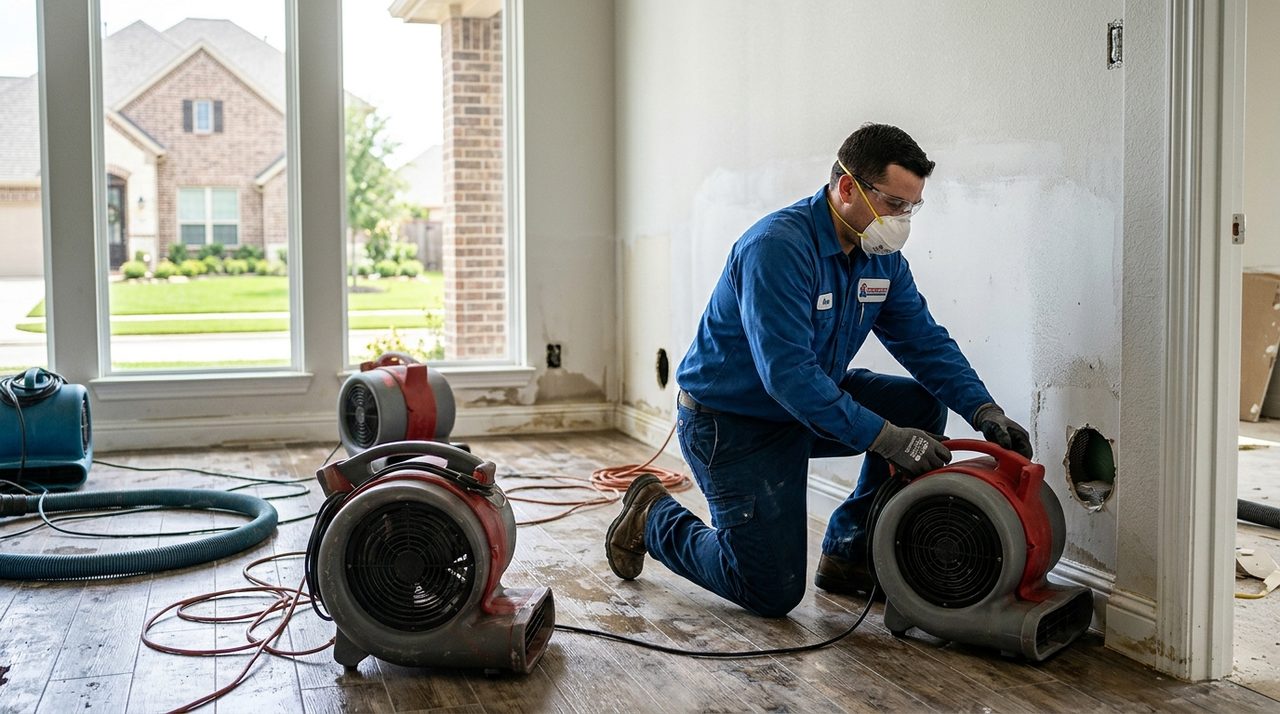
Qualified restoration contractors use a combination of penetrating moisture meters and thermal imaging cameras to map residual moisture at the slab-wall interface, not just at drywall surface height. Drying equipment (desiccant dehumidifiers and directed air movers) must be positioned to address the bottom 12–18 inches of wall assemblies where clay-fed wicking concentrates. Drying logs should document daily readings at multiple points until materials reach IICRC S500 target moisture levels before equipment removal is approved.
Sources: IICRC (water/mold restoration standards), Harris County Flood Control District
Why it matters to you
Many of Katy's original 1990s subdivisions still have flex duct systems installed when the homes were built—fiberglass-lined ducts running through unconditioned attic spaces where summer temperatures regularly exceed 130°F. When Harvey 2017 or Beryl 2024 inundated these homes, floodwater entered floor-level supply registers and saturated the duct insulation; Houston's average 74% relative humidity then created conditions for Cladosporium and Aspergillus growth inside the duct system within 48–72 hours. Homeowners who restored walls and flooring but did not address duct contamination report persistent musty odors and elevated indoor mold spore counts months after reconstruction.
What a good pro does
Restoration scopes for Katy homes with original flex duct should include a post-flood duct inspection using video or borescope equipment, not just a visual register check. Any duct segment confirmed to have been submerged or showing visible microbial growth should be replaced, not cleaned—flex duct insulation cannot be effectively remediated once saturated. HVAC duct replacement requires coordination with a TDLR-licensed HVAC contractor and, depending on jurisdiction (City of Katy or Harris County), a mechanical permit through the appropriate permit office.
Sources: IICRC (water/mold restoration standards), Texas Department of Licensing & Regulation, Municipal permit office (see area profile)
Why it matters to you
Katy's sprawl crosses city and county lines in ways that catch homeowners and contractors off guard: a home on one street may fall under the City of Katy's permit office, a neighbor two blocks away may be in unincorporated Harris County (Harris County Engineering Department), and a third property nearby may sit in an area annexed by the City of Houston that requires permits through the Houston Permitting Center. A flood restoration project that touches drywall demolition, plumbing line repairs, or electrical panels needs permits from whichever jurisdiction applies—and mis-routing that application means delays in the Certificate of Completion that insurance carriers require to close claims.
What a good pro does
Before pulling any permit, your contractor must confirm the property's exact jurisdiction using Harris County's online address lookup or HCAD records, not just zip code or mailing address. City of Katy permits are handled through the City of Katy Community Development Department; unincorporated Harris County areas go through Harris County Engineering; Houston-annexed parcels use the Houston Permitting Center. Plumbing repairs require a TSBPE-licensed plumber pulling a separate trade permit; electrical work exposed during demo requires a TDLR-licensed electrician doing the same. A restoration contractor who pulls only a demolition permit and leaves plumbing and electrical uninspected creates liability for the homeowner at resale.
Sources: Municipal permit office (see area profile), City of Houston Permitting Center, Texas State Board of Plumbing Examiners, Texas Department of Licensing & Regulation
Hiring water & flood restoration in Katy? Katy and West Houston encompass dozens of master-planned subdivisions, each with its own HOA or property owners' association enforcing architectural standards. The predominantly suburban housing stock demands regular maintenance of slab foundations, modern HVAC systems, and exterior compliance with deed restrictions. Contractors working here must navigate subdivision-specific approval processes and remain aware of moderate flood risk across much of the area.
Building era
Primarily 1990s through 2010s, with continued new construction in outer sections.
Typical style
Production-built traditional and transitional suburban homes typical of Houston-area master-planned communities.
Foundations
Predominantly slab-on-grade (not explicitly confirmed in research but consistent with area construction patterns).
Common systems
Central AC systems (typically 15-20 SEER rated in newer builds), copper or PEX plumbing, 200-amp electrical panels in post-2000 homes. Older 1990s sections may have original R-410A or R-22 refrigerant systems nearing end of life.
What that means for repairs
Kitchen and bathroom remodels are common in 1990s-era sections aging into their second ownership cycle. Exterior modifications—roofing, fencing, paint, pergolas, and pools—require prior ACC/HOA approval in virtually all subdivisions.
Permit jurisdiction
Mixed jurisdiction. Portions within the City of Katy require permits through the City of Katy; unincorporated Harris County areas use Harris County Engineering; portions annexed by the City of Houston use the Houston Permitting Center. Verify ETJ status by specific address.
HOA & deed restrictions
Mandatory HOAs/POAs are very common across Katy and West Houston subdivisions. Each subdivision maintains its own HOA with an Architectural Control Committee (ACC). Examples include Mission West (mandatory HOA) and West Memorial Civic Association (deed-restricted community managed by Goodwin & Company). No single area-wide HOA exists; specific HOA names must be verified by subdivision via county clerk records or TREC HOA Management Certificate database.
Historic districts
No City of Houston historic district designation confirmed. Katy subdivisions are suburban master-planned communities, not historic areas.
Contractor note
Contractors must verify which jurisdiction applies to each job site, as Katy straddles city and county lines. Nearly all subdivisions require HOA/ACC pre-approval for exterior work, and failure to obtain approval exposes homeowners and contractors to legal enforcement under Texas Property Code Chapter 204.
FEMA flood zone
FEMA Zone X500 (moderate flood risk) - source: fema_nfhl. Portions of Katy and West Houston are proximate to Buffalo Bayou tributaries and Barker Reservoir, which can influence localized flood conditions beyond what the zone designation suggests.
Hurricane Harvey impact
Research did not provide subdivision-specific Harvey impact data for Katy/West Houston. However, the Katy area is widely known to have experienced significant flooding during Hurricane Harvey (2017), particularly in neighborhoods near Barker Reservoir due to controlled releases. Homeowners should check individual property flood history through Harris County Flood Control District records and FEMA claims data.
Heat & humidity load
Extreme Houston-area summer heat (sustained 95°F+ with high humidity) places heavy demand on HVAC systems in these largely single-story and two-story homes. Attic insulation degradation, refrigerant loss, and condensate drain issues are common summer service calls. Slab foundations may experience seasonal movement due to expansive clay soils cycling between drought and saturation.
Working with contractors here
Contractors in Katy and West Houston most frequently handle HVAC maintenance and replacement, roof repairs, and fence/exterior renovation projects driven by aging 1990s-2000s housing stock. HOA-mandated architectural standards mean exterior jobs—from paint to roofing material selection—often require ACC pre-approval before work begins, so contractors should build approval timelines into project scoping. Post-Harvey, there remains steady demand for foundation inspection, moisture remediation, and drainage improvement work. The sprawling geography of the area means job sites can be 15-20 miles apart even within 'Katy,' so efficient scheduling is essential. Contractors should verify permit jurisdiction (City of Katy, City of Houston, or Harris County) for each address before pulling permits.
Local Tip
Always ask for a written estimate before work begins. Texas contractors are required to provide one on jobs over $1,000.
Katy and West Houston encompass dozens of master-planned subdivisions, each with its own HOA or property owners' association enforcing architectural standards. The predominantly suburban housing stock demands regular maintenance of slab foundations, modern HVAC systems, and exterior compliance with deed restrictions. Contractors working here must navigate subdivision-specific approval processes and remain aware of moderate flood risk across much of the area.
Source: U.S. Census Bureau, ACS 5-Year 2023
Katy carries FEMA Zone X500 (moderate flood risk): outside the 100-year floodplain but inside the 500-year, so heavy-rain events still reach homes and flood-aware work pays off.
Source: FEMA National Flood Hazard Layer (NFHL). Flood zones vary by parcel — verify your individual FIRM panel.
Harvey 2017 proved that moderate-risk zones in Houston metro are not immune to catastrophic inundation, so ask a licensed restoration firm to review your property's moisture history and identify entry points where floodwater could migrate into wall assemblies. Early documentation of dry conditions also strengthens insurance claims if a hurricane does strike Katy, TX. Confirm the current FEMA panel for your Katy parcel — the area maps to Zone X500, but adjacent lots can differ.
Severe thunderstorms drop two to four inches of rain in under an hour regularly across the Houston metro, and in Katy, TX that volume can back up through floor drains or HVAC condensate lines into finished spaces even without mapped floodplain exposure. Scheduling a post-storm moisture assessment with an IICRC WRT-certified technician after any significant squall prevents slow saturation from reaching the mold-growth threshold. Confirm the current FEMA panel for your Katy parcel — the area maps to Zone X500, but adjacent lots can differ.
Hard freezes cause polybutylene and CPVC supply lines in Katy, TX attics and exterior walls to split, releasing water that travels along ceiling joists and saturates insulation in rooms far from the break. A water-restoration technician using thermal cameras can locate all wet assemblies, not just the obviously damaged ones, and develop a targeted drying plan that prevents secondary losses. Confirm the current FEMA panel for your Katy parcel — the area maps to Zone X500, but adjacent lots can differ.
Sources: FEMA National Flood Hazard Layer (NFHL), Ready.gov -- Hurricanes, CenterPoint Energy -- Storm Center, City of Houston -- Emergency Preparedness, Ready.gov -- Winter Weather, Harris County Flood Control District
Houston-specific estimators to plan your project before you call a pro. All results are planning estimates — a licensed local pro confirms the details on site.
Disconnect & drain every outdoor hose bib
Remove hoses, drain the spigots, and cover each with an insulated faucet sock. Un-drained hose bibs are the #1 burst point in a Houston freeze.
Insulate exposed pipes in the attic & garage
Wrap any pipe in an unconditioned space (attic runs, garage walls) with foam sleeves. Houston homes rarely insulate these because they only matter a few nights a year — which is exactly why they burst.
Open cabinet doors & keep a pencil-width drip
On hard-freeze nights, open kitchen/bath cabinets so warm air reaches the pipes and let faucets on exterior walls drip to relieve pressure.
Protect the attic/garage water heater & its lines
An attic or garage tank sits in unconditioned space. Insulate the cold-inlet and hot-outlet lines and confirm the emergency drain pan is clear so a leak doesn't reach the ceiling.
This is a planning estimate only — actual requirements depend on an on-site assessment by a licensed Houston pro. If a pipe has already burst, shut off your main water supply and call a licensed Houston plumber immediately — freeze bursts flood fast.
Sources: Municipal permit office (see area profile)City of Houston Permitting Center
Sources: Local HOA / deed restrictions (see area profile)
Sources: IICRC (water/mold restoration standards)Texas Commission on Environmental Quality