Open Now
920 S Mason Rd Ste G, Katy, TX 77450
Cinco Ranch's 1990s–2000s production-built homes on Fort Bend County clay soil face a deceptively quiet water-damage risk: FEMA Zone X status means most properties sit outside the mapped floodplain, yet the area's heavy shrink-swell clay holds moisture against slab perimeters for weeks after any inundation event, and aging flex-duct HVAC systems in homes now 20–30 years old can turn a single pipe burst or slow roof leak into a mold problem within days. Add the community's mandatory dual-HOA architectural review process and Fort Bend County's independent permit office — neither of which pauses for a water emergency — and homeowners here face a tighter, more procedurally complex recovery window than they might expect.
Ranked by verified Google rating × review volume × verification tier. How we rank →
Some highly-rated pros serve Cinco Ranch from nearby and may not keep a Cinco Ranch street address. Those are listed under "Also serving Cinco Ranch" with their real city and distance, so you always know where each business is based.
920 S Mason Rd Ste G, Katy, TX 77450
20527 FM 1093 #206b, Richmond, TX 77407
2055 Bluffton Ln, Katy, TX 77450
21811 Katy Fwy Suite D104, Katy, TX 77450
20770 Westheimer Pkwy #506, Katy, TX 77450
1119 Comstock Springs Dr, Katy, TX 77450
19935 Katy Fwy, Houston, TX 77094
Highly-rated pros based nearby who cover Cinco Ranch. Distance shown from the Cinco Ranch area.
Serving Cinco Ranch Based in Katy · 2.1 mi away
Serving Cinco Ranch Based in Katy · 2.3 mi away
Serving Cinco Ranch Based in Katy · 2.5 mi away
Why it matters to you
Nearly every home in Cinco Ranch sits on a conventional slab-on-grade foundation over the same Fort Bend County Black clay that plagues the wider West Houston area. Unlike sandy soils that drain quickly, this clay retains water against the slab perimeter and beneath the foundation edge for weeks after a burst pipe, appliance leak, or hard-rain infiltration event — even when the home maps to FEMA Zone X and never sees bayou overflow. That prolonged soil saturation wicks moisture into bottom plates, drywall, and wall insulation from the ground up, a pattern that is easy to miss if a contractor only meters at visible wet areas.
What a good pro does
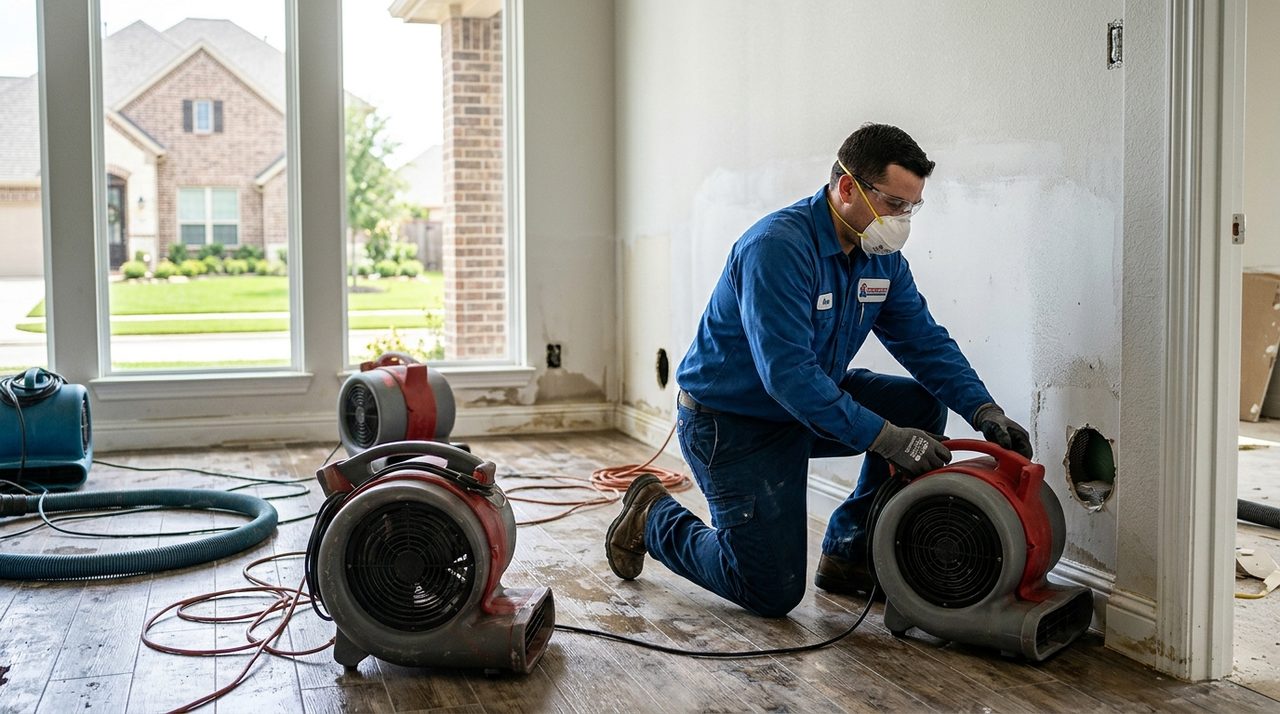
A qualified restoration contractor should use both thermal imaging cameras and calibrated moisture meters to map the full saturation envelope around the affected slab edge, not just the visibly damaged room. Structural drying timelines in Cinco Ranch routinely run longer than national IICRC S500 drying-standard estimates because of the clay-soil moisture reservoir; drying logs should be pulled daily and equipment repositioned as readings migrate. Any mold assessment or remediation work must be performed by a TDLR-licensed Mold Remediation Contractor (MRC) if microbial growth is found before reconstruction begins.
Sources: IICRC (water/mold restoration standards), Texas Department of Licensing & Regulation
Why it matters to you
Homes built in Cinco Ranch's original 1990s sections are now 25–30 years old, and many still contain their original flexible duct systems. When a water event — whether from a slab leak, a failed water heater, or a pinhole in attic supply plumbing — introduces moisture into an unconditioned attic space or runs beneath the slab, flex duct insulation acts as a sponge. Houston's average relative humidity above 70% and summer attic temperatures that regularly exceed 130°F create conditions where Aspergillus and Cladosporium colonies can establish within 48–72 hours of saturation, spreading spores through the entire supply-air system every time the air handler runs.
What a good pro does
During any restoration scope in a Cinco Ranch home with original or early-replacement flex ductwork, a thorough contractor will inspect duct insulation and interior liner surfaces for moisture and microbial growth before reinstating the HVAC system. In most cases where inundation lasted longer than 24 hours or where attic-routed ducts were exposed to saturation, full duct replacement is the correct call and should be included in the remediation scope presented to the insurer. HVAC duct replacement requires a mechanical permit pulled through Fort Bend County's development services office — not the City of Houston's permit portal.
Sources: IICRC (water/mold restoration standards), Texas Department of Licensing & Regulation, Municipal permit office (see area profile)
Why it matters to you
Cinco Ranch operates under a mandatory dual-HOA structure — Cinco Ranch HOA I east of Katy-Gaston Road and Cinco Ranch Residential Association II west of it, both under the master Cinco Residential Property Association — with Architectural Control Committee review legally required before most exterior work begins. This matters for water restoration because emergency demo that involves removing exterior wall cladding, stucco, or brick veneer to address wind-driven rain intrusion or wall-cavity moisture falls within ACC jurisdiction. A homeowner who authorizes a contractor to pull off exterior materials without prior ACC approval risks a mandatory removal-and-restore order at their own expense, regardless of the underlying damage.
What a good pro does
The practical approach is to work the ACC notification process in parallel with emergency interior drying, not sequentially. Most ACC boards in Cinco Ranch will issue expedited approvals for documented emergency conditions, but that request must be submitted in writing with contractor documentation and photos before exterior materials are removed. A restoration contractor familiar with Cinco Ranch should factor a 48–72 hour ACC fast-track window into the project schedule and structure the first work phase around interior drying and demo of non-exterior-visible materials while the HOA review is in process.
Sources: Local HOA / deed restrictions (see area profile), IICRC (water/mold restoration standards)
Why it matters to you
Cinco Ranch sits in unincorporated Fort Bend County, which means every structural demolition permit, plumbing repair permit, and electrical permit generated by a restoration project routes through Fort Bend County's engineering and development services office — not the City of Houston's permit portal that many large-volume Houston restoration firms use by default. Fee schedules, inspection cadences, and application forms differ, and a contractor who mis-routes paperwork to Houston's online system will not receive a valid permit, which in turn delays the Certificate of Completion that most homeowners need to close their insurance claim.
What a good pro does
Confirm at the outset that any restoration contractor you hire has an active record of pulling permits through Fort Bend County and not just Harris County or City of Houston jurisdictions. The restoration firm typically pulls the demolition permit directly; TSBPE-licensed plumbers and TDLR-licensed electricians must pull their own trade permits for any line repairs or panel work exposed during the project. MUD district rules may add another layer for certain infrastructure-adjacent items, so ask the contractor to confirm the full permit checklist before mobilization.
Sources: Municipal permit office (see area profile), Texas State Board of Plumbing Examiners, Texas Department of Licensing & Regulation
Hiring water & flood restoration in Cinco Ranch? Cinco Ranch is one of Houston's largest master-planned communities, featuring production-built suburban homes from the 1990s and 2000s now reaching the age where major system replacements become routine. Homeowners must navigate mandatory HOA architectural review alongside Fort Bend County permitting for exterior modifications, roofing, and additions. The predominantly slab-on-grade construction on Fort Bend County clay soils means foundation monitoring and drainage management are ongoing concerns.
Building era
Primarily 1990s–2000s, with continued build-out into the early 2010s.
Typical style
Conventional suburban traditional — brick and brick/stone two-story and single-story homes, with some Mediterranean/stucco accents.
Foundations
Likely predominantly slab-on-grade (consistent with 1990s–2000s Houston-area production building; not explicitly documented in sources reviewed).
Common systems
Central forced-air HVAC (typically 15–25 years old, many nearing or past replacement age), copper or CPVC supply plumbing, PVC drain lines, 200-amp electrical panels. Original HVAC units in 1990s-era sections are likely already replaced or due for replacement.
What that means for repairs
Kitchen and bathroom remodels are common as homes reach 20–30 years. HVAC replacements and roof replacements (composition shingle, 20-year cycle) are the most frequent major projects. All exterior modifications require HOA Architectural Control Committee approval before work begins.
Permit jurisdiction
Fort Bend County engineering and development services (unincorporated area — not City of Houston or any incorporated municipality). MUD districts may also apply for certain infrastructure items.
HOA & deed restrictions
Mandatory dual HOA system: Cinco Ranch HOA I (east of Katy-Gaston Road) and Cinco Ranch Residential Association II, Inc. (west of Katy-Gaston Road), under the Cinco Residential Property Association master association. Deed restrictions and architectural guidelines are legally enforceable. ACC approval required for most exterior changes.
Historic districts
No City of Houston historic district designation confirmed. Cinco Ranch is in unincorporated Fort Bend County and is not subject to HAHC oversight.
Contractor note
Contractors must obtain Fort Bend County permits for structural, electrical, plumbing, and mechanical work, and homeowners must separately secure HOA ACC approval before exterior work begins. Failing to obtain ACC pre-approval can result in required removal of completed work at the homeowner's expense.
FEMA flood zone
FEMA Zone X (low flood risk) — source: fema_nfhl. Cinco Ranch is largely outside FEMA special flood hazard areas. Some sections near Buffalo Bayou tributaries or detention basins may carry higher risk at the lot level; buyers should verify individual parcels with Fort Bend County floodplain data.
Hurricane Harvey impact
Cinco Ranch is characterized as mostly outside special flood hazard areas and is generally marketed as low flood risk. Broader Harvey-era media coverage referenced Katy-area and Barker Reservoir impacts, but sourced research did not identify specific Cinco Ranch streets or subsections with confirmed significant or recurring Harvey flooding. Lot-level flood history should be verified through Fort Bend County records and individual seller disclosures.
Heat & humidity load
Extreme summer heat drives heavy HVAC demand; aging 1990s-era systems in older sections are particularly vulnerable to compressor failure during sustained 95°F+ stretches. Slab foundations on expansive clay soils can shift during drought cycles, requiring foundation inspections and watering programs. Composition shingle roofs degrade faster under intense UV exposure, and 20-year replacements often come due at 15–18 years.
Working with contractors here
The most common contractor work in Cinco Ranch centers on aging-system replacements: HVAC changeouts, roof replacements, and water heater swaps for homes now 20–30 years old. Foundation repair and drainage improvement are steady demand drivers given the clay soil conditions and slab-on-grade construction. Kitchen and bathroom remodels are the leading interior renovation category as homeowners update original 1990s finishes. Contractors should factor HOA ACC review timelines into project schedules — exterior work proposals can take 2–4 weeks for approval, and non-compliant work may need to be undone. Permitting through Fort Bend County rather than the City of Houston means different inspection scheduling processes and fee structures than inner-loop Houston work.
Local Tip
Always ask for a written estimate before work begins. Texas contractors are required to provide one on jobs over $1,000.
Cinco Ranch is one of Houston's largest master-planned communities, featuring production-built suburban homes from the 1990s and 2000s now reaching the age where major system replacements become routine. Homeowners must navigate mandatory HOA architectural review alongside Fort Bend County permitting for exterior modifications, roofing, and additions. The predominantly slab-on-grade construction on Fort Bend County clay soils means foundation monitoring and drainage management are ongoing concerns.
Source: U.S. Census Bureau, ACS 5-Year 2023
Most of Cinco Ranch maps to FEMA Zone X (low mapped flood risk), but Houston's flash-flood reality means even low-risk blocks benefit from smart drainage and storm-hardened installs.
Source: FEMA National Flood Hazard Layer (NFHL). Flood zones vary by parcel — verify your individual FIRM panel.
Water-restoration companies serving Cinco Ranch, TX can install or recommend backflow prevention add-ons on floor drains and advise on contents-elevation strategies that limit category-2 water contact during a tropical event. The May 2024 derecho reminded Houston homeowners that extreme rain is not exclusive to named hurricanes, making year-round readiness essential. As a Fort Bend County community, Cinco Ranch may follow county rather than City of Houston storm rebuild rules.
Even in low-flood-mapped areas of Cinco Ranch, TX, intense thunderstorm rainfall can overwhelm gutter systems and force water through foundation weep holes or into slab expansion joints, creating sub-floor moisture that feeds mold undetected. An IICRC-certified water-restoration technician can use penetrating moisture meters to confirm whether a post-storm inspection is clear or whether targeted structural drying is needed. As a Fort Bend County community, Cinco Ranch may follow county rather than City of Houston storm rebuild rules.
Homes in lower-flood-risk areas of Cinco Ranch, TX are not immune to the interior water losses Uri 2021 caused — burst attic supply lines and failed icemaker connections caused extensive drywall and flooring damage regardless of floodplain designation. A water-restoration contractor can extract standing water, remove wet flooring, and place structural drying equipment within the window that prevents a straightforward dryout from escalating to mold remediation. Confirm the current FEMA panel for your Cinco Ranch parcel — the area maps to Zone X, but adjacent lots can differ.
Sources: FEMA National Flood Hazard Layer (NFHL), Ready.gov -- Hurricanes, CenterPoint Energy -- Storm Center, City of Houston -- Emergency Preparedness, Ready.gov -- Winter Weather, Harris County Flood Control District
Houston-specific estimators to plan your project before you call a pro. All results are planning estimates — a licensed local pro confirms the details on site.
Disconnect & drain every outdoor hose bib
Remove hoses, drain the spigots, and cover each with an insulated faucet sock. Un-drained hose bibs are the #1 burst point in a Houston freeze.
Insulate exposed pipes in the attic & garage
Wrap any pipe in an unconditioned space (attic runs, garage walls) with foam sleeves. Houston homes rarely insulate these because they only matter a few nights a year — which is exactly why they burst.
Open cabinet doors & keep a pencil-width drip
On hard-freeze nights, open kitchen/bath cabinets so warm air reaches the pipes and let faucets on exterior walls drip to relieve pressure.
Protect the attic/garage water heater & its lines
An attic or garage tank sits in unconditioned space. Insulate the cold-inlet and hot-outlet lines and confirm the emergency drain pan is clear so a leak doesn't reach the ceiling.
This is a planning estimate only — actual requirements depend on an on-site assessment by a licensed Houston pro. If a pipe has already burst, shut off your main water supply and call a licensed Houston plumber immediately — freeze bursts flood fast.
Sources: IICRC (water/mold restoration standards)FEMA National Flood Hazard Layer (NFHL)
Sources: Texas State Board of Plumbing ExaminersMunicipal permit office (see area profile)
Sources: Local HOA / deed restrictions (see area profile)
Sources: EPA Lead Renovation, Repair and Painting (RRP) Rule