Closed
Serving Fulshear Based in Katy · 5.6 mi away
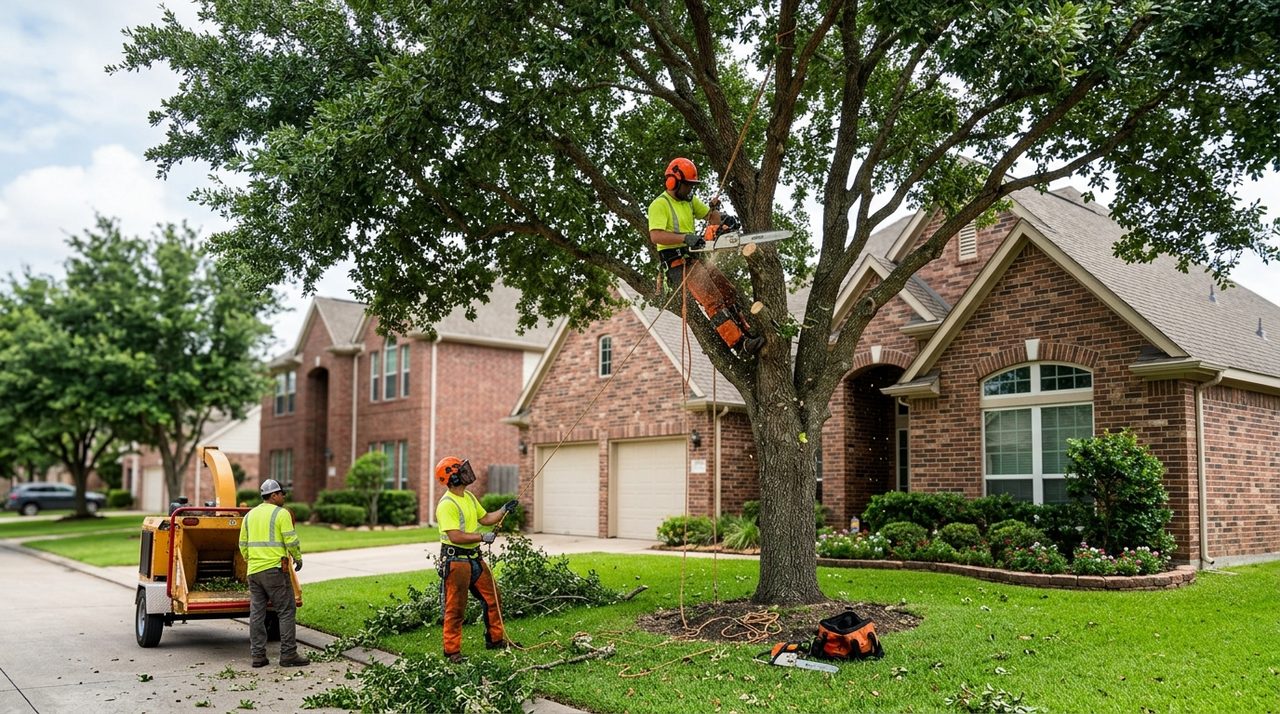
Fulshear's rapid transformation from rural Fort Bend County farmland into a sprawling collection of master-planned subdivisions has left many lots with a mix of newly planted neighborhood trees, legacy pecans and post oaks carried over from agricultural land, and aggressively sprouting Chinese tallow volunteers along the Brazos River corridor — all growing over slabs poured on expansive clay soil. Before a single cut is made, Fulshear homeowners must navigate both the City of Fulshear Building Department or Fort Bend County Engineering (depending on which side of the city-limits line their parcel falls) and, almost certainly, a formal HOA architectural review process. This page explains exactly what tree removal looks like on the ground in Fulshear so you can budget, plan, and avoid the fines and forced-replanting orders that catch unprepared owners by surprise.
Ranked by verified Google rating × review volume × verification tier. How we rank →
Some highly-rated pros serve Fulshear from nearby and may not keep a Fulshear street address. Those are listed under "Also serving Fulshear" with their real city and distance, so you always know where each business is based.
Highly-rated pros based nearby who cover Fulshear. Distance shown from the Fulshear area.
Serving Fulshear Based in Katy · 5.6 mi away
Serving Fulshear Based in Katy · 5.9 mi away
Why it matters to you
Nearly every production subdivision in Fulshear — Weston Lakes, Fulshear Lakes, Pecan Ridge, Polo Ranch, and others — operates under a mandatory HOA with formal architectural review authority over exterior modifications, and tree removal is almost universally listed as a modification requiring written approval. Removing a tree without that sign-off can result in fines and a requirement to replant at your expense, even if the tree was genuinely hazardous. Because most of Fulshear's housing stock was built between 2000 and the early 2020s, deed restrictions are actively enforced and not yet diluted by decades of lax oversight.
What a good pro does
Before contacting any tree-removal company, pull your subdivision's deed restrictions and submit a written request to the architectural review committee, including photos, the tree's approximate trunk diameter, and the reason for removal. A reputable Fulshear tree company will ask whether you have HOA approval before scheduling work — treat any company that skips that question as a red flag. Document the committee's written approval and keep it on file in case of a neighbor complaint after the job.
Sources: Local HOA / deed restrictions (see area profile), Municipal permit office (see area profile)
Why it matters to you
Fulshear's rapid annexation history means that homes just streets apart may fall under entirely different permitting authorities: properties inside Fulshear city limits go through the City of Fulshear Building Department, while parcels in the extraterritorial jurisdiction or unincorporated areas are handled by Fort Bend County Engineering. The City of Houston does not have any role here — this is Fort Bend County territory — and the rules, fees, and inspection timelines between the two jurisdictions are not identical. Acreage tracts along older rural roads in particular are frequently in the unincorporated zone, and owners of those properties sometimes assume city rules apply when they do not.
What a good pro does
Before scheduling work, confirm your exact permit jurisdiction by looking up your parcel on the Fort Bend County Appraisal District map and cross-referencing the city-limits boundary. A contractor experienced in Fulshear will know to ask this question upfront and will pull any required permit under the correct authority. Note that while routine tree removal on private residential property does not typically trigger a building permit in most Texas jurisdictions, work near utilities or involving large-scale land clearing on acreage lots may trigger different requirements under Fort Bend County rules.
Sources: Municipal permit office (see area profile), Local HOA / deed restrictions (see area profile)
Why it matters to you
The Brazos River runs along Fulshear's western edge, and the disturbed soil and drainage ditches throughout the subdivision buildout have created ideal habitat for Chinese tallow (Triadica sebifera), a Texas state-listed invasive species that can grow five or more feet per year. On Fulshear's expansive Fort Bend County clay soils, tallow root systems spread aggressively, and improperly removed stumps resprout within weeks — especially along rear drainage easements and fence lines bordering undeveloped tracts. Because tallow wood is considered invasive debris, some regional mulching and recycling facilities refuse the material, complicating disposal.
What a good pro does
Insist that any tallow removal include stump grinding to below grade — estimate $150 to $400 per stump — plus herbicide treatment of the ground stump by an applicator licensed under TCEQ requirements if you want to prevent resprouting. Ask the company explicitly how they dispose of tallow debris, since not all Houston-area facilities accept it; a contractor who has not thought through disposal is likely to leave you with a chip pile you cannot easily move. Monitor the removal site for the first two growing seasons, as even partial root systems can push new shoots.
Sources: Texas Commission on Environmental Quality, Local HOA / deed restrictions (see area profile)
Why it matters to you
Although Fulshear maps primarily to FEMA Zone X and carries a low mapped flood risk, it sits squarely in the path of Gulf-origin storms, and Hurricane Beryl in July 2024 brought damaging winds across Fort Bend County within weeks of the May 2024 derecho's destruction. Both events created a regional demand spike for tree-removal crews across the entire west Houston and Fort Bend area, and pricing for tree work routinely ran 40 to 80 percent above normal rates in the weeks following each storm. Fulshear's newer tree canopy — many subdivision trees are under 15 years old — suffered significant structural failures because younger trees have not yet developed the wind-resilient crown architecture of mature stock.
What a good pro does
If you are scheduling tree removal in the wake of any named storm or declared disaster, get a minimum of three written quotes from companies with verifiable Fort Bend County references and current liability insurance you can confirm independently. Budget at the high end of any range: a mid-size water oak or cedar elm that might run $750 to $1,800 under normal conditions may be quoted at $1,500 to $2,800 in the weeks after a major storm. Avoid out-of-state crews who appear soliciting door-to-door and cannot provide a local business address or ISA Certified Arborist credential.
Sources: FEMA National Flood Hazard Layer (NFHL), Municipal permit office (see area profile)
Hiring tree removal in Fulshear? Fulshear is one of the fastest-growing communities in the Houston metro, dominated by post-2000 master-planned subdivisions with mandatory HOAs and rigorous deed restrictions. Homeowners here typically deal with newer construction systems but face strict architectural review for any exterior modifications. The mix of production homes and rural acreage tracts means service needs range from standard warranty-era maintenance to custom work on larger estate properties.
Building era
2000s–2020s (bulk of inventory); limited older housing in original town of Fulshear.
Typical style
Contemporary suburban production homes — brick and stone façades, 1- and 2-story detached single-family, mix of traditional, Texas Hill Country-inspired, and transitional elevations.
Foundations
Slab-on-grade (standard for post-2000 Fort Bend County production homes; older farmhouses or custom acreage homes may use pier-and-beam but are a small minority).
Common systems
Modern high-efficiency HVAC systems (14+ SEER), PEX or copper plumbing, 200-amp electrical panels, tankless or high-efficiency water heaters common in newer builds.
What that means for repairs
Most homes are under 20 years old, so major renovation is limited. Common projects include patio covers, outdoor kitchens, pool installations, and garage conversions — all typically requiring HOA architectural review and approval before work begins.
Permit jurisdiction
City of Fulshear Building Department for properties within city limits; Fort Bend County Engineering for unincorporated ETJ areas. Jurisdiction depends on exact property location.
HOA & deed restrictions
Most master-planned subdivisions (Weston Lakes, Fulshear Lakes, Pecan Ridge, Polo Ranch, and others) have mandatory HOAs with formal architectural review, deed restriction enforcement, and annual assessments (e.g., Fulshear Lakes charges ~$1,850/year including front yard maintenance). Non-HOA parcels exist on acreage tracts and older rural roads but are the minority of housing units.
Historic districts
No historic district designation confirmed. Fulshear is a rapidly growing area with almost entirely modern construction.
Contractor note
Contractors must verify whether a property falls within Fulshear city limits or unincorporated Fort Bend County, as permitting requirements and inspection processes differ. Nearly all subdivision work also requires prior HOA architectural committee approval before permits are pulled.
FEMA flood zone
FEMA Zone X (low flood risk) per official NFHL data. However, the broader Fulshear area sits between bayous and the Brazos River, so flood risk is highly location-specific — some parcels closer to waterways may carry different designations. Always verify FEMA FIRM panels for specific addresses.
Hurricane Harvey impact
No area-wide documentation confirms broad Harvey flooding across Fulshear subdivisions. Regional Harvey impact reports focus on Brazos River flooding near Simonton and Richmond rather than Fulshear master-planned communities. Marketing materials for major Fulshear subdivisions do not disclose Harvey flooding. However, no authoritative source definitively confirms zero impact for all Fulshear properties — for a specific address, check FEMA claims data and Fort Bend County floodplain records.
Heat & humidity load
New slab-on-grade construction on expansive Fort Bend County clay soils is subject to significant seasonal soil movement. Extended summer heat and drought cause soil shrinkage that can stress slab foundations and exterior hardscape. Proper irrigation of foundation perimeters is critical. High-efficiency HVAC systems in these larger homes (many 2,500–4,000+ sq ft) face heavy summer loads and benefit from annual pre-season maintenance.
Working with contractors here
Contractors in Fulshear primarily handle new-home warranty work, HVAC maintenance on modern high-efficiency systems, and outdoor living additions such as pools, covered patios, and outdoor kitchens. Because most homes are under 20 years old, major system replacements are uncommon, but foundation monitoring and minor slab repair due to expansive clay soils is a recurring need. HOA architectural review is a significant factor — contractors should advise homeowners to secure written HOA approval before scheduling exterior work, as non-compliant modifications can result in forced removal. The mix of production subdivisions and rural acreage means job scoping varies widely: subdivision work follows tight lot-line and setback constraints, while acreage properties may involve well/septic systems and longer material delivery logistics.
Local Tip
Always ask for a written estimate before work begins. Texas contractors are required to provide one on jobs over $1,000.
Fulshear is one of the fastest-growing communities in the Houston metro, dominated by post-2000 master-planned subdivisions with mandatory HOAs and rigorous deed restrictions. Homeowners here typically deal with newer construction systems but face strict architectural review for any exterior modifications. The mix of production homes and rural acreage tracts means service needs range from standard warranty-era maintenance to custom work on larger estate properties.
Source: U.S. Census Bureau, ACS 5-Year 2023
Most of Fulshear maps to FEMA Zone X (low mapped flood risk), but Houston's flash-flood reality means even low-risk blocks benefit from smart drainage and storm-hardened installs; risk climbs sharply on blocks nearest the Brazos River, where it varies parcel to parcel.
Source: FEMA National Flood Hazard Layer (NFHL). Flood zones vary by parcel — verify your individual FIRM panel.
Wind is the primary tree hazard in lower-risk Fulshear, TX neighborhoods during a Gulf hurricane, so focus pre-storm efforts on removing dead or structurally weak trees that could reach your roof line or power drop. A TDLR-licensed contractor can perform a hazard assessment and complete removal well before a storm's 72-hour watch window, when crews become unavailable across the Houston metro. As a Fort Bend County community, Fulshear may follow county rather than City of Houston storm rebuild rules.
After any severe thunderstorm drops large limbs in your yard in Fulshear, TX, have a licensed contractor assess the parent tree for hidden decay before assuming the remaining structure is sound. Snap failures during the May 2024 derecho frequently involved trees that had experienced prior lightning strikes or previous partial limb loss that had gone uninspected. As a Fort Bend County community, Fulshear may follow county rather than City of Houston storm rebuild rules.
The most actionable winter prep for tree removal in Fulshear, TX is removing any tree or large limb that hangs directly over a roofline, vehicle parking area, or power service drop before the first freeze advisory. Ice adds weight faster than most homeowners expect, and Houston trees that have never experienced sustained ice loading have no adaptive resilience to that stress. Because Fulshear drains toward the Brazos River, block-level runoff can differ sharply from the mapped zone.
Sources: FEMA National Flood Hazard Layer (NFHL), Ready.gov -- Hurricanes, CenterPoint Energy -- Storm Center, City of Houston -- Emergency Preparedness, Ready.gov -- Winter Weather, Harris County Flood Control District
Houston-specific estimators to plan your project before you call a pro. All results are planning estimates — a licensed local pro confirms the details on site.
Grouped by mature root aggression & water demand.
Trunk center to the nearest exterior wall.
The root zone likely reaches your foundation's soil during Houston's dry summers, when clay shrinks most. Watch for sticking doors and diagonal cracks, keep soil moisture even with a soaker hose during drought, and have a foundation pro evaluate if you see any movement.
Find a Houston foundation pro →This is a planning estimate only — actual requirements depend on an on-site assessment by a licensed Houston pro. Guidance is based on general species root behavior in expansive clay, not a soil test.
Disconnect & drain every outdoor hose bib
Remove hoses, drain the spigots, and cover each with an insulated faucet sock. Un-drained hose bibs are the #1 burst point in a Houston freeze.
Insulate exposed pipes in the attic & garage
Wrap any pipe in an unconditioned space (attic runs, garage walls) with foam sleeves. Houston homes rarely insulate these because they only matter a few nights a year — which is exactly why they burst.
Open cabinet doors & keep a pencil-width drip
On hard-freeze nights, open kitchen/bath cabinets so warm air reaches the pipes and let faucets on exterior walls drip to relieve pressure.
Protect the attic/garage water heater & its lines
An attic or garage tank sits in unconditioned space. Insulate the cold-inlet and hot-outlet lines and confirm the emergency drain pan is clear so a leak doesn't reach the ceiling.
This is a planning estimate only — actual requirements depend on an on-site assessment by a licensed Houston pro. If a pipe has already burst, shut off your main water supply and call a licensed Houston plumber immediately — freeze bursts flood fast.
Sources: Municipal permit office (see area profile)
Sources: Local HOA / deed restrictions (see area profile)
Sources: Municipal permit office (see area profile)