Open Now
2855 Katy Hockley Cut Off Rd, Katy, TX 77493
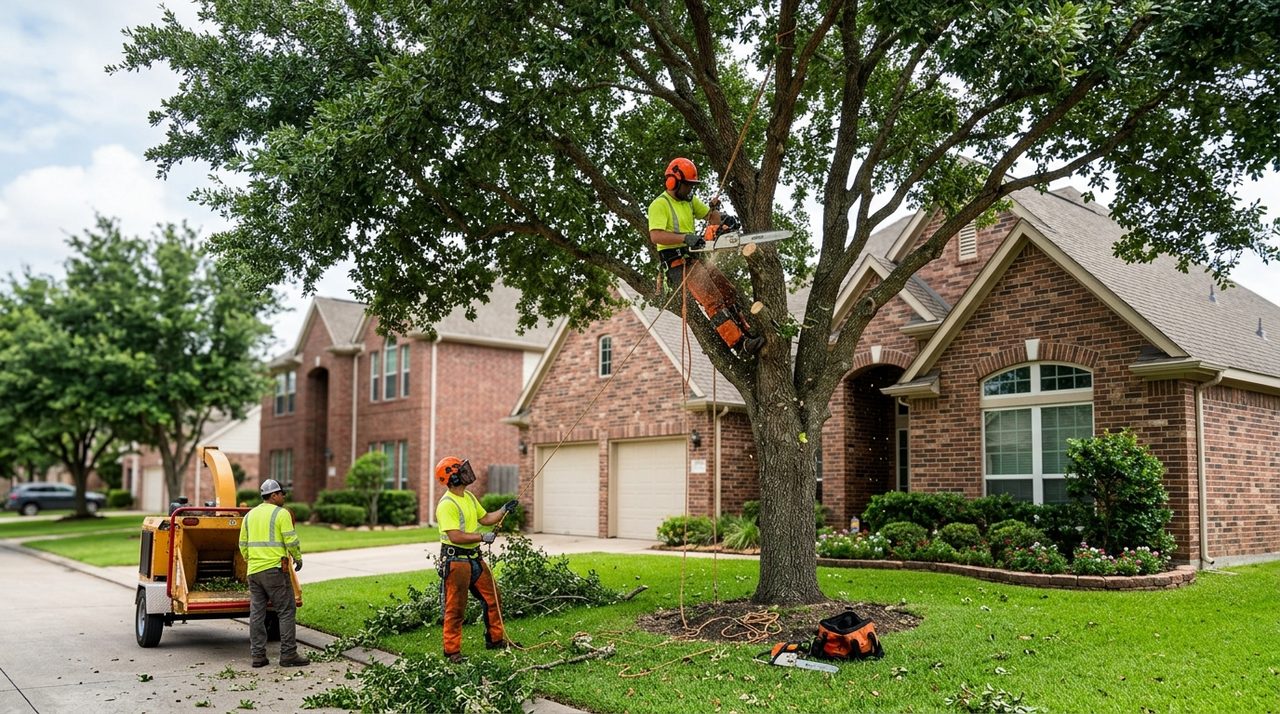
Katy's master-planned subdivisions — built mostly between the mid-1990s and 2010s on Houston's expansive Beaumont Black clay — are now old enough that original builder-era trees have grown into genuine liabilities: root systems pushing against slab edges, canopies overhanging houses, and HOA architectural committees waiting in line between you and the chainsaw. Add the fact that Katy straddles three separate permit jurisdictions (City of Katy, unincorporated Harris County, and City of Houston ETJ) and that virtually every subdivision runs its own ACC approval process, and tree removal here is more procedurally layered than almost anywhere else in the metro.
Ranked by verified Google rating × review volume × verification tier. How we rank →
2855 Katy Hockley Cut Off Rd, Katy, TX 77493
3550 Schlipf Rd, Katy, TX 77493
25919 Hunter Ln, Katy, TX 77494
5139 E 5th St, Katy, TX 77493
20350 Morton Rd, Katy, TX 77449
19234 Montclair Meadow Ln, Katy, TX 77449
4907 Katy Hockley Rd, Katy, TX 77493
1617 Avenue B, Katy, TX 77493
440 Cobia Dr, Katy, TX 77494
24118 Nomini Hall Ln, Katy, TX 77493
Why it matters to you
Because Katy's subdivisions — from Mission West to the communities managed by Goodwin & Company — each maintain their own Architectural Control Committee, tree removal is treated the same as a fence replacement or exterior repaint: exterior work requiring prior written approval. Skip that step on a tree over the typical 6–8 inch DBH threshold and you risk fines and a forced replanting order under Texas Property Code Chapter 204, which gives HOAs real enforcement teeth.
What a good pro does
Before scheduling any crew, pull your subdivision's deed restrictions from the Harris County Clerk's records or the TREC HOA Management Certificate database to confirm the exact caliper threshold and submission requirements. A reputable Katy-area tree company will ask for your ACC approval letter before booking the job — that's a green flag. Budget two to four weeks for ACC review cycles when scheduling non-emergency removals.
Sources: Local HOA / deed restrictions (see area profile)
Why it matters to you
Katy's sprawl means a house on one street may fall under the City of Katy's permit office, while a neighbor two blocks away is in unincorporated Harris County Engineering jurisdiction, and another is in a Houston ETJ pocket — each with different rules and procedures. While routine private-property tree removal inside the City of Houston does not require a homeowner permit, the City of Katy and Harris County each have their own requirements that must be verified address by address, and getting this wrong can stall a job mid-project.
What a good pro does
Confirm your site's jurisdiction before any work begins — the easiest method is to run the address through Harris County's online appraisal district records and then call the applicable office directly. A contractor who pulls the correct permits (or confirms none are required) for your specific address is protecting you, not adding paperwork. Never assume Katy-wide rules apply uniformly.
Sources: Municipal permit office (see area profile), City of Houston Permitting Center
Why it matters to you
Katy's 1990s-vintage slab-on-grade homes sit on the same expansive Beaumont Black clay found across West Houston, and the water oaks and live oaks planted by original builders in the mid-1990s are now 25–35 years old with root systems wide enough to exploit every moisture-driven shrink-and-swell cycle the clay goes through. Roots within 20 feet of a slab edge can undermine the zone where the clay stabilizes, and that risk compounds if the tree is on the southwest or west side of the home where summer heat dries the soil fastest.
What a good pro does
A qualified ISA Certified Arborist — the relevant voluntary credential since Texas TDLR does not license this trade — should assess root proximity and direction before recommending full removal versus root barrier installation. If removal is the call, stump grinding to at least 12 inches below grade (quoted separately at roughly $150–$400 per stump as an estimate) is essential on clay soils to eliminate the void left as wood decays and soil settles unevenly under the slab.
Sources: Harris County Flood Control District
Why it matters to you
Hurricane Beryl in 2024 and the May 2024 derecho both tracked through West Houston corridors close to Katy, and when regional demand spikes after a named event, out-of-state fly-by-night crews flood the area offering fast cuts at prices that look competitive but frequently come without adequate liability insurance — leaving homeowners exposed if a worker is injured on their property or a falling limb damages a neighbor's fence.
What a good pro does
Get proof of general liability and workers' compensation insurance before any crew sets foot in your yard — a certificate of insurance naming you as additionally insured is the standard request. Post-storm pricing in the Houston metro routinely runs 40–80% above normal rates as an estimate, so if a quote seems unusually low in the weeks after a storm event, that's a warning sign rather than a bargain. Scheduling non-urgent removals during calm periods between storm seasons will consistently save money.
Sources: FEMA National Flood Hazard Layer (NFHL), Local HOA / deed restrictions (see area profile)
Hiring tree removal in Katy? Katy and West Houston encompass dozens of master-planned subdivisions, each with its own HOA or property owners' association enforcing architectural standards. The predominantly suburban housing stock demands regular maintenance of slab foundations, modern HVAC systems, and exterior compliance with deed restrictions. Contractors working here must navigate subdivision-specific approval processes and remain aware of moderate flood risk across much of the area.
Building era
Primarily 1990s through 2010s, with continued new construction in outer sections.
Typical style
Production-built traditional and transitional suburban homes typical of Houston-area master-planned communities.
Foundations
Predominantly slab-on-grade (not explicitly confirmed in research but consistent with area construction patterns).
Common systems
Central AC systems (typically 15-20 SEER rated in newer builds), copper or PEX plumbing, 200-amp electrical panels in post-2000 homes. Older 1990s sections may have original R-410A or R-22 refrigerant systems nearing end of life.
What that means for repairs
Kitchen and bathroom remodels are common in 1990s-era sections aging into their second ownership cycle. Exterior modifications—roofing, fencing, paint, pergolas, and pools—require prior ACC/HOA approval in virtually all subdivisions.
Permit jurisdiction
Mixed jurisdiction. Portions within the City of Katy require permits through the City of Katy; unincorporated Harris County areas use Harris County Engineering; portions annexed by the City of Houston use the Houston Permitting Center. Verify ETJ status by specific address.
HOA & deed restrictions
Mandatory HOAs/POAs are very common across Katy and West Houston subdivisions. Each subdivision maintains its own HOA with an Architectural Control Committee (ACC). Examples include Mission West (mandatory HOA) and West Memorial Civic Association (deed-restricted community managed by Goodwin & Company). No single area-wide HOA exists; specific HOA names must be verified by subdivision via county clerk records or TREC HOA Management Certificate database.
Historic districts
No City of Houston historic district designation confirmed. Katy subdivisions are suburban master-planned communities, not historic areas.
Contractor note
Contractors must verify which jurisdiction applies to each job site, as Katy straddles city and county lines. Nearly all subdivisions require HOA/ACC pre-approval for exterior work, and failure to obtain approval exposes homeowners and contractors to legal enforcement under Texas Property Code Chapter 204.
FEMA flood zone
FEMA Zone X500 (moderate flood risk) - source: fema_nfhl. Portions of Katy and West Houston are proximate to Buffalo Bayou tributaries and Barker Reservoir, which can influence localized flood conditions beyond what the zone designation suggests.
Hurricane Harvey impact
Research did not provide subdivision-specific Harvey impact data for Katy/West Houston. However, the Katy area is widely known to have experienced significant flooding during Hurricane Harvey (2017), particularly in neighborhoods near Barker Reservoir due to controlled releases. Homeowners should check individual property flood history through Harris County Flood Control District records and FEMA claims data.
Heat & humidity load
Extreme Houston-area summer heat (sustained 95°F+ with high humidity) places heavy demand on HVAC systems in these largely single-story and two-story homes. Attic insulation degradation, refrigerant loss, and condensate drain issues are common summer service calls. Slab foundations may experience seasonal movement due to expansive clay soils cycling between drought and saturation.
Working with contractors here
Contractors in Katy and West Houston most frequently handle HVAC maintenance and replacement, roof repairs, and fence/exterior renovation projects driven by aging 1990s-2000s housing stock. HOA-mandated architectural standards mean exterior jobs—from paint to roofing material selection—often require ACC pre-approval before work begins, so contractors should build approval timelines into project scoping. Post-Harvey, there remains steady demand for foundation inspection, moisture remediation, and drainage improvement work. The sprawling geography of the area means job sites can be 15-20 miles apart even within 'Katy,' so efficient scheduling is essential. Contractors should verify permit jurisdiction (City of Katy, City of Houston, or Harris County) for each address before pulling permits.
Local Tip
Always ask for a written estimate before work begins. Texas contractors are required to provide one on jobs over $1,000.
Katy and West Houston encompass dozens of master-planned subdivisions, each with its own HOA or property owners' association enforcing architectural standards. The predominantly suburban housing stock demands regular maintenance of slab foundations, modern HVAC systems, and exterior compliance with deed restrictions. Contractors working here must navigate subdivision-specific approval processes and remain aware of moderate flood risk across much of the area.
Source: U.S. Census Bureau, ACS 5-Year 2023
Katy carries FEMA Zone X500 (moderate flood risk): outside the 100-year floodplain but inside the 500-year, so heavy-rain events still reach homes and flood-aware work pays off.
Source: FEMA National Flood Hazard Layer (NFHL). Flood zones vary by parcel — verify your individual FIRM panel.
Proactively pruning or removing trees within striking distance of your home in Katy, TX is one of the highest-return storm-prep steps you can take before a Gulf hurricane approaches. Harvey 2017 proved that even moderate-zone lots accumulate enough surface water during multi-day rain events to destabilize root systems, making pre-storm tree work critical rather than optional. Confirm the current FEMA panel for your Katy parcel — the area maps to Zone X500, but adjacent lots can differ.
Large hardwoods with included bark unions or significant deadwood are the trees most likely to fail in a severe thunderstorm, and having them professionally removed in Katy, TX before peak storm season is far less disruptive than emergency extraction after a failure. The May 2024 derecho illustrated how fast moderate-zone neighborhoods can transition from routine evening storm to widespread tree-on-structure damage. Confirm the current FEMA panel for your Katy parcel — the area maps to Zone X500, but adjacent lots can differ.
After Winter Storm Uri 2021, many Katy, TX homeowners discovered that the Bradford pears, water oaks, and loblolly pines most damaged by ice were exactly the trees a licensed contractor would have flagged as removal candidates before the storm. Scheduling a pre-winter hazard assessment every fall is particularly valuable in moderate-zone areas where the combination of heavy fall rains and an early freeze can stress both roots and canopy simultaneously. Confirm the current FEMA panel for your Katy parcel — the area maps to Zone X500, but adjacent lots can differ.
Sources: FEMA National Flood Hazard Layer (NFHL), Ready.gov -- Hurricanes, CenterPoint Energy -- Storm Center, City of Houston -- Emergency Preparedness, Ready.gov -- Winter Weather, Harris County Flood Control District
Houston-specific estimators to plan your project before you call a pro. All results are planning estimates — a licensed local pro confirms the details on site.
Grouped by mature root aggression & water demand.
Trunk center to the nearest exterior wall.
The root zone likely reaches your foundation's soil during Houston's dry summers, when clay shrinks most. Watch for sticking doors and diagonal cracks, keep soil moisture even with a soaker hose during drought, and have a foundation pro evaluate if you see any movement.
Find a Houston foundation pro →This is a planning estimate only — actual requirements depend on an on-site assessment by a licensed Houston pro. Guidance is based on general species root behavior in expansive clay, not a soil test.
Disconnect & drain every outdoor hose bib
Remove hoses, drain the spigots, and cover each with an insulated faucet sock. Un-drained hose bibs are the #1 burst point in a Houston freeze.
Insulate exposed pipes in the attic & garage
Wrap any pipe in an unconditioned space (attic runs, garage walls) with foam sleeves. Houston homes rarely insulate these because they only matter a few nights a year — which is exactly why they burst.
Open cabinet doors & keep a pencil-width drip
On hard-freeze nights, open kitchen/bath cabinets so warm air reaches the pipes and let faucets on exterior walls drip to relieve pressure.
Protect the attic/garage water heater & its lines
An attic or garage tank sits in unconditioned space. Insulate the cold-inlet and hot-outlet lines and confirm the emergency drain pan is clear so a leak doesn't reach the ceiling.
This is a planning estimate only — actual requirements depend on an on-site assessment by a licensed Houston pro. If a pipe has already burst, shut off your main water supply and call a licensed Houston plumber immediately — freeze bursts flood fast.
Sources: Municipal permit office (see area profile)Local HOA / deed restrictions (see area profile)
Sources: Local HOA / deed restrictions (see area profile)
Sources: FEMA National Flood Hazard Layer (NFHL)Harris County Flood Control District