Closed
Serving Memorial Based in Tanglewood · 0.8 mi away
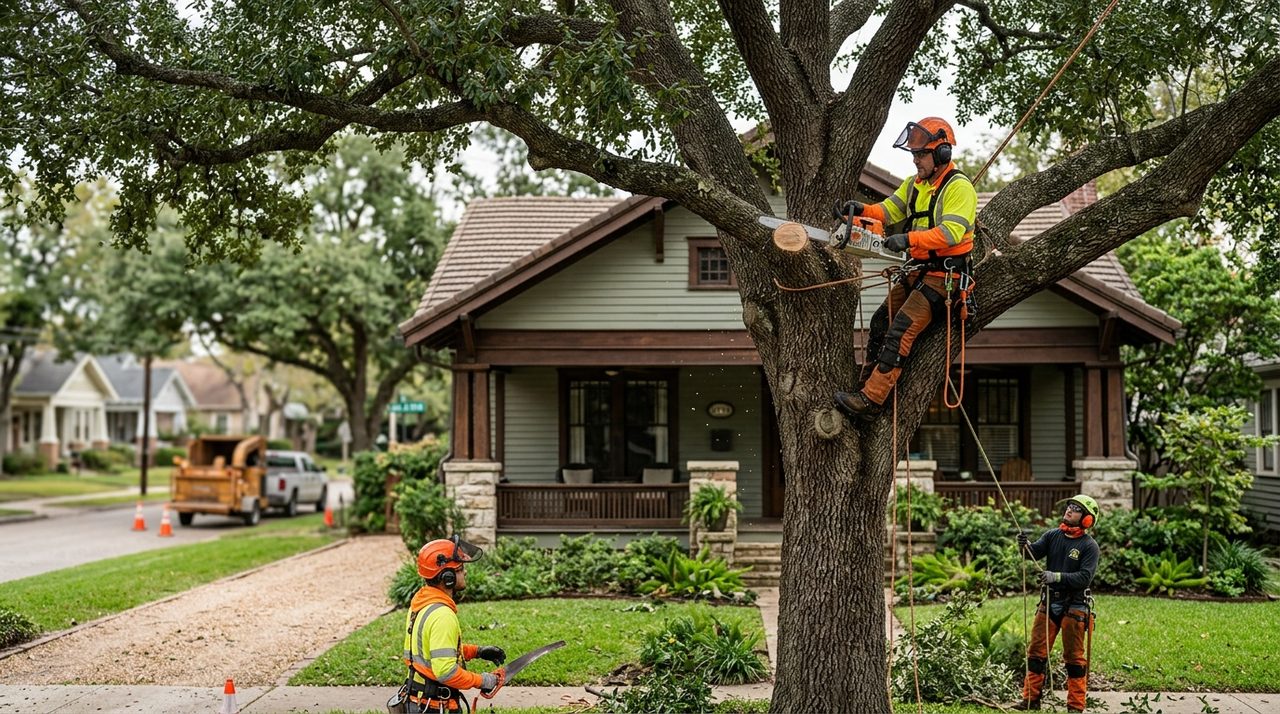
Memorial's corridor of mature live oaks, water oaks, and Chinese tallow trees — many planted during the original 1950s–1970s ranch-home era and now towering over newer custom rebuilds — creates a nuanced tree-removal landscape where root systems, subdivision deed restrictions, and post-storm demand all collide. The City of Houston does not require a permit for private-property tree removal, but Memorial's block-by-block patchwork of deed restrictions and Architectural Control Committees means the rules governing whether you can even cut a tree vary by which subdivision your lot falls in. Understanding those layers before calling a crew is the difference between a smooth project and a costly violation.
Ranked by verified Google rating × review volume × verification tier. How we rank →
Some highly-rated pros serve Memorial from nearby and may not keep a Memorial street address. Those are listed under "Also serving Memorial" with their real city and distance, so you always know where each business is based.
Highly-rated pros based nearby who cover Memorial. Distance shown from the Memorial area.
Serving Memorial Based in Tanglewood · 0.8 mi away
Serving Memorial Based in Galleria · 1.1 mi away
Serving Memorial Based in Galleria · 2 mi away
Serving Memorial Based in Bellaire · 3 mi away
Serving Memorial Based in West University · 3.5 mi away
Serving Memorial Based in Lazybrook / Timbergrove · 3.5 mi away
Serving Memorial Based in Lazybrook / Timbergrove · 4.1 mi away
Serving Memorial Based in River Oaks · 4.1 mi away
Serving Memorial Based in Lazybrook / Timbergrove · 4.1 mi away
Serving Memorial Based in Brookhollow · 4.2 mi away
Why it matters to you
Memorial's original 1950s–1970s ranch homes sit on slab-on-grade foundations surrounded by live oaks and water oaks that have had 50 to 70 years to spread their surface-feeding root systems — often within feet of slab edges. Houston's expansive Beaumont Black clay soil shrinks and swells with every wet-dry cycle, and large roots exploit that movement, heaving slab corners and cracking the driveways and walkways common on these older properties. Homes that haven't been torn down are increasingly showing the cumulative stress of mature canopy planted too close to original construction.
What a good pro does
A qualified arborist — ideally one holding ISA Certified Arborist credentials — should assess root proximity before any removal decision is made, since in some cases strategic root pruning extends the tree's life without the full removal cost. When full removal is warranted, the crew should grind the stump deep (8–12 inches minimum) and excavate lateral roots near the foundation rather than leaving them to continue pushing as they decay. Texas does not license tree removal contractors through TDLR, so ISA certification and verified liability insurance are the primary ways to vet a crew working this close to a $807,000-median-value home.
Sources: City of Houston Permitting Center, Local HOA / deed restrictions (see area profile)
Why it matters to you
Unlike a master-planned community with one governing HOA, Memorial inside the Loop is a corridor of multiple distinct subdivisions — each with its own deed restrictions, some with mandatory HOAs and Architectural Control Committees, others with voluntary civic clubs, and a few with no active enforcement at all. A homeowner on one block may need ACC approval before removing any tree over 6 inches DBH; their neighbor three streets over may face no such requirement. There is no area-wide rule to rely on, and removing a tree without required approval can trigger fines and forced replanting demands from whichever association governs that specific lot.
What a good pro does
Before scheduling any removal, pull your specific subdivision's deed restrictions through the Harris County Clerk's recorded documents — do not assume your neighbor's experience applies to your lot. Reputable Memorial-area tree companies working in this corridor routinely ask for the subdivision name and check restriction records before quoting, because an unapproved removal can expose both the homeowner and the contractor to liability. The City of Houston itself imposes no private-property tree permit requirement, so the only binding rules here are deed restrictions and any HOA covenants on your particular parcel.
Sources: City of Houston Permitting Center, Local HOA / deed restrictions (see area profile)
Why it matters to you
The May 2024 derecho's straight-line winds tracked directly through the Memorial and Energy Corridor area, snapping mature oaks and toppling pines across some of Houston's highest-canopy neighborhoods. Hurricane Beryl followed in July 2024, compounding the backlog. In the weeks after both events, legitimate local arborists were booked weeks out, and out-of-state crews with no local track record — and sometimes inadequate insurance — canvassed Memorial streets taking cash deposits for removal work they couldn't reliably schedule. On a block where new custom homes regularly sell above $1 million, an uninsured crew dropping a limb onto a neighbor's roof or a parked car creates a financial exposure that falls on the homeowner if the contractor isn't properly covered.
What a good pro does
Verify current general liability insurance (minimum $1 million per occurrence is reasonable for large-tree work) and workers' compensation coverage before signing anything — ask for certificates naming you as an additional insured and call the issuing insurer to confirm the policy is active, not lapsed. Emergency removals of storm-damaged trees in Memorial are private-pay projects; most of the area maps to FEMA Zone X, meaning FEMA Public Assistance debris programs are not typically triggered for individual private lots. Budget at the high end of cost ranges — large live oaks in tight Memorial lots commonly run $2,000–$5,000+ even in normal markets, and post-storm pricing frequently adds 40–80% on top of that.
Sources: FEMA National Flood Hazard Layer (NFHL), City of Houston Permitting Center
Why it matters to you
Buffalo Bayou's banks and the drainage easements threading through the Memorial corridor are prime habitat for Chinese tallow (Triadica sebifera), a Texas-listed invasive that grows 5 or more feet per year and reseeds prolifically onto adjacent private lots — particularly onto the disturbed soil common in Memorial's active teardown-and-rebuild construction zones. Tallows that volunteers near newer custom homes quickly develop aggressive root systems that crack driveways and infiltrate drainage infrastructure, and homeowners routinely underestimate how rapidly a stump that wasn't ground deeply will resprout into a multi-stem thicket.
What a good pro does
Chinese tallow removal requires deep stump grinding — at least 8 to 10 inches below grade — combined with a targeted cut-stump herbicide application immediately after cutting to prevent resprouting; leaving the stump untreated almost guarantees regrowth within one growing season. Confirm that the crew is aware that some wood-recycling facilities in the Houston metro decline Chinese tallow due to its invasive status, meaning disposal logistics need to be arranged in advance. Because the bayou corridor continuously reseeds adjacent lots, a one-time removal paired with a follow-up inspection the next spring is worth budgeting for on Memorial properties that back to drainage easements.
Sources: Texas Commission on Environmental Quality, Harris County Flood Control District
Hiring tree removal in Memorial? Memorial inside the Loop is a corridor of multiple smaller subdivisions rather than one unified neighborhood, meaning deed restrictions, HOA rules, and housing conditions vary block by block. Homeowners deal with a mix of original 1950s–70s ranch homes needing major system updates and newer custom construction from the 1990s–2020s. Proximity to Buffalo Bayou makes drainage management and foundation monitoring critical home service priorities.
Building era
1950s–1970s original stock with significant 1990s–2020s teardown-and-rebuild activity.
Typical style
Original ranch and mid-century traditional homes alongside newer traditional brick, Mediterranean, soft contemporary, modern farmhouse, and fee-simple townhomes.
Foundations
Predominantly slab-on-grade; some pier-and-beam in the oldest remaining structures.
Common systems
Original homes often have galvanized or early copper plumbing, aging R-22 HVAC systems, and 100–150 amp electrical panels; newer rebuilds feature modern PEX plumbing, high-efficiency HVAC, and 200+ amp panels.
What that means for repairs
Teardown-and-rebuild is the dominant renovation pattern, driven by lot values exceeding the value of original structures. Where original homes are retained, whole-house repiping, electrical panel upgrades, and HVAC replacement are the most common major projects.
Permit jurisdiction
City of Houston — Houston Permitting Center.
HOA & deed restrictions
No single area-wide mandatory HOA. The corridor is governed by multiple subdivision-level organizations—some with mandatory HOAs (e.g., specific townhome and condo developments), others with voluntary civic clubs or property owners associations. Deed restrictions are common but must be confirmed per subdivision through Harris County Clerk records.
Historic districts
No City of Houston historic district designation confirmed for the Memorial inside-the-Loop corridor.
Contractor note
Contractors must verify deed restrictions and architectural review requirements on a per-subdivision basis before exterior work begins. Some subdivisions require Architectural Control Committee (ACC) approval for additions, fencing, and material changes.
FEMA flood zone
FEMA Zone X (low flood risk) per official NFHL data. However, the corridor's proximity to Buffalo Bayou means individual parcels closer to the bayou may carry higher risk; homeowners should verify flood zone status at the parcel level, as conditions vary significantly within the corridor.
Hurricane Harvey impact
Specific block-by-block Harvey impact data for the Memorial inside-the-Loop corridor was not confirmed in research. Buffalo Bayou experienced historic flooding during Harvey, and properties nearest the bayou along Memorial Drive were likely affected. Homeowners should check individual property flood history through Harris County Flood Control District records.
Heat & humidity load
Original 1950s–70s homes with aging insulation and single-pane windows place heavy demands on HVAC systems during Houston summers. Slab-on-grade foundations on the expansive clay soils near Buffalo Bayou are susceptible to shifting during summer drought cycles, making foundation monitoring and consistent watering programs important.
Working with contractors here
Contractors working in Memorial inside the Loop most commonly handle full teardown-and-rebuild projects on lots where original ranch homes are being replaced with larger custom homes. For retained original structures, whole-house repiping (replacing galvanized lines), electrical panel upgrades from 100 to 200 amps, and HVAC system replacements are the highest-demand services. The subdivision-by-subdivision deed restriction landscape means contractors must scope exterior projects carefully—confirming setbacks, height limits, and material requirements with the specific neighborhood association before bidding. Drainage and grading work is common given proximity to Buffalo Bayou, and foundation repair contractors see steady demand due to the clay soil conditions and mature tree root systems throughout the corridor.
Local Tip
Always ask for a written estimate before work begins. Texas contractors are required to provide one on jobs over $1,000.
Memorial inside the Loop is a corridor of multiple smaller subdivisions rather than one unified neighborhood, meaning deed restrictions, HOA rules, and housing conditions vary block by block. Homeowners deal with a mix of original 1950s–70s ranch homes needing major system updates and newer custom construction from the 1990s–2020s. Proximity to Buffalo Bayou makes drainage management and foundation monitoring critical home service priorities.
Source: U.S. Census Bureau, ACS 5-Year 2023
Most of Memorial maps to FEMA Zone X (low mapped flood risk), but Houston's flash-flood reality means even low-risk blocks benefit from smart drainage and storm-hardened installs; risk climbs sharply on blocks nearest Buffalo Bayou, where it varies parcel to parcel.
Source: FEMA National Flood Hazard Layer (NFHL). Flood zones vary by parcel — verify your individual FIRM panel.
After a hurricane makes landfall, tree removal demand across the Houston metro surges overnight, so contracting a licensed crew in Memorial for pre-storm hazard removal is far faster and less expensive than emergency post-storm work. Focus removal priority on trees with crowns that extend over the roofline or within one tree-length of the structure, which is where wind-throw damage concentrates. Confirm the current FEMA panel for your Memorial parcel — the area maps to Zone X, but adjacent lots can differ.
After any severe thunderstorm drops large limbs in your yard in Memorial, have a licensed contractor assess the parent tree for hidden decay before assuming the remaining structure is sound. Snap failures during the May 2024 derecho frequently involved trees that had experienced prior lightning strikes or previous partial limb loss that had gone uninspected. Because Memorial drains toward Buffalo Bayou, block-level runoff can differ sharply from the mapped zone.
Freeze-cracked bark and split branch unions caused by Uri 2021 left thousands of Houston-area trees with compromised structural integrity that persisted well into subsequent years, so Memorial homeowners should request a post-freeze assessment even if no immediate failure occurred. A licensed contractor can identify cold-induced damage that will accelerate decay and create a hazard within one to three growing seasons. Confirm the current FEMA panel for your Memorial parcel — the area maps to Zone X, but adjacent lots can differ.
Sources: FEMA National Flood Hazard Layer (NFHL), Ready.gov -- Hurricanes, CenterPoint Energy -- Storm Center, City of Houston -- Emergency Preparedness, Ready.gov -- Winter Weather, Harris County Flood Control District
Houston-specific estimators to plan your project before you call a pro. All results are planning estimates — a licensed local pro confirms the details on site.
Grouped by mature root aggression & water demand.
Trunk center to the nearest exterior wall.
The root zone likely reaches your foundation's soil during Houston's dry summers, when clay shrinks most. Watch for sticking doors and diagonal cracks, keep soil moisture even with a soaker hose during drought, and have a foundation pro evaluate if you see any movement.
Find a Houston foundation pro →This is a planning estimate only — actual requirements depend on an on-site assessment by a licensed Houston pro. Guidance is based on general species root behavior in expansive clay, not a soil test.
Disconnect & drain every outdoor hose bib
Remove hoses, drain the spigots, and cover each with an insulated faucet sock. Un-drained hose bibs are the #1 burst point in a Houston freeze.
Insulate exposed pipes in the attic & garage
Wrap any pipe in an unconditioned space (attic runs, garage walls) with foam sleeves. Houston homes rarely insulate these because they only matter a few nights a year — which is exactly why they burst.
Open cabinet doors & keep a pencil-width drip
On hard-freeze nights, open kitchen/bath cabinets so warm air reaches the pipes and let faucets on exterior walls drip to relieve pressure.
Protect the attic/garage water heater & its lines
An attic or garage tank sits in unconditioned space. Insulate the cold-inlet and hot-outlet lines and confirm the emergency drain pan is clear so a leak doesn't reach the ceiling.
This is a planning estimate only — actual requirements depend on an on-site assessment by a licensed Houston pro. If a pipe has already burst, shut off your main water supply and call a licensed Houston plumber immediately — freeze bursts flood fast.
Sources: City of Houston Permitting CenterLocal HOA / deed restrictions (see area profile)
Sources: FEMA National Flood Hazard Layer (NFHL)Harris County Flood Control District
Sources: Local HOA / deed restrictions (see area profile)
Sources: Local HOA / deed restrictions (see area profile)