Open Now
9302 Hillhaven Ct suite 800, Rosenberg, TX 77469
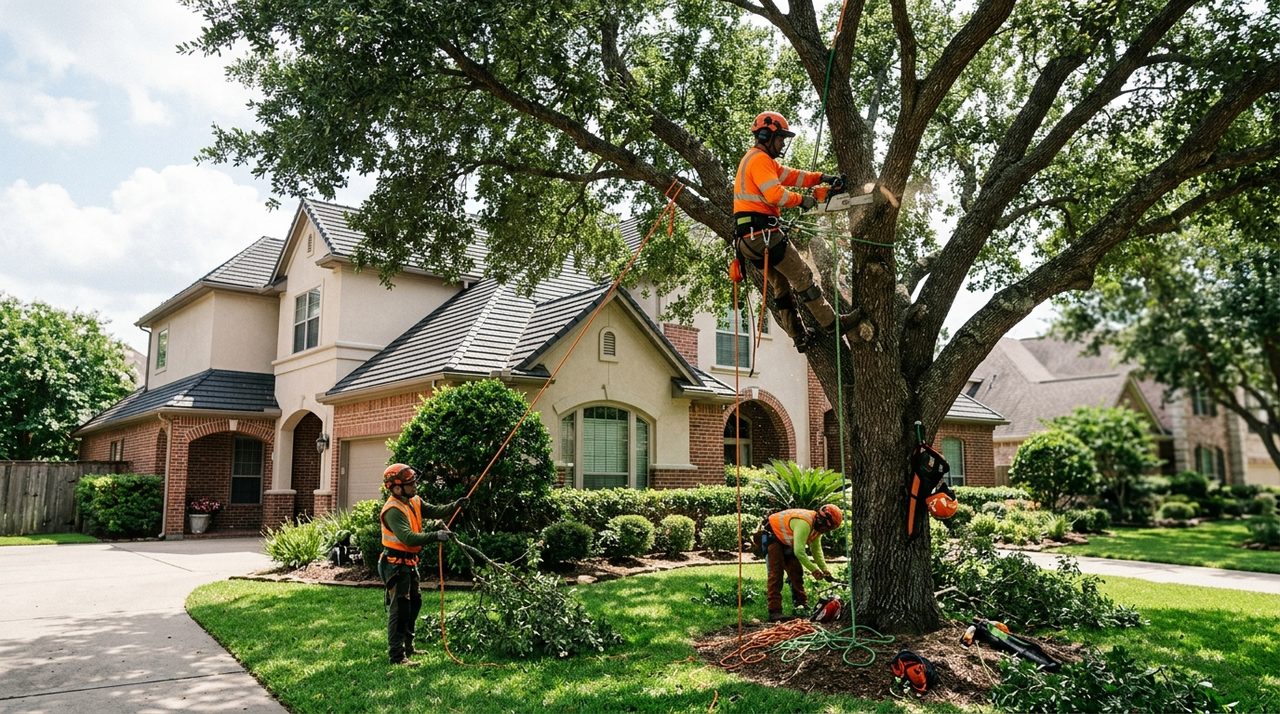
Richmond, TX sits at the fast-growing edge of Fort Bend County where 1980s Pecan Grove ranches, 2000s Greatwood traditionals, and brand-new Harvest Green phases all share the same heavy expansive clay soil — and that soil makes tree removal far more consequential than in sandier parts of the metro. Master-planned communities dominate the area, and nearly every HOA in these subdivisions requires architectural committee sign-off before a chainsaw touches a trunk, meaning a homeowner who skips that step risks fines and forced replanting. This page covers what Richmond homeowners specifically need to know about permit jurisdiction, HOA approval, root damage on post-tension slabs, and the surge pricing that follows Fort Bend's regular severe weather events.
Ranked by verified Google rating × review volume × verification tier. How we rank →
Some highly-rated pros serve Richmond from nearby and may not keep a Richmond street address. Those are listed under "Also serving Richmond" with their real city and distance, so you always know where each business is based.
9302 Hillhaven Ct suite 800, Rosenberg, TX 77469
231 Rochelle St, Richmond, TX 77469
913 Victoria Dr, Richmond, TX 77469
Highly-rated pros based nearby who cover Richmond. Distance shown from the Richmond area.
Serving Richmond Based in Rosenberg · 2.6 mi away
Serving Richmond Based in Rosenberg · 3.3 mi away
Serving Richmond Based in Sugar Land · 4.6 mi away
Serving Richmond Based in Sugar Land · 4.7 mi away
Why it matters to you
Richmond is not a single community — it is a patchwork of master-planned subdivisions including Pecan Grove, Greatwood, Long Meadow Farms, Old Orchard, Del Webb Sweetgrass, and Harvest Green, each governed by its own mandatory HOA with recorded deed restrictions. Most of these associations require architectural committee approval before removing any tree above a threshold caliper (commonly 6–8 inches DBH), and approval timelines can run two to six weeks. A homeowner who removes a protected tree without that written approval faces fines and may be required to plant replacement trees at their own expense.
What a good pro does
Before scheduling a contractor, pull your subdivision's CC&Rs — under 2026 Texas HOA transparency rules, associations with 60 or more lots must post governing documents publicly. Submit your tree-removal request to the architectural review committee with species, trunk diameter, and the contractor's site plan. A reputable Fort Bend arborist will hold the start date until written approval is in hand and can help document tree health or structural risk to support your application.
Sources: Local HOA / deed restrictions (see area profile)
Why it matters to you
The majority of Richmond's suburban housing stock from the 1980s through the 2020s sits on post-tension concrete slab foundations poured over Fort Bend County's heavy expansive clay. Live oaks, water oaks, and Chinese tallow trees growing within 15–20 feet of a foundation can develop surface-feeding roots that exploit the soil's shrink-swell cycles, gradually heaving slab edges and cracking driveways and sidewalks. Homeowners in aging Pecan Grove and Greatwood homes are increasingly discovering this issue as the trees planted at subdivision build-out in the late 1980s and 1990s reach full maturity.
What a good pro does
A qualified ISA Certified Arborist should assess root proximity using a root-barrier probe before removal begins to avoid cutting post-tension cable zones during stump grinding — striking a stressed cable on a post-tension slab causes immediate and expensive structural damage. After the stump is ground to 12–18 inches below grade, the contractor should backfill with compactible material rather than leaving a void that accelerates differential soil movement under the slab. Budget $150–$400 for stump grinding as a separate line item; it is rarely included in base removal quotes.
Why it matters to you
Richmond is unusual even by Houston-metro standards because the permit authority is not uniform across the area. Properties inside Richmond city limits fall under the City of Richmond's permits office, while the many subdivisions surrounding the historic core — including large swaths of Pecan Grove, Long Meadow Farms, and newer phases of master-planned communities — are unincorporated Fort Bend County and fall under the Fort Bend County Engineering Department. The Texas Department of Licensing and Regulation does not license tree removal contractors at the state level, so there is no state credential to verify — but the permit jurisdiction determines who inspects any associated site work such as utility-proximity clearing or drainage modifications.
What a good pro does
Confirm your parcel's jurisdiction before signing any contract: look up your address on the Fort Bend County Central Appraisal District's online map or call the City of Richmond directly. If your property is within city limits and the removal involves work near overhead power lines, the contractor must coordinate with CenterPoint Energy regardless of jurisdiction. Ask any prospective contractor for proof of liability insurance and verify their ISA Certified Arborist credential — it is the recognized professional standard in the absence of state licensing.
Sources: Municipal permit office (see area profile)
Why it matters to you
Richmond and Fort Bend County sit in the path of Gulf-sourced weather systems and inland severe weather. The May 2024 derecho that cut through the greater Houston metro and Hurricane Beryl in July 2024 both generated immediate regional demand spikes for tree-removal crews, with backlogs stretching weeks and pricing running 40–80% above normal in the aftermath. Homeowners near the Brazos River corridor, where flood risk rises sharply parcel-by-parcel despite the area's overall FEMA Zone X designation, often face compound problems of storm damage combined with soil saturation that makes crane access difficult and increases job complexity.
What a good pro does
Document all storm-damaged trees with time-stamped photos immediately after the event, and submit a claim inquiry to your homeowner's insurance carrier before agreeing to any emergency removal quote — storm-felled or storm-damaged trees that struck a structure may be partially covered under the dwelling portion of a standard HO-3 policy. In the weeks following a named event, get at least two written quotes, verify that the crew is not an out-of-state operator without local references, and be cautious of door-to-door solicitors requiring large cash deposits upfront. Fort Bend County's most-affected blocks may have time-limited curbside debris pickup for storm material; confirm pickup rules with Fort Bend County before piling debris at the curb.
Sources: FEMA National Flood Hazard Layer (NFHL), Harris County Flood Control District
Hiring tree removal in Richmond? Richmond encompasses a wide range of housing from historic city-center properties to modern master-planned communities, each with its own HOA and deed restrictions. Homeowners must identify their specific subdivision's governing documents before initiating exterior modifications. The mix of newer construction and rapid growth means contractors frequently handle warranty-era repairs, energy efficiency upgrades, and landscape compliance work.
Building era
Mixed: historic Richmond core dates to pre-1970s; dominant suburban stock built 1980s–2020s, with heaviest construction in the 2000s–2020s across master-planned communities.
Typical style
Traditional suburban brick, brick-and-stone Texas traditional, and contemporary transitional elevations in newer master-planned phases; one- and two-story production homes with front-loaded attached garages.
Foundations
Predominantly slab-on-grade (post-tension concrete) for suburban tract homes; some older historic Richmond homes may have pier-and-beam foundations.
Common systems
Central HVAC (heat pump and gas furnace split systems common), copper and PEX plumbing in newer homes (possible polybutylene in 1980s–early 1990s stock), 200-amp electrical panels standard in post-2000 construction.
What that means for repairs
Kitchen and bathroom remodels are common in 1990s–2000s homes reaching their second-owner cycle. Exterior modifications (fences, patios, driveways, generators) require HOA architectural review in most subdivisions. Older Pecan Grove and Greatwood-era homes often need HVAC replacements and roof upgrades.
Permit jurisdiction
City of Richmond permits office for properties within city limits; Fort Bend County Engineering Department for unincorporated Fort Bend County areas surrounding Richmond.
HOA & deed restrictions
No single mandatory HOA covers all of Richmond. Most master-planned communities (Harvest Green, Old Orchard, Pecan Grove, Greatwood, Long Meadow Farms, Del Webb Sweetgrass, etc.) have mandatory HOAs with recorded deed restrictions and architectural review committees. Some older or rural tracts have no HOA. HOA status is strictly subdivision-by-subdivision.
Historic districts
No City of Houston historic district designation confirmed. Richmond has its own historic downtown area, but formal historic district protections and review processes should be verified with the City of Richmond.
Contractor note
Contractors must determine whether a property is within Richmond city limits or unincorporated Fort Bend County, as permit jurisdiction and inspection requirements differ. Most subdivisions require HOA architectural approval before exterior work begins, and 2026 Texas HOA transparency laws require governing documents to be publicly posted for associations with 60+ lots.
FEMA flood zone
FEMA Zone X (low flood risk) per official NFHL data. Richmond is situated along the Brazos River, and some areas near the river and Rabbs Bayou carry higher flood risk than the Zone X designation of the sampled point; homeowners should verify their specific lot's flood zone.
Hurricane Harvey impact
Hurricane Harvey (2017) caused significant flooding in parts of Fort Bend County, particularly along the Brazos River corridor. The Barker Reservoir controlled releases and Brazos River flooding impacted numerous Richmond-area subdivisions. Specific impact varied greatly by subdivision and proximity to waterways — homeowners should check individual property flood history through Fort Bend County records.
Heat & humidity load
Extreme summer heat and humidity drive heavy HVAC demand across Richmond's slab-on-grade homes. Expansive clay soils common in Fort Bend County cause seasonal foundation movement, increasing demand for foundation inspection and repair services. Newer homes with large roof spans require periodic inspection for heat-related shingle degradation.
Working with contractors here
Contractors in Richmond work across a wide spectrum of housing ages, from 1980s master-planned homes needing full system replacements to brand-new construction warranty work. HVAC replacement and repair is the most consistent demand driver due to the extreme Fort Bend County summers and the aging of 2000s-era equipment. Foundation monitoring and repair are common given the expansive clay soils, particularly for homes built on slab-on-grade foundations. Exterior work — fencing, patio covers, roofing — almost always requires HOA architectural committee pre-approval, so contractors should build submission lead time into project schedules. The split jurisdiction between City of Richmond and unincorporated Fort Bend County means permit requirements and inspection timelines can differ significantly even between adjacent subdivisions.
Local Tip
Always ask for a written estimate before work begins. Texas contractors are required to provide one on jobs over $1,000.
Richmond encompasses a wide range of housing from historic city-center properties to modern master-planned communities, each with its own HOA and deed restrictions. Homeowners must identify their specific subdivision's governing documents before initiating exterior modifications. The mix of newer construction and rapid growth means contractors frequently handle warranty-era repairs, energy efficiency upgrades, and landscape compliance work.
Source: U.S. Census Bureau, ACS 5-Year 2023
Most of Richmond maps to FEMA Zone X (low mapped flood risk), but Houston's flash-flood reality means even low-risk blocks benefit from smart drainage and storm-hardened installs; risk climbs sharply on blocks nearest the Brazos River, where it varies parcel to parcel.
Source: FEMA National Flood Hazard Layer (NFHL). Flood zones vary by parcel — verify your individual FIRM panel.
After a hurricane makes landfall, tree removal demand across the Houston metro surges overnight, so contracting a licensed crew in Richmond, TX for pre-storm hazard removal is far faster and less expensive than emergency post-storm work. Focus removal priority on trees with crowns that extend over the roofline or within one tree-length of the structure, which is where wind-throw damage concentrates. Confirm the current FEMA panel for your Richmond parcel — the area maps to Zone X, but adjacent lots can differ.
Wind and lightning are the dominant tree hazards in Richmond, TX during severe Houston thunderstorms, and the May 2024 derecho proved that low-flood-risk areas are not insulated from widespread tree-on-structure damage when straight-line winds exceed 75 mph. A pre-season inspection by a licensed tree removal contractor focused on dead wood, weak branch attachments, and trees leaning toward structures is the most direct mitigation step available. As a Fort Bend County community, Richmond may follow county rather than City of Houston storm rebuild rules.
Wind loading on ice-coated canopies in Richmond, TX during a hard freeze creates the same failure risk as a severe windstorm, and lower flood-risk areas are just as exposed to ice-storm tree damage as any other part of the Houston metro. Uri 2021 left neighborhoods across the city dealing with fallen trees on homes and vehicles for weeks, primarily because no pre-storm removal of structurally weak specimens had been completed. With a median build year of 1979, the older building stock here is more exposed to hard-freeze damage than newer construction. Confirm the current FEMA panel for your Richmond parcel — the area maps to Zone X, but adjacent lots can differ.
Sources: FEMA National Flood Hazard Layer (NFHL), Ready.gov -- Hurricanes, CenterPoint Energy -- Storm Center, City of Houston -- Emergency Preparedness, Ready.gov -- Winter Weather, Harris County Flood Control District
Houston-specific estimators to plan your project before you call a pro. All results are planning estimates — a licensed local pro confirms the details on site.
Grouped by mature root aggression & water demand.
Trunk center to the nearest exterior wall.
The root zone likely reaches your foundation's soil during Houston's dry summers, when clay shrinks most. Watch for sticking doors and diagonal cracks, keep soil moisture even with a soaker hose during drought, and have a foundation pro evaluate if you see any movement.
Find a Houston foundation pro →This is a planning estimate only — actual requirements depend on an on-site assessment by a licensed Houston pro. Guidance is based on general species root behavior in expansive clay, not a soil test.
Disconnect & drain every outdoor hose bib
Remove hoses, drain the spigots, and cover each with an insulated faucet sock. Un-drained hose bibs are the #1 burst point in a Houston freeze.
Insulate exposed pipes in the attic & garage
Wrap any pipe in an unconditioned space (attic runs, garage walls) with foam sleeves. Houston homes rarely insulate these because they only matter a few nights a year — which is exactly why they burst.
Open cabinet doors & keep a pencil-width drip
On hard-freeze nights, open kitchen/bath cabinets so warm air reaches the pipes and let faucets on exterior walls drip to relieve pressure.
Protect the attic/garage water heater & its lines
An attic or garage tank sits in unconditioned space. Insulate the cold-inlet and hot-outlet lines and confirm the emergency drain pan is clear so a leak doesn't reach the ceiling.
This is a planning estimate only — actual requirements depend on an on-site assessment by a licensed Houston pro. If a pipe has already burst, shut off your main water supply and call a licensed Houston plumber immediately — freeze bursts flood fast.
Sources: Municipal permit office (see area profile)
Sources: FEMA National Flood Hazard Layer (NFHL)Local HOA / deed restrictions (see area profile)
Sources: Local HOA / deed restrictions (see area profile)
Sources: Texas Commission on Environmental QualityLocal HOA / deed restrictions (see area profile)