Serving River Oaks Based in Lazybrook / Timbergrove · 1.7 mi away
Best Solar Installers in River Oaks
River Oaks presents a solar installer with a rare combination of challenges: estate-scale English Tudor and Georgian homes from the 1920s–1940s whose original roof structures and electrical systems were built decades before photovoltaics existed, a mandatory deed-restriction regime run by River Oaks Property Owners, Inc. (ROPO) that controls what appears on any street-facing elevation, and City of Houston permitting requirements that apply to every system regardless of lot size or home value. Understanding how these three forces interact determines whether a River Oaks solar project is completed on time and remains legally energized—or stalls in review queues and HOA disputes.
Verified against Google Business data
Updated 2026
See the 10 Solar Installers Serving River Oaks 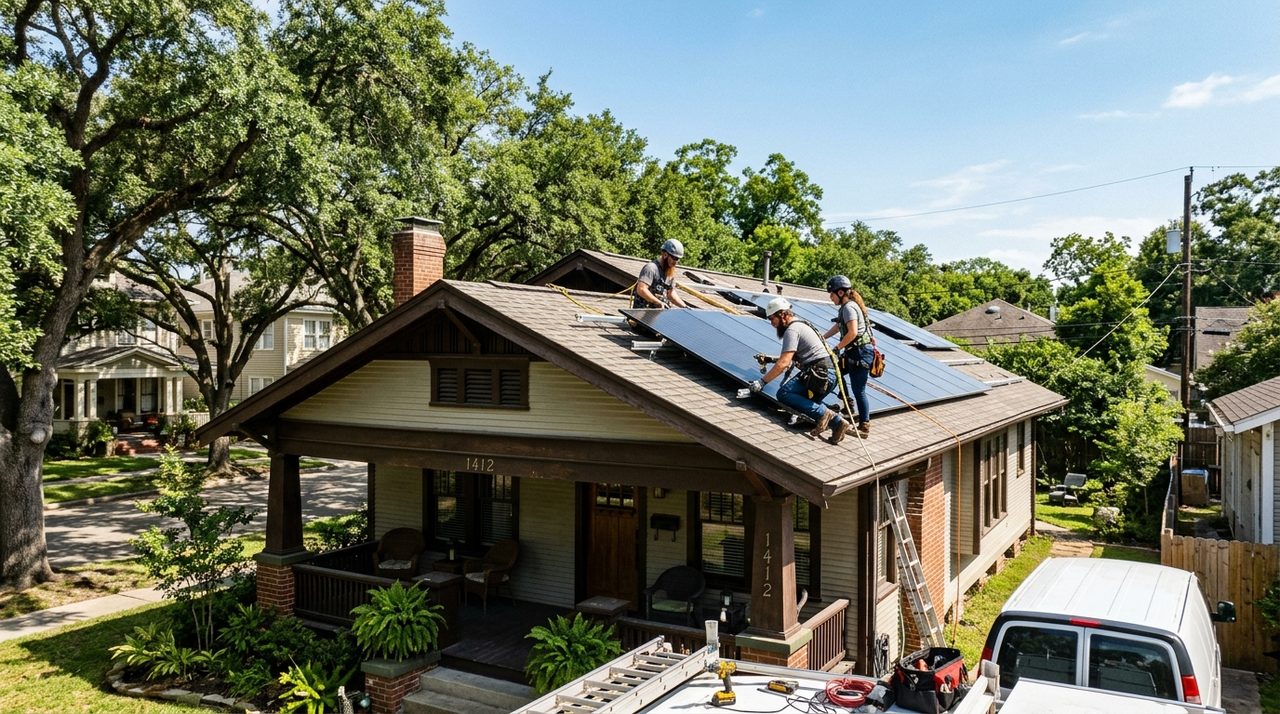
- Median home built
- 2001
- Median home value
- $724,900
- FEMA flood zone
- X (low)
- Typical system cost (est.)
- $22,000–$35,000 gross (8–10 kW) before 30% federal ITC
- Most common local issue
- ROPO deed-restriction review forcing rear-slope or concealed placement on high-value historic rooflines
Ranked by verified Google rating × review volume × verification tier. How we rank →
Some highly-rated pros serve River Oaks from nearby and may not keep a River Oaks street address. Those are listed under "Also serving River Oaks" with their real city and distance, so you always know where each business is based.
Min rating:
10 resultsAlso serving River Oaks
Highly-rated pros based nearby who cover River Oaks. Distance shown from the River Oaks area.
Closed
Serving River Oaks Based in Upper Kirby · 1.7 mi away
Closed
Serving River Oaks Based in Tanglewood · 2.6 mi away
Closed
Serving River Oaks Based in Spring Branch · 2.7 mi away
Closed
Serving River Oaks Based in Midtown · 3.2 mi away
Closed
Serving River Oaks Based in Midtown · 3.2 mi away
Closed
Serving River Oaks Based in Lazybrook / Timbergrove · 3.4 mi away
Closed
Serving River Oaks Based in Bellaire · 3.4 mi away
Closed
Serving River Oaks Based in Midtown · 3.4 mi away
Solar Installers in River Oaks: What You Should Know
ROPO's 'Not Visible from the Street' Rule Can Cost You 15–25% of Annual Production
Why it matters to you
River Oaks Property Owners, Inc. enforces recorded deed restrictions across the core platted sections, and while Texas Property Code §202.010 protects your right to install solar, it explicitly permits HOAs to require placement that keeps panels out of street view. On the English Tudor and Spanish Colonial Revival rooflines that define River Oaks's streetscape, the south-facing primary slope almost always faces the street—meaning ROPO compliance typically pushes arrays to rear or east-facing slopes. For a 5,000–8,000 sq ft estate running 1,600–2,200 kWh per month in summer, a forced east-facing orientation instead of true south reduces output enough to eliminate a meaningful portion of the system's projected payback.
What a good pro does
A qualified installer serving River Oaks should request your specific plat section and pull the recorded deed restriction language before any design is finalized—not after. They should then model both the ROPO-compliant rear-slope layout and the optimal south-facing layout side by side using actual CenterPoint historical usage data for your address, so you enter the ROPO architectural review with a documented production trade-off in hand rather than discovering it post-approval. All exterior modifications visible from the street require City of Houston building permits through the Houston Permitting Center regardless of HOA status.
Sources: Local HOA / deed restrictions (see area profile), City of Houston Permitting Center, Municipal permit office (see area profile)
Aging Electrical Panels in 1920s–1940s Estates Must Be Upgraded Before a Grid-Tie System Can Be Permitted
Why it matters to you
A significant share of River Oaks's surviving original estate homes—those that have not undergone full teardown-rebuild—still carry 100-amp or even older fuse-based electrical service that predates modern load expectations. A grid-tied solar installation with battery backup requires a minimum 200-amp main panel and a licensed master electrician to pull the interconnection permit; installing an inverter on an undersized panel is a code violation that CenterPoint Energy will flag during its interconnection review, delaying energization by weeks. For homes on the 1920s–1940s stock, the panel upgrade alone can run $3,000–$6,000 before the solar work begins, a cost that should appear as a separate line item in any honest proposal.
What a good pro does
In Texas, all electrical work associated with a solar PV installation—including the panel upgrade—must be performed under a TDLR-licensed Electrical Contractor with a licensed master electrician pulling the City of Houston permit. Ask every bidder to confirm their TDLR electrical contractor license number and to show the panel upgrade as a distinct permitted scope in their proposal. Installers who bundle it invisibly into the system price are obscuring a real cost and a real permit step. NABCEP-certified PV Installation Professionals are trained to identify service upgrade requirements during the site assessment, before contracts are signed.
Sources: Texas Department of Licensing & Regulation, North American Board of Certified Energy Practitioners (NABCEP), City of Houston Permitting Center
Historic-Era Roof Structures Require Engineering Review Before Any Racking Is Attached
Why it matters to you
River Oaks's original 1920s–1930s homes were framed with old-growth lumber that may be structurally sound but dimensionally inconsistent by modern standards—rafter spacing, ridge-board connections, and sheathing thickness can all vary from what a standard racking manufacturer's structural template assumes. Houston sits in ASCE 7 Wind Zone D with design wind speeds of 130–140 mph, meaning racking attachment points must be engineered for that load, not estimated. An improperly flashed or under-torqued rail attachment on a 90-year-old rafter can lift panels in a storm, breach the roof deck, and generate a homeowner insurance claim that the carrier may deny if the installation lacked a structural engineering sign-off.
What a good pro does
For any pre-1960 roof structure in River Oaks, a responsible installer will engage a licensed structural engineer to review the attic framing before finalizing the mounting plan—this is distinct from the solar permit itself and typically adds $500–$1,500 to project cost but is essential for both City of Houston permit approval and your homeowner's insurance validity. The City of Houston Permitting Center requires structural documentation for solar installations when the roof assembly is non-standard, and a NABCEP-certified installer will know to flag this during the site survey rather than discover it during installation.
Sources: International Residential Code (as adopted by City of Houston), City of Houston Permitting Center, North American Board of Certified Energy Practitioners (NABCEP)
Post-Uri Battery Storage Demand Is Real Here—But Older Panels and CenterPoint's Separate Metering Add Timeline
Why it matters to you
Winter Storm Uri's grid failures created strong demand for battery backup across River Oaks, where homeowners with large homes and home offices experienced extended outages despite the neighborhood's low flood risk (FEMA Zone X). Adding a Tesla Powerwall or Enphase IQ Battery to a River Oaks estate is technically straightforward on newer luxury rebuilds with 200A panels—but for original homes that still need a panel upgrade, the battery integration triggers a separate CenterPoint interconnection tariff application for storage-paired systems that can add six to ten weeks beyond the standard solar interconnection timeline. Homeowners who are quoted a single 'go-live date' without acknowledging this two-step utility queue are frequently surprised.
What a good pro does
Any River Oaks installer proposing a storage-paired system should submit the CenterPoint interconnection application for the battery separately and in parallel with the building permit application at the Houston Permitting Center—not sequentially. Ask your installer to show you the CenterPoint application receipt date as a project milestone, and confirm that the City of Houston permit covers both the PV array and the battery enclosure as permitted scopes. Battery enclosure placement on River Oaks lots must also be reviewed against ROPO deed restrictions if the unit would be visible from the street or from adjacent property.
Sources: City of Houston Permitting Center, Local HOA / deed restrictions (see area profile), Texas Department of Licensing & Regulation
Solar Installers in River Oaks: What You Should Know
Hiring solar installers in River Oaks? River Oaks is Houston's premier residential neighborhood, featuring 1920s–1930s estate homes alongside modern luxury rebuilds on large lots. Homeowners face a unique combination of mandatory HOA oversight from River Oaks Property Owners, Inc. (ROPO), strict deed restrictions, and the maintenance demands of aging pier-and-beam foundations, mature tree root systems, and historic-era plumbing and electrical. Contractors working here must navigate both high client expectations and the regulatory requirements of the City of Houston permitting process.
- Housing era
- 1920s–1930s (original build-out), with significant post-1980 and 2000s-present luxury infill and teardown rebuilds
- Foundation
- Mixed — older homes predominantly pier-and-beam
- Flood zone
- FEMA Zone X (low flood risk) per official NFHL data
- Permits
- Houston Permitting Center (City of Houston)
Housing stock & systems
Building era
1920s–1930s (original build-out), with significant post-1980 and 2000s-present luxury infill and teardown rebuilds.
Typical style
English Tudor, Spanish Colonial Revival, Georgian, Colonial, and contemporary custom luxury homes.
Foundations
Mixed — older homes predominantly pier-and-beam; newer construction and rebuilds typically slab-on-grade with post-tension or drilled piers.
Common systems
Original homes may retain cast-iron drain lines, galvanized supply piping, and older panel boxes requiring upgrades. Newer builds feature modern PEX/copper plumbing, 200+ amp electrical panels, and high-efficiency zoned HVAC systems. Mature-era homes often have outdated ductwork and window-unit retrofits.
What that means for repairs
Teardown-and-rebuild activity is extremely common on original lots, as land values far exceed structure values for many older homes. Whole-house gut renovations of surviving 1920s–1940s estates are also frequent, typically involving foundation leveling, full re-plumbing, electrical panel upgrades, and HVAC modernization while preserving architectural character.
Permits & restrictions
Permit jurisdiction
Houston Permitting Center (City of Houston).
HOA & deed restrictions
Core River Oaks platted sections (e.g., River Oaks Sec 01) are governed by River Oaks Property Owners, Inc. (ROPO) — a mandatory HOA/POA with recorded deed restrictions. Adjacent pockets such as Huldy Street Terrace / Shepherd Crest near the River Oaks Shopping Area have no HOA. Condominiums like River Oaks Gardens are governed by their own condo associations (e.g., River Oaks Gardens Council of Co-Owners). Related civic organizations in the broader super neighborhood include Avalon Property Owners Association and West Lane Place Civic Association.
Historic districts
No City of Houston historic district designation confirmed. River Oaks is deed-restricted through its original master-planned community covenants, but this is a private restriction, not a Houston Archaeological and Historical Commission (HAHC) overlay.
Contractor note
ROPO and section POAs actively monitor and may require pre-approval for exterior modifications, fencing, and new construction visible from the street. Contractors should verify both City of Houston permit requirements and HOA/deed restriction compliance before beginning any exterior or structural work.
Flood & weather
FEMA flood zone
FEMA Zone X (low flood risk) per official NFHL data. However, the neighborhood's western edge borders Buffalo Bayou, and localized street flooding can occur during extreme rainfall events despite the low-risk designation.
Hurricane Harvey impact
Not confirmed with specific damage data from research — River Oaks experienced some flooding during Hurricane Harvey (2017), particularly in areas closest to Buffalo Bayou. The neighborhood's elevation and drainage infrastructure offered relative protection to many homes, but properties along the bayou corridor and lower-lying lots did sustain water damage. Check Harris County Flood Control District records for property-specific Harvey inundation data.
Heat & humidity load
Houston's extreme summer heat and humidity place heavy demands on HVAC systems in River Oaks' large-footprint homes, especially older estates with poor insulation and aging ductwork. Mature tree canopy provides shade but contributes to foundation movement through root-driven soil moisture changes. Pier-and-beam crawl spaces in original homes require ventilation monitoring to prevent moisture-related wood damage.
Working with contractors here
The most common contractor work in River Oaks includes foundation repair and leveling on 1920s–1940s pier-and-beam structures, whole-house re-plumbing to replace cast-iron and galvanized lines, electrical panel upgrades from 100-amp to 200+ amp service, and full HVAC system replacements with zoned systems for 5,000–16,000+ square foot homes. Teardown-and-rebuild projects are a significant portion of new construction activity, requiring demolition, site engineering, and ground-up custom builds. Contractors should expect extended project timelines due to ROPO architectural review, City of Houston permitting for demolitions and new construction, and the high-end finish expectations of River Oaks homeowners. Job scoping must account for mature tree preservation ordinances, potential asbestos and lead paint in pre-1980 structures, and limited staging space on densely landscaped lots.
Local Tip
Always ask for a written estimate before work begins. Texas contractors are required to provide one on jobs over $1,000.
About River Oaks
River Oaks is Houston's premier residential neighborhood, featuring 1920s–1930s estate homes alongside modern luxury rebuilds on large lots. Homeowners face a unique combination of mandatory HOA oversight from River Oaks Property Owners, Inc. (ROPO), strict deed restrictions, and the maintenance demands of aging pier-and-beam foundations, mature tree root systems, and historic-era plumbing and electrical. Contractors working here must navigate both high client expectations and the regulatory requirements of the City of Houston permitting process.
- Median year built
- 2001
- Median home value
- $724,900
- Owner-occupied
- 41.2%
- Population
- 23,662
- Housing units
- 14,387
- Median income
- $108,353
Source: U.S. Census Bureau, ACS 5-Year 2023
Flood & storm risk
FEMA Zone XLow flood riskMost of River Oaks maps to FEMA Zone X (low mapped flood risk), but Houston's flash-flood reality means even low-risk blocks benefit from smart drainage and storm-hardened installs; risk climbs sharply on blocks nearest Buffalo Bayou, where it varies parcel to parcel.
Source: FEMA National Flood Hazard Layer (NFHL). Flood zones vary by parcel — verify your individual FIRM panel.
Houston Storm Readiness in River Oaks
Hurricane & flooding
Wind damage, not flooding, is the primary hurricane threat for solar systems in lower-risk River Oaks, so prioritize a pre-season inspection confirming your racking's hurricane-rated uplift capacity meets the local design wind speed in the City of Houston building code. Loose or improperly torqued rail clamps were a leading cause of panel loss across the metro after Beryl 2024's sustained tropical-force winds. Confirm the current FEMA panel for your River Oaks parcel — the area maps to Zone X, but adjacent lots can differ.
Severe storms & hail
Wind uplift from severe thunderstorm straight-line winds — not just hurricanes — is the most common cause of panel dislodgement in River Oaks; confirm with your TDLR-licensed installer that your racking was installed with hurricane-rated lag screws into verified rafter locations, not just into decking. The May 2024 derecho demonstrated that 80-plus-mph gusts arrive with little warning and no opportunity for last-minute hardware checks. Confirm the current FEMA panel for your River Oaks parcel — the area maps to Zone X, but adjacent lots can differ.
Ice storms & freezes
Winter Storm Uri demonstrated that even low-flood-risk areas of the Houston metro face multi-day power outages when the ERCOT grid is stressed; solar homeowners in River Oaks should test their battery backup system's automatic transfer function annually, ideally before December, to confirm it will island critical loads smoothly if the grid fails during a freeze. A TDLR-licensed solar technician can perform this test and verify that the rapid-shutdown system resets correctly when grid power is restored. In-city River Oaks work falls under City of Houston floodplain and permitting rules.
Sources: FEMA National Flood Hazard Layer (NFHL), Ready.gov -- Hurricanes, CenterPoint Energy -- Storm Center, City of Houston -- Emergency Preparedness, Ready.gov -- Winter Weather, Harris County Flood Control District
Free River Oaks Tools & Calculators
Houston-specific estimators to plan your project before you call a pro. All results are planning estimates — a licensed local pro confirms the details on site.
Houston Freeze Prep & Pipe Insulation Checklist
Open full tool & FAQ →Your freeze checklist — 4 tasks
- 1
Disconnect & drain every outdoor hose bib
Remove hoses, drain the spigots, and cover each with an insulated faucet sock. Un-drained hose bibs are the #1 burst point in a Houston freeze.
- 2
Insulate exposed pipes in the attic & garage
Wrap any pipe in an unconditioned space (attic runs, garage walls) with foam sleeves. Houston homes rarely insulate these because they only matter a few nights a year — which is exactly why they burst.
- 3
Open cabinet doors & keep a pencil-width drip
On hard-freeze nights, open kitchen/bath cabinets so warm air reaches the pipes and let faucets on exterior walls drip to relieve pressure.
- 4
Protect the attic/garage water heater & its lines
An attic or garage tank sits in unconditioned space. Insulate the cold-inlet and hot-outlet lines and confirm the emergency drain pan is clear so a leak doesn't reach the ceiling.
This is a planning estimate only — actual requirements depend on an on-site assessment by a licensed Houston pro. If a pipe has already burst, shut off your main water supply and call a licensed Houston plumber immediately — freeze bursts flood fast.
Frequently Asked Questions
Does the Houston Permitting Center require a separate structural submittal for solar on a 1930s Tudor with original roof framing?
Yes — the City of Houston Permitting Center requires both an electrical permit and a structural/building permit for any rooftop solar installation, and on a pre-1940s home with original rafter-and-purlin framing the plan reviewer will typically require stamped engineering calculations showing the existing roof structure can handle added dead load and wind uplift before issuing approval. Submittal turnaround at the Houston Permitting Center currently averages two to four weeks for residential solar, but an incomplete structural package — missing rafter dimensions or span tables — will trigger a correction cycle that adds weeks. Have your installer pull the permit with a licensed master electrician and include a structural letter from a Texas PE before submitting.
Sources: City of Houston Permitting CenterInternational Residential Code (as adopted by City of Houston)
My River Oaks home has a FEMA Zone X rating — does that change anything about how a solar installer should plan a rooftop or ground-mount system?
Zone X means your parcel carries low mapped flood risk, so the racking design itself does not need to meet TWIA coastal wind or flood-zone-specific hardware requirements the way a Galveston Island system would. However, River Oaks lots closest to Buffalo Bayou can carry parcel-level flood exposure that the Zone X map does not fully capture, so any ground-mount conduit runs or inverter enclosures placed at grade should be elevated or weatherproofed as a precaution given Houston's history of rapid flash-flood events. Roof-mount systems on this side of town face Houston's standard ASCE 7 Wind Zone D design speed of 130–140 mph, which does require hurricane-rated racking hardware regardless of flood zone.
Sources: FEMA National Flood Hazard Layer (NFHL)International Residential Code (as adopted by City of Houston)
How does ROPO's deed-restriction review process actually work, and how long should I budget for it before my installer can begin work?
River Oaks Property Owners, Inc. (ROPO) requires a written application for any exterior modification visible from a public street or neighboring property, and solar panels are explicitly subject to that review under Texas Property Code §202.010, which permits HOAs to restrict placement to non-street-visible elevations even though it cannot prohibit solar outright. ROPO's architectural committee review cycles typically run four to eight weeks depending on submission completeness and meeting schedule, so a homeowner should budget that time before the installer can schedule a permit submittal with the Houston Permitting Center. Submitting detailed renderings that demonstrate rear-slope or courtyard-facing placement from the outset is the fastest path to approval.
Sources: Local HOA / deed restrictions (see area profile)City of Houston Permitting Center
What should I actually ask a solar installer about their experience with the oversized, high-load homes in River Oaks — my house is nearly 8,000 square feet?
Ask specifically whether the installer has sized systems using actual CenterPoint monthly usage data from homes above 5,000 square feet in the Houston inner loop, because national sizing calculators routinely underestimate the 1,400–1,800 kWh monthly cooling load that large, older River Oaks estates carry in summer. Ask for a NABCEP PV Installation Professional certification number, which is the nationally recognized credential that indicates design training beyond minimum licensing, and ask for at least two River Oaks or comparable inner-loop reference projects you can contact. Also confirm they hold a TDLR Electrical Contractor license, since pulling the permit in the City of Houston requires a licensed master electrician on the permit application.
Sources: North American Board of Certified Energy Practitioners (NABCEP)Texas Department of Licensing & Regulation
If I replace the roof on my 1940s estate before going solar, does the timing of the two projects affect the City of Houston permit process?
It does matter operationally: the Houston Permitting Center issues solar permits against the current permitted structure, and if a full re-roof permit is open or recently closed, the plan reviewer will want to confirm the new roof material and sheathing specs match what the solar structural submittal references. Coordinating the re-roof and solar permits under a single general sequence — closing the roofing permit first — avoids a correction cycle where solar racking attachment points are questioned against an undocumented substrate. As a rough cost estimate, a full architectural-shingle re-roof on a large River Oaks home runs $18,000–$35,000 before solar, and bundling the two scopes with overlapping contractor schedules can save mobilization costs.
Sources: City of Houston Permitting Center
Is there a best time of year to start the ROPO review and permit process for a River Oaks solar project if I want the system energized by summer?
Working backward from Houston's peak cooling season starting in June, a River Oaks homeowner should initiate ROPO's architectural committee application no later than late January or early February to allow four to eight weeks for HOA approval, followed immediately by a Houston Permitting Center submittal targeting a two-to-four-week turnaround, and then CenterPoint's interconnection approval queue, which adds another four to ten weeks for a storage-paired system. That means a practical energization target of late May or early June requires a project start no later than February 1 in most years. Homeowners who also need a panel upgrade should add another four to six weeks for that electrical permit to close before the solar permit can be finalized.