1909 W Lamar St, Houston, TX 77019
Best Roofers in River Oaks
River Oaks estates — many built in the 1920s and 1930s under English Tudor, Spanish Colonial, and Georgian rooflines — carry decades of thermal cycling, hurricane seasons, and Houston humidity on their original or once-replaced roof systems, and every exterior change must satisfy both the Houston Permitting Center and ROPO's architectural review before a single shingle is lifted. The combination of century-old design profiles (complex hipped rooflines, steep-pitch clay-look sections, decorative copper flashing details) and active deed-restriction enforcement makes roofing here a category apart from standard Houston residential work. This page explains the four roofing challenges that actually apply to River Oaks homeowners — and what competent execution looks like for each.
Verified against Google Business data
Updated 2026
See the 10 Roofers Serving River Oaks 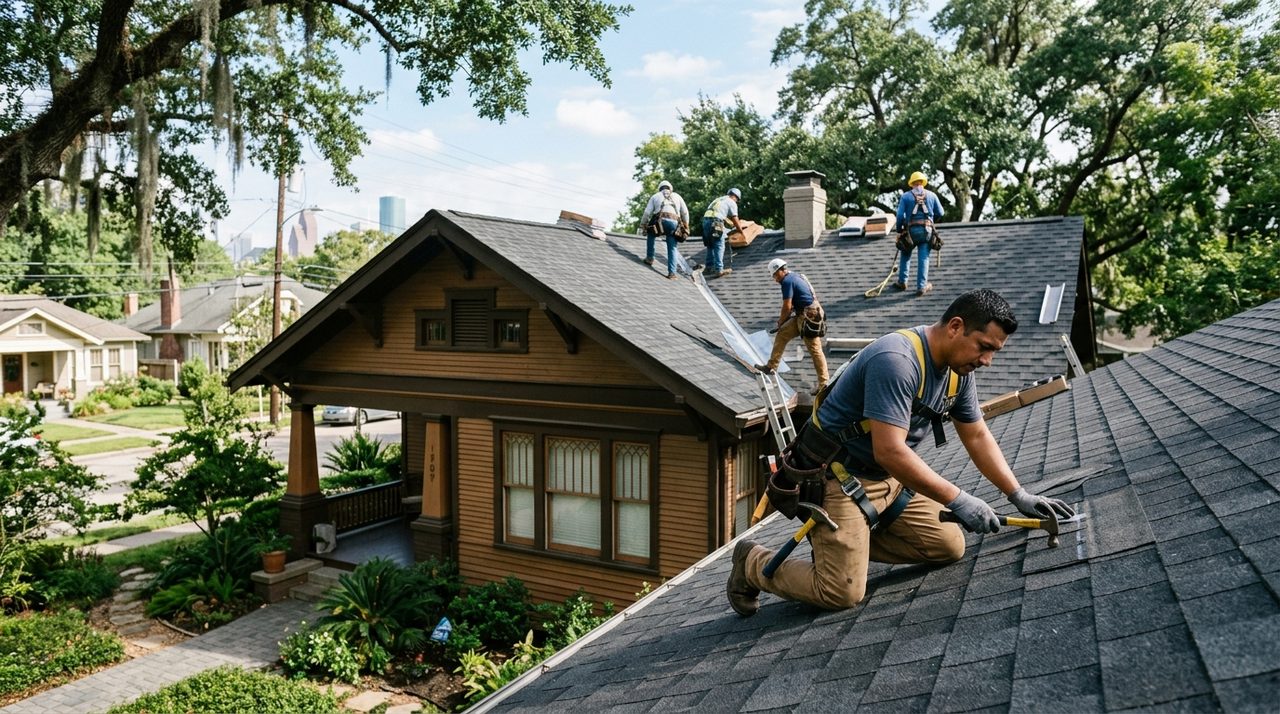
- Median home built
- 2001
- Median home value
- $724,900
- FEMA flood zone
- X (low)
- Typical re-roof cost (est.)
- $12,000–$35,000+
- Most common local issue
- Deck rot under decades-old original slate or clay-profile shingles on 1920s–1940s steep-pitch roofs
Ranked by verified Google rating × review volume × verification tier. How we rank →
Some highly-rated pros serve River Oaks from nearby and may not keep a River Oaks street address. Those are listed under "Also serving River Oaks" with their real city and distance, so you always know where each business is based.
Min rating:
10 resultsBased in River Oaks
Also serving River Oaks
Highly-rated pros based nearby who cover River Oaks. Distance shown from the River Oaks area.
Closed
Serving River Oaks Based in Upper Kirby · 1.1 mi away
Open Now
Serving River Oaks Based in Galleria · 1.3 mi away
Open Now
Serving River Oaks Based in Upper Kirby · 1.3 mi away
Open Now
Serving River Oaks Based in Lazybrook / Timbergrove · 1.6 mi away
Serving River Oaks Based in West University · 1.7 mi away
Open Now
Serving River Oaks Based in Lazybrook / Timbergrove · 1.8 mi away
Serving River Oaks Based in Lazybrook / Timbergrove · 2 mi away
Open Now
Serving River Oaks Based in West University · 2.2 mi away
Open Now
Serving River Oaks Based in Lazybrook / Timbergrove · 2.3 mi away
Roofers in River Oaks: What You Should Know
ROPO Deed-Restriction Review Before Any Material or Color Change
Why it matters to you
River Oaks Property Owners, Inc. (ROPO) enforces recorded deed restrictions across the core platted sections, and any change to roofing material type or color — including upgrading from a standard architectural shingle to a Class 4 impact-resistant product or switching to standing-seam metal — requires written ARC approval before work begins. Homeowners who authorize a roofer to start immediately after storm damage risk a forced re-roof at their own expense if the installed product doesn't match approved specifications, a particularly costly outcome on estates where roof systems can run $25,000–$35,000 or more.
What a good pro does
A roofer experienced in River Oaks will obtain the proposed product's manufacturer spec sheet, color sample, and profile drawing, submit them to ROPO before pulling any City of Houston permit, and build the ARC review window — typically 10 to 30 days — into the project schedule from day one. The Houston Permitting Center permit application should be filed in parallel so both approvals land close together and no start date is missed. Verify that your contractor has done this sequence before in River Oaks, not just in a suburban HOA community.
Sources: Local HOA / deed restrictions (see area profile), City of Houston Permitting Center
Deck Rot Hidden Beneath Historic-Era Steep-Pitch Roof Systems
Why it matters to you
The original 1920s and 1930s River Oaks estates were built with board-sheathed decks under heavy roofing systems — clay tile, slate, or early asphalt — that have been re-roofed one or more times without full tear-offs in some cases. Houston's annual average relative humidity exceeds 75%, and homes with inadequate ridge-to-soffit ventilation (common on original gable-and-hip configurations with no ridge vent) accumulate moisture against the decking year-round. By the time a homeowner notices a soft spot or interior stain, OSB or board sheathing may be delaminating across entire field sections, a problem that neither the roof surface nor the attic reveals until tear-off.
What a good pro does
A qualified roofer on a River Oaks estate should perform a full tear-off to bare deck and inspect every panel before laying new underlayment — never re-cover over existing layers, which masks the problem and voids warranties. Deck replacement cost adds to the estimate but is far cheaper than a second mobilization. The contractor should also calculate existing ridge and soffit vent ratios against IRC R806 minimums and propose corrections as part of the scope, since a new membrane over an under-ventilated attic will simply rot the fresh deck within five to eight years in Houston's climate.
Sources: International Residential Code (as adopted by City of Houston), City of Houston Permitting Center
Mature Tree Canopy and Shading Accelerating Algae and Granule Loss
Why it matters to you
River Oaks lots are among the most heavily canopied in Houston's Inner Loop, with live oaks and magnolias that predate many of the homes themselves. Persistent shade keeps roof surfaces damp for days after rain, fueling algae streaking (Gloeocapsa magma) that strips granules from asphalt shingles and shortens their effective life well below the stated 25–30 year rating. On the south- and west-facing planes that do get sun, Houston's 2,700+ annual cooling degree days and attic deck temperatures that can exceed 160°F drive thermal binder oxidation — so the same roof may have algae-degraded shingles on one face and heat-cracked shingles on another.
What a good pro does
For River Oaks homes staying with asphalt shingles, specify an algae-resistant product with copper-infused granules rated for the Gulf Coast climate, and confirm it meets ROPO's approved profile before ordering. Homeowners upgrading to standing-seam metal eliminate the algae and granule-loss problem entirely and can select an Energy Star-rated finish that qualifies for efficiency rebates — but the metal product color and panel profile must still clear ROPO's ARC review before installation begins. Factor that review window into the contractor's schedule.
Sources: Local HOA / deed restrictions (see area profile), ENERGY STAR / U.S. Dept. of Energy, International Residential Code (as adopted by City of Houston)
Complex Historic Rooflines Require Flashing Details That Standard Storm Crews Skip
Why it matters to you
The Tudor, Colonial, and Spanish Revival rooflines common throughout River Oaks include steep-pitch valleys, decorative copper or lead-coated copper flashing at dormers and chimneys, parapet returns, and multiple penetrations for original masonry chimneys — details that post-storm surge crews, who flooded Houston after Harvey in 2017 and after the May 2024 derecho, routinely handle with generic step flashing and caulk rather than custom-fabricated counterflashing. An improperly flashed chimney or dormer on a River Oaks estate can allow water intrusion that goes undetected for years behind plaster walls, ultimately damaging the very architectural character the deed restrictions are designed to protect.
What a good pro does
Insist on a roofer who can fabricate or source custom counterflashing in the original material — copper where the existing details call for it — and who documents each flashing replacement with photographs before close-in. Because Texas has no state-issued roofing contractor license, the only regulatory checkpoint in River Oaks is the City of Houston Permitting Center inspection for structural or full re-roof scopes; verify your contractor is pulling that permit and scheduling the required inspection rather than working without it. Ask specifically whether the flashing scope is itemized in the written estimate or rolled into a lump-sum price.
Sources: City of Houston Permitting Center, Local HOA / deed restrictions (see area profile), EPA Lead Renovation, Repair and Painting (RRP) Rule
Roofers in River Oaks: What You Should Know
Hiring roofers in River Oaks? River Oaks is Houston's premier residential neighborhood, featuring 1920s–1930s estate homes alongside modern luxury rebuilds on large lots. Homeowners face a unique combination of mandatory HOA oversight from River Oaks Property Owners, Inc. (ROPO), strict deed restrictions, and the maintenance demands of aging pier-and-beam foundations, mature tree root systems, and historic-era plumbing and electrical. Contractors working here must navigate both high client expectations and the regulatory requirements of the City of Houston permitting process.
- Housing era
- 1920s–1930s (original build-out), with significant post-1980 and 2000s-present luxury infill and teardown rebuilds
- Foundation
- Mixed — older homes predominantly pier-and-beam
- Flood zone
- FEMA Zone X (low flood risk) per official NFHL data
- Permits
- Houston Permitting Center (City of Houston)
Housing stock & systems
Building era
1920s–1930s (original build-out), with significant post-1980 and 2000s-present luxury infill and teardown rebuilds.
Typical style
English Tudor, Spanish Colonial Revival, Georgian, Colonial, and contemporary custom luxury homes.
Foundations
Mixed — older homes predominantly pier-and-beam; newer construction and rebuilds typically slab-on-grade with post-tension or drilled piers.
Common systems
Original homes may retain cast-iron drain lines, galvanized supply piping, and older panel boxes requiring upgrades. Newer builds feature modern PEX/copper plumbing, 200+ amp electrical panels, and high-efficiency zoned HVAC systems. Mature-era homes often have outdated ductwork and window-unit retrofits.
What that means for repairs
Teardown-and-rebuild activity is extremely common on original lots, as land values far exceed structure values for many older homes. Whole-house gut renovations of surviving 1920s–1940s estates are also frequent, typically involving foundation leveling, full re-plumbing, electrical panel upgrades, and HVAC modernization while preserving architectural character.
Permits & restrictions
Permit jurisdiction
Houston Permitting Center (City of Houston).
HOA & deed restrictions
Core River Oaks platted sections (e.g., River Oaks Sec 01) are governed by River Oaks Property Owners, Inc. (ROPO) — a mandatory HOA/POA with recorded deed restrictions. Adjacent pockets such as Huldy Street Terrace / Shepherd Crest near the River Oaks Shopping Area have no HOA. Condominiums like River Oaks Gardens are governed by their own condo associations (e.g., River Oaks Gardens Council of Co-Owners). Related civic organizations in the broader super neighborhood include Avalon Property Owners Association and West Lane Place Civic Association.
Historic districts
No City of Houston historic district designation confirmed. River Oaks is deed-restricted through its original master-planned community covenants, but this is a private restriction, not a Houston Archaeological and Historical Commission (HAHC) overlay.
Contractor note
ROPO and section POAs actively monitor and may require pre-approval for exterior modifications, fencing, and new construction visible from the street. Contractors should verify both City of Houston permit requirements and HOA/deed restriction compliance before beginning any exterior or structural work.
Flood & weather
FEMA flood zone
FEMA Zone X (low flood risk) per official NFHL data. However, the neighborhood's western edge borders Buffalo Bayou, and localized street flooding can occur during extreme rainfall events despite the low-risk designation.
Hurricane Harvey impact
Not confirmed with specific damage data from research — River Oaks experienced some flooding during Hurricane Harvey (2017), particularly in areas closest to Buffalo Bayou. The neighborhood's elevation and drainage infrastructure offered relative protection to many homes, but properties along the bayou corridor and lower-lying lots did sustain water damage. Check Harris County Flood Control District records for property-specific Harvey inundation data.
Heat & humidity load
Houston's extreme summer heat and humidity place heavy demands on HVAC systems in River Oaks' large-footprint homes, especially older estates with poor insulation and aging ductwork. Mature tree canopy provides shade but contributes to foundation movement through root-driven soil moisture changes. Pier-and-beam crawl spaces in original homes require ventilation monitoring to prevent moisture-related wood damage.
Working with contractors here
The most common contractor work in River Oaks includes foundation repair and leveling on 1920s–1940s pier-and-beam structures, whole-house re-plumbing to replace cast-iron and galvanized lines, electrical panel upgrades from 100-amp to 200+ amp service, and full HVAC system replacements with zoned systems for 5,000–16,000+ square foot homes. Teardown-and-rebuild projects are a significant portion of new construction activity, requiring demolition, site engineering, and ground-up custom builds. Contractors should expect extended project timelines due to ROPO architectural review, City of Houston permitting for demolitions and new construction, and the high-end finish expectations of River Oaks homeowners. Job scoping must account for mature tree preservation ordinances, potential asbestos and lead paint in pre-1980 structures, and limited staging space on densely landscaped lots.
Local Tip
Always ask for a written estimate before work begins. Texas contractors are required to provide one on jobs over $1,000.
About River Oaks
River Oaks is Houston's premier residential neighborhood, featuring 1920s–1930s estate homes alongside modern luxury rebuilds on large lots. Homeowners face a unique combination of mandatory HOA oversight from River Oaks Property Owners, Inc. (ROPO), strict deed restrictions, and the maintenance demands of aging pier-and-beam foundations, mature tree root systems, and historic-era plumbing and electrical. Contractors working here must navigate both high client expectations and the regulatory requirements of the City of Houston permitting process.
- Median year built
- 2001
- Median home value
- $724,900
- Owner-occupied
- 41.2%
- Population
- 23,662
- Housing units
- 14,387
- Median income
- $108,353
Source: U.S. Census Bureau, ACS 5-Year 2023
Flood & storm risk
FEMA Zone XLow flood riskMost of River Oaks maps to FEMA Zone X (low mapped flood risk), but Houston's flash-flood reality means even low-risk blocks benefit from smart drainage and storm-hardened installs; risk climbs sharply on blocks nearest Buffalo Bayou, where it varies parcel to parcel.
Source: FEMA National Flood Hazard Layer (NFHL). Flood zones vary by parcel — verify your individual FIRM panel.
Houston Storm Readiness in River Oaks
Hurricane & flooding
For homeowners in River Oaks: beryl 2024 stripped unsealed ridge vents and attic ventilators off roofs across low-flood-risk Houston neighborhoods, creating interior soaking before homeowners even knew there was an opening. Have a roofer install hurricane-rated ridge vent covers or temporarily cap off-ridge ventilators if a storm is within 72 hours of landfall. Confirm the current FEMA panel for your River Oaks parcel — the area maps to Zone X, but adjacent lots can differ.
Severe storms & hail
Hail damage to roofs in River Oaks is often invisible from the ground but destroys the granule layer that blocks UV degradation, cutting shingle life by half without a single active leak. Ask a TDLR-licensed roofer to inspect after any storm that produced hail an inch or larger in diameter and document findings for your insurer before the one-year claim deadline passes. Confirm the current FEMA panel for your River Oaks parcel — the area maps to Zone X, but adjacent lots can differ.
Ice storms & freezes
Winter Storm Uri 2021 showed that ice-covered roofs across the Houston metro lost shingles when the freeze-thaw cycle broke the adhesion seal on standard three-tab and architectural shingles never designed for sustained below-freezing temperatures. Have a TDLR-licensed roofer inspect your shingle tab adhesion in River Oaks each autumn and apply supplemental roofing cement to any tabs that no longer lie flat. In-city River Oaks work falls under City of Houston floodplain and permitting rules.
Sources: FEMA National Flood Hazard Layer (NFHL), Ready.gov -- Hurricanes, CenterPoint Energy -- Storm Center, City of Houston -- Emergency Preparedness, Ready.gov -- Winter Weather, Harris County Flood Control District
Free River Oaks Tools & Calculators
Houston-specific estimators to plan your project before you call a pro. All results are planning estimates — a licensed local pro confirms the details on site.
Hurricane Roof Wind-Load & TDI/WPI-8 Estimator
Open full tool & FAQ →115–120 mph
Estimated design wind speed for your zone
Outside the TDI catastrophe area, so a WPI-8 is generally not mandated — but Houston still sees hurricane-force gusts (Beryl, 2024). Insist on properly rated shingles installed to the manufacturer's high-wind nailing pattern (6 nails) and starter strips, or a wind claim can be denied for improper installation.
Find a Houston roofer →This is a planning estimate only — actual requirements depend on an on-site assessment by a licensed Houston pro. Wind-speed zones are approximate; your exact TDI/WPI-8 obligation depends on your address's designation. Verify with the Texas Department of Insurance before contracting.
Houston Freeze Prep & Pipe Insulation Checklist
Open full tool & FAQ →Your freeze checklist — 4 tasks
- 1
Disconnect & drain every outdoor hose bib
Remove hoses, drain the spigots, and cover each with an insulated faucet sock. Un-drained hose bibs are the #1 burst point in a Houston freeze.
- 2
Insulate exposed pipes in the attic & garage
Wrap any pipe in an unconditioned space (attic runs, garage walls) with foam sleeves. Houston homes rarely insulate these because they only matter a few nights a year — which is exactly why they burst.
- 3
Open cabinet doors & keep a pencil-width drip
On hard-freeze nights, open kitchen/bath cabinets so warm air reaches the pipes and let faucets on exterior walls drip to relieve pressure.
- 4
Protect the attic/garage water heater & its lines
An attic or garage tank sits in unconditioned space. Insulate the cold-inlet and hot-outlet lines and confirm the emergency drain pan is clear so a leak doesn't reach the ceiling.
This is a planning estimate only — actual requirements depend on an on-site assessment by a licensed Houston pro. If a pipe has already burst, shut off your main water supply and call a licensed Houston plumber immediately — freeze bursts flood fast.
Frequently Asked Questions
Does the City of Houston require a permit for a full re-roof on my River Oaks estate, and who actually pulls it?
The Houston Permitting Center requires a building permit for a full re-roof — tear-off and replacement — on any residential structure in the City of Houston, including River Oaks. The roofing contractor must hold an active City of Houston Contractor Registration to pull that permit; Texas issues no state roofing license, so that registration is the primary credential to verify. Your roofer should hand you the permit number before work begins, and a city inspector will need to sign off on the completed deck and finished surface.
Sources: City of Houston Permitting CenterMunicipal permit office (see area profile)
My River Oaks home has a 1930s clay-tile roof and I want to switch to a modern high-wind architectural shingle — does ROPO have to approve the material change even if the city permit is already issued?
Yes — a City of Houston building permit and ROPO architectural review are completely separate processes, and both are required before work begins on platted River Oaks sections governed by River Oaks Property Owners, Inc. ROPO's ARC reviews exterior material and color changes and can take an estimated 10–30 days; starting work without that approval risks fines and a forced re-do at your expense regardless of permit status. Submit your shingle sample, color chip, and contractor spec sheet to ROPO simultaneously with your city permit application to run the two tracks in parallel and avoid compounding delays.
Sources: Local HOA / deed restrictions (see area profile)
River Oaks is mapped FEMA Zone X, so why is my insurer still asking about wind and hail coverage for the roof?
FEMA Zone X reflects low flood risk, not wind or hail risk, and those are separate insurance lines entirely. Harris County averages three to five significant hail events per year according to NOAA SPC records, and the May 2024 derecho produced winds exceeding 100 mph across Harris County — both of which are covered under your homeowner's wind-and-hail policy, not flood insurance. If your home is also near Buffalo Bayou — where flood risk climbs sharply even within River Oaks's generally low-risk census tract — flood coverage is a separate conversation, but wind and hail exposure affects every block regardless of flood zone.
Sources: FEMA National Flood Hazard Layer (NFHL)Texas Windstorm Insurance Association (TWIA)
My 1930s River Oaks home likely has pre-1980 materials under the existing roof layers — do I need to worry about asbestos or lead before tear-off?
Yes, this is a real concern on homes built before approximately 1980. Original roofing felts, certain shingle types, and older flashing compounds used in 1920s–1940s construction can contain asbestos, and lead-based paints were common on trim and flashing details through the late 1970s. Before any tear-off, have a certified inspector sample suspect materials; your contractor should follow EPA lead-safe work practices and any applicable asbestos abatement protocols, which add cost and time but are legally required. Budget this testing into your project scope upfront rather than discovering it mid-job.
Sources: EPA Lead Renovation, Repair and Painting (RRP) Rule
What time of year should I schedule a roof replacement in River Oaks to avoid weather delays, and how far out should I expect to wait for a quality contractor?
October through mid-December is generally the most favorable window in Houston — temperatures drop below the brutal May-through-September heat, afternoon thunderstorm frequency decreases, and the Atlantic hurricane season is winding down. That said, River Oaks roofing projects on large estates with complex historic rooflines often require two to four weeks of active installation time even in good weather, and scheduling quality crews in a high-demand neighborhood adds lead time. After a major storm event like the May 2024 derecho, post-storm demand surges have historically pushed both contractor availability and prices 15–25% above baseline for six to eighteen months, so booking before a storm season is worth considering if your roof is already aging.
Is a Class 4 impact-resistant shingle worth the premium on a River Oaks home, and will it actually lower my insurance cost?
Class 4 impact-resistant shingles carry a meaningful premium — estimated at $1,500–$3,500 more than standard architectural shingles on a typical Houston home — but on a River Oaks estate with a larger footprint and premium finishes, the upcharge can be higher. Many Texas homeowners insurers offer discounts of 15–30% on the wind-and-hail portion of the premium for verified Class 4 installations; ask your insurer for their specific credit before committing, since rates and eligibility vary by carrier. Keep in mind that ROPO's ARC may need to approve the specific shingle model and color before installation even if the material grade is purely a performance upgrade, so confirm that parallel review step.
Sources: Local HOA / deed restrictions (see area profile)Texas Windstorm Insurance Association (TWIA)