Open Now
Serving River Oaks Based in Upper Kirby · 0.9 mi away
River Oaks's 1920s–1940s estate homes carry original electrical systems that were never designed for today's 5,000–16,000-square-foot luxury living demands — think knob-and-tube remnants buried behind lath-and-plaster walls and 100-amp panels feeding 6,000-square-foot Georgian colonials. Every electrical project here runs through the Houston Permitting Center under City of Houston jurisdiction, while ROPO deed restrictions add an additional layer of exterior-compliance review before conduit risers or generator enclosures can be visible from the street. This page explains the four electrical challenges that actually show up in River Oaks — from aluminum branch circuits in postwar wings to weatherhead damage from the May 2024 derecho — so you can hire and scope work with confidence.
Ranked by verified Google rating × review volume × verification tier. How we rank →
Some highly-rated pros serve River Oaks from nearby and may not keep a River Oaks street address. Those are listed under "Also serving River Oaks" with their real city and distance, so you always know where each business is based.
Highly-rated pros based nearby who cover River Oaks. Distance shown from the River Oaks area.
Serving River Oaks Based in Upper Kirby · 0.9 mi away
Serving River Oaks Based in Upper Kirby · 1.3 mi away
Serving River Oaks Based in Tanglewood · 2.7 mi away
Serving River Oaks Based in Lazybrook / Timbergrove · 2.9 mi away
Serving River Oaks Based in Bellaire · 2.9 mi away
Serving River Oaks Based in Lazybrook / Timbergrove · 3.3 mi away
Serving River Oaks Based in Lazybrook / Timbergrove · 3.6 mi away
Serving River Oaks Based in Tanglewood · 3.7 mi away
Serving River Oaks Based in Lazybrook / Timbergrove · 3.7 mi away
Serving River Oaks Based in Bellaire · 3.7 mi away
Why it matters to you
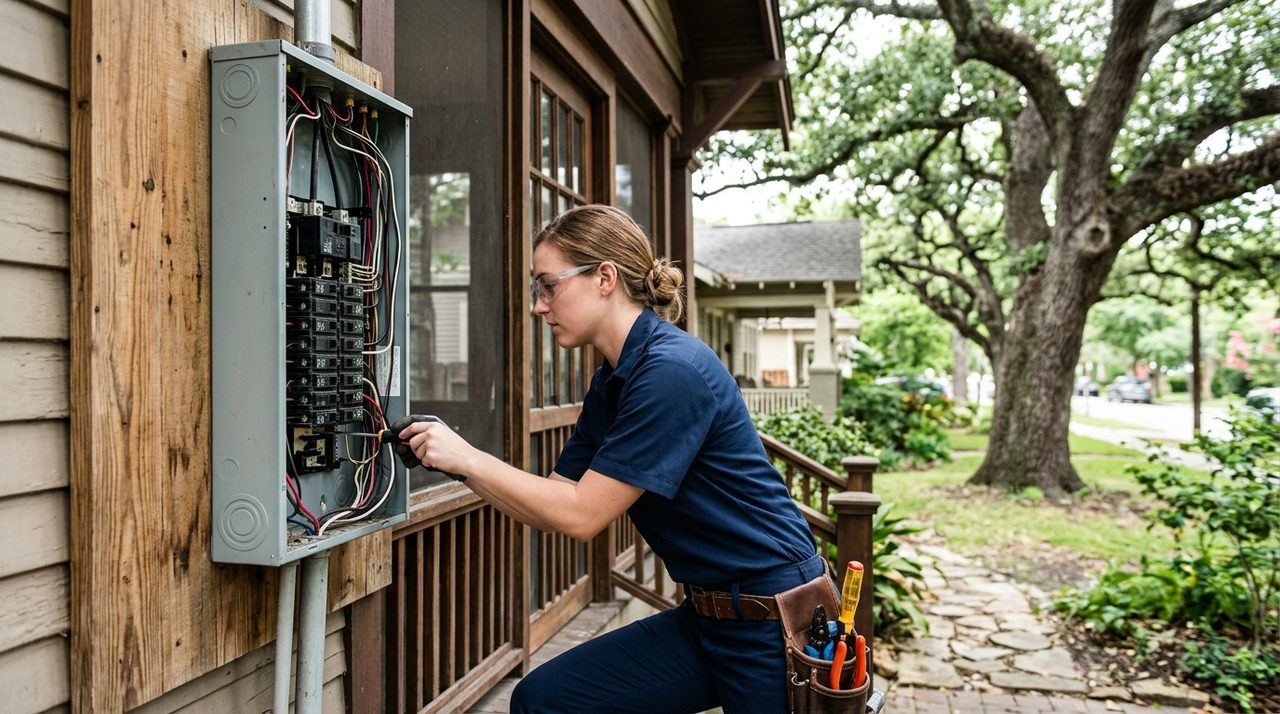
Many of the original River Oaks estate homes that survived teardown pressure still carry their 1940s–1960s electrical infrastructure, including 100-amp main service panels that were sized for modest lighting and a few appliances — not the zoned HVAC systems, chef kitchens, home theaters, and whole-home generators that today's luxury renovations demand. When Uri hit in February 2021 and homeowners added electric space heaters or heat-pump water heaters as gas-supply backups, these undersized services became genuinely dangerous, causing nuisance tripping and overheated conductors in wall cavities hidden behind original millwork. A 5,000-square-foot Georgian Colonial running a 4-ton zoned HVAC system, an EV charger, and a standby generator simply cannot operate safely on a panel designed when Eisenhower was president.
What a good pro does
A licensed Master Electrician — the credential required by TDLR to pull permits in Texas — will perform a load calculation per NEC Article 220 and specify whether a 200A or 400A service upgrade is warranted; for estates adding solar, EV charging, and a whole-home standby generator concurrently, 400A is increasingly the baseline. The electrician pulls the electrical permit through the Houston Permitting Center, CenterPoint Energy disconnects and reconnects the utility drop around the upgrade, and the work is inspected by the City of Houston before energization. Budget estimates run $1,800–$3,200 installed for a 100A-to-200A upgrade and $3,500–$6,000 for 400A service — both are estimates that vary with site conditions and current permit fees.
Sources: Texas Department of Licensing & Regulation, City of Houston Permitting Center, International Residential Code (as adopted by City of Houston)
Why it matters to you
River Oaks's build-out spans nearly a century: alongside the 1920s Tudor originals sit early-postwar additions and 1965–1975 infill homes constructed during Houston's aluminum-wiring era. Those postwar additions and infill structures frequently have single-strand aluminum branch circuits that oxidize at every receptacle and switch termination, generating heat that can smolder inside walls for hours before becoming visible. As River Oaks homeowners undertake whole-house gut renovations to modernize surviving estates, inspectors routinely flag these aluminum circuits — and a sale-pending inspection on a $2M+ home that surfaces unaddressed aluminum wiring can derail a closing fast.
What a good pro does
Proper remediation is not a coat of No-Ox paste: it requires either full replacement with copper conductors or the installation of CO/ALR-rated devices and listed AlumiConn connectors at every single termination on every affected circuit — a scope that runs an estimated $3,500–$8,000 for a whole home depending on square footage and circuit count. The electrician pulls a City of Houston electrical permit through the Houston Permitting Center for all remediation work, and the completed installation is inspected before walls are closed. For major River Oaks renovations preserving original architectural character, sequencing aluminum remediation before plaster restoration saves the cost of reopening finished walls.
Sources: City of Houston Permitting Center, Texas Department of Licensing & Regulation, International Residential Code (as adopted by City of Houston)
Why it matters to you
River Oaks's magnificent tree canopy — the mature live oaks and pecans that define the streetscape — became a liability during the May 2024 derecho and Hurricane Beryl, both of which brought sustained winds exceeding 80 mph across the inner loop. Limbs sheared overhead service drops, bent mast risers off original masonry facades, and pulled meter cans from brick walls on homes throughout the neighborhood. CenterPoint Energy is responsible only for the utility side of the connection; the weatherhead, mast, meter base, and service entrance cable from the meter to the panel are the homeowner's responsibility, meaning storm-damaged River Oaks estates needed both a licensed electrician and a CenterPoint reconnect appointment before power could be restored.
What a good pro does
After any storm event, do not allow CenterPoint to reconnect power until a licensed electrician has physically inspected the weatherhead, mast, meter base, and the first six feet of service entrance cable for physical damage, water intrusion, and conductor insulation integrity. Repairs require an electrical permit from the Houston Permitting Center and a City of Houston inspection before CenterPoint will restore service — so calling the electrician first, before calling CenterPoint, actually shortens the total outage time. For homes with exposed overhead service on original 1930s mast configurations, this is also the logical moment to evaluate conversion to an underground service lateral, which eliminates future weatherhead exposure risk.
Sources: City of Houston Permitting Center, Texas Department of Licensing & Regulation, Local HOA / deed restrictions (see area profile)
Why it matters to you
River Oaks estates that have retained original plaster ceilings, coffered millwork, and ornate light fixture locations often have decades of attic-run wiring in junction boxes that nobody has opened since the Truman administration. Houston's average relative humidity exceeds 75%, and River Oaks attics routinely exceed 140°F in summer; that combination accelerates oxidation of wire nuts, corrodes aluminum neutral conductors, and degrades THHN insulation — all hidden above ceilings that no owner wants to cut into. Homeowners typically discover the problem only when a breaker trips repeatedly or a thermal imaging scan during a pre-renovation assessment reveals a hot spot directly above a plaster medallion.
What a good pro does
Before closing walls or ceilings during any River Oaks renovation, schedule a thermal imaging inspection of the attic wiring runs; a qualified electrician can identify hot splices without destructive access. Where corroded junction boxes are found, the fix is opening the box, replacing oxidized connectors with properly rated wire nuts or lever-lock connectors, verifying neutral integrity, and ensuring every box has a removable cover — a requirement under NEC 314.29 that is inspected as part of City of Houston electrical permits. In attic spaces with particularly severe thermal cycling, the electrician may recommend transitioning exposed wire runs to conduit-protected wiring, which also simplifies future access when the next generation of owners renovates.
Sources: City of Houston Permitting Center, Texas Department of Licensing & Regulation, International Residential Code (as adopted by City of Houston)
Hiring electricians in River Oaks? River Oaks is Houston's premier residential neighborhood, featuring 1920s–1930s estate homes alongside modern luxury rebuilds on large lots. Homeowners face a unique combination of mandatory HOA oversight from River Oaks Property Owners, Inc. (ROPO), strict deed restrictions, and the maintenance demands of aging pier-and-beam foundations, mature tree root systems, and historic-era plumbing and electrical. Contractors working here must navigate both high client expectations and the regulatory requirements of the City of Houston permitting process.
Building era
1920s–1930s (original build-out), with significant post-1980 and 2000s-present luxury infill and teardown rebuilds.
Typical style
English Tudor, Spanish Colonial Revival, Georgian, Colonial, and contemporary custom luxury homes.
Foundations
Mixed — older homes predominantly pier-and-beam; newer construction and rebuilds typically slab-on-grade with post-tension or drilled piers.
Common systems
Original homes may retain cast-iron drain lines, galvanized supply piping, and older panel boxes requiring upgrades. Newer builds feature modern PEX/copper plumbing, 200+ amp electrical panels, and high-efficiency zoned HVAC systems. Mature-era homes often have outdated ductwork and window-unit retrofits.
What that means for repairs
Teardown-and-rebuild activity is extremely common on original lots, as land values far exceed structure values for many older homes. Whole-house gut renovations of surviving 1920s–1940s estates are also frequent, typically involving foundation leveling, full re-plumbing, electrical panel upgrades, and HVAC modernization while preserving architectural character.
Permit jurisdiction
Houston Permitting Center (City of Houston).
HOA & deed restrictions
Core River Oaks platted sections (e.g., River Oaks Sec 01) are governed by River Oaks Property Owners, Inc. (ROPO) — a mandatory HOA/POA with recorded deed restrictions. Adjacent pockets such as Huldy Street Terrace / Shepherd Crest near the River Oaks Shopping Area have no HOA. Condominiums like River Oaks Gardens are governed by their own condo associations (e.g., River Oaks Gardens Council of Co-Owners). Related civic organizations in the broader super neighborhood include Avalon Property Owners Association and West Lane Place Civic Association.
Historic districts
No City of Houston historic district designation confirmed. River Oaks is deed-restricted through its original master-planned community covenants, but this is a private restriction, not a Houston Archaeological and Historical Commission (HAHC) overlay.
Contractor note
ROPO and section POAs actively monitor and may require pre-approval for exterior modifications, fencing, and new construction visible from the street. Contractors should verify both City of Houston permit requirements and HOA/deed restriction compliance before beginning any exterior or structural work.
FEMA flood zone
FEMA Zone X (low flood risk) per official NFHL data. However, the neighborhood's western edge borders Buffalo Bayou, and localized street flooding can occur during extreme rainfall events despite the low-risk designation.
Hurricane Harvey impact
Not confirmed with specific damage data from research — River Oaks experienced some flooding during Hurricane Harvey (2017), particularly in areas closest to Buffalo Bayou. The neighborhood's elevation and drainage infrastructure offered relative protection to many homes, but properties along the bayou corridor and lower-lying lots did sustain water damage. Check Harris County Flood Control District records for property-specific Harvey inundation data.
Heat & humidity load
Houston's extreme summer heat and humidity place heavy demands on HVAC systems in River Oaks' large-footprint homes, especially older estates with poor insulation and aging ductwork. Mature tree canopy provides shade but contributes to foundation movement through root-driven soil moisture changes. Pier-and-beam crawl spaces in original homes require ventilation monitoring to prevent moisture-related wood damage.
Working with contractors here
The most common contractor work in River Oaks includes foundation repair and leveling on 1920s–1940s pier-and-beam structures, whole-house re-plumbing to replace cast-iron and galvanized lines, electrical panel upgrades from 100-amp to 200+ amp service, and full HVAC system replacements with zoned systems for 5,000–16,000+ square foot homes. Teardown-and-rebuild projects are a significant portion of new construction activity, requiring demolition, site engineering, and ground-up custom builds. Contractors should expect extended project timelines due to ROPO architectural review, City of Houston permitting for demolitions and new construction, and the high-end finish expectations of River Oaks homeowners. Job scoping must account for mature tree preservation ordinances, potential asbestos and lead paint in pre-1980 structures, and limited staging space on densely landscaped lots.
Local Tip
Always ask for a written estimate before work begins. Texas contractors are required to provide one on jobs over $1,000.
River Oaks is Houston's premier residential neighborhood, featuring 1920s–1930s estate homes alongside modern luxury rebuilds on large lots. Homeowners face a unique combination of mandatory HOA oversight from River Oaks Property Owners, Inc. (ROPO), strict deed restrictions, and the maintenance demands of aging pier-and-beam foundations, mature tree root systems, and historic-era plumbing and electrical. Contractors working here must navigate both high client expectations and the regulatory requirements of the City of Houston permitting process.
Source: U.S. Census Bureau, ACS 5-Year 2023
Most of River Oaks maps to FEMA Zone X (low mapped flood risk), but Houston's flash-flood reality means even low-risk blocks benefit from smart drainage and storm-hardened installs; risk climbs sharply on blocks nearest Buffalo Bayou, where it varies parcel to parcel.
Source: FEMA National Flood Hazard Layer (NFHL). Flood zones vary by parcel — verify your individual FIRM panel.
Beryl 2024 demonstrated that Houston's above-ground distribution grid fails even in areas well away from surge zones, leaving River Oaks residents in dangerous July heat without a way to power fans or refrigeration. Protect your home's sensitive electronics — smart panels, EV chargers, and variable-speed HVAC controls — with a whole-house surge protector installed by a licensed electrician before the next storm forms in the Gulf. Confirm the current FEMA panel for your River Oaks parcel — the area maps to Zone X, but adjacent lots can differ.
After the May 2024 derecho left parts of River Oaks dark for four days, homeowners without transfer switches had no safe way to connect a generator — a TDLR-licensed electrician can install an interlock kit on most existing panels in four hours, making it one of the most time-effective storm-prep investments available. Book the work now, before the next round of severe weather puts every licensed electrician in Houston on a three-week waiting list. Confirm the current FEMA panel for your River Oaks parcel — the area maps to Zone X, but adjacent lots can differ.
In River Oaks, the primary ice-storm electrical risk is the same one that paralyzed Houston during Uri 2021: extended outage combined with unsafe generator use inside or near the home. A TDLR-licensed electrician can install a transfer switch or interlock kit that lets you run your furnace blower, well pump, and essential circuits from a portable generator safely, without the back-feed risk that puts CenterPoint lineworkers in danger during restoration. In-city River Oaks work falls under City of Houston floodplain and permitting rules.
Sources: FEMA National Flood Hazard Layer (NFHL), Ready.gov -- Hurricanes, CenterPoint Energy -- Storm Center, City of Houston -- Emergency Preparedness, Ready.gov -- Winter Weather, Harris County Flood Control District
Houston-specific estimators to plan your project before you call a pro. All results are planning estimates — a licensed local pro confirms the details on site.
Disconnect & drain every outdoor hose bib
Remove hoses, drain the spigots, and cover each with an insulated faucet sock. Un-drained hose bibs are the #1 burst point in a Houston freeze.
Insulate exposed pipes in the attic & garage
Wrap any pipe in an unconditioned space (attic runs, garage walls) with foam sleeves. Houston homes rarely insulate these because they only matter a few nights a year — which is exactly why they burst.
Open cabinet doors & keep a pencil-width drip
On hard-freeze nights, open kitchen/bath cabinets so warm air reaches the pipes and let faucets on exterior walls drip to relieve pressure.
Protect the attic/garage water heater & its lines
An attic or garage tank sits in unconditioned space. Insulate the cold-inlet and hot-outlet lines and confirm the emergency drain pan is clear so a leak doesn't reach the ceiling.
This is a planning estimate only — actual requirements depend on an on-site assessment by a licensed Houston pro. If a pipe has already burst, shut off your main water supply and call a licensed Houston plumber immediately — freeze bursts flood fast.
Sources: City of Houston Permitting CenterLocal HOA / deed restrictions (see area profile)
Sources: City of Houston Permitting CenterInternational Residential Code (as adopted by City of Houston)
Sources: City of Houston Permitting CenterLocal HOA / deed restrictions (see area profile)
Sources: City of Houston Permitting Center
Sources: Local HOA / deed restrictions (see area profile)City of Houston Permitting CenterTexas Department of Licensing & Regulation