Open Now
1719 Marshall St, Houston, TX 77098
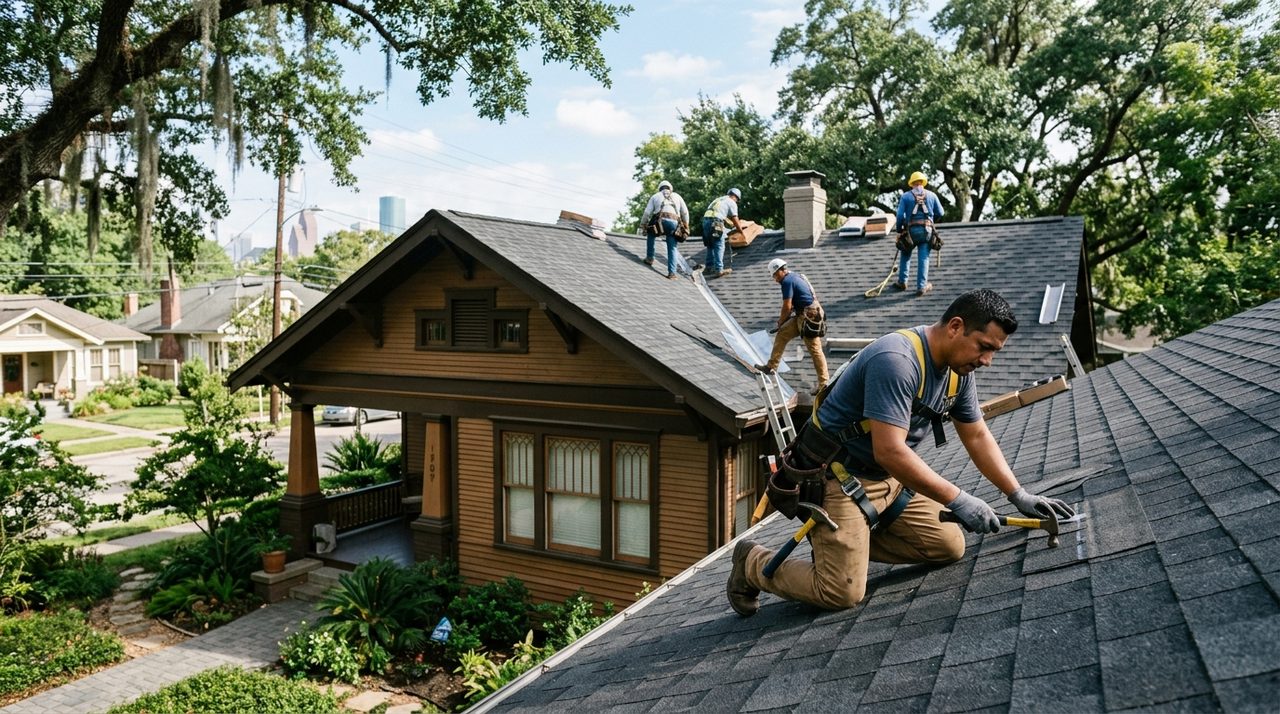
Upper Kirby's roofing landscape is unlike any other Houston neighborhood: a single block can hold a 1950s pier-and-beam bungalow, a three-story stucco townhome cluster, and a mid-rise condominium whose roof is governed by a COA—not the individual owner. City of Houston permitting rules apply throughout, but every exterior roofing scope on a condo or townhome here must also clear an individual building HOA or COA before a single shingle comes off, making pre-project coordination as important as the repair itself.
Ranked by verified Google rating × review volume × verification tier. How we rank →
Some highly-rated pros serve Upper Kirby from nearby and may not keep a Upper Kirby street address. Those are listed under "Also serving Upper Kirby" with their real city and distance, so you always know where each business is based.
1719 Marshall St, Houston, TX 77098
2925 Richmond Ave Floor 12, Houston, TX 77098
Highly-rated pros based nearby who cover Upper Kirby. Distance shown from the Upper Kirby area.
Serving Upper Kirby Based in Galleria · 0.7 mi away
Serving Upper Kirby Based in West University · 0.8 mi away
Serving Upper Kirby Based in West University · 1.4 mi away
Serving Upper Kirby Based in Lazybrook / Timbergrove · 2.5 mi away
Serving Upper Kirby Based in River Oaks · 2.5 mi away
Serving Upper Kirby Based in Lazybrook / Timbergrove · 2.5 mi away
Serving Upper Kirby Based in Tanglewood · 2.5 mi away
Serving Upper Kirby Based in Tanglewood · 2.6 mi away
Why it matters to you
Upper Kirby's dominant housing form — the three-story infill townhome built between the 1990s and 2020s on small lots — almost always incorporates a flat or low-slope rooftop deck or mechanical well. These sections routinely sit below a 2:12 pitch, making them susceptible to prolonged ponding after Houston's intense rain events. With the neighborhood's median year-built of 1994, many modified bitumen and early TPO membranes on these structures are approaching or past their practical service life, and Houston's high annual humidity above 75% accelerates membrane delamination when drainage scuppers clog.
What a good pro does
A qualified roofer should probe the membrane for soft spots indicating trapped moisture beneath the surface, inspect and clear all interior drains and scuppers, and specify a replacement system rated for ponding conditions (typically a mechanically attached TPO or torch-applied modified bitumen with a minimum 10-year membrane warranty). Because these townhomes are tightly clustered with shared walls, the roofer must pull a City of Houston building permit for any structural deck repair — the Houston Permitting Center requires it — and must also submit exterior scope details to the individual building's COA or HOA for approval before scheduling the tear-off.
Sources: City of Houston Permitting Center, Local HOA / deed restrictions (see area profile), International Residential Code (as adopted by City of Houston)
Why it matters to you
A meaningful share of Upper Kirby's surviving 1940s–1960s single-family homes on Kirby Drive's side streets still carry their original gable-only or box-vent attic ventilation — no ridge vent system — which is wholly inadequate for Houston's year-round humidity. Without balanced ridge-to-soffit airflow per IRC R806 ratios, moisture condenses on OSB or board-sheathed decking continuously, not just in winter. Several of these homes also accumulated two or more shingle layers before the current owners purchased, which traps heat and moisture against the deck and masks rot that only becomes visible during full tear-off.
What a good pro does
Before accepting a surface-level repair bid on one of these older homes, insist on a full deck inspection after stripping all layers — a responsible roofer will probe for soft spots and delamination before pricing. The re-roof scope should include installing a continuous ridge vent and clearing or expanding soffit intake venting to meet IRC ventilation ratios, not just swapping shingles. The City of Houston does not require a permit for a like-for-like shingle replacement on a non-structural repair, but any deck board replacement or structural vent modification does require a permit through the Houston Permitting Center.
Sources: International Residential Code (as adopted by City of Houston), City of Houston Permitting Center
Why it matters to you
Upper Kirby has no single neighborhood-wide HOA, but virtually every mid- and high-rise condo and townhome cluster — including buildings along Kirby Drive and West Main Street — operates under a mandatory COA or HOA with its own Architectural Review process. After the May 2024 derecho pushed 100-plus mph straight-line winds across Harris County, owners in these buildings discovered that even emergency shingle or membrane repairs on common-area roof sections required board approval, which can take 10–30 days under many COA bylaws. Owners who bypassed the process and hired a roofer directly faced fines and, in some cases, forced removal of the repair.
What a good pro does
Contact your building's COA or HOA management company before signing any roofing contract — get the required submittal form, approved-materials list, and realistic ARC timeline in writing. A roofer experienced in Upper Kirby's condo market will have COA submittal packets ready and can document emergency conditions that may qualify for expedited review under the building's bylaws. For single-family detached homes on deed-restricted lots, verify your specific plat's restrictions, since there is no master HOA governing the entire Upper Kirby area.
Sources: Local HOA / deed restrictions (see area profile), Municipal permit office (see area profile)
Why it matters to you
Upper Kirby's dense urban fabric offers limited tree canopy compared to Memorial or The Woodlands, leaving south- and west-facing roof planes on both surviving bungalows and newer townhomes fully exposed to Houston's 2,700-plus annual cooling degree days and ambient summer temperatures that push attic decks above 160°F. Standard 30-year architectural shingles under these conditions realistically last 15–18 years, meaning the wave of townhomes built here in the mid-1990s through early 2000s — reflected in the neighborhood's 1994 median year-built — is entering or already past its practical shingle replacement window, regardless of what the warranty paperwork says.
What a good pro does
When replacing shingles on a south- or west-facing Upper Kirby roof, ask your roofer to quote Class 4 impact-resistant shingles with a high solar reflectance index — Energy Star-rated cool-roof products can meaningfully reduce attic temperatures and qualify for utility rebates from CenterPoint Energy. The upgrade typically adds an estimated $1,500–$3,500 to total project cost but extends the realistic service interval and lowers cooling load in homes that already carry heavy air-conditioning burdens. Confirm that any proposed product color or material change is permissible under your specific building's COA guidelines before ordering materials.
Sources: ENERGY STAR / U.S. Dept. of Energy, Local HOA / deed restrictions (see area profile), International Residential Code (as adopted by City of Houston)
Hiring roofers in Upper Kirby? Upper Kirby's housing stock spans mid-century single-family homes, modern townhomes, and mid- to high-rise condominiums, creating an unusually diverse home service landscape within a compact urban footprint. Contractors must be prepared for slab-on-grade foundations on newer builds, occasional pier-and-beam on surviving 1940s–1960s homes, and the unique permitting and access challenges of working in dense multifamily structures. Individual condo and townhome buildings typically have their own HOA rules governing exterior work, so verifying architectural guidelines before scoping a project is essential.
Building era
Mixed: original single-family from 1940s–1960s; heavy infill redevelopment from 1980s–present, with ongoing high-rise construction through the 2020s.
Typical style
Modern urban townhomes (three-story stucco/brick), mid- and high-rise contemporary condominiums, and remaining mid-century bungalows and ranch-style homes.
Foundations
Predominantly slab-on-grade for post-1970 townhomes, condos, and newer single-family; some remaining pier-and-beam on older mid-century homes.
Common systems
Newer townhomes and condos typically have central HVAC with high-efficiency units, PEX or copper plumbing, and 200-amp electrical panels. Surviving mid-century homes may have original galvanized or cast-iron plumbing, older R-22 HVAC systems, and 100-amp electrical service requiring upgrades.
What that means for repairs
Tear-down-and-rebuild of mid-century single-family lots into townhome clusters is the dominant renovation pattern. Condo and townhome interior remodels—kitchens, bathrooms, and flooring—are extremely common. Older surviving homes frequently need full plumbing re-pipes, electrical panel upgrades, and HVAC replacements.
Permit jurisdiction
City of Houston — Houston Permitting Center.
HOA & deed restrictions
No single mandatory neighborhood-wide HOA exists. Individual condo and townhome buildings (e.g., 2520 Robinhood at Kirby COA) have mandatory HOAs/COAs. Detached single-family homes may be subject to lot-level deed restrictions and voluntary civic clubs, but no master HOA governs the entire Upper Kirby area.
Historic districts
No City of Houston historic district designation confirmed.
Contractor note
Contractors working in condo or townhome buildings must coordinate with the individual building's HOA or COA for exterior modifications, access scheduling, and noise restrictions. Deed restrictions on single-family lots vary by plat and should be verified before proposing exterior changes.
FEMA flood zone
FEMA Zone X (low flood risk) per official NFHL data. Upper Kirby is not immediately adjacent to a major bayou channel, though it sits between Buffalo Bayou to the north and Braes Bayou to the south. Property-level flood determinations should still be verified for parcels near drainage corridors.
Hurricane Harvey impact
No publicly available sources single out Upper Kirby as a major repetitive structural flood-loss area during Hurricane Harvey. The neighborhood experienced citywide street ponding common across Inner Loop commercial corridors, but it was not identified as a Harvey hot spot comparable to Meyerland or Memorial. Property-level Harvey impact should be confirmed through seller disclosures and Harris County Flood Control District records.
Heat & humidity load
Houston's extreme summer heat and humidity drive heavy HVAC demand across all building types. Older mid-century homes with original insulation and single-pane windows struggle with cooling efficiency. High-rise and mid-rise condos may experience rooftop HVAC unit strain and condensate drain issues. Flat-roof townhomes common in the area require regular inspection for ponding water and membrane degradation.
Working with contractors here
Upper Kirby's contractor demand is driven by its three distinct housing types. Modern townhomes and condos generate steady interior remodel work—kitchen and bath upgrades, flooring, and smart home installations—often requiring HOA-compliant specifications and contractor insurance minimums. Surviving mid-century single-family homes frequently need full mechanical system overhauls: galvanized plumbing re-pipes, electrical panel upgrades from 100 to 200 amps, and HVAC conversions from R-22 to modern refrigerant systems. The neighborhood's density creates logistical challenges including limited staging areas, tight lot access, and coordinating with building management for elevator and loading dock access in high-rise projects. Contractors should plan for City of Houston permitting timelines and verify whether individual building HOAs require pre-approved contractor lists or additional liability coverage.
Local Tip
Always ask for a written estimate before work begins. Texas contractors are required to provide one on jobs over $1,000.
Upper Kirby's housing stock spans mid-century single-family homes, modern townhomes, and mid- to high-rise condominiums, creating an unusually diverse home service landscape within a compact urban footprint. Contractors must be prepared for slab-on-grade foundations on newer builds, occasional pier-and-beam on surviving 1940s–1960s homes, and the unique permitting and access challenges of working in dense multifamily structures. Individual condo and townhome buildings typically have their own HOA rules governing exterior work, so verifying architectural guidelines before scoping a project is essential.
Source: U.S. Census Bureau, ACS 5-Year 2023
Most of Upper Kirby maps to FEMA Zone X (low mapped flood risk), but Houston's flash-flood reality means even low-risk blocks benefit from smart drainage and storm-hardened installs.
Source: FEMA National Flood Hazard Layer (NFHL). Flood zones vary by parcel — verify your individual FIRM panel.
Even in lower-risk Upper Kirby, a Gulf hurricane can drive 130-mph gusts that peel ridge caps and send shingles airborne, so have a TDLR-licensed roofer apply additional hand-sealing to all perimeter and hip shingles with roofing cement before the season opens. A two-hour prep visit is far less disruptive than a post-storm emergency tarp call when every roofer in Houston is booked. Confirm the current FEMA panel for your Upper Kirby parcel — the area maps to Zone X, but adjacent lots can differ.
After a severe thunderstorm, the first thing a roofer should check in Upper Kirby is whether wind-driven rain has pushed up under any low-slope transition sections—areas where a steep roof meets a flatter porch or addition—because these joints separate under gust pressure and rarely reseal on their own. Sealing those transitions with a peel-and-stick modified bitumen patch costs far less than replacing the framing they protect. In-city Upper Kirby work falls under City of Houston floodplain and permitting rules.
Even in lower-flood-risk Upper Kirby, a hard freeze following a rainstorm can trap water under lifted perimeter shingles and expand it into cracks in the decking, a failure mode that became widespread during Uri 2021. Ask a roofer to hand-seal any perimeter shingles showing daylight beneath them before December so freeze-water expansion does not open your deck to spring rains. In-city Upper Kirby work falls under City of Houston floodplain and permitting rules.
Sources: FEMA National Flood Hazard Layer (NFHL), Ready.gov -- Hurricanes, CenterPoint Energy -- Storm Center, City of Houston -- Emergency Preparedness, Ready.gov -- Winter Weather, Harris County Flood Control District
Houston-specific estimators to plan your project before you call a pro. All results are planning estimates — a licensed local pro confirms the details on site.
Estimated design wind speed for your zone
Outside the TDI catastrophe area, so a WPI-8 is generally not mandated — but Houston still sees hurricane-force gusts (Beryl, 2024). Insist on properly rated shingles installed to the manufacturer's high-wind nailing pattern (6 nails) and starter strips, or a wind claim can be denied for improper installation.
Find a Houston roofer →This is a planning estimate only — actual requirements depend on an on-site assessment by a licensed Houston pro. Wind-speed zones are approximate; your exact TDI/WPI-8 obligation depends on your address's designation. Verify with the Texas Department of Insurance before contracting.
Disconnect & drain every outdoor hose bib
Remove hoses, drain the spigots, and cover each with an insulated faucet sock. Un-drained hose bibs are the #1 burst point in a Houston freeze.
Insulate exposed pipes in the attic & garage
Wrap any pipe in an unconditioned space (attic runs, garage walls) with foam sleeves. Houston homes rarely insulate these because they only matter a few nights a year — which is exactly why they burst.
Open cabinet doors & keep a pencil-width drip
On hard-freeze nights, open kitchen/bath cabinets so warm air reaches the pipes and let faucets on exterior walls drip to relieve pressure.
Protect the attic/garage water heater & its lines
An attic or garage tank sits in unconditioned space. Insulate the cold-inlet and hot-outlet lines and confirm the emergency drain pan is clear so a leak doesn't reach the ceiling.
This is a planning estimate only — actual requirements depend on an on-site assessment by a licensed Houston pro. If a pipe has already burst, shut off your main water supply and call a licensed Houston plumber immediately — freeze bursts flood fast.
Sources: City of Houston Permitting CenterMunicipal permit office (see area profile)
Sources: Municipal permit office (see area profile)Texas Windstorm Insurance Association (TWIA)
Sources: FEMA National Flood Hazard Layer (NFHL)International Residential Code (as adopted by City of Houston)
Sources: Local HOA / deed restrictions (see area profile)ENERGY STAR / U.S. Dept. of Energy
Sources: City of Houston Permitting Center