Open Now
10101 Fondren Rd, Houston, TX 77096
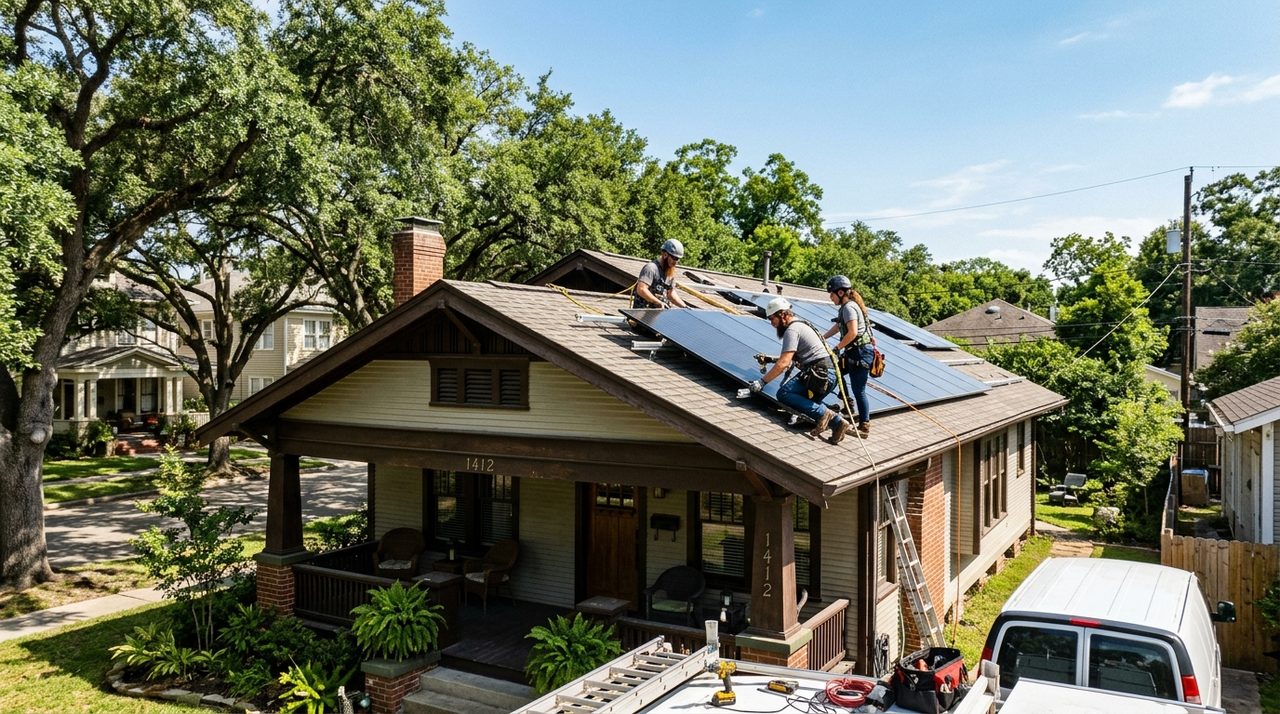
Meyerland's landscape of flood-battered mid-century ranch homes and post-Harvey elevated rebuilds creates a uniquely complicated environment for solar installation — aging low-slope roofs on original 1960s brick ranches, mixed electrical panel vintages, and mandatory MCIA deed-restriction review all add steps that most generic solar quotes ignore. Understanding how Brays Bayou flood history, City of Houston permitting, and Meyerland's split housing stock interact with a 25-year panel commitment is the difference between a sound investment and a costly do-over.
Ranked by verified Google rating × review volume × verification tier. How we rank →
Some highly-rated pros serve Meyerland from nearby and may not keep a Meyerland street address. Those are listed under "Also serving Meyerland" with their real city and distance, so you always know where each business is based.
10101 Fondren Rd, Houston, TX 77096
Highly-rated pros based nearby who cover Meyerland. Distance shown from the Meyerland area.
Serving Meyerland Based in Bellaire · 2 mi away
Serving Meyerland Based in Medical Center · 2.2 mi away
Serving Meyerland Based in Bellaire · 2.3 mi away
Serving Meyerland Based in Medical Center · 2.5 mi away
Serving Meyerland Based in Bellaire · 2.9 mi away
Serving Meyerland Based in Upper Kirby · 3.2 mi away
Serving Meyerland Based in Sharpstown · 4 mi away
Serving Meyerland Based in Westbury · 4.7 mi away
Why it matters to you
Meyerland's signature mid-century single-story brick ranch homes were built with low-slope or nearly flat roof profiles that are already prone to ponding during Houston's frequent 10-inch-plus rain events. Houston's UV index averaging 10–11 and relentless summer humidity degrade standard asphalt shingles in 12–15 years, not the rated 20–25 — and a home originally built in 1962 may have had multiple budget emergency re-roofs after repeated flooding in 2015, 2016, and 2017 that are now quietly failing. Mounting a 25-year solar array on one of these roofs without a thorough condition assessment virtually guarantees a $8,000–$14,000 panel removal and reinstall bill within a few years.
What a good pro does
A qualified installer should pull the permit history from the Houston Permitting Center and physically inspect the roof deck, not just the surface, before committing to a quote — specifically looking for water infiltration around existing penetrations on the low-slope sections. If the roof is within 7–10 years of end of life, the honest recommendation is to bundle a full re-roof into the project scope before racking goes on. All electrical and structural permits are filed with the City of Houston; the master electrician of record must be TDLR-licensed and named on the permit application.
Sources: City of Houston Permitting Center, Texas Department of Licensing & Regulation, International Residential Code (as adopted by City of Houston)
Why it matters to you
A large share of Meyerland homes have been elevated above base flood elevation since Harvey — some sit on raised slabs four or more feet above grade — while unrenovated originals remain at their 1962 slab elevation in the same FEMA Zone AE high-risk flood zone. For solar projects, the critical consequence is equipment placement: string inverters, combiner boxes, and battery storage units installed at grade or in a ground-floor utility room on an un-elevated home are directly exposed to the next AE-zone flood event, which FEMA maps indicate has a 1-percent annual chance of occurring. A flooded inverter or battery is not a warranty claim — it is a total loss.
What a good pro does
On original un-elevated ranch homes, a competent installer positions all inverters and battery enclosures at a height that meets or exceeds the neighborhood's base flood elevation, typically by mounting them on the wall of an attached garage above the BFE rather than on the floor slab. On post-Harvey elevated rebuilds with 200-amp panels already in place, battery integration (Powerwall or Enphase IQ) is more straightforward, but the CenterPoint interconnection application for a storage-paired system still requires a separate metering amendment that can add 6–10 weeks to energization. Confirm BFE for the specific parcel with Harris County Flood Control before finalizing equipment locations.
Sources: FEMA National Flood Hazard Layer (NFHL), City of Houston Permitting Center
Why it matters to you
The Meyerland Community Improvement Association enforces deed restrictions across all roughly 2,238 homes in the neighborhood, and under Texas Property Code §202.010, the MCIA retains the right to require that panels not be visible from the street. For Meyerland's typical east-west oriented ranch homes with street-facing south slopes, this can mean the HOA directs arrays to rear-facing north or rear-facing east exposures — orientations that routinely reduce annual production 15–25% compared to optimal south-facing placement. A solar quote built on south-facing assumptions but delivered on a north rear slope will miss its payback projection by years.
What a good pro does
Before finalizing system sizing, submit the proposed layout to the MCIA at 4999 W. Bellfort Ave. for written approval — verbal assurances are not binding. A good installer will model production for the HOA-approved placement using actual CenterPoint historical usage data from your account, not national averages, and will resize the array upward if a suboptimal orientation reduces output below your offset target. Get the MCIA approval letter in hand before the City of Houston permit application is filed, since a mid-project redesign resets the permit timeline.
Sources: Local HOA / deed restrictions (see area profile), City of Houston Permitting Center
Why it matters to you
Meyerland has an unusually split electrical reality: original 1960s ranch homes frequently still have 60–100 amp panels, while post-Harvey rebuilds installed since 2017 typically have modern 200-amp service. Post-Uri demand for battery backup has accelerated across the neighborhood, but City of Houston AHJ requirements on battery enclosure fire separation and the CenterPoint interconnection tariff for storage-paired systems add complexity regardless of which housing vintage you own. On unrenovated originals with undersized panels, a battery integration project almost always requires a panel upgrade first — a cost of $3,000–$6,000 that solar sales quotes often omit.
What a good pro does
Ask any installer for a written scope that explicitly lists whether a panel upgrade is included and how the battery enclosure fire separation will be documented for the City of Houston building inspection. The master electrician pulling the permit under TDLR must sign off on the full electrical scope, including the panel upgrade if required, before the CenterPoint storage interconnection application can proceed. For post-Harvey rebuilds with 200-amp service already installed, confirm the existing panel brand is not on CenterPoint's compatibility exception list before purchasing battery hardware.
Sources: Texas Department of Licensing & Regulation, City of Houston Permitting Center, Municipal permit office (see area profile)
Hiring solar installers in Meyerland? Meyerland is a deed-restricted southwest Houston neighborhood of roughly 2,238 single-family homes, most originally built in the late 1950s–1960s, with a significant wave of post-Harvey rebuilds and elevations since 2017. The neighborhood sits in FEMA Zone AE near Brays Bayou, making flood mitigation, foundation elevation, and water damage restoration among the most critical home service categories. Contractors here must navigate mandatory HOA oversight through the Meyerland Community Improvement Association and City of Houston permitting requirements.
Building era
Late 1950s–1960s (median year built 1962), with substantial post-2017 new construction and rebuilds.
Typical style
Mid-century ranch-style single-story homes (brick veneer, low-sloped roofs) alongside newer two-story traditional/transitional rebuilds.
Foundations
Predominantly slab-on-grade; many post-Harvey rebuilds feature elevated slab foundations raised above base flood elevation.
Common systems
Original homes often have aging central HVAC systems, copper or galvanized plumbing, and older electrical panels (60–100 amp). Rebuilt homes typically have modern high-efficiency HVAC, PEX plumbing, and 200-amp electrical service.
What that means for repairs
Post-flood gut renovations and full rebuilds have been the dominant renovation activity since 2015. Many homeowners have elevated homes, replaced all drywall and insulation, upgraded plumbing to PEX, and installed modern HVAC. Unrenovated original ranch homes still require significant systems updates.
Permit jurisdiction
City of Houston — Houston Permitting Center.
HOA & deed restrictions
Mandatory HOA — Meyerland Community Improvement Association (MCIA), 4999 W. Bellfort Ave., Houston, TX 77035, (713) 729-2167. MCIA maintains a management certificate with the Texas Real Estate Commission and enforces deed restrictions across the neighborhood.
Historic districts
No City of Houston historic district designation confirmed.
Contractor note
Contractors must obtain City of Houston permits for structural, electrical, plumbing, and mechanical work. MCIA deed restrictions may also govern exterior modifications, fencing, and accessory structures — always verify with the HOA before beginning exterior work.
FEMA flood zone
FEMA Zone AE (high flood risk) — source: fema_nfhl. Meyerland is situated adjacent to Brays Bayou, and much of the neighborhood falls within the 100-year floodplain. Properties closest to the bayou and in lower-lying sections face the highest risk.
Hurricane Harvey impact
Meyerland experienced extensive, widespread home flooding during Hurricane Harvey (2017) and is one of Houston's most prominently impacted neighborhoods. The area also flooded significantly during the 2015 Memorial Day Flood and 2016 Tax Day Flood. Sections closest to Brays Bayou (including Meyerland Sections 1–8) were especially hard hit. Hundreds of homes were gutted and many were demolished and rebuilt or elevated. For street-level repetitive loss data, consult the Harris County Flood Education Mapping Tool and FEMA FIRMs.
Heat & humidity load
Original 1960s ranch homes with aging HVAC systems struggle with Houston's extreme summer heat and humidity. Older ductwork in unconditioned attics can develop condensation issues and mold. Post-flood rebuilt homes generally perform better but elevated foundations can expose ductwork and plumbing to extreme heat beneath the structure. Dehumidification and proper attic ventilation are essential across all vintages.
Working with contractors here
The most common contractor work in Meyerland falls into two categories: maintaining and upgrading original 1960s ranch homes, and completing or refining post-Harvey rebuilds and elevations. Plumbing contractors frequently replace galvanized or cast-iron drain lines in original homes, while electricians upgrade older panels to handle modern loads. Foundation repair is common on original slab-on-grade homes due to Houston's expansive clay soils and repeated flood saturation. Flood mitigation work — including home elevation, backflow preventer installation, and flood-resistant material retrofits — remains in high demand. Contractors should scope jobs with the understanding that many homes have had multiple flood events, and hidden moisture damage or improper previous repairs may be present behind walls and under flooring.
Local Tip
Always ask for a written estimate before work begins. Texas contractors are required to provide one on jobs over $1,000.
Meyerland is a deed-restricted southwest Houston neighborhood of roughly 2,238 single-family homes, most originally built in the late 1950s–1960s, with a significant wave of post-Harvey rebuilds and elevations since 2017. The neighborhood sits in FEMA Zone AE near Brays Bayou, making flood mitigation, foundation elevation, and water damage restoration among the most critical home service categories. Contractors here must navigate mandatory HOA oversight through the Meyerland Community Improvement Association and City of Houston permitting requirements.
Source: U.S. Census Bureau, ACS 5-Year 2023
Much of Meyerland maps to FEMA Zone AE (high flood risk), so flood-resilient detailing -- elevated equipment, water-tolerant materials, and drainage-first thinking -- is essential here, not optional; risk climbs sharply on blocks nearest Brays Bayou, where it varies parcel to parcel.
Source: FEMA National Flood Hazard Layer (NFHL). Flood zones vary by parcel — verify your individual FIRM panel.
After Beryl 2024 revealed how quickly FEMA Zone AE inside the 100-year floodplain and proximity to Brays Bayou can strand homeowners without grid power, having a solar-plus-storage system with a properly rated, weatherproof transfer arrangement becomes critical in Meyerland. Schedule a pre-hurricane inspection with your TDLR-licensed installer to confirm all conduit penetrations and combiner boxes are sealed against wind-driven rain. Much of the housing stock predates modern wind codes (median build year 1972), so retrofits matter more here. Confirm the current FEMA panel for your Meyerland parcel — the area maps to Zone AE, but adjacent lots can differ.
Hail stones above one inch in diameter, common in Houston severe thunderstorm outbreaks, can micro-crack solar panel glass without immediately shattering it; homeowners in Meyerland should have a licensed inspector check for delamination and internal cell damage after any significant hail report. Your installer can also confirm whether your specific panel model's hail-impact rating matches the size of hail that struck your neighborhood. In-city Meyerland work falls under City of Houston floodplain and permitting rules.
Ice accumulation on solar panels in Meyerland temporarily reduces output, but the more serious risk is the weight load of thick ice on a racking system not engineered for it — confirm with your licensed installer that your roof structure and mounting hardware meet the load requirements listed in the City of Houston building code for the rare but real Texas ice event. Panels typically self-clear once temperatures rise, but do not attempt to chip ice off manually, as this can crack tempered glass. With a median build year of 1972, the older building stock here is more exposed to hard-freeze damage than newer construction. Confirm the current FEMA panel for your Meyerland parcel — the area maps to Zone AE, but adjacent lots can differ.
Sources: FEMA National Flood Hazard Layer (NFHL), Ready.gov -- Hurricanes, CenterPoint Energy -- Storm Center, City of Houston -- Emergency Preparedness, Ready.gov -- Winter Weather, Harris County Flood Control District
Houston-specific estimators to plan your project before you call a pro. All results are planning estimates — a licensed local pro confirms the details on site.
Disconnect & drain every outdoor hose bib
Remove hoses, drain the spigots, and cover each with an insulated faucet sock. Un-drained hose bibs are the #1 burst point in a Houston freeze.
Insulate exposed pipes in the attic & garage
Wrap any pipe in an unconditioned space (attic runs, garage walls) with foam sleeves. Houston homes rarely insulate these because they only matter a few nights a year — which is exactly why they burst.
Open cabinet doors & keep a pencil-width drip
On hard-freeze nights, open kitchen/bath cabinets so warm air reaches the pipes and let faucets on exterior walls drip to relieve pressure.
Protect the attic/garage water heater & its lines
An attic or garage tank sits in unconditioned space. Insulate the cold-inlet and hot-outlet lines and confirm the emergency drain pan is clear so a leak doesn't reach the ceiling.
This is a planning estimate only — actual requirements depend on an on-site assessment by a licensed Houston pro. If a pipe has already burst, shut off your main water supply and call a licensed Houston plumber immediately — freeze bursts flood fast.
Sources: City of Houston Permitting CenterMunicipal permit office (see area profile)
Sources: FEMA National Flood Hazard Layer (NFHL)City of Houston Permitting Center
Sources: Local HOA / deed restrictions (see area profile)
Sources: City of Houston Permitting CenterTexas Department of Licensing & Regulation