Closed
7411 Hillcroft St, Houston, TX 77081
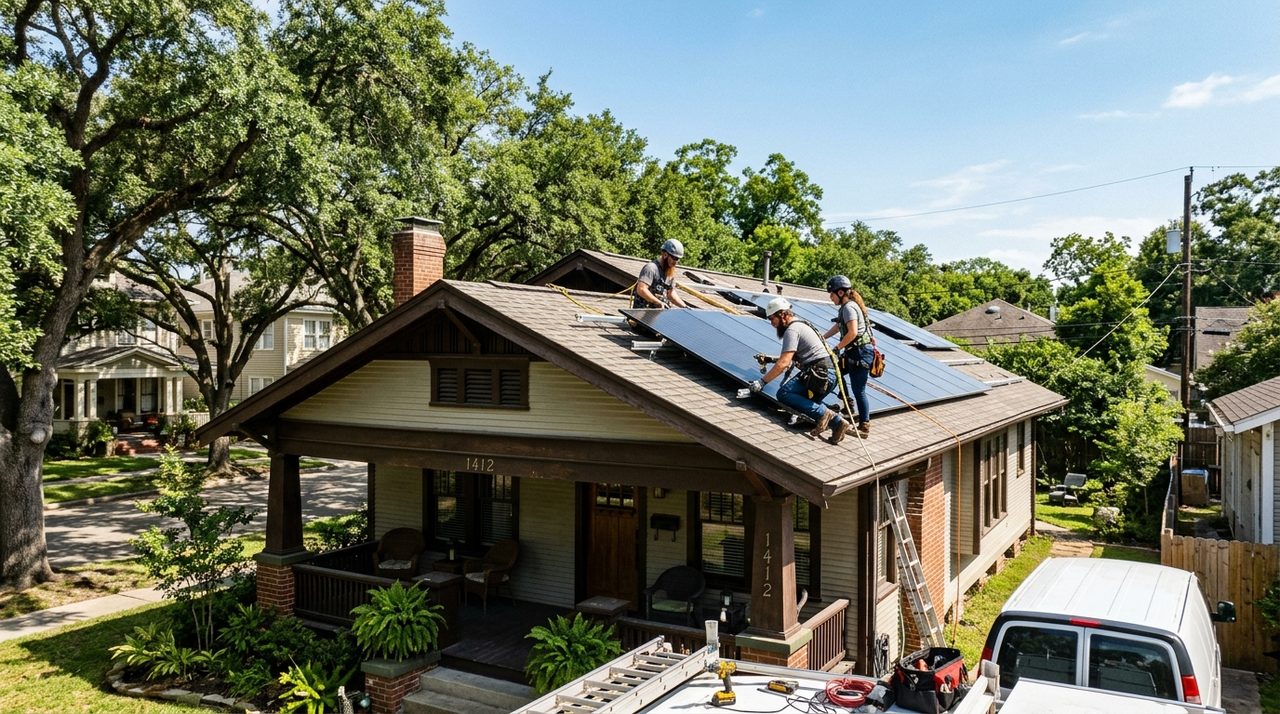
Bellaire's post-Harvey teardown-and-rebuild wave has produced a block-by-block mix of original 1950s–60s slab ranches and newly elevated two-story homes — a combination that complicates solar installations more than almost anywhere else in the inner loop. Because Bellaire is an incorporated city with its own building department entirely separate from Houston Permitting Center and Harris County, every solar permit flows through the City of Bellaire Building Department, and that office also enforces floodplain elevation requirements that can affect where and how roof-mounted equipment is detailed. Understanding which generation of home you're working with — and whether the roof is genuinely post-Harvey new construction or a 1960s original — is the essential first step before any solar conversation in this city.
Ranked by verified Google rating × review volume × verification tier. How we rank →
Some highly-rated pros serve Bellaire from nearby and may not keep a Bellaire street address. Those are listed under "Also serving Bellaire" with their real city and distance, so you always know where each business is based.
7411 Hillcroft St, Houston, TX 77081
5620 S Rice Ave, Houston, TX 77081
6065 Hillcroft St Suite 601, Houston, TX 77081
Highly-rated pros based nearby who cover Bellaire. Distance shown from the Bellaire area.
Serving Bellaire Based in Upper Kirby · 2 mi away
Serving Bellaire Based in Medical Center · 2.7 mi away
Serving Bellaire Based in Medical Center · 3 mi away
Serving Bellaire Based in Meyerland · 3.8 mi away
Serving Bellaire Based in Tanglewood · 3.8 mi away
Serving Bellaire Based in Sharpstown · 4.2 mi away
Why it matters to you
Thousands of Bellaire roofs were replaced rapidly between 2017 and 2019 using budget shingles under insurance claims after Harvey. Houston's UV index of 10–11 and near-daily summer heat cycles above 95°F degrade standard 3-tab shingles in 12–15 years rather than the rated 20–25, meaning many of those emergency replacements are already mid-life or worse. An installer who mounts a 25-year panel array on one of these roofs without documenting its age is setting you up for an $8,000–$14,000 panel removal-and-reinstall cost when the roof fails within five years — a cost almost never disclosed upfront.
What a good pro does
A competent installer will obtain the roofing permit history from the City of Bellaire Building Department to confirm the installation year and material grade of your current roof before drawing up any proposal. If the roof is post-Harvey and used economy shingles, they should quote a coordinated re-roof and solar package so both go on simultaneously; separating the two jobs on a Bellaire home almost always costs more in the long run.
Sources: Municipal permit office (see area profile), International Residential Code (as adopted by City of Houston)
Why it matters to you
Post-Harvey rebuilds in Bellaire are constructed on elevated foundations — structural piers or raised stem walls — to satisfy the city's requirement that new construction clear the 500-year floodplain elevation. These taller, steeper-roofed two-story traditionals sit higher above grade than the original ranches they replaced, increasing effective wind exposure; Bellaire is in ASCE 7 Wind Zone D with design speeds of 130–140 mph. Improperly torqued rail attachments or unsealed flashing penetrations on an elevated roof create both uplift risk and a direct water intrusion path that can void your new construction's roof warranty.
What a good pro does
Your installer must submit engineered racking drawings — specifying attachment hardware, torque specs, and flashing details — to the City of Bellaire Building Department as part of the electrical and building permit package. Because Bellaire runs its own permitting office, inspection timelines and submittal checklists differ from what contractors accustomed to Harris County or Houston Permitting Center are used to; confirm the inspector's structural review scope before scheduling the rough-in.
Sources: Municipal permit office (see area profile), International Residential Code (as adopted by City of Houston), FEMA National Flood Hazard Layer (NFHL)
Why it matters to you
A meaningful share of Bellaire's surviving original ranch stock still carries 100–150 amp panels, some with Federal Pacific or Zinsco equipment that predates modern solar-ready infrastructure. Post-Winter Storm Uri demand for battery backup (Tesla Powerwall, Enphase IQ Battery) is high in Bellaire, but integrating storage into an undersized or obsolete panel is a code compliance problem: CenterPoint's interconnection tariff for storage-paired systems requires a separate metering application that adds 6–10 weeks to the project timeline, and the City of Bellaire's electrical inspectors will flag a panel that lacks the ampacity and breaker space for both a solar inverter and a battery circuit.
What a good pro does
Before quoting a storage-paired system on any pre-2000 Bellaire ranch, a qualified installer — holding a TDLR Electrical Contractor license with a licensed master electrician pulling the permit — should audit the existing panel and quote the upgrade as a line item, not an afterthought. Expect a 200-amp panel replacement to add $3,000–$5,500 (estimated) to the project; bundling it with the solar permit through the City of Bellaire Building Department in a single submittal is typically faster than two separate pulls.
Sources: Texas Department of Licensing & Regulation, North American Board of Certified Energy Practitioners (NABCEP), Municipal permit office (see area profile)
Why it matters to you
Bellaire has no single city-wide HOA, but individual subdivisions carry their own recorded deed restrictions with architectural controls that can dictate panel visibility from the street. Under Texas Property Code §202.010, you have the right to install solar, but a deed restriction committee can legally require rear-slope or east-facing placement — which in Bellaire's predominantly north-south-oriented streets can cut system production 15–25% compared to an optimal south-facing array, directly affecting your payback period on a system that may have cost $22,000–$35,000 before the federal 30% Investment Tax Credit.
What a good pro does
Before finalizing your system design, pull the recorded CC&Rs for your specific lot through Harris County property records — deed restriction status in Bellaire is genuinely lot-specific and cannot be assumed from a neighboring property. A good installer will review those restrictions alongside a shading analysis and production model, then present you with compliant layout options that maximize output within the architectural limits your subdivision actually imposes, rather than simply defaulting to whatever avoids conflict.
Sources: Local HOA / deed restrictions (see area profile), Municipal permit office (see area profile)
Hiring solar installers in Bellaire? Bellaire is an incorporated city almost entirely within the FEMA AE high-risk flood zone, which means elevation requirements, floodplain permitting, and post-Harvey rebuilds dominate the home service landscape. Housing stock ranges from 1950s slab-on-grade ranches to elevated new-construction traditionals, so contractors must be prepared for both legacy and modern systems on the same block. The city runs its own permitting office, and deed restrictions vary by subdivision, making pre-project due diligence essential.
Building era
1950s–1960s (original ranch stock) with a major wave of teardown/rebuild infill from the 1990s–2020s, accelerated after Hurricane Harvey.
Typical style
Traditional brick two-story (newer builds), single-story brick ranch (original 1950s–60s stock), transitional/Mediterranean customs, and remaining bungalows/cottages from the 1920s–1940s.
Foundations
Mixed — older homes are commonly slab-on-grade; post-Harvey new construction and major remodels are typically elevated on pier-and-beam or raised structural piers to meet floodplain requirements.
Common systems
Older ranches: original copper or galvanized plumbing, single-stage HVAC, 100–150 amp electrical panels. Newer builds: PEX plumbing, high-efficiency multi-stage HVAC, 200+ amp panels with whole-home surge protection. Tankless water heaters increasingly standard in post-2010 construction.
What that means for repairs
The dominant renovation activity is full teardown-and-rebuild or substantial elevation of existing structures to comply with the city's requirement that permitted construction be above the 500-year floodplain. Post-Harvey, many 1950s–60s ranches were demolished and replaced with larger two-story homes on elevated foundations.
Permit jurisdiction
City of Bellaire Building Department (Bellaire is an incorporated city with its own permitting office, independent of Houston Permitting Center and Harris County).
HOA & deed restrictions
No single city-wide mandatory HOA. Bellaire is composed of individual subdivisions, each with its own recorded deed restrictions. Some subdivisions have mandatory HOAs with dues and architectural controls; others rely on voluntary civic clubs or deed-restriction committees for enforcement. HOA status is lot-specific — check recorded CC&Rs via Harris County property records.
Historic districts
No City of Houston historic district designation confirmed. Bellaire is an independent incorporated city and does not fall under the Houston Archaeological and Historical Commission (HAHC).
Contractor note
Bellaire's floodplain regulations require an elevation certificate for most permitted work, and new construction or substantial improvements must meet or exceed the 500-year floodplain elevation. Contractors should confirm current BFE requirements and any deed-restriction architectural controls with the Bellaire Building Department before scoping work.
FEMA flood zone
FEMA Zone AE (high flood risk) — source: fema_nfhl. Virtually the entire city of Bellaire sits within the 100-year floodplain. Brays Bayou runs along Bellaire's northern boundary, and localized drainage issues compound flood risk throughout the city.
Hurricane Harvey impact
Hurricane Harvey (2017) caused significant flooding across Bellaire, inundating a large number of homes — particularly the older slab-on-grade ranch stock. The storm accelerated an already-active teardown cycle, with many flooded homes demolished and replaced by elevated new construction. Post-Harvey, the city enforces strict elevation requirements for permitted work, requiring structures to be built above the 500-year floodplain.
Heat & humidity load
Houston's extreme summer heat and humidity stress older HVAC systems in 1950s–60s ranches, many of which have limited insulation and single-pane windows. Elevated pier-and-beam homes require attention to moisture management and ventilation beneath the structure. Seasonal thunderstorms can overwhelm aging drainage infrastructure, making sump pumps and proper grading critical even for elevated homes.
Working with contractors here
Contractors in Bellaire most commonly handle full teardown-and-rebuild projects, structural elevation of existing homes, and flood damage remediation — all driven by the city's AE flood zone status and post-Harvey rebuilding activity. Older 1950s–60s ranches frequently need complete plumbing re-pipes (galvanized-to-PEX), electrical panel upgrades, and HVAC replacement. Because Bellaire is an incorporated city with its own building department, contractors must pull permits through the City of Bellaire rather than Harris County or Houston, and must navigate subdivision-specific deed restrictions that can impose setback, height, and material requirements. Job scoping should always begin with an elevation certificate review and a check of the property's specific deed restrictions and HOA status, as these vary block by block.
Local Tip
Always ask for a written estimate before work begins. Texas contractors are required to provide one on jobs over $1,000.
Bellaire is an incorporated city almost entirely within the FEMA AE high-risk flood zone, which means elevation requirements, floodplain permitting, and post-Harvey rebuilds dominate the home service landscape. Housing stock ranges from 1950s slab-on-grade ranches to elevated new-construction traditionals, so contractors must be prepared for both legacy and modern systems on the same block. The city runs its own permitting office, and deed restrictions vary by subdivision, making pre-project due diligence essential.
Source: U.S. Census Bureau, ACS 5-Year 2023
Much of Bellaire maps to FEMA Zone AE (high flood risk), so flood-resilient detailing -- elevated equipment, water-tolerant materials, and drainage-first thinking -- is essential here, not optional.
Source: FEMA National Flood Hazard Layer (NFHL). Flood zones vary by parcel — verify your individual FIRM panel.
In Bellaire, where FEMA Zone AE inside the 100-year floodplain puts solar arrays at direct risk, have a TDLR-licensed solar installer verify that your racking system meets IEC 61215 hurricane-rated uplift standards before storm season. If floodwaters threaten your inverter or battery storage unit, shut down via the rapid-shutdown switch and do not re-energize until a licensed technician confirms no water intrusion. Confirm the current FEMA panel for your Bellaire parcel — the area maps to Zone AE, but adjacent lots can differ.
Hail stones above one inch in diameter, common in Houston severe thunderstorm outbreaks, can micro-crack solar panel glass without immediately shattering it; homeowners in Bellaire should have a licensed inspector check for delamination and internal cell damage after any significant hail report. Your installer can also confirm whether your specific panel model's hail-impact rating matches the size of hail that struck your neighborhood. In-city Bellaire work falls under City of Houston floodplain and permitting rules.
Winter Storm Uri 2021 proved that the Houston grid can fail for days in a freeze, and for homeowners in Bellaire where FEMA Zone AE inside the 100-year floodplain already complicates recovery, a solar-plus-battery system with a properly sized critical-load panel can sustain heat, lighting, and medical devices when CenterPoint cannot deliver power. Have your TDLR-licensed installer verify the battery bank's cold-temperature discharge rating, since lithium-ion capacity drops noticeably below 32°F. With a median build year of 1981, the older building stock here is more exposed to hard-freeze damage than newer construction. In-city Bellaire work falls under City of Houston floodplain and permitting rules.
Sources: FEMA National Flood Hazard Layer (NFHL), Ready.gov -- Hurricanes, CenterPoint Energy -- Storm Center, City of Houston -- Emergency Preparedness, Ready.gov -- Winter Weather, Harris County Flood Control District
Houston-specific estimators to plan your project before you call a pro. All results are planning estimates — a licensed local pro confirms the details on site.
Disconnect & drain every outdoor hose bib
Remove hoses, drain the spigots, and cover each with an insulated faucet sock. Un-drained hose bibs are the #1 burst point in a Houston freeze.
Insulate exposed pipes in the attic & garage
Wrap any pipe in an unconditioned space (attic runs, garage walls) with foam sleeves. Houston homes rarely insulate these because they only matter a few nights a year — which is exactly why they burst.
Open cabinet doors & keep a pencil-width drip
On hard-freeze nights, open kitchen/bath cabinets so warm air reaches the pipes and let faucets on exterior walls drip to relieve pressure.
Protect the attic/garage water heater & its lines
An attic or garage tank sits in unconditioned space. Insulate the cold-inlet and hot-outlet lines and confirm the emergency drain pan is clear so a leak doesn't reach the ceiling.
This is a planning estimate only — actual requirements depend on an on-site assessment by a licensed Houston pro. If a pipe has already burst, shut off your main water supply and call a licensed Houston plumber immediately — freeze bursts flood fast.
Sources: Municipal permit office (see area profile)FEMA National Flood Hazard Layer (NFHL)
Sources: Municipal permit office (see area profile)International Residential Code (as adopted by City of Houston)
Sources: FEMA National Flood Hazard Layer (NFHL)Municipal permit office (see area profile)
Sources: Texas Department of Licensing & RegulationNorth American Board of Certified Energy Practitioners (NABCEP)
Sources: ENERGY STAR / U.S. Dept. of Energy