Closed
4620 S Sam Houston Pkwy W, Houston, TX 77053
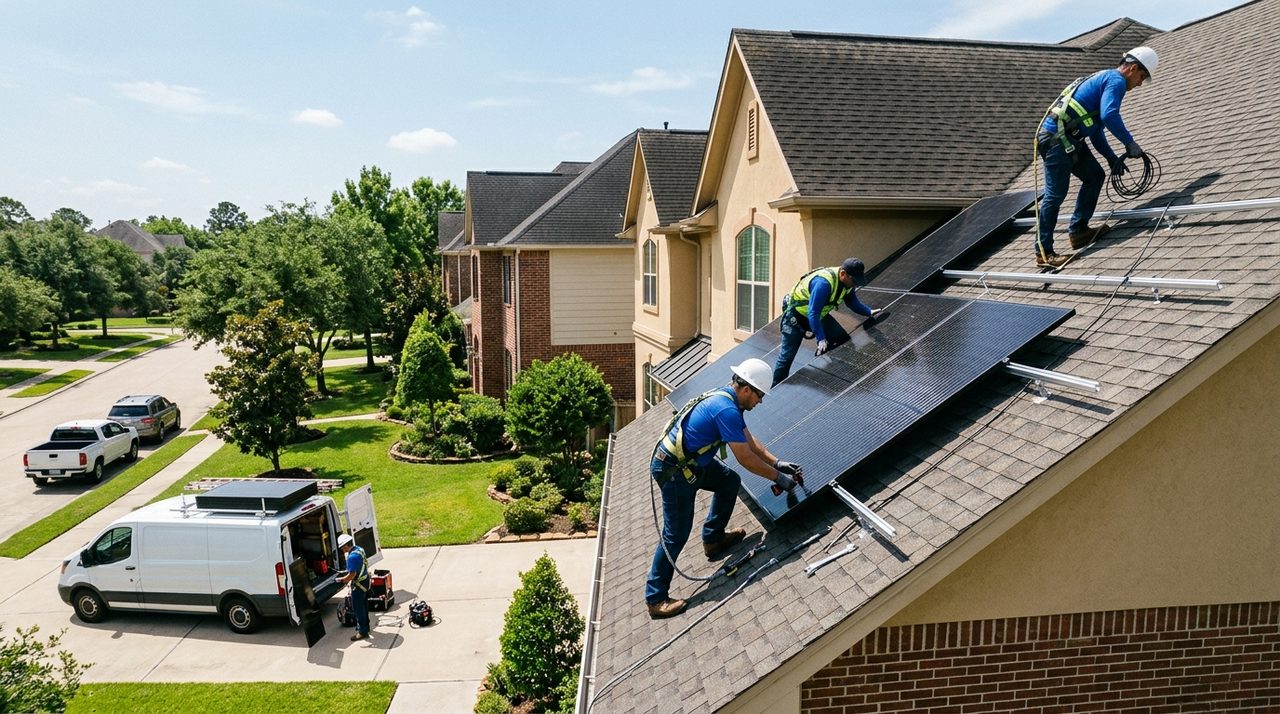
Westbury's roughly 5,000 mid-century ranch homes — most built between 1950 and 1965, most sitting on concrete slabs, most still running 100-amp electrical panels — present a specific and underappreciated set of hurdles for solar installations that generic installer quotes almost never address upfront. Add the Westbury Civic Club's Architectural Review Committee, the City of Houston permitting queue, and Houston's brutal 9-month cooling season, and the gap between a salesperson's production estimate and your actual bill savings can be substantial. This page breaks down the four issues that matter most for Westbury homeowners considering solar.
Ranked by verified Google rating × review volume × verification tier. How we rank →
Some highly-rated pros serve Westbury from nearby and may not keep a Westbury street address. Those are listed under "Also serving Westbury" with their real city and distance, so you always know where each business is based.
4620 S Sam Houston Pkwy W, Houston, TX 77053
6911 Brasada Dr, Houston, TX 77085
13810 Ambrose St, Houston, TX 77045
Highly-rated pros based nearby who cover Westbury. Distance shown from the Westbury area.
Serving Westbury Based in Meyerland · 2.2 mi away
Serving Westbury Based in Bellaire · 2.8 mi away
Serving Westbury Based in Medical Center · 3.1 mi away
Serving Westbury Based in Medical Center · 3.3 mi away
Serving Westbury Based in Sharpstown · 3.8 mi away
Serving Westbury Based in Missouri City · 3.8 mi away
Serving Westbury Based in Bellaire · 4 mi away
Why it matters to you
The original electrical service in most Westbury ranch homes — built when central air conditioning was not yet standard — is 100-amp, which is insufficient to simultaneously carry a grid-tied solar inverter, a modern HVAC system, and anything approaching today's household loads. The City of Houston Permitting Center will not approve a solar electrical permit on a 100-amp service without a concurrent or prior panel upgrade, and a licensed master electrician must pull both permits. Homeowners who receive solar quotes that omit panel upgrade costs are being set up for a significant surprise: a full 200-amp service upgrade in Westbury typically adds $2,500–$5,000 to the project before the first panel goes on the roof.
What a good pro does
A reputable solar installer serving Westbury will pull your CenterPoint meter data and physically inspect your panel before quoting, confirming whether you have 100-amp or already-upgraded 200-amp service. The electrical contractor must hold a valid license issued by TDLR and must list the panel upgrade on the same City of Houston permit application as the solar installation. Ask to see the permit number and the TDLR license number before any deposit changes hands.
Sources: Texas Department of Licensing & Regulation, City of Houston Permitting Center, Municipal permit office (see area profile)
Why it matters to you
Westbury's signature hipped and low-slope ranch roofs — practical for 1950s construction aesthetics — pond water during the intense single-storm rain events Houston regularly experiences, including the May 2024 derecho and repeated Brays Bayou overflow events that affect blocks near Willow Waterhole. Ballasted or improperly flashed racking bases on these shallow-pitch roofs accelerate membrane degradation underneath the rails, which typically triggers a warranty dispute between your roofer and your solar installer: each blames the other for the leak. Many of Westbury's original roofs have also been patched rather than fully replaced, meaning the underlying deck may be compromised in ways that only a full tear-off reveals.
What a good pro does
Before signing a solar contract on a Westbury ranch home, get an independent roofing assessment — not one performed by the solar company — to document remaining membrane life and deck condition. A qualified installer will specify roof-mount flashings and rail attachments rated for Houston's ASCE 7 wind zone and will coordinate with your roofer in writing on warranty boundaries. If the roof is within 7 years of needing replacement, replacing it before racking installation is almost always the lower-cost path over a 25-year panel lifespan.
Sources: International Residential Code (as adopted by City of Houston), City of Houston Permitting Center, FEMA National Flood Hazard Layer (NFHL)
Why it matters to you
Westbury's deed restrictions, enforced by the Westbury Civic Club Architectural Review Committee, require approval for exterior modifications including rooftop solar installations. Texas Property Code §202.010 gives homeowners the right to install solar, but it explicitly allows HOAs to require placement that keeps panels 'not visible from the street.' On Westbury's typical north-south oriented streets with front-facing south slopes, that restriction can force arrays onto north-facing or east-facing rear slopes — a placement that can reduce annual production by 15–25% compared to a south-optimized layout. An installer who quotes system size based on a south-facing assumption without checking ARC requirements is giving you a production number that will never be achieved.
What a good pro does
Submit your ARC application to the Westbury Civic Club before finalizing your installer contract, and have your installer model production specifically for the approved panel placement using your actual CenterPoint historical usage data — not national averages. Verify your specific lot's deed restriction status through Harris County Clerk records, since the legal enforceability of dues and restrictions varies by section within Westbury. City of Houston permits are still required regardless of ARC outcome; the two approval processes run in parallel, not sequentially.
Sources: Local HOA / deed restrictions (see area profile), Municipal permit office (see area profile), City of Houston Permitting Center
Why it matters to you
A 2,200-square-foot Westbury ranch home with original 1960s wall insulation, single-pane jalousie or early aluminum-frame windows, and a recently replaced but oversized HVAC system can easily consume 1,600–1,900 kWh per month during the June–September peak — well above the national averages that many solar sizing calculators use as a baseline. Houston's roughly 3,000 annual cooling degree days mean that a system sized to offset 80% of load in Atlanta or Phoenix will offset only 50–60% of a Westbury home's actual load. Post-Uri interest in battery backup adds another layer: a single Tesla Powerwall or equivalent adds $10,000–$14,000 installed, and CenterPoint's interconnection process for storage-paired systems adds 6–10 weeks to the project timeline.
What a good pro does
Insist that your installer pull at least 12 months of CenterPoint billing data — not a neighborhood average — and size the array against your actual peak summer consumption. NABCEP-certified installers are trained in load analysis specific to high-cooling-degree-day climates and are the credential to verify before trusting a production estimate. If battery backup is part of your plan post-Uri, confirm the installer has completed CenterPoint storage interconnection applications before and understands the separate metering paperwork required.
Sources: North American Board of Certified Energy Practitioners (NABCEP), ENERGY STAR / U.S. Dept. of Energy, Municipal permit office (see area profile)
Hiring solar installers in Westbury? Westbury is a large 1950s-era subdivision of roughly 5,000 single-family homes plus thousands of multifamily units in southwest Houston. Homeowners here contend with aging slab foundations, original-era plumbing and electrical systems, and flood risk in sections near Willow Waterhole and Brays Bayou. Deed restrictions enforced by the Westbury Civic Club/HOA require architectural review for exterior modifications, making pre-project compliance checks essential.
Building era
1950s–1960s (original subdivision), with later multifamily and infill development.
Typical style
One-story mid-century ranch homes with brick veneer, low-sloped or hipped roofs, attached garages or carports, and wide lots.
Foundations
Predominantly concrete slab-on-grade; some pier-and-beam may exist in earliest sections but slab is clearly prevalent in listings.
Common systems
Original homes likely have galvanized steel or early copper supply lines, cast iron drain lines, 100-amp electrical panels, and older forced-air HVAC systems or window units later converted to central air. Many systems are 50–70 years old and approaching or past end of life.
What that means for repairs
Kitchen and bathroom remodels are common as owners update mid-century layouts. Whole-house replumbing (replacing galvanized and cast iron), electrical panel upgrades to 200-amp service, and HVAC replacements are frequent due to system age. Some lots see teardown-rebuild activity as land values support new construction.
Permit jurisdiction
City of Houston Permitting Center (Westbury is within Houston city limits).
HOA & deed restrictions
Westbury Civic Club, Inc. operates as the primary neighborhood association (Super Neighborhood 37). Deed restrictions with an Architectural Review/Control Committee are described as mandatory for compliance. The exact legal status of dues (mandatory vs. voluntary for each section) is not fully verifiable from public sources alone — check Harris County Clerk deed restriction records for your specific lot.
Historic districts
No City of Houston historic district designation confirmed.
Contractor note
Contractors must obtain City of Houston permits for structural, mechanical, electrical, and plumbing work, and should verify Westbury's deed restriction and ARC/ACC requirements before beginning any exterior modifications including fencing, roofing material changes, or additions.
FEMA flood zone
FEMA Zone X (low flood risk) per official NFHL data. However, Westbury is adjacent to Brays Bayou and Willow Waterhole, and portions of the neighborhood — especially lower-lying southern and eastern sections near these drainage features — have documented histories of flooding. Parcel-level flood risk can vary significantly; an elevation certificate and HCFCD inundation maps should be consulted for individual addresses.
Hurricane Harvey impact
Significant flooding occurred in portions of Westbury during Hurricane Harvey (2017), particularly in lower-lying sections closest to Willow Waterhole, Brays Bayou, and drainage corridors near US 90A and South Post Oak. Post-Harvey flood mitigation projects were implemented around Willow Waterhole. Block-by-block impact data is not available in text sources; homeowners should request seller's disclosure, prior flood claim history, and Harris County Flood Control District high-water-mark data for specific addresses.
Heat & humidity load
1950s slab homes with original insulation and single-pane windows put heavy loads on HVAC systems during Houston summers. Aging ductwork in unconditioned attics degrades efficiency. Foundation movement on expansive clay soils accelerates during summer drought cycles, making seasonal watering programs and foundation monitoring important for these older slabs.
Working with contractors here
The dominant work in Westbury involves updating 1950s–1960s building systems: whole-house replumbing from galvanized and cast iron to PEX/PVC, electrical panel upgrades from 100-amp to 200-amp service, and HVAC replacement with modern high-efficiency equipment. Slab foundation repair is common due to the age of the homes and Houston's expansive clay soils. Contractors should be aware that the Westbury Architectural Review Committee requires compliance with deed restrictions for exterior work, so scope proposals for roofing, siding, fencing, or additions should account for review and approval timelines. Flood-damaged properties near Willow Waterhole and Brays Bayou may require remediation work including mold abatement, drywall replacement, and elevated mechanical equipment installation.
Local Tip
Always ask for a written estimate before work begins. Texas contractors are required to provide one on jobs over $1,000.
Westbury is a large 1950s-era subdivision of roughly 5,000 single-family homes plus thousands of multifamily units in southwest Houston. Homeowners here contend with aging slab foundations, original-era plumbing and electrical systems, and flood risk in sections near Willow Waterhole and Brays Bayou. Deed restrictions enforced by the Westbury Civic Club/HOA require architectural review for exterior modifications, making pre-project compliance checks essential.
Source: U.S. Census Bureau, ACS 5-Year 2023
Most of Westbury maps to FEMA Zone X (low mapped flood risk), but Houston's flash-flood reality means even low-risk blocks benefit from smart drainage and storm-hardened installs; risk climbs sharply on blocks nearest Brays Bayou, where it varies parcel to parcel.
Source: FEMA National Flood Hazard Layer (NFHL). Flood zones vary by parcel — verify your individual FIRM panel.
Your solar panels themselves are rated to survive high winds, but the roof structure beneath them must also be sound — have a TDLR-licensed installer inspect flashing and attachment points in Westbury before hurricane season to confirm the assembly will perform as a unit. If CenterPoint declares a major outage event, your battery backup system's automatic transfer function is what decides whether your home stays powered. Because Westbury drains toward Brays Bayou, block-level runoff can differ sharply from the mapped zone.
Hail damage to solar panels in Westbury is often invisible from the ground but detectable through performance monitoring — if your system's daily output drops noticeably after a storm, that is a signal to request a licensed inspection before the damage compounds. Cracked panel glass also creates a ground-fault risk that your inverter's built-in GFCI may flag as an error code. In-city Westbury work falls under City of Houston floodplain and permitting rules.
Ice accumulation temporarily cuts solar panel output in Westbury, but the larger freeze-related risk for solar homeowners is an inverter or battery enclosure mounted in an uninsulated garage or attic space exposed to sub-freezing temperatures — equipment manufacturers specify minimum operating temperatures, and falling below them can cause shutdowns or permanent damage. Ask your installer to confirm all system components are within their rated temperature range before the next hard freeze. With a median build year of 1977, the older building stock here is more exposed to hard-freeze damage than newer construction. Confirm the current FEMA panel for your Westbury parcel — the area maps to Zone X, but adjacent lots can differ.
Sources: FEMA National Flood Hazard Layer (NFHL), Ready.gov -- Hurricanes, CenterPoint Energy -- Storm Center, City of Houston -- Emergency Preparedness, Ready.gov -- Winter Weather, Harris County Flood Control District
Houston-specific estimators to plan your project before you call a pro. All results are planning estimates — a licensed local pro confirms the details on site.
Disconnect & drain every outdoor hose bib
Remove hoses, drain the spigots, and cover each with an insulated faucet sock. Un-drained hose bibs are the #1 burst point in a Houston freeze.
Insulate exposed pipes in the attic & garage
Wrap any pipe in an unconditioned space (attic runs, garage walls) with foam sleeves. Houston homes rarely insulate these because they only matter a few nights a year — which is exactly why they burst.
Open cabinet doors & keep a pencil-width drip
On hard-freeze nights, open kitchen/bath cabinets so warm air reaches the pipes and let faucets on exterior walls drip to relieve pressure.
Protect the attic/garage water heater & its lines
An attic or garage tank sits in unconditioned space. Insulate the cold-inlet and hot-outlet lines and confirm the emergency drain pan is clear so a leak doesn't reach the ceiling.
This is a planning estimate only — actual requirements depend on an on-site assessment by a licensed Houston pro. If a pipe has already burst, shut off your main water supply and call a licensed Houston plumber immediately — freeze bursts flood fast.
Sources: City of Houston Permitting CenterTexas Department of Licensing & Regulation
Sources: City of Houston Permitting CenterTexas Department of Licensing & Regulation
Sources: Local HOA / deed restrictions (see area profile)ENERGY STAR / U.S. Dept. of Energy
Sources: North American Board of Certified Energy Practitioners (NABCEP)Texas Department of Licensing & Regulation
Sources: City of Houston Permitting Center