5934 Rutherglenn Dr, Houston, TX 77096
Best AC Repair in Meyerland
Meyerland's roughly 2,238 homes — most originally built between 1958 and 1968, sitting in FEMA Zone AE directly alongside Brays Bayou — present a split-personality HVAC challenge: aging mid-century ranch systems that survived repeated flooding alongside post-Harvey rebuilds with modern high-efficiency equipment that still needs proper setup and maintenance in one of Houston's most relentlessly humid microclimates. Whether your home was elevated after Harvey, gut-renovated after Beryl, or is still running on original 1990s equipment, the HVAC decisions you make here carry consequences that go beyond a typical Houston neighborhood because flood saturation, bayou-adjacent humidity, and mandatory MCIA deed restrictions all shape what's possible. This page cuts through the specifics so Meyerland homeowners know exactly what to expect from an AC repair or replacement project.
Verified against Google Business data
Updated 2026
See the 10 AC Repair Serving Meyerland 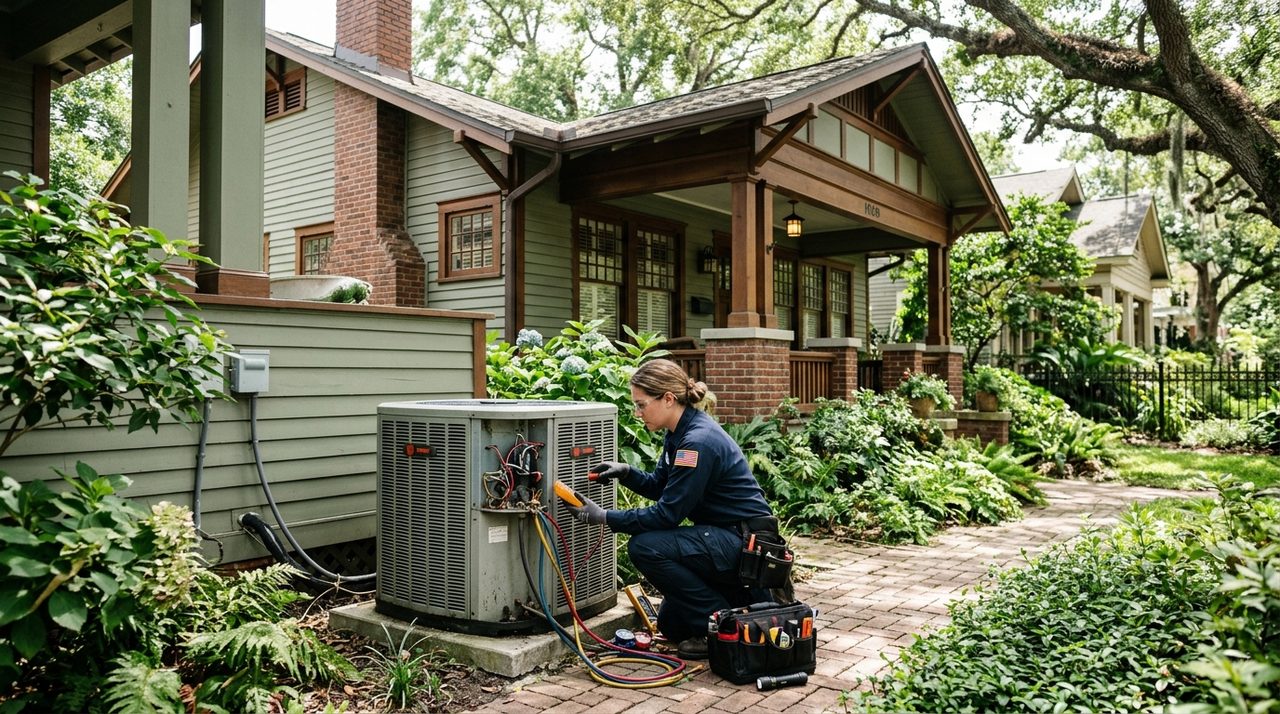
- Median home built
- 1972
- Median home value
- $334,585
- FEMA flood zone
- AE (high)
- Typical AC repair or replacement cost (est.)
- $180–$9,500 depending on scope
- Most common local issue
- Flood-damaged or flood-submerged condenser units and condensate drain overflow into elevated slabs
Ranked by verified Google rating × review volume × verification tier. How we rank →
Some highly-rated pros serve Meyerland from nearby and may not keep a Meyerland street address. Those are listed under "Also serving Meyerland" with their real city and distance, so you always know where each business is based.
Min rating:
10 resultsBased in Meyerland
Open Now
10101 Fondren Rd, Houston, TX 77096
Open Now
9402 Glenfield Ct, Houston, TX 77096
Also serving Meyerland
Highly-rated pros based nearby who cover Meyerland. Distance shown from the Meyerland area.
Closed
Serving Meyerland Based in Bellaire · 0.3 mi away
Closed
Serving Meyerland Based in Bellaire · 1.9 mi away
Closed
Serving Meyerland Based in Bellaire · 1.9 mi away
Closed
Serving Meyerland Based in Bellaire · 1.9 mi away
Open Now
Serving Meyerland Based in Bellaire · 2 mi away
Open Now
Serving Meyerland Based in Bellaire · 2.1 mi away
Closed
Serving Meyerland Based in Braeswood · 2.1 mi away
AC Repair in Meyerland: What You Should Know
Flood-Submerged Condenser Units in a FEMA Zone AE Neighborhood
Why it matters to you
Meyerland's position in FEMA Zone AE along Brays Bayou means condenser units installed at grade have been underwater — sometimes repeatedly — during Harvey (2017), the 2015 Memorial Day and Tax Day floods, and Beryl (2024). Saltwater-laden floodwater corrodes aluminum fins, copper coils, and electrical contactors rapidly in Houston's already humid air, and a unit that appears to be running after a flood event may fail catastrophically within one to two cooling seasons as internal corrosion progresses.
What a good pro does
A qualified HVAC contractor should perform a post-flood inspection that goes beyond a basic startup test — checking refrigerant pressure, megging the compressor motor windings, and inspecting contactor and capacitor condition before declaring a flooded unit serviceable. For homes that haven't already done so, elevating the condenser pad above the base flood elevation established for your specific parcel is worth the upfront cost; in Zone AE, this is not over-engineering, it's standard risk management. Any replacement unit installation requires a City of Houston mechanical permit pulled through the Houston Permitting Center.
Sources: FEMA National Flood Hazard Layer (NFHL), City of Houston Permitting Center, Texas Windstorm Insurance Association (TWIA)
Evaporator Coil Mold and Condensate Overflow in a Bayou-Adjacent Microclimate
Why it matters to you
Meyerland's location directly adjacent to Brays Bayou keeps ambient relative humidity measurably higher than Houston's already extreme baseline, and homes that underwent post-flood gut renovations — even thorough ones — sometimes have air handlers reinstalled in tight interior closets without adequate floor drains. When condensate drain lines clog (one of the most frequent Houston HVAC service calls), pan overflow on a slab-on-grade home doesn't have anywhere to go except under the slab or into rebuilt drywall, which is a particularly painful outcome for homeowners who just finished a major renovation.
What a good pro does
Meyerland homeowners should ask their HVAC technician to flush and treat condensate drain lines at every seasonal tune-up — not just when there's a visible problem — and to install or verify a functioning secondary drain pan with a float switch that shuts the system down before overflow occurs. For post-Harvey rebuilds where the air handler closet was rebuilt, confirm with your contractor that a secondary pan drain line was roughed in and terminates visibly (typically over a window or exterior wall) so overflow is obvious before it causes damage. Condensate drain clearing typically costs $95–$225 estimated, a small investment against the cost of another drywall replacement.
Sources: FEMA National Flood Hazard Layer (NFHL), City of Houston Permitting Center
Aging R-22 Equipment in Unrenovated 1960s Ranch Homes
Why it matters to you
A meaningful share of Meyerland's original ranch homes — those that survived flooding without a full gut renovation — are still running pre-2010 central systems charged with R-22 refrigerant, which EPA banned from new production as of January 2020. Reclaimed R-22 on the Houston market now runs an estimated $80–$150 per pound, meaning a slow refrigerant leak on an older system can cost $600–$1,500 or more just for a recharge that doesn't fix the underlying leak. Homeowners who received partial insurance settlements after earlier floods and deferred full HVAC replacement may be particularly exposed to this cost spiral.
What a good pro does
If your Meyerland ranch home still has its original or early-replacement R-22 system, get a leak-and-pressure diagnostic before committing to another recharge; if refrigerant has been topped off more than once in the last three years, the economics almost certainly favor full replacement over repeated recharging. A TDLR-licensed HVAC contractor can evaluate whether a retrofit refrigerant like R-407C is compressor-compatible, but in many cases on aging Meyerland equipment — especially units that have been through flood cycles — full system replacement at $5,500–$9,500 estimated is the more durable path. The City of Houston requires a mechanical permit for replacement work, pulled by your licensed contractor through the Houston Permitting Center.
Sources: Texas Department of Licensing & Regulation, City of Houston Permitting Center, ENERGY STAR / U.S. Dept. of Energy
MCIA Deed Restrictions Governing Condenser Placement and Screening
Why it matters to you
Meyerland is a deed-restricted neighborhood enforced by the Meyerland Community Improvement Association (MCIA), and those deed restrictions govern exterior modifications including the placement and screening of HVAC condenser units. Post-Harvey rebuilds that shifted a home's footprint or added a second story sometimes result in condenser locations that weren't contemplated in the original installation — and a condenser visible from the street or sited in a non-compliant location can trigger an MCIA violation notice, forcing a costly relocation on top of the original project cost.
What a good pro does
Before any condenser replacement or relocation in Meyerland, verify the proposed placement with the MCIA directly at (713) 729-2167 or 4999 W. Bellfort Ave. — this is a parallel approval track that runs alongside the City of Houston mechanical permit, not a substitute for it. A contractor who tells you only the city permit matters is not accounting for Meyerland's deed restriction reality. If screening is required, clarify with MCIA whether lattice, fence panels, or landscaping are acceptable before installation, since the wrong screening material can result in a second violation.
Sources: Local HOA / deed restrictions (see area profile), City of Houston Permitting Center
AC Repair in Meyerland: What You Should Know
Hiring ac repair in Meyerland? Meyerland is a deed-restricted southwest Houston neighborhood of roughly 2,238 single-family homes, most originally built in the late 1950s–1960s, with a significant wave of post-Harvey rebuilds and elevations since 2017. The neighborhood sits in FEMA Zone AE near Brays Bayou, making flood mitigation, foundation elevation, and water damage restoration among the most critical home service categories. Contractors here must navigate mandatory HOA oversight through the Meyerland Community Improvement Association and City of Houston permitting requirements.
- Housing era
- Late 1950s–1960s (median year built 1962), with substantial post-2017 new construction and rebuilds
- Foundation
- Predominantly slab-on-grade
- Flood zone
- FEMA Zone AE (high flood risk) — source
- Permits
- City of Houston — Houston Permitting Center
Housing stock & systems
Building era
Late 1950s–1960s (median year built 1962), with substantial post-2017 new construction and rebuilds.
Typical style
Mid-century ranch-style single-story homes (brick veneer, low-sloped roofs) alongside newer two-story traditional/transitional rebuilds.
Foundations
Predominantly slab-on-grade; many post-Harvey rebuilds feature elevated slab foundations raised above base flood elevation.
Common systems
Original homes often have aging central HVAC systems, copper or galvanized plumbing, and older electrical panels (60–100 amp). Rebuilt homes typically have modern high-efficiency HVAC, PEX plumbing, and 200-amp electrical service.
What that means for repairs
Post-flood gut renovations and full rebuilds have been the dominant renovation activity since 2015. Many homeowners have elevated homes, replaced all drywall and insulation, upgraded plumbing to PEX, and installed modern HVAC. Unrenovated original ranch homes still require significant systems updates.
Permits & restrictions
Permit jurisdiction
City of Houston — Houston Permitting Center.
HOA & deed restrictions
Mandatory HOA — Meyerland Community Improvement Association (MCIA), 4999 W. Bellfort Ave., Houston, TX 77035, (713) 729-2167. MCIA maintains a management certificate with the Texas Real Estate Commission and enforces deed restrictions across the neighborhood.
Historic districts
No City of Houston historic district designation confirmed.
Contractor note
Contractors must obtain City of Houston permits for structural, electrical, plumbing, and mechanical work. MCIA deed restrictions may also govern exterior modifications, fencing, and accessory structures — always verify with the HOA before beginning exterior work.
Flood & weather
FEMA flood zone
FEMA Zone AE (high flood risk) — source: fema_nfhl. Meyerland is situated adjacent to Brays Bayou, and much of the neighborhood falls within the 100-year floodplain. Properties closest to the bayou and in lower-lying sections face the highest risk.
Hurricane Harvey impact
Meyerland experienced extensive, widespread home flooding during Hurricane Harvey (2017) and is one of Houston's most prominently impacted neighborhoods. The area also flooded significantly during the 2015 Memorial Day Flood and 2016 Tax Day Flood. Sections closest to Brays Bayou (including Meyerland Sections 1–8) were especially hard hit. Hundreds of homes were gutted and many were demolished and rebuilt or elevated. For street-level repetitive loss data, consult the Harris County Flood Education Mapping Tool and FEMA FIRMs.
Heat & humidity load
Original 1960s ranch homes with aging HVAC systems struggle with Houston's extreme summer heat and humidity. Older ductwork in unconditioned attics can develop condensation issues and mold. Post-flood rebuilt homes generally perform better but elevated foundations can expose ductwork and plumbing to extreme heat beneath the structure. Dehumidification and proper attic ventilation are essential across all vintages.
Working with contractors here
The most common contractor work in Meyerland falls into two categories: maintaining and upgrading original 1960s ranch homes, and completing or refining post-Harvey rebuilds and elevations. Plumbing contractors frequently replace galvanized or cast-iron drain lines in original homes, while electricians upgrade older panels to handle modern loads. Foundation repair is common on original slab-on-grade homes due to Houston's expansive clay soils and repeated flood saturation. Flood mitigation work — including home elevation, backflow preventer installation, and flood-resistant material retrofits — remains in high demand. Contractors should scope jobs with the understanding that many homes have had multiple flood events, and hidden moisture damage or improper previous repairs may be present behind walls and under flooring.
Local Tip
Always ask for a written estimate before work begins. Texas contractors are required to provide one on jobs over $1,000.
About Meyerland
Meyerland is a deed-restricted southwest Houston neighborhood of roughly 2,238 single-family homes, most originally built in the late 1950s–1960s, with a significant wave of post-Harvey rebuilds and elevations since 2017. The neighborhood sits in FEMA Zone AE near Brays Bayou, making flood mitigation, foundation elevation, and water damage restoration among the most critical home service categories. Contractors here must navigate mandatory HOA oversight through the Meyerland Community Improvement Association and City of Houston permitting requirements.
- Median year built
- 1972
- Median home value
- $334,585
- Owner-occupied
- 43.9%
- Population
- 68,840
- Housing units
- 31,152
- Median income
- $70,969
Source: U.S. Census Bureau, ACS 5-Year 2023
Flood & storm risk
FEMA Zone AEHigh flood riskMuch of Meyerland maps to FEMA Zone AE (high flood risk), so flood-resilient detailing -- elevated equipment, water-tolerant materials, and drainage-first thinking -- is essential here, not optional; risk climbs sharply on blocks nearest Brays Bayou, where it varies parcel to parcel.
Source: FEMA National Flood Hazard Layer (NFHL). Flood zones vary by parcel — verify your individual FIRM panel.
Houston Storm Readiness in Meyerland
Hurricane & flooding
Disconnect and tag out your outdoor condenser's electrical supply before a named storm makes landfall in Meyerland; standing water inside a live unit can destroy compressors and create shock hazards when FEMA Zone AE inside the 100-year floodplain and proximity to Brays Bayou. A post-storm inspection by a TDLR-licensed technician should confirm refrigerant lines, capacitors, and coil fins are undamaged before you restart. Much of the housing stock predates modern wind codes (median build year 1972), so retrofits matter more here. Confirm the current FEMA panel for your Meyerland parcel — the area maps to Zone AE, but adjacent lots can differ.
Severe storms & hail
Hail from a severe Houston thunderstorm flattens aluminum fin coils on outdoor condensers, and in Meyerland the added risk of FEMA Zone AE inside the 100-year floodplain and proximity to Brays Bayou means a damaged unit may also sit in standing water before you can get a technician on site — photograph damage for your homeowner's claim immediately and shut the disconnect to prevent compressor strain through the bent fins. Most TDLR-licensed HVAC contractors can document hail impact size with a fin comb measurement that satisfies adjusters. In-city Meyerland work falls under City of Houston floodplain and permitting rules.
Ice storms & freezes
Freeze-protect your condensate drain line before a hard-freeze warning reaches Meyerland; a blocked drain from ice backup can overflow the secondary pan, drip into FEMA Zone AE inside the 100-year floodplain and proximity to Brays Bayou-saturated ceiling drywall, and trigger a mold issue within days of the thaw. Heat-trace tape on the last 12 inches of the drain stub-out is an inexpensive fix a licensed HVAC technician can install in under an hour. With a median build year of 1972, the older building stock here is more exposed to hard-freeze damage than newer construction. Confirm the current FEMA panel for your Meyerland parcel — the area maps to Zone AE, but adjacent lots can differ.
Sources: FEMA National Flood Hazard Layer (NFHL), Ready.gov -- Hurricanes, CenterPoint Energy -- Storm Center, City of Houston -- Emergency Preparedness, Ready.gov -- Winter Weather, Harris County Flood Control District
Free Meyerland Tools & Calculators
Houston-specific estimators to plan your project before you call a pro. All results are planning estimates — a licensed local pro confirms the details on site.
Houston AC Tonnage & Sizing Estimator
Open full tool & FAQ →Living space you want cooled (400–10,000 sq ft).
5.0tons
Recommended nominal size
60,000 BTU/hr
Estimated cooling load
This is a planning estimate only — actual requirements depend on an on-site assessment by a licensed Houston pro. Houston's humidity and long cooling season make an oversized unit a common, costly mistake — it short-cycles and never dehumidifies. A licensed contractor confirms sizing with a full Manual J calculation.
Houston Freeze Prep & Pipe Insulation Checklist
Open full tool & FAQ →Your freeze checklist — 4 tasks
- 1
Disconnect & drain every outdoor hose bib
Remove hoses, drain the spigots, and cover each with an insulated faucet sock. Un-drained hose bibs are the #1 burst point in a Houston freeze.
- 2
Insulate exposed pipes in the attic & garage
Wrap any pipe in an unconditioned space (attic runs, garage walls) with foam sleeves. Houston homes rarely insulate these because they only matter a few nights a year — which is exactly why they burst.
- 3
Open cabinet doors & keep a pencil-width drip
On hard-freeze nights, open kitchen/bath cabinets so warm air reaches the pipes and let faucets on exterior walls drip to relieve pressure.
- 4
Protect the attic/garage water heater & its lines
An attic or garage tank sits in unconditioned space. Insulate the cold-inlet and hot-outlet lines and confirm the emergency drain pan is clear so a leak doesn't reach the ceiling.
This is a planning estimate only — actual requirements depend on an on-site assessment by a licensed Houston pro. If a pipe has already burst, shut off your main water supply and call a licensed Houston plumber immediately — freeze bursts flood fast.
Frequently Asked Questions
Do I need a City of Houston mechanical permit to replace my AC unit in Meyerland, and can I pull it myself?
Yes, any equipment replacement — condenser, air handler, or full system swap — requires a mechanical permit through the City of Houston Permitting Center's One-Stop portal. Houston does not allow homeowners to self-pull HVAC mechanical permits; the permit must be pulled by a TDLR-licensed contractor, so confirm your technician holds that credential before work begins. Permit fees in Houston typically run $75–$150 as an estimate, and an inspection will be scheduled after installation.
Sources: City of Houston Permitting CenterTexas Department of Licensing & Regulation
My Meyerland home was elevated after Harvey and the air handler is now in a second-floor utility closet — does that change how a tech services the condensate drain?
It does, and this is one of the most underappreciated details in post-Harvey rebuild homes. Elevated-slab and two-story rebuilds often route the primary condensate drain line a longer vertical and horizontal distance to a standpipe or exterior wall, increasing the chance of biofilm buildup and slow drainage in Meyerland's persistently humid air. Ask your technician to verify both the primary and secondary drain pan float switch is functional — if the secondary activates, water can still damage the elevated subfloor. Annual flushing and pan treatment are practical minimum maintenance here.
How does Meyerland's FEMA Zone AE status affect whether my homeowner's insurance will cover a flood-damaged condenser unit?
Standard homeowner's insurance policies generally exclude flood damage; in Zone AE, a separate NFIP or private flood policy is what covers a condenser that was submerged during a Brays Bayou overflow event. NFIP building coverage can include permanently installed HVAC equipment, but contents policies typically do not, and there are coverage caps that may not cover full system replacement cost — verify your declarations page before assuming you're fully covered. After Beryl (2024) and Harvey (2017), many Meyerland homeowners discovered their flood policy only partially reimbursed equipment that had already been elevated once.
Sources: FEMA National Flood Hazard Layer (NFHL)Texas Windstorm Insurance Association (TWIA)
What's the realistic timeline to get a full AC system replacement permitted and installed in Meyerland during peak summer?
During Houston's June–August demand surge, expect lead times of one to two weeks from permit submission to final inspection completion as an estimate — contractors are stretched thin and City of Houston inspection scheduling adds a day or two buffer after installation. Some companies will install the equipment and run it before the inspection closes, which is allowed under temporary operation provisions, but confirm this with your contractor upfront. Ordering equipment in late April or early May, before temperatures consistently break 90°F, is the most effective way to avoid the backlog that forms after the first major heat event of the season.
Sources: City of Houston Permitting Center
My 1963 Meyerland ranch still has the original ductwork running through the attic — should I replace it when I replace the AC system?
In a home of that era, attic ductwork is very likely flex or early fiberglass-lined metal that has degraded, separated at joints, or lost R-value — replacing the system without addressing ductwork often means the new high-efficiency unit won't perform as rated, and you'll continue to see humidity control problems common to bayou-adjacent Meyerland lots. Full ductwork replacement in a slab-on-grade home around 2,000 sq ft typically runs $4,000–$8,000 as an estimate and does require its own mechanical permit scope. If your contractor doesn't do a duct leakage assessment as part of the system sizing conversation, treat that as a red flag.
Sources: ENERGY STAR / U.S. Dept. of EnergyCity of Houston Permitting Center
Does the Meyerland Community Improvement Association have any say over where I place a new condenser unit or what screening I need?
Yes — the MCIA enforces deed restrictions that can govern the placement and visual screening of outdoor mechanical equipment, and their approval process runs parallel to, not in place of, the City of Houston mechanical permit. Before finalizing condenser placement with your contractor, contact the MCIA directly at (713) 729-2167 or check your deed restriction documents to confirm whether a screen fence or landscaping buffer is required and what materials are approved. Getting MCIA sign-off before installation avoids the frustrating (and costly) scenario of moving a freshly permitted unit because it violates a deed restriction.
Sources: Local HOA / deed restrictions (see area profile)