Serving Texas City Based in La Marque · 4.3 mi away
Best Pressure Washing in Texas City, TX
Texas City homeowners contend with a pressure-washing environment that few Houston suburbs match: salt-laden Gulf air accelerates biological growth and surface corrosion on everything from 1960s-era brick near the historic core to the new fiber-cement and stone facades rising in Lago Mar and Park Place South. The median home here was built in 1981 (U.S. Census Bureau, ACS 5-Year 2023), meaning a large portion of the housing stock sits in that sweet spot where original concrete driveways are porous and aging, wood fences are weathered, and exterior surfaces have absorbed decades of coastal humidity — but are not yet due for full replacement. This page cuts through generic advice to address the specific staining, material, and compliance issues that Texas City's coastal-industrial setting and dual housing market actually create.
Verified against Google Business data
Updated 2026
See the 3 Pressure Washing Serving Texas City 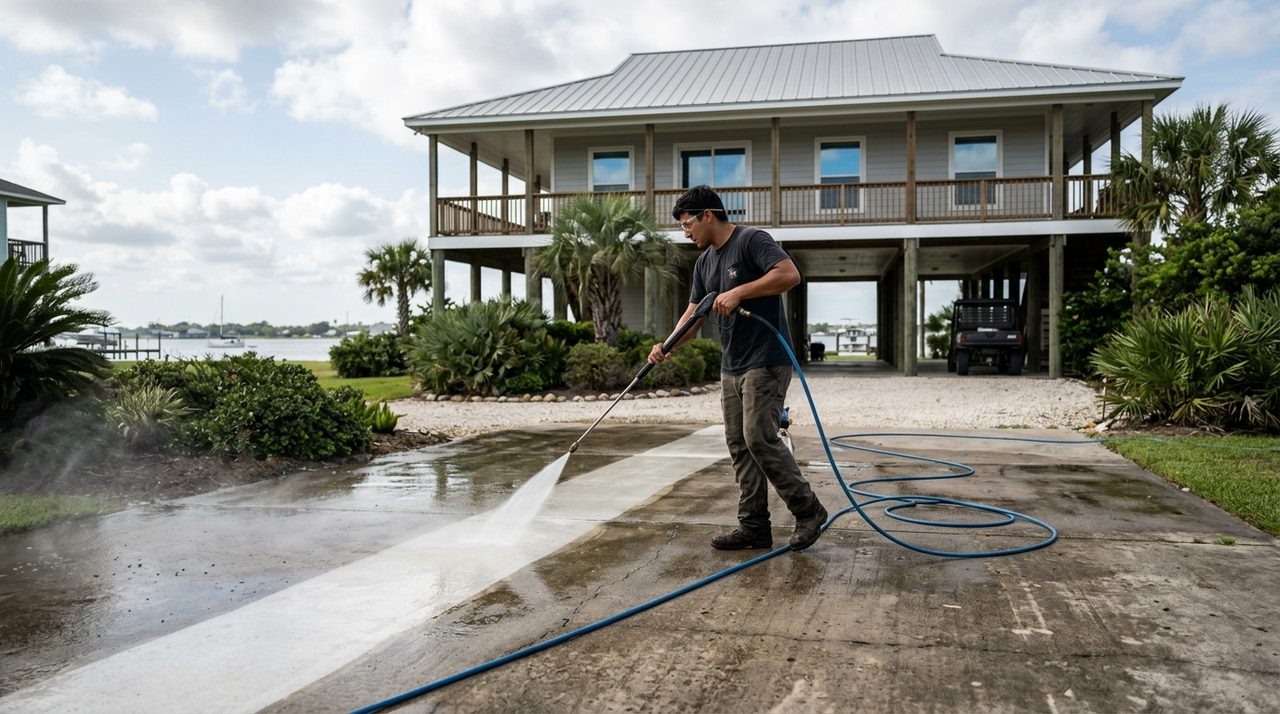
- Median home built
- 1981
- Median home value
- $190,600
- FEMA flood zone
- X (low)
- Typical cost (est.)
- $150–$900 depending on scope
- Most common local issue
- Salt-air accelerated mold and biological staining on Gulf Coast-exposed siding and driveways
Ranked by verified Google rating × review volume × verification tier. How we rank →
Some highly-rated pros serve Texas City from nearby and may not keep a Texas City street address. Those are listed under "Also serving Texas City" with their real city and distance, so you always know where each business is based.
Min rating:
3 resultsAlso serving Texas City
Highly-rated pros based nearby who cover Texas City. Distance shown from the Texas City area.
Serving Texas City Based in La Marque · 4.8 mi away
Closed
Serving Texas City Based in Dickinson · 7 mi away
Pressure Washing in Texas City: What You Should Know
Salt-Air Humidity Drives Relentless Mold on Both Old and New Exteriors
Why it matters to you
Texas City's position on Galveston Bay means airborne salt particles deposit on every exterior surface year-round, and the metro's average annual humidity above 75% gives Gloeocapsa magma black algae and green mold near-perfect conditions to colonize within months of cleaning. This hits both ends of the housing stock: the older brick homes near the historic core absorb moisture into already-porous masonry, while the newer fiber-cement and painted-brick facades in Lago Mar and Park Place South develop green streaks on north- and shade-facing elevations within a single Gulf Coast wet season.
What a good pro does
A qualified operator in Texas City should apply a post-wash biocide — sodium hypochlorite-based soft-wash solution at appropriate dilution — rather than stopping at a water rinse. On newer production-builder homes with painted or primed surfaces, low-pressure soft-wash (under 500 PSI at the surface) protects the factory finish while delivering the chemistry needed to kill biological growth at the root. Ask any operator whether they apply a residual inhibitor after rinsing, because without it, re-colonization on Gulf-exposed surfaces commonly restarts within 6–12 months. Note that operators applying algaecide products qualifying as pesticides under Texas Department of Agriculture definitions may need a TDA pesticide applicator license.
Aging Concrete Driveways with Oil Staining and Post-Uri Surface Spalling
Why it matters to you
A significant share of Texas City's owner-occupied homes — 53.9% owner-occupied per the ACS 2023 — sit in neighborhoods built in the mid-to-late 20th century with original concrete driveways poured directly over slab-on-grade construction. Decades of vehicle oil on porous concrete bake in under South Texas UV, and Winter Storm Uri's freeze-thaw cycle in February 2021 accelerated surface spalling on driveways that had never experienced sustained sub-freezing temperatures, opening new pores that trap staining even more aggressively.
What a good pro does
Effective driveway cleaning on Texas City's older concrete requires chemical pre-treatment with a degreaser applied and allowed to dwell before any pressure is applied — cold-water rinsing alone will not lift oil that has polymerized into the surface. For spalled concrete, operators should use a surface cleaner attachment (spinning bar head) rather than a pinpoint wand to avoid deepening existing divots. Importantly, TCEQ regulations prohibit wash water containing degreasers or chemical cleaners from entering storm drains, which in Galveston County drain toward the bay; a responsible operator will either wet-vac the wastewater or use berms to route it to a landscaped area for absorption rather than letting it sheet-flow to the curb.
HOA Appearance Deadlines in Lago Mar and Park Place South Require Fast, Correct Action
Why it matters to you
The master-planned communities that represent Texas City's newest growth — Lago Mar (managed by Principle Management Group) and Park Place South — carry mandatory HOA covenants with architectural review committees that issue written violation notices for algae-stained driveways, discolored fences, and green roofs, often with cure windows as short as 30 days. A homeowner who responds by hiring a high-pressure operator who damages a relatively new roof or leaves streaks on a stone-veneer facade may find themselves facing both a lingering HOA notice and a warranty dispute.
What a good pro does
Before scheduling any work in Lago Mar or Park Place South, confirm with the specific HOA management company whether the CC&Rs specify soft-wash-only on roofing materials or restrict certain chemical products near the community's retention ponds and bay-adjacent drainage. Keep the vendor's invoice and before/after photos as documentation when responding to an HOA violation notice — cure confirmation typically requires written proof. HOA status in older Texas City neighborhoods must be verified independently through deed records at the Galveston County Clerk or hoa.texas.gov, since many older blocks have only recorded deed restrictions with no active enforcement body.
Sources: Local HOA / deed restrictions (see area profile), Texas Commission on Environmental Quality
Wood Fence Deterioration Accelerated by Coastal Conditions and Industrial Proximity
Why it matters to you
The post-1980s subdivisions ringing Texas City's newer residential areas rely heavily on wood privacy fencing, and the coastal environment here compounds the standard Houston deterioration timeline. Salt-laden air, humidity above 75%, and Texas City's industrial corridor proximity — which can introduce airborne particulates — cause untreated pine privacy fences to gray, crack, and develop mold noticeably faster than in inland Houston suburbs. A fence that might last 18–24 months before needing a wash-and-seal cycle inland may show significant biological and UV weathering within 12 months here.
What a good pro does
Pressure washing ahead of staining or sealing is the critical first step, but over-pressuring weathered coastal pine — anything above 1,200 PSI at the surface — splinters the already-open grain and shortens the fence's remaining life. A good operator will test pressure on a low-visibility board first and work at a consistent 12–18 inch standoff distance. After washing and a minimum 48-hour dry time (longer in Texas City's humid conditions), a penetrating oil-based or semi-transparent stain applied to the clean surface provides the best barrier against re-colonization and UV graying. No City of Texas City permit is required for routine fence washing, but work in HOA-governed subdivisions requires confirming approved stain colors with the architectural review committee before applying any finish coat.
Sources: Local HOA / deed restrictions (see area profile)
Pressure Washing in Texas City: What You Should Know
Hiring pressure washing in Texas City? Texas City is an incorporated Galveston County city with a wide range of housing stock, from newer master-planned communities like Lago Mar to older neighborhoods near the historic core and refineries. Homeowners here face coastal weather exposure, salt-air corrosion, and varying flood risk depending on elevation and proximity to the bay. Permitting runs through the City of Texas City, not Houston, and HOA requirements vary significantly by subdivision.
- Housing era
- Mixed — older core neighborhoods date to the mid-20th century
- Foundation
- Predominantly slab-on-grade in modern subdivisions
- Flood zone
- FEMA Zone X (low flood risk) per official NFHL data
- Permits
- City of Texas City Permits and Inspections Department (independent municipality, not Houston Permitting Center)
Housing stock & systems
Building era
Mixed — older core neighborhoods date to the mid-20th century; master-planned communities like Lago Mar and Park Place South are primarily 2010s–2020s construction.
Typical style
Modern production-builder suburban homes (brick and stone, one- and two-story) in newer subdivisions; older areas feature more varied Gulf Coast residential styles.
Foundations
Predominantly slab-on-grade in modern subdivisions; some older coastal and bay-adjacent homes may be pier-and-beam or raised construction — confirm via Galveston County Appraisal District records.
Common systems
Newer homes feature modern central HVAC, PEX or CPVC plumbing, and 200-amp electrical panels; older homes may have original ductwork, galvanized or copper plumbing, and smaller electrical services requiring upgrades.
What that means for repairs
Older homes near the historic core often need HVAC modernization, electrical panel upgrades, and corrosion-related exterior repairs due to salt air and industrial proximity. Newer HOA communities focus on cosmetic upgrades and energy efficiency improvements.
Permits & restrictions
Permit jurisdiction
City of Texas City Permits and Inspections Department (independent municipality, not Houston Permitting Center).
HOA & deed restrictions
Mixed — mandatory HOAs govern newer subdivisions including Lago Mar Owners Association (managed by Principle Management Group) and Park Place South Homeowners Association. Older neighborhoods may have only recorded deed restrictions with no active HOA. HOA status must be confirmed lot-by-lot via deed records, Galveston County Clerk, or hoa.texas.gov.
Historic districts
No City of Houston historic district designation confirmed. Texas City is a separate incorporated municipality; any local historic designations would be administered by the City of Texas City.
Contractor note
Contractors must pull permits through the City of Texas City, not Harris County or the City of Houston. HOA-governed subdivisions like Lago Mar and Park Place South require architectural approval before exterior work begins; confirm requirements with the specific HOA management company.
Flood & weather
FEMA flood zone
FEMA Zone X (low flood risk) per official NFHL data. However, Texas City is a low-lying coastal community along Galveston Bay, and localized flooding can occur in areas near Dickinson Bayou, Moses Lake, and the bay shoreline. Flood risk varies significantly by subdivision and elevation.
Hurricane Harvey impact
Specific Harvey 2017 flood depths and damage data for Texas City subdivisions were not confirmed in available research. As a low-lying coastal community in Galveston County, Texas City likely experienced storm surge and rainfall impacts, but street-level or subdivision-specific flood data should be verified through FEMA claims records, the Galveston County Appraisal District, or the Texas General Land Office.
Heat & humidity load
Extreme humidity and salt air from Galveston Bay accelerate exterior corrosion on HVAC condensers, metal roofing components, and fasteners. Older homes without adequate insulation or modern HVAC systems face heavy cooling loads. Mold risk is elevated in poorly ventilated homes, especially those with pier-and-beam foundations near the coast.
Working with contractors here
Texas City's dual housing stock creates two distinct contractor markets. In newer master-planned communities like Lago Mar and Park Place South, work centers on warranty-period punch lists, fence and patio additions within HOA guidelines, and energy-efficiency upgrades. In older neighborhoods, contractors commonly handle HVAC system replacements, electrical panel upgrades from 100-amp to 200-amp service, re-piping from galvanized to PEX, and exterior repairs driven by salt-air corrosion. Coastal proximity means roofing contractors must account for wind uplift ratings and corrosion-resistant fasteners. All work requires City of Texas City permits, and contractors unfamiliar with the local permitting process should budget additional time compared to Houston-area jurisdictions.
Local Tip
Always ask for a written estimate before work begins. Texas contractors are required to provide one on jobs over $1,000.
About Texas City
Texas City is an incorporated Galveston County city with a wide range of housing stock, from newer master-planned communities like Lago Mar to older neighborhoods near the historic core and refineries. Homeowners here face coastal weather exposure, salt-air corrosion, and varying flood risk depending on elevation and proximity to the bay. Permitting runs through the City of Texas City, not Houston, and HOA requirements vary significantly by subdivision.
- Median year built
- 1981
- Median home value
- $190,600
- Owner-occupied
- 53.9%
- Population
- 54,159
- Housing units
- 23,248
- Median income
- $65,447
Source: U.S. Census Bureau, ACS 5-Year 2023
Flood & storm risk
FEMA Zone XLow flood riskMost of Texas City maps to FEMA Zone X (low mapped flood risk), but Houston's flash-flood reality means even low-risk blocks benefit from smart drainage and storm-hardened installs; as a Galveston County coastal community, tropical surge and wind add a layer generic guidance misses.
Source: FEMA National Flood Hazard Layer (NFHL). Flood zones vary by parcel — verify your individual FIRM panel.
Frequently Asked Questions
Do I need a permit from the City of Texas City to pressure wash my house or driveway?
Routine residential pressure washing does not require a permit from the City of Texas City Permits and Inspections Department — this is true whether you hire a company or do it yourself. However, if the job involves chemical degreasers or algaecides being washed into storm drains, the operator must comply with TCEQ stormwater discharge rules regardless of permit status, since Texas City's storm drainage ultimately reaches Galveston Bay. Confirm with the City of Texas City (not the Houston Permitting Center, which has no jurisdiction here) if you have questions about any associated exterior repair work that might cross into a permitted trade.
Sources: Texas Commission on Environmental QualityCity of Houston Permitting Center
My Texas City home is in FEMA Zone X — does that mean I won't get the flood-line staining I've heard about from neighbors closer to Galveston Bay?
Most of Texas City maps to FEMA Zone X, which means lower mapped flood risk compared to the AE zones covering much of coastal Galveston County, so a classic bathtub-ring flood mark on your foundation or siding is less likely here than for bay-adjacent properties. That said, Galveston County's tropical surge history and Texas City's flat topography mean heavy rainfall from Gulf events can still deposit mud staining, tannic leaf residue, and wind-driven salt-grime on your exterior even without standing water reaching your slab. If you do see a mineral or tide-line mark after a storm event, a soft-wash chemical treatment rather than straight high-pressure rinsing will address the mineral salts without damaging older brick mortar.
I live in Lago Mar — do I need HOA approval before scheduling a pressure washer to come out?
For routine cleaning of existing surfaces (driveway, siding, fence), the Lago Mar Owners Association managed by Principle Management Group does not typically require advance architectural approval — you are maintaining an existing surface, not altering it. However, if the visit is being scheduled specifically to cure a written violation notice, confirm with Principle Management Group directly that the proposed cleaning method (especially soft-wash chemical application on a specific surface like the roof or fence) satisfies the cited standard before the cure-window deadline closes, since some CC&Rs specify prohibited methods. Lot-specific deed restriction language can vary even within newer Texas City subdivisions, so verify your own HOA status via the Galveston County Clerk or hoa.texas.gov if you are unsure whether your block has an active HOA.
Sources: Local HOA / deed restrictions (see area profile)
How often should I realistically schedule pressure washing for a home near the Texas City industrial corridor, and is there a best season to do it?
For homes within a mile or two of the Texas City refineries and petrochemical facilities along the Ship Channel, airborne particulate and hydrogen sulfide deposits accelerate surface darkening and organic growth beyond typical suburban rates, so an annual cleaning cycle — rather than the every-two-years schedule common in inland Houston suburbs — is a reasonable baseline estimate. Timing-wise, late February through April is generally optimal: you get ahead of peak summer mold growth, humidity is lower than July or August, and you avoid scheduling conflicts that pile up after major hurricane-season storm events in the fall. Avoid scheduling immediately before a named storm is forecast, since coastal wind and debris will re-contaminate surfaces within days.
Can a pressure washer in Texas City handle the older pier-and-beam homes near the historic core, or is slab-on-grade experience enough?
Some older Texas City homes near the historic core and bay-adjacent blocks are pier-and-beam or raised construction — confirmed via Galveston County Appraisal District records — rather than the slab-on-grade standard in Lago Mar and Park Place South. This matters for pressure washing because raised homes expose underside skirting, wood decking, and older brick or stucco at grade level that requires lower PSI settings and targeted biocide application to avoid forcing water into wall cavities. Ask any operator you consider whether they have worked on raised coastal Gulf homes specifically, not just modern production-builder slabs, before they quote your job.
What should I ask a Texas City pressure washing company about their wastewater handling before I hire them for a driveway with heavy oil staining?
Because Texas City's storm drainage flows toward Galveston Bay, ask the operator directly how they contain and dispose of wash water when using chemical degreasers on an oil-stained driveway — TCEQ rules prohibit detergent-laden wash water from entering storm drains under the Texas Pollutant Discharge Elimination System (TPDES) framework. A reputable operator will describe a containment method (berms, a wet vacuum, or a reclaim system) and explain where the collected water goes; if they cannot answer that question, that is a compliance red flag. Also confirm whether the degreaser product they plan to use qualifies as a pesticide under Texas Department of Agriculture definitions, which would require the applicator to hold a TDA pesticide applicator credential.