2354 Plantation Bend Dr, Sugar Land, TX 77478
Best Pressure Washing in Sugar Land, TX
Sugar Land's master-planned subdivisions — First Colony, New Territory, Telfair, and dozens more — pair 1980s–2000s brick veneer exteriors and composition shingle roofs with mandatory HOAs that issue written violation notices for algae staining, discolored driveways, and green-streaked fencing. Fort Bend County's expansive Beaumont clay soil and the area's proximity to Oyster Creek mean mineral wicking and organic growth are facts of life on slabs poured here in 1994 (the Census median build year). This page explains exactly which surfaces cause the most trouble in Sugar Land, what a qualified soft-wash operator does differently here, and what it realistically costs.
Verified against Google Business data
Updated 2026
See the 10 Pressure Washing Serving Sugar Land 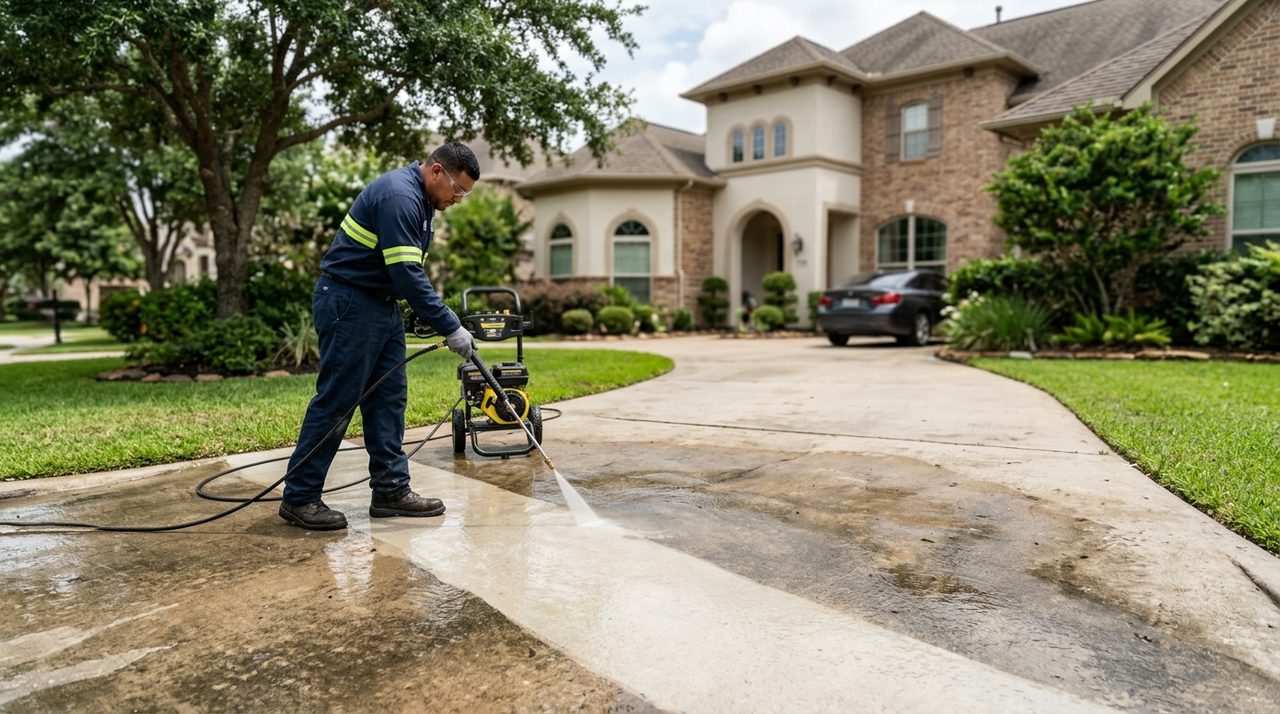
- Median home built
- 1994
- Median home value
- $406,600
- FEMA flood zone
- X (low)
- Typical full-property package (est.)
- $500–$900
- Most common local issue
- HOA violation notices for algae-stained driveways and green brick exteriors
Ranked by verified Google rating × review volume × verification tier. How we rank →
Min rating:
10 results Open Now
8311 Big Bend Dr, Sugar Land, TX 77479
Open Now
2245 Texas Dr Suite 300, Sugar Land, TX 77479
13500 W Airport Blvd, Sugar Land, TX 77498
Closed
7627 Redmond Ct, Sugar Land, TX 77479
Closed
225 Matlage Way #1772, Sugar Land, TX 77487
14090 sw freeway frontage rd, Sugar Land, TX 77478
6115 Hansford Ln, Sugar Land, TX 77479
Open Now
1601 Industrial Blvd Ste 3033, Sugar Land, TX 77478
Sugar Land, TX 77479
Pressure Washing in Sugar Land: What You Should Know
HOA Violation Clocks Are Real — and the Cure Window Is Short
Why it matters to you
Virtually every Sugar Land subdivision — from Sugar Lakes POA to the First Colony community associations to New Territory Residential Community Association — enforces deed restrictions requiring homeowners to keep driveways, fences, and exterior walls free of algae, mold, and discoloration. Architectural control committees conduct periodic inspections, and written cure notices often allow as little as 30 days to remediate visible staining. For the 1980s–1990s brick homes that dominate the area, green-black Gloeocapsa magma streaks on north-facing elevations and shaded driveways are common enough that they're a leading HOA complaint category in Fort Bend County subdivisions.
What a good pro does
Before scheduling a wash, ask your HOA's architectural control committee whether a pre-approval form is required for exterior cleaning — some Sugar Land subdivisions treat soft-wash chemical application as a 'treatment' subject to review. A qualified operator will document the violation notice, confirm the surfaces specified, apply a post-wash algaecide or biocide to slow regrowth (critical in Houston's perennial humidity), and provide a written service record you can submit as proof of cure. No City of Sugar Land permit is required for routine residential pressure washing, but the HOA paperwork can add days to your timeline.
Sources: Local HOA / deed restrictions (see area profile), Texas Commission on Environmental Quality
Slab-on-Grade Clay Soil Drives Persistent Driveway Staining
Why it matters to you
Sugar Land sits on the same Houston Black and Beaumont clay series that underlies much of the southwest Houston metro. These expansive clays shrink during summer droughts and swell after rain, wicking mineral salts upward through concrete slabs and depositing white efflorescence along expansion joints and at the slab perimeter — a highly visible problem on the flat, broad driveways characteristic of 1980s–1990s suburban homes here. Red clay mud tracking from landscaped beds onto unsealed concrete compounds the problem, especially after Fort Bend County's frequent heavy rains.
What a good pro does
Standard cold-water rinsing won't dissolve calcium carbonate efflorescence. A competent operator will apply a dilute acid-based pre-treatment (typically a mild phosphoric or citric acid wash) to break the mineral bond before pressure washing, then rinse thoroughly and confirm no wash water is directed toward storm drain inlets — a TCEQ compliance requirement that applies in incorporated Sugar Land just as it does elsewhere in the metro. Expect a 20–30% cost premium over a basic driveway wash when chemical pre-treatment is required, so budget $185–$450 for a treated driveway job (estimate only).
Sources: Texas Commission on Environmental Quality, FEMA National Flood Hazard Layer (NFHL)
Composition Shingle Roofs Need Soft-Wash — Not Pressure — to Stay HOA-Compliant and Warranty-Valid
Why it matters to you
The majority of Sugar Land homes carry 3-tab or architectural asphalt shingles installed during the 1990s–2000s build-out, placing them in the age range where granule loss from high-pressure washing is a genuine risk. HOA architectural committees in communities like Telfair and First Colony cite roof discoloration caused by Gloeocapsa magma black streaks as a violation, yet manufacturers including GAF and CertainTeed explicitly state that high-pressure (above ~500 PSI) washing voids shingle warranties — leaving homeowners caught between an HOA mandate and warranty protection.
What a good pro does
The correct method is low-pressure soft-wash: surfactant and sodium hypochlorite solution applied at under 100 PSI, allowed to dwell, then gently rinsed. A responsible operator will confirm the shingle brand and age before quoting, avoid directing runoff into landscaped beds without pre-wetting plants, and provide documentation showing the soft-wash approach was used — useful if a warranty question arises later. Texas does not require a state pressure-washing license, but operators applying algaecide products classified as pesticides under Texas Department of Agriculture rules must hold a TDA pesticide applicator credential. Ask to see it.
Sources: Local HOA / deed restrictions (see area profile), International Residential Code (as adopted by City of Houston)
Wood Privacy Fences Gray Fast in Fort Bend County's Heat and Rain Cycle
Why it matters to you
Post-1980s Sugar Land subdivisions — particularly the larger lots in Ranch Country and older First Colony sections — commonly feature cedar or pine privacy fences that face a brutal maintenance cycle: 100°F-plus summers, frequent Gulf moisture, and high subterranean termite pressure cause uncoated wood to gray and develop surface mold within 12–18 months. Many HOA deed restrictions require fences to maintain a 'natural wood' or stained appearance, making fence washing and re-staining a recurring obligation rather than an optional upgrade. Over-pressure washing (above 1,200 PSI) on weathered pine will splinter the grain and accelerate deterioration.
What a good pro does
A good operator will test an inconspicuous fence section first, wash at 800–1,000 PSI using a fan tip rather than a zero-degree nozzle, and allow full drying time (typically 48–72 hours in Sugar Land's humidity) before any stain or sealer is applied. Bundling fence washing with a house exterior or driveway job typically brings the per-linear-foot cost down toward the $0.35–$0.55 range (estimate only). Confirm with your HOA whether the replacement stain color requires architectural committee approval before the wood dries — some Sugar Land associations have an approved color palette.
Sources: Local HOA / deed restrictions (see area profile)
Pressure Washing in Sugar Land: What You Should Know
Hiring pressure washing in Sugar Land? Sugar Land is composed of numerous master-planned communities, each governed by its own mandatory HOA or POA with actively enforced deed restrictions. The housing stock is predominantly 1980s–2000s suburban brick construction on slab-on-grade foundations, requiring contractors to navigate both city permitting and subdivision-level architectural review for most exterior projects. Proximity to the Brazos River and Oyster Creek creates localized flood risk despite generally favorable FEMA designations.
- Housing era
- Primarily 1980s–2000s, with newer construction in communities like Telfair from the late 2000s–2010s and…
- Foundation
- Slab-on-grade (standard for post-1970 Fort Bend County suburban construction)
- Flood zone
- FEMA Zone X (low flood risk) per official NFHL data
- Permits
- City of Sugar Land Development Services (Sugar Land is an incorporated city with its…
Housing stock & systems
Building era
Primarily 1980s–2000s, with newer construction in communities like Telfair from the late 2000s–2010s and older sections dating to the 1970s.
Typical style
Traditional suburban brick homes (1- and 2-story) with brick veneer, composition shingle roofs, and attached garages; variants include Colonial-influenced, Mediterranean-influenced, and transitional brick/stone combinations.
Foundations
Slab-on-grade (standard for post-1970 Fort Bend County suburban construction).
Common systems
Central HVAC systems (many original units in 1980s–1990s homes nearing or past replacement age), copper or CPVC plumbing supply lines, cast iron or PVC drain lines depending on era, 200-amp electrical panels in most homes.
What that means for repairs
Kitchen and bathroom remodels are common in 1980s–1990s homes as original finishes age out. HVAC replacement is a major category given system lifespans. Many homeowners pursue exterior updates (stone accents, roof replacement, garage door upgrades) subject to HOA architectural review and approval.
Permits & restrictions
Permit jurisdiction
City of Sugar Land Development Services (Sugar Land is an incorporated city with its own permitting office).
HOA & deed restrictions
HOA or POA membership is mandatory at the subdivision level across virtually all Sugar Land neighborhoods. Examples include Sugar Lakes POA, Ranch Country Association (POA), New Territory Residential Community Association, and First Colony community associations. Each subdivision enforces its own deed restrictions, architectural standards, and assessment schedules. No single city-wide HOA exists.
Historic districts
No historic district designation confirmed. Sugar Land is an incorporated city in Fort Bend County, outside City of Houston HAHC jurisdiction.
Contractor note
Contractors must obtain permits through the City of Sugar Land and should anticipate HOA architectural review requirements for exterior work. Many subdivisions require pre-approval from the HOA's architectural control committee before visible modifications can begin.
Flood & weather
FEMA flood zone
FEMA Zone X (low flood risk) per official NFHL data. However, portions of Sugar Land near the Brazos River, Oyster Creek, and areas behind levee systems may carry higher risk designations at the parcel level. Property-specific FEMA lookups are recommended.
Hurricane Harvey impact
Sugar Land experienced significant flooding in some areas during Hurricane Harvey (2017), particularly in subdivisions near the Brazos River, Oyster Creek, and low-lying areas associated with levee districts. Not all subdivisions were equally affected — some experienced minimal impact while others saw substantial water intrusion. Specific subdivision-level Harvey damage records should be verified through Fort Bend County records.
Heat & humidity load
Extreme summer heat and humidity place heavy demand on HVAC systems, particularly in 1980s–1990s homes with aging equipment. Slab-on-grade foundations on expansive clay soils are susceptible to movement during drought-to-rain cycles, making foundation monitoring and proper drainage maintenance critical. Composition shingle roofs degrade faster under sustained UV exposure.
Working with contractors here
HVAC replacement and repair is among the most common contractor activities in Sugar Land, as many homes from the 1980s–1990s build-out are on their second or third system. Roof replacement is frequent given the age of the housing stock and storm exposure. Foundation repair is a recurring need due to expansive clay soils and seasonal moisture fluctuations. Contractors should budget extra time for HOA architectural review and approval processes, which vary by subdivision and can add weeks to project timelines. Exterior work — including paint colors, fencing, roofing materials, and landscaping — is tightly regulated by deed restrictions, so contractors must confirm approved materials and specifications with the relevant HOA before ordering supplies or beginning work.
Local Tip
Always ask for a written estimate before work begins. Texas contractors are required to provide one on jobs over $1,000.
About Sugar Land
Sugar Land is composed of numerous master-planned communities, each governed by its own mandatory HOA or POA with actively enforced deed restrictions. The housing stock is predominantly 1980s–2000s suburban brick construction on slab-on-grade foundations, requiring contractors to navigate both city permitting and subdivision-level architectural review for most exterior projects. Proximity to the Brazos River and Oyster Creek creates localized flood risk despite generally favorable FEMA designations.
- Median year built
- 1994
- Median home value
- $406,600
- Owner-occupied
- 80.1%
- Population
- 109,735
- Housing units
- 39,196
- Median income
- $137,511
Source: U.S. Census Bureau, ACS 5-Year 2023
Flood & storm risk
FEMA Zone XLow flood riskMost of Sugar Land maps to FEMA Zone X (low mapped flood risk), but Houston's flash-flood reality means even low-risk blocks benefit from smart drainage and storm-hardened installs; risk climbs sharply on blocks nearest the Brazos River, where it varies parcel to parcel.
Source: FEMA National Flood Hazard Layer (NFHL). Flood zones vary by parcel — verify your individual FIRM panel.
Frequently Asked Questions
Does the City of Sugar Land require a permit for residential pressure washing, or do I just need HOA approval?
The City of Sugar Land Development Services does not require a municipal permit for routine residential pressure washing — it is not a permitted trade in the same category as electrical or plumbing work. However, because virtually every Sugar Land subdivision runs its own HOA or POA with an architectural control committee, you should confirm whether your subdivision requires written pre-approval before any visible exterior cleaning work begins, particularly for roof soft-wash or fence treatments that could alter surface appearance.
Sources: Local HOA / deed restrictions (see area profile)
My home in First Colony was built in the early 1990s — are there specific risks with pressure washing 30-year-old brick veneer on these slab foundations?
Yes, and it is a real concern for Sugar Land's 1980s–2000s brick stock: three decades of clay-soil movement have likely introduced minor mortar-joint cracking at the brick veneer, and high-pressure water directed into those joints can accelerate moisture intrusion and efflorescence wicking through the slab. A qualified operator working on Census-era (built around 1994) Sugar Land homes should inspect mortar joints before choosing nozzle pressure and default to lower PSI settings on brick field surfaces, using higher pressure only on concrete flatwork like driveways and walkways.
Sugar Land is FEMA Zone X, so do I really need to worry about flood-line staining the way Meyerland homeowners do?
Most Sugar Land parcels carry a low mapped flood risk under FEMA Zone X, so the distinct bathtub-ring flood marks seen on Meyerland brick are uncommon here. That said, blocks nearest Oyster Creek or the Brazos River floodplain can carry higher parcel-specific risk, and Fort Bend County's intense flash-flood events have left mud-line staining on low-lying Sugar Land properties even in nominally low-risk zones — so homeowners near those drainageways should ask a pressure washer about organic mud-stain pre-treatment the same way bayou-adjacent homeowners would.
What is the best time of year to schedule pressure washing in Sugar Land, and how quickly will surfaces re-stain?
Late February through April is the sweet spot for Sugar Land: temperatures are mild, humidity briefly drops before summer monsoon season begins, and cleaning before the long rainy season prevents organic material from baking onto brick and concrete under July and August heat. Without a post-treatment biocide applied after washing, Gloeocapsa magma (the black algae common on Sugar Land roofs and driveways) typically recolonizes within 6–12 months given Fort Bend County's year-round humidity — so ask your operator whether they apply an algaecide treatment, and note that high-concentration algaecides may require the operator to hold a Texas Department of Agriculture pesticide applicator license.
My New Territory HOA sent a violation notice about my driveway and gave me a 30-day cure window — is that a realistic timeline to get a job scheduled and completed?
Thirty days is tight but achievable in Sugar Land's market, especially if you book within the first week of receiving the notice: most local pressure washing operators can schedule residential driveway and flatwork jobs within 7–14 days, and the work itself typically takes half a day for a standard two-car driveway and walkway. To document compliance for your HOA, ask the operator to send before-and-after photos by email so you have timestamped evidence to submit to your subdivision's architectural control committee before the cure deadline.
Sources: Local HOA / deed restrictions (see area profile)
Does the pressure washer's wash water runoff matter in Sugar Land, or is that mainly a City of Houston issue?
It matters in Sugar Land too: TCEQ stormwater rules under the Texas Pollutant Discharge Elimination System apply statewide, and wash water containing degreasers, chemical cleaners, or oil residue cannot legally be directed into Sugar Land's storm drains, which flow to Oyster Creek and ultimately to the Brazos River watershed. For routine soft-wash house and driveway cleaning with dilute detergents, containment requirements are less stringent than for commercial degreaser jobs, but any operator using concentrated chemical products on your driveway or hardscape should be able to explain their runoff management plan before starting work.