Closed
502 Land Grant Dr, Richmond, TX 77406
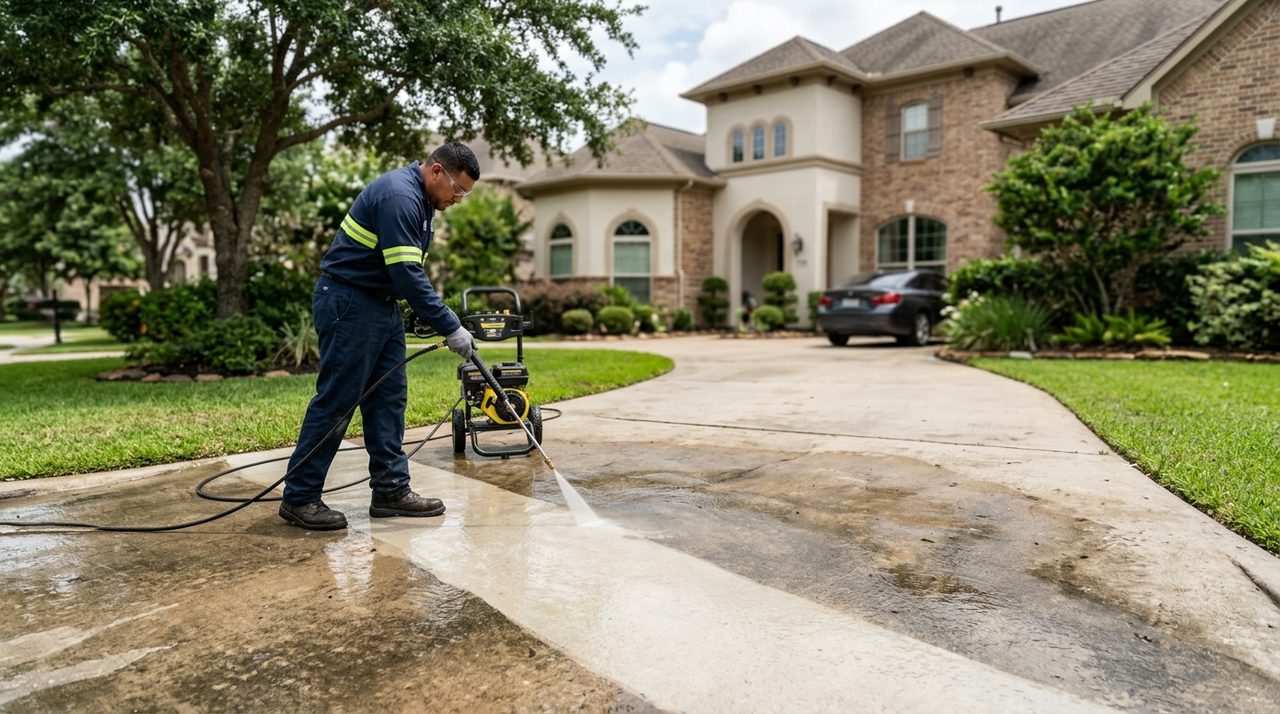
Richmond's exterior surfaces face a double burden: Fort Bend County's heavy Beaumont clay wicks mineral salts and red-mud staining onto the post-tension slab driveways and brick facades that define the area's 1990s–2020s master-planned subdivisions, while the region's 75%-plus annual humidity feeds year-round mold and algae growth on every porous surface. Whether your home sits in Harvest Green, Pecan Grove, Greatwood, or Long Meadow Farms, understanding what Richmond's soils, HOA architectural committees, and older concrete actually require from a pressure-washing job will save you a violation notice — and prevent costly surface damage.
Ranked by verified Google rating × review volume × verification tier. How we rank →
Some highly-rated pros serve Richmond from nearby and may not keep a Richmond street address. Those are listed under "Also serving Richmond" with their real city and distance, so you always know where each business is based.
502 Land Grant Dr, Richmond, TX 77406
2109 Silver Canyon Ln, Richmond, TX 77469
Highly-rated pros based nearby who cover Richmond. Distance shown from the Richmond area.
Serving Richmond Based in Rosenberg · 2.6 mi away
Serving Richmond Based in Cinco Ranch · 2.6 mi away
Serving Richmond Based in Sugar Land · 5.7 mi away
Serving Richmond Based in Sugar Land · 6.2 mi away
Serving Richmond Based in Cinco Ranch · 7.4 mi away
Serving Richmond Based in Westchase · 9.2 mi away
Why it matters to you
Richmond's dominant master-planned communities — Harvest Green, Greatwood, Pecan Grove, Long Meadow Farms, Del Webb Sweetgrass, and others — each operate their own architectural review committee with recorded deed restrictions. These HOAs routinely issue written violation notices for algae-streaked driveways, green-stained brick exteriors, and discolored wood fences, and cure windows can be as short as 30 days. Because HOA status is strictly subdivision-by-subdivision in Richmond (some older or rural tracts have no HOA at all), homeowners must pull their specific CC&Rs before scheduling any exterior work.
What a good pro does
Before work begins, confirm your subdivision's governing documents — which Texas law now requires HOAs of 60-plus lots to post publicly — to understand whether your roof material, fence type, or driveway surface has any restriction on cleaning methods or chemical applications. A qualified operator will document the pre-clean condition, apply a post-treatment biocide to slow algae regrowth, and provide a dated invoice you can submit to your ARС as evidence of compliance. Texas does not license pressure washing as a standalone trade, so verifying the operator carries general liability insurance is your primary vetting tool.
Sources: Local HOA / deed restrictions (see area profile)
Why it matters to you
The expansive Beaumont and Houston Black clay underlying Richmond's post-tension slab homes shrinks and swells with every wet-dry cycle, pushing mineral salts upward through concrete and mortar joints and depositing white efflorescence and rust-colored clay mud along slab edges, brick courses at grade, and driveway aprons. Homes built in the 2000s–2010s construction boom — the dominant era across Pecan Grove and Harvest Green phases — are now hitting the age where this staining is unmistakable and standard cold-water rinsing cannot break the mineral bond.
What a good pro does
Effective treatment requires a dilute acid wash (typically a phosphoric- or muriatic-based pre-treatment) applied dwell time before the pressure pass — not simply higher PSI. A knowledgeable operator will neutralize the acid rinse before it reaches the storm drain, because TCEQ rules and Fort Bend area ordinances prohibit chemical wash water containing degreasers or cleaners from entering storm drain inlets that flow to local waterways. Budget for a 20–30 percent premium over a basic driveway wash (estimated $150–$350 baseline) when efflorescence or clay staining is present.
Why it matters to you
The privacy wood fences installed across Richmond's 1990s–2000s master-planned phases — untreated pine boards that were standard in production homebuilding — are now 15–30 years old. Fort Bend County's combination of 100°F-plus summers, frequent heavy rainfall, and high termite pressure has left many of these fences gray, cracked, and carrying surface mold. Pressure washing before restaining or sealing is a critical step to extend service life, but weathered pine boards that have been through repeated wet seasons will splinter if hit with more than 1,200 PSI — and a splintered fence in a community like Harvest Green or Long Meadow Farms can itself trigger an HOA appearance notice.
What a good pro does
The correct approach is a low-pressure pass (800–1,200 PSI) with a fan tip held at consistent distance, followed by a wood brightener to open the grain before any stain or sealer is applied. Because fence replacement or significant refinishing in most Richmond subdivisions requires HOA architectural committee pre-approval, confirm in advance whether your ARС treats washing-plus-staining as a modification requiring a submittal — some do, especially if the stain color deviates from the approved palette. Fence washing typically runs $0.35–$0.65 per linear foot; staining is a separate scope.
Sources: Local HOA / deed restrictions (see area profile)
Why it matters to you
Richmond's heaviest construction wave — the 2000s–2010s master-planned buildout of communities like Old Orchard, Pecan Grove's newer phases, and Long Meadow Farms — means a large share of the local housing stock now carries asphalt architectural shingles that are 10–20 years old. Houston's humidity produces Gloeocapsa magma black algae streaks on these roofs within 2–3 years of installation, and several Richmond HOA communities cite roof appearance in violation letters. Homeowners sometimes assume pressure washing is the answer, but high-pressure washing (above 500 PSI) on aged shingles accelerates granule loss and can void remaining manufacturer warranties.
What a good pro does
The correct method is a low-pressure soft-wash using a sodium hypochlorite-based algaecide mix applied at under 100 PSI — the same chemistry the Asphalt Roofing Manufacturers Association endorses. A roof soft-wash on a single-story Richmond home typically runs $300–$600 (estimate), though two-story homes common in Harvest Green and Long Meadow Farms command higher quotes due to access. Because the chemical concentrate involved may qualify as a pesticide under Texas Department of Agriculture definitions, ask your operator whether they hold a TDA pesticide applicator license if they are applying algaecide products — there is no separate state pressure-washing license, but TDA applicator credentials are a meaningful qualifier for chemical roof treatments.
Sources: Local HOA / deed restrictions (see area profile), International Residential Code (as adopted by City of Houston)
Hiring pressure washing in Richmond? Richmond encompasses a wide range of housing from historic city-center properties to modern master-planned communities, each with its own HOA and deed restrictions. Homeowners must identify their specific subdivision's governing documents before initiating exterior modifications. The mix of newer construction and rapid growth means contractors frequently handle warranty-era repairs, energy efficiency upgrades, and landscape compliance work.
Building era
Mixed: historic Richmond core dates to pre-1970s; dominant suburban stock built 1980s–2020s, with heaviest construction in the 2000s–2020s across master-planned communities.
Typical style
Traditional suburban brick, brick-and-stone Texas traditional, and contemporary transitional elevations in newer master-planned phases; one- and two-story production homes with front-loaded attached garages.
Foundations
Predominantly slab-on-grade (post-tension concrete) for suburban tract homes; some older historic Richmond homes may have pier-and-beam foundations.
Common systems
Central HVAC (heat pump and gas furnace split systems common), copper and PEX plumbing in newer homes (possible polybutylene in 1980s–early 1990s stock), 200-amp electrical panels standard in post-2000 construction.
What that means for repairs
Kitchen and bathroom remodels are common in 1990s–2000s homes reaching their second-owner cycle. Exterior modifications (fences, patios, driveways, generators) require HOA architectural review in most subdivisions. Older Pecan Grove and Greatwood-era homes often need HVAC replacements and roof upgrades.
Permit jurisdiction
City of Richmond permits office for properties within city limits; Fort Bend County Engineering Department for unincorporated Fort Bend County areas surrounding Richmond.
HOA & deed restrictions
No single mandatory HOA covers all of Richmond. Most master-planned communities (Harvest Green, Old Orchard, Pecan Grove, Greatwood, Long Meadow Farms, Del Webb Sweetgrass, etc.) have mandatory HOAs with recorded deed restrictions and architectural review committees. Some older or rural tracts have no HOA. HOA status is strictly subdivision-by-subdivision.
Historic districts
No City of Houston historic district designation confirmed. Richmond has its own historic downtown area, but formal historic district protections and review processes should be verified with the City of Richmond.
Contractor note
Contractors must determine whether a property is within Richmond city limits or unincorporated Fort Bend County, as permit jurisdiction and inspection requirements differ. Most subdivisions require HOA architectural approval before exterior work begins, and 2026 Texas HOA transparency laws require governing documents to be publicly posted for associations with 60+ lots.
FEMA flood zone
FEMA Zone X (low flood risk) per official NFHL data. Richmond is situated along the Brazos River, and some areas near the river and Rabbs Bayou carry higher flood risk than the Zone X designation of the sampled point; homeowners should verify their specific lot's flood zone.
Hurricane Harvey impact
Hurricane Harvey (2017) caused significant flooding in parts of Fort Bend County, particularly along the Brazos River corridor. The Barker Reservoir controlled releases and Brazos River flooding impacted numerous Richmond-area subdivisions. Specific impact varied greatly by subdivision and proximity to waterways — homeowners should check individual property flood history through Fort Bend County records.
Heat & humidity load
Extreme summer heat and humidity drive heavy HVAC demand across Richmond's slab-on-grade homes. Expansive clay soils common in Fort Bend County cause seasonal foundation movement, increasing demand for foundation inspection and repair services. Newer homes with large roof spans require periodic inspection for heat-related shingle degradation.
Working with contractors here
Contractors in Richmond work across a wide spectrum of housing ages, from 1980s master-planned homes needing full system replacements to brand-new construction warranty work. HVAC replacement and repair is the most consistent demand driver due to the extreme Fort Bend County summers and the aging of 2000s-era equipment. Foundation monitoring and repair are common given the expansive clay soils, particularly for homes built on slab-on-grade foundations. Exterior work — fencing, patio covers, roofing — almost always requires HOA architectural committee pre-approval, so contractors should build submission lead time into project schedules. The split jurisdiction between City of Richmond and unincorporated Fort Bend County means permit requirements and inspection timelines can differ significantly even between adjacent subdivisions.
Local Tip
Always ask for a written estimate before work begins. Texas contractors are required to provide one on jobs over $1,000.
Richmond encompasses a wide range of housing from historic city-center properties to modern master-planned communities, each with its own HOA and deed restrictions. Homeowners must identify their specific subdivision's governing documents before initiating exterior modifications. The mix of newer construction and rapid growth means contractors frequently handle warranty-era repairs, energy efficiency upgrades, and landscape compliance work.
Source: U.S. Census Bureau, ACS 5-Year 2023
Most of Richmond maps to FEMA Zone X (low mapped flood risk), but Houston's flash-flood reality means even low-risk blocks benefit from smart drainage and storm-hardened installs; risk climbs sharply on blocks nearest the Brazos River, where it varies parcel to parcel.
Source: FEMA National Flood Hazard Layer (NFHL). Flood zones vary by parcel — verify your individual FIRM panel.
Sources: City of Houston Permitting Center
Sources: Local HOA / deed restrictions (see area profile)
Sources: Local HOA / deed restrictions (see area profile)