Closed
1119 Georgina St, Rosenberg, TX 77471
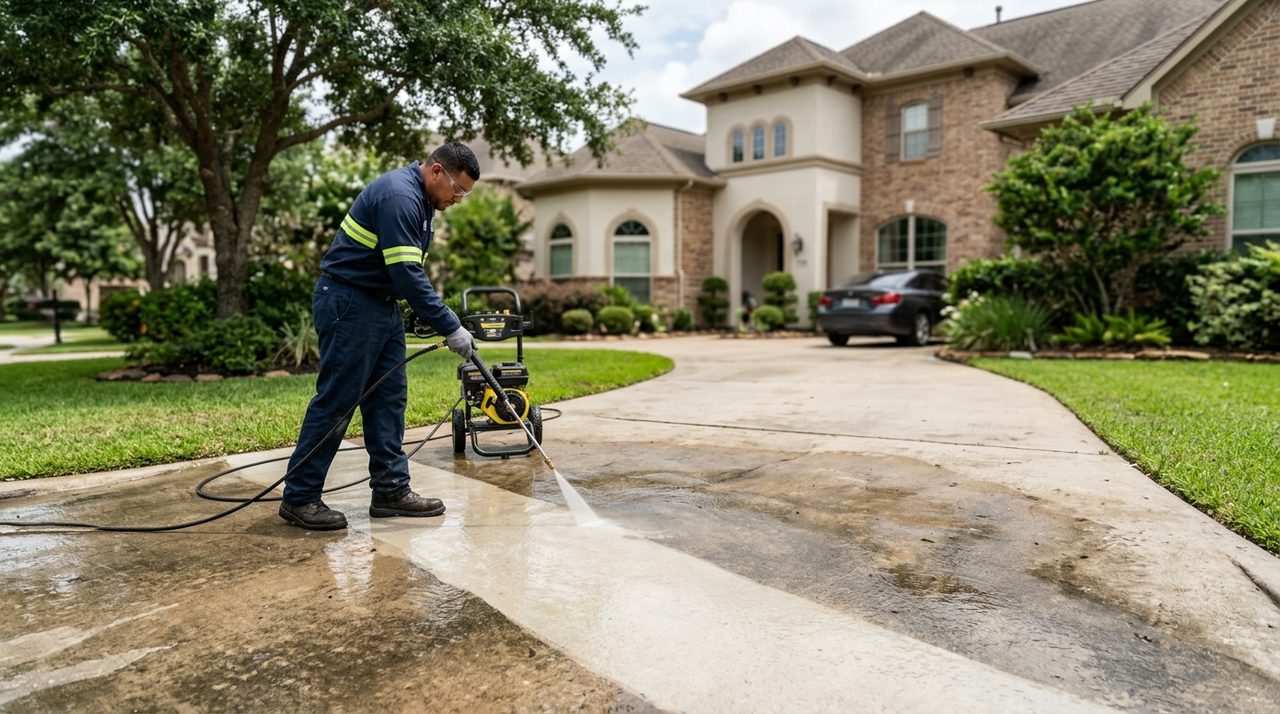
Rosenberg's split personality — a mid-century railroad-era core ringed by 1990s–2020s master-planned subdivisions like Oaks of Rosenberg and The Preserve at Rosenberg — means pressure-washing challenges range from oil-stained aged concrete on 1960s ranch driveways to HOA violation notices targeting algae-covered brick on brand-new production-builder homes. Fort Bend County's notorious expansive black clay soil wicks mineral salts and red-clay mud onto every low-lying surface year-round, and Rosenberg's flat terrain gives mold and mildew nowhere to drain away from. This page explains exactly which surfaces fail first here, what cleaning methods actually work, and what the City of Rosenberg permit and HOA landscape means for homeowners on either side of the city-limit line.
Ranked by verified Google rating × review volume × verification tier. How we rank →
Some highly-rated pros serve Rosenberg from nearby and may not keep a Rosenberg street address. Those are listed under "Also serving Rosenberg" with their real city and distance, so you always know where each business is based.
1119 Georgina St, Rosenberg, TX 77471
Highly-rated pros based nearby who cover Rosenberg. Distance shown from the Rosenberg area.
Serving Rosenberg Based in Richmond · 5.8 mi away
Serving Rosenberg Based in Cinco Ranch · 5.8 mi away
Serving Rosenberg Based in Richmond · 6.8 mi away
Serving Rosenberg Based in Cinco Ranch · 9.9 mi away
Why it matters to you
Fort Bend County sits on some of the thickest Beaumont/Houston Black clay in the metro. As this clay swells and contracts through Rosenberg's wet-dry cycles, it forces mineral salts upward through slab-on-grade concrete driveways and into the mortar joints of the brick-veneer exteriors that dominate newer subdivisions — leaving white efflorescent crust and rust-red clay mud deposits that worsen with every rain. Homes built in Rosenberg's 1990s–2020s production-builder era with poured concrete slabs are especially prone because the slabs sit directly on native clay with no basement buffer.
What a good pro does
A qualified pressure-washing operator will apply a pH-appropriate acidic pre-treatment (typically dilute muriatic or phosphoric acid solution) to dissolve efflorescence before rinsing, rather than simply blasting with cold water — which spreads salts without removing them. On brick veneer, low-to-medium pressure (800–1,200 PSI) with a fan tip protects mortar joints. Note that Texas does not require a state license for pressure washing itself, but operators applying algaecide or chemical cleaners that qualify as pesticides should hold a Texas Department of Agriculture (TDA) applicator credential — ask to see it.
Why it matters to you
Rosenberg's newer master-planned communities operate under mandatory HOA/POA membership with recorded CC&Rs that spell out acceptable exterior appearance standards — and architectural review committees in subdivisions like Oaks of Rosenberg Community Association actively issue written violation notices for algae-darkened driveways, green-stained fence boards, and black-streaked roof shingles. Cure windows can be as short as 30 days, and fines accumulate quickly. Importantly, the older inner-Rosenberg core near the railroad district typically has no HOA at all, so requirements are entirely subdivision-specific — verify via your deed or Fort Bend County property records before assuming either way.
What a good pro does
In HOA-governed subdivisions, get the cleaning done before a notice arrives — annual or biennial washing with a post-treatment biocide dramatically extends the clean interval and keeps you off the architectural review committee's radar. For roof surfaces, confirm your CC&Rs' stance on cleaning method: some prohibit high-pressure washing on asphalt shingles, requiring a low-pressure chemical soft-wash (under 500 PSI) instead. The City of Rosenberg Building & Permitting Department does not require a permit for routine residential pressure washing, so the only approval layer that matters here is your HOA.
Sources: Local HOA / deed restrictions (see area profile), City of Houston Permitting Center
Why it matters to you
Rosenberg's census median year built of 1994 means a large share of homes are now 25–35 years old, pushing many original asphalt-shingle roofs toward the end of their service life. Houston's year-round humidity — consistently above 75% — feeds Gloeocapsa magma black-algae streaks that appear within two to three years of a prior cleaning on these aging shingles. High-pressure washing (above 500 PSI) on brittle, granule-depleted shingles accelerates granule loss, can void remaining manufacturer warranties, and shortens roof life noticeably — a costly mistake on a home already approaching re-roofing age.
What a good pro does
The correct approach for any Rosenberg home with shingles older than ten years is a dedicated low-pressure soft-wash: a sodium hypochlorite and surfactant solution applied at low pressure that kills the algae colony at the root rather than blasting it off mechanically. A reputable operator will inspect shingle condition before quoting and will flag roofs too deteriorated to clean safely. Budget roughly $300–$600 (estimate) for a single-story soft-wash; two-story homes or steep pitches add to that range. Post-treatment algaecide tablets installed at the ridge can stretch the clean interval to three to five years.
Sources: International Residential Code (as adopted by City of Houston), Local HOA / deed restrictions (see area profile)
Why it matters to you
Rosenberg's older core-area homes — modest ranch and traditional styles dating to the mid-20th century with driveways that have absorbed decades of vehicle oil — often need degreaser-assisted hot-water cleaning to lift embedded petroleum stains. Here the regulatory picture matters: TCEQ prohibits pressure-wash wastewater containing degreasers, detergents, or oils from entering storm drains, which in Rosenberg ultimately drain toward the Brazos River corridor. Even in FEMA Zone X (Rosenberg's predominant flood classification), storm drain inlets are a direct pathway to local waterways, and TCEQ has issued notices of violation to Houston-area wash operators for improper discharge.
What a good pro does
For any driveway job that requires chemical degreasers, ask your operator how they handle containment: a compliant crew will use a squeegee berm or vacuum recovery equipment to collect wash water and dispose of it through a sanitary sewer connection or a permitted disposal facility — not down the nearest inlet. This is especially important on older core-area lots where the storm drain inlet may be within a few feet of the driveway apron. Jobs on properties inside Rosenberg city limits fall under city code enforcement oversight; unincorporated Fort Bend County parcels are governed by Fort Bend County Engineering, but TCEQ's statewide TPDES rules apply in both jurisdictions.
Sources: Texas Commission on Environmental Quality, FEMA National Flood Hazard Layer (NFHL)
Hiring pressure washing in Rosenberg? Rosenberg spans a historic railroad-era core surrounded by modern master-planned subdivisions, creating a wide range of home service needs from aging mid-century systems to newer production-builder homes. Homeowners must verify HOA status, deed restrictions, and flood exposure on a subdivision-by-subdivision basis, as conditions vary significantly across the city. Fort Bend County's expansive clay soils and flat terrain make foundation maintenance and drainage management recurring concerns for all eras of housing.
Building era
Mixed: mid-20th century homes near the original city core; 1990s–2020s production homes in surrounding master-planned subdivisions such as Oaks of Rosenberg and The Preserve at Rosenberg.
Typical style
Contemporary production-builder suburban (brick/stone veneer, 1- and 2-story, attached garages) in newer subdivisions; modest ranch and traditional styles in older core areas.
Foundations
Predominantly concrete slab-on-grade in post-1970s construction (inferred from regional practice); older pre-1960s homes near the city core may include pier-and-beam — confirm via Fort Bend CAD or inspection.
Common systems
Newer subdivisions: central HVAC (14+ SEER), copper/PEX plumbing, 200-amp electrical panels. Older core homes: original HVAC units potentially past service life, galvanized or copper plumbing, 100–150 amp panels potentially needing upgrades.
What that means for repairs
Older core-area homes frequently require electrical panel upgrades, re-plumbing from galvanized to PEX/copper, and HVAC replacement. Newer subdivision homes see cosmetic remodeling, patio additions, and fence replacements subject to HOA architectural review.
Permit jurisdiction
City of Rosenberg Building & Permitting Department for properties within city limits; Fort Bend County Engineering for unincorporated areas.
HOA & deed restrictions
Subdivision-specific. Newer master-planned communities such as Oaks of Rosenberg Community Association and The Preserve at Rosenberg Community Association have mandatory HOA/POA membership with recorded CC&Rs. Older inner-Rosenberg neighborhoods may have no HOA or only informal deed-restriction committees. Verify HOA status via deed, Fort Bend County property records, or the City of Rosenberg HOA contact list.
Historic districts
No historic district designation confirmed. Rosenberg's historic downtown area has heritage significance but no formal historic preservation overlay was identified in the research.
Contractor note
Contractors must determine whether a property falls within Rosenberg city limits or unincorporated Fort Bend County, as permit requirements and inspections differ. In HOA-governed subdivisions, architectural review committee approval is typically required before exterior work begins.
FEMA flood zone
FEMA Zone X (low flood risk) — source: fema_nfhl. Rosenberg is situated near the Brazos River, and localized flooding can occur along tributaries and drainage channels even in Zone X areas. Property-level flood risk should be verified via Fort Bend County Drainage District data.
Hurricane Harvey impact
Fort Bend County experienced severe regional flooding during Hurricane Harvey (2017), but specific street-level or subdivision-level flood data for Rosenberg neighborhoods was not confirmed in available research. Some areas near the Brazos River and low-lying drainage corridors likely experienced impacts, but which platted subdivisions flooded versus stayed dry cannot be stated definitively without FEMA loss data or City of Rosenberg floodplain reports.
Heat & humidity load
Extreme summer heat and humidity drive heavy HVAC demand across all housing eras. Slab-on-grade foundations on Fort Bend County's expansive clay soils are vulnerable to seasonal moisture cycling — prolonged summer drought followed by heavy rain events causes soil shrinkage and swelling that can lead to foundation movement. Proper drainage and foundation watering programs are commonly recommended.
Working with contractors here
Contractors in Rosenberg most commonly handle HVAC servicing and replacement, foundation repair due to expansive clay soils, and re-plumbing of older galvanized systems in the city's mid-century core. In newer master-planned subdivisions, work tends toward warranty-related repairs, fence and patio installations, and exterior modifications that require HOA architectural committee approval before proceeding. Roof replacements following hail and storm events are a steady demand driver across all eras. Contractors should verify permit jurisdiction (city vs. county) and HOA requirements early in the scoping process, as failing to obtain proper approvals can result in project delays and fines.
Local Tip
Always ask for a written estimate before work begins. Texas contractors are required to provide one on jobs over $1,000.
Rosenberg spans a historic railroad-era core surrounded by modern master-planned subdivisions, creating a wide range of home service needs from aging mid-century systems to newer production-builder homes. Homeowners must verify HOA status, deed restrictions, and flood exposure on a subdivision-by-subdivision basis, as conditions vary significantly across the city. Fort Bend County's expansive clay soils and flat terrain make foundation maintenance and drainage management recurring concerns for all eras of housing.
Source: U.S. Census Bureau, ACS 5-Year 2023
Most of Rosenberg maps to FEMA Zone X (low mapped flood risk), but Houston's flash-flood reality means even low-risk blocks benefit from smart drainage and storm-hardened installs; risk climbs sharply on blocks nearest the Brazos River, where it varies parcel to parcel.
Source: FEMA National Flood Hazard Layer (NFHL). Flood zones vary by parcel — verify your individual FIRM panel.
Sources: Local HOA / deed restrictions (see area profile)