Best Pressure Washing in Spring Branch
Spring Branch's 1950s–1960s brick ranch homes on concrete slab foundations have spent six-plus decades absorbing Houston's humidity, clay-soil mineral migration, and storm debris — and it shows on every driveway, fence, and north-facing brick wall. The neighborhood sits in FEMA Zone X, so flood-line staining isn't the dominant story here; instead, it's decades of efflorescence creeping up from expansive Harris County clay, relentless black-algae growth on aging mortar joints, and original concrete driveways pocked by Winter Storm Uri freeze-spalling that have never been properly treated. This page covers the pressure-washing realities specific to that housing stock, under City of Houston jurisdiction, where no municipal permit is required for residential washing but TCEQ wastewater rules still apply when chemical degreasers hit the driveway.
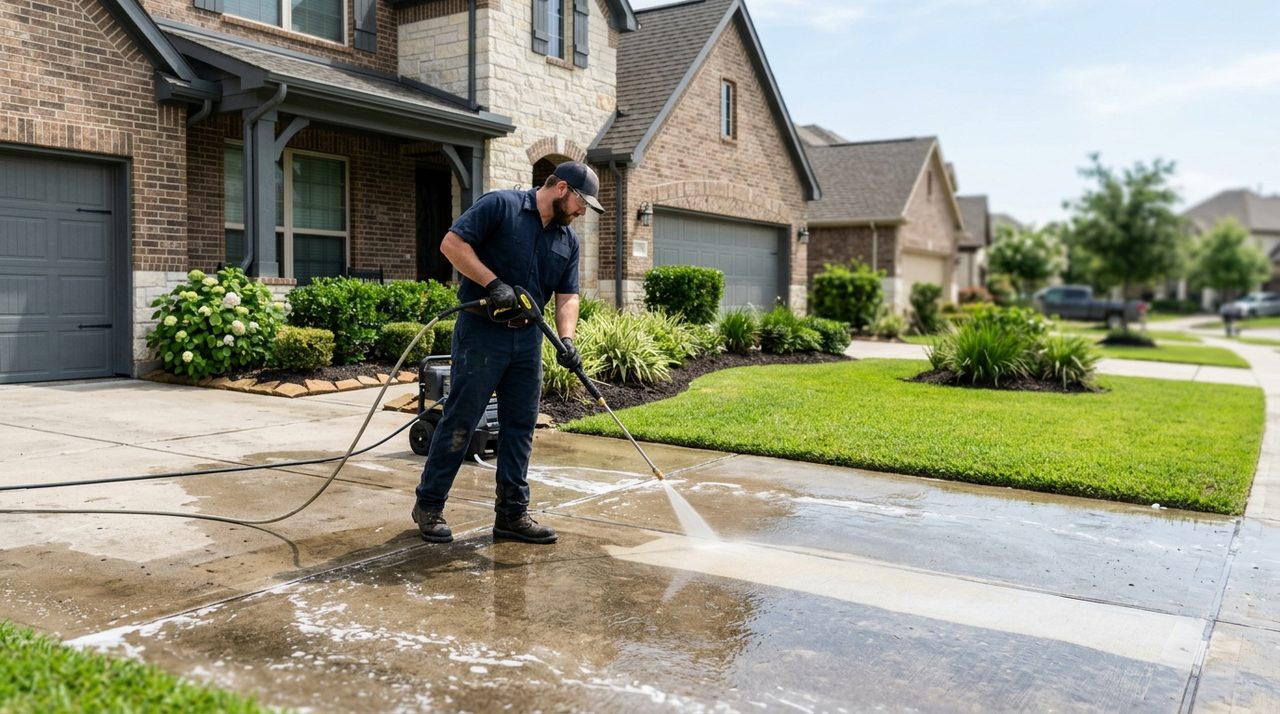
- Median home built
- 1978
- Median home value
- $640,789
- FEMA flood zone
- X (low)
- Typical cost (est.)
- $150–$900 depending on scope
- Most common local issue
- Efflorescence & clay-mineral staining on 60-year-old brick and slab concrete
Ranked by verified Google rating × review volume × verification tier. How we rank →
Some highly-rated pros serve Spring Branch from nearby and may not keep a Spring Branch street address. Those are listed under "Also serving Spring Branch" with their real city and distance, so you always know where each business is based.
Based in Spring Branch
12645 Memorial Dr Ste F1 - 705, Houston, TX 77024
12645 Memorial Dr Ste F1 - 747, Houston, TX 77024
1717 Gessner Rd A, Houston, TX 77080
754 International Blvd Apt. 62, Houston, TX 77024
Also serving Spring Branch
Highly-rated pros based nearby who cover Spring Branch. Distance shown from the Spring Branch area.
Serving Spring Branch Based in Brookhollow · 2.7 mi away
Serving Spring Branch Based in Lazybrook / Timbergrove · 3.1 mi away
Serving Spring Branch Based in Brookhollow · 3.2 mi away
Serving Spring Branch Based in Brookhollow · 3.4 mi away
Serving Spring Branch Based in Brookhollow · 3.7 mi away
Pressure Washing in Spring Branch: What You Should Know
Clay-Mineral Efflorescence Climbing Up Aging Brick Ranch Walls
Why it matters to you
Spring Branch's slab-on-grade foundations sit directly on Houston Black expansive clay, and after six decades of moisture cycling that clay wicks mineral salts upward through mortar joints and the lower courses of brick — depositing chalky white efflorescence that standard cold-water rinsing spreads rather than removes. On homes built in the 1950s and 1960s, the original mortar is already porous and worn, making this process faster and the staining more visible. Left untreated, the salt deposits trap additional moisture and accelerate mortar joint deterioration on walls that may not have been repointed since the Eisenhower administration.
What a good pro does
A qualified operator pre-treats efflorescence with a dilute masonry-safe acid wash (typically a phosphoric-acid solution), dwell-treats, and then rinses at controlled low-to-medium pressure — not a full high-pressure blast that blows out aging mortar. Post-rinse, a penetrating masonry sealer applied to the lower brick courses slows future salt migration. No City of Houston permit is required for the wash itself, but any acid-containing runoff must be contained and not directed to a storm drain inlet per TCEQ stormwater rules.
Sources: Texas Commission on Environmental Quality, City of Houston Permitting Center
Spalled and Oil-Stained Original Concrete Driveways After Uri Freeze Damage
Why it matters to you
Many Spring Branch driveways are original pours from the 1950s–1960s — more than 60 years old, porous, and already showing surface spalling before Winter Storm Uri (February 2021) pushed standing water into those cracks, froze it, and popped off the surface layer. Those spalled zones are now open pores that absorb motor oil and tire rubber at an accelerated rate in Houston's 100°F-plus summers, baking the hydrocarbons in before the next rain. On a block where half the driveways are being torn out during teardown-and-rebuild projects, the surviving original slabs often get neglected until an HOA notice or a home sale forces attention.
What a good pro does
Effective treatment on these driveways requires hot-water pressure washing (180°F-plus) combined with an alkaline degreaser pre-soak on oil-stained zones — cold water alone will not emulsify baked-in hydrocarbons on porous aged concrete. The operator should contain degreaser runoff rather than letting it sheet into the street gutter, which in Spring Branch connects to the City of Houston storm-drain system and ultimately to Buffalo Bayou — a TCEQ compliance point. Estimates for a heavily stained original driveway with chemical pre-treatment typically run $200–$450, marking a 20–40 percent premium over a clean modern surface.
Sources: Texas Commission on Environmental Quality, City of Houston Permitting Center
Gloeocapsa Magma Black Streaks on Aging Asphalt-Shingle Ranch Roofs
Why it matters to you
The original one-story roof pitch common to Spring Branch ranch homes — low-slope, north-facing, often shaded by the mature oak and pecan canopy that characterizes the older blocks — creates a near-ideal incubator for Gloeocapsa magma, the blue-green algae that produces the black streaking visible on shingles across the neighborhood. On roofs that have not been replaced since the early 2000s or that survived Beryl (July 2024) without full replacement, the shingles are already losing granules and a high-pressure wash above 500 PSI will accelerate granule loss and potentially void any remaining manufacturer warranty. Some Spring Branch subdivisions with recorded deed restrictions — Spring Branch Estates and Spring Branch Estates II among them — have appearance obligations that can trigger written notices if roof discoloration is visible from the street.
What a good pro does
The correct method is a low-pressure soft-wash: a sodium hypochlorite and surfactant solution applied at under 100 PSI, allowed to dwell 15–20 minutes to kill the algae at the root, then rinsed gently. No high-pressure equipment touches the shingles. Texas does not require a state license for pressure washing as a trade, but if the operator is applying an algaecide product registered as a pesticide with the EPA, the Texas Department of Agriculture requires the applicator to hold a TDA pesticide applicator credential — homeowners should ask to see it. Roof soft-wash on a typical Spring Branch single-story ranch runs an estimated $300–$600.
Sources: Local HOA / deed restrictions (see area profile), City of Houston Permitting Center
Weathered Pine Privacy Fences Needing Prep Before Staining or Sealing
Why it matters to you
The wave of teardown-and-rebuild activity that has reshaped Spring Branch since the mid-2000s brought with it hundreds of new pine privacy fences — and Houston's combination of 60-plus inches of annual rainfall, summer UV, and high subterranean termite pressure means those fences gray, check, and develop surface mold within 12–18 months of installation. On the older original lots, some fences are simply weathered wood that has never been sealed. Homeowners who want to stain or seal before the next rainy season need a thorough low-pressure wash first — but over-pressuring dry, checked pine above 1,200 PSI splinters the grain and raises fibers that absorb stain unevenly.
What a good pro does
A properly scoped fence wash in Spring Branch starts with a mold-inhibiting detergent pre-spray, washes at 800–1,100 PSI with a wide fan tip to clean without grain damage, and allows 48–72 hours of dry time before any stain or sealer is applied — critical in Houston's humidity where wood that looks dry on the surface can still hold 18-plus percent moisture content. Pricing estimates run $0.35–$0.65 per linear foot for wash-only; bundled house-plus-fence packages commonly quote $500–$900 for a full Spring Branch property. The City of Houston does not require a permit for this work.
Sources: City of Houston Permitting Center, Texas Commission on Environmental Quality
Pressure Washing in Spring Branch: What You Should Know
Hiring pressure washing in Spring Branch? Spring Branch's housing stock is dominated by 1950s–1960s single-family brick ranch homes on slab foundations, creating consistent demand for foundation repair, re-plumbing, and electrical upgrades. Ongoing teardown-and-rebuild activity means contractors regularly encounter both vintage systems and modern infill construction side by side. Deed restrictions and HOA rules vary subdivision by subdivision, so contractors should verify requirements on a per-project basis.
- Housing era
- Primarily 1950s–1960s, with significant infill and townhome construction from the 2000s onward
- Foundation
- Predominantly concrete slab-on-grade for original 1950s–1960s homes
- Flood zone
- FEMA Zone X (low flood risk) per the official NFHL API
- Permits
- City of Houston — Houston Permitting Center (Spring Branch is within Houston city limits)
Housing stock & systems
Building era
Primarily 1950s–1960s, with significant infill and townhome construction from the 2000s onward.
Typical style
One-story brick ranch houses (original stock); two-story contemporary/transitional homes and townhomes (infill).
Foundations
Predominantly concrete slab-on-grade for original 1950s–1960s homes; some pier-and-beam in earlier or custom structures. Confirm per-property via inspection or appraisal records.
Common systems
Original homes often have galvanized steel or cast-iron drain plumbing, older electrical panels (60–100 amp), and aging central HVAC units. Many properties have been partially updated but may still have legacy piping and wiring. Newer infill homes feature modern PEX plumbing, 200-amp panels, and high-efficiency HVAC systems.
What that means for repairs
Teardown-and-rebuild activity is very common as lot values support new construction. Remaining original homes frequently undergo whole-house renovations including re-plumbing (replacing galvanized lines), electrical panel upgrades, HVAC replacement, and kitchen/bath remodels. Foundation leveling is a recurring need on slab homes due to expansive clay soils.
Permits & restrictions
Permit jurisdiction
City of Houston — Houston Permitting Center (Spring Branch is within Houston city limits).
HOA & deed restrictions
No single area-wide mandatory HOA. Voluntary civic associations (e.g., Spring Branch Civic Association, Spring Branch Oaks Civic Association) cover much of the older residential area. Some platted subdivisions have mandatory HOAs with recorded deed restrictions and mandatory assessments (e.g., Spring Branch Estates, Spring Branch Estates II). At least six mandatory HOAs are registered in the broader Spring Branch area. Deed restrictions are common at the subdivision level but vary by plat—check Harris County Clerk records for each property.
Historic districts
No City of Houston historic district designation confirmed.
Contractor note
Because deed restrictions and HOA requirements vary by subdivision, contractors should confirm any architectural review, fence/accessory structure, and material restrictions before beginning work. The City of Houston permitting process applies to all structural, electrical, plumbing, and mechanical work.
Flood & weather
FEMA flood zone
FEMA Zone X (low flood risk) per the official NFHL API. However, Spring Branch is bisected by several tributaries of White Oak Bayou and Spring Branch Creek, and localized street flooding can still occur during heavy rain events. Property-level flood risk should be verified, especially for lots near drainage channels.
Hurricane Harvey impact
Research did not return specific Harvey damage documentation for this civic-association-defined area of Spring Branch. Broader media and City of Houston reporting indicate that portions of the Spring Branch area experienced significant flooding during Harvey, particularly near bayou tributaries and low-lying streets. Homeowners and contractors should check individual property flood claims history through FEMA and the Harris County Flood Control District for site-specific impact data.
Heat & humidity load
Extended Houston summers with sustained 95°F+ temperatures and high humidity stress aging HVAC systems and accelerate attic insulation degradation in 1950s–1960s ranch homes. Slab-on-grade foundations on expansive clay soils are vulnerable to differential settlement during summer drought cycles. Exterior paint and caulking on older brick veneer homes deteriorate quickly in UV-intense conditions.
Working with contractors here
The most common work in Spring Branch involves updating the mechanical and plumbing systems in 1950s–1960s ranch homes—re-plumbing galvanized supply lines, replacing cast-iron drains, upgrading electrical panels, and installing modern HVAC systems. Foundation repair is a perennial need due to expansive clay soils and slab-on-grade construction. Teardown-and-rebuild projects are frequent, requiring contractors familiar with City of Houston new-construction permitting and lot-specific deed restriction compliance. For renovation jobs on older homes, contractors should budget for potential asbestos abatement (siding, flooring, duct insulation) and lead paint remediation. Scoping should account for the wide variation between unrenovated originals and partially updated homes on the same block.
Local Tip
Always ask for a written estimate before work begins. Texas contractors are required to provide one on jobs over $1,000.
About Spring Branch
Spring Branch's housing stock is dominated by 1950s–1960s single-family brick ranch homes on slab foundations, creating consistent demand for foundation repair, re-plumbing, and electrical upgrades. Ongoing teardown-and-rebuild activity means contractors regularly encounter both vintage systems and modern infill construction side by side. Deed restrictions and HOA rules vary subdivision by subdivision, so contractors should verify requirements on a per-project basis.
- Median year built
- 1978
- Median home value
- $640,789
- Owner-occupied
- 52.3%
- Population
- 157,142
- Housing units
- 65,035
- Median income
- $90,513
Source: U.S. Census Bureau, ACS 5-Year 2023
Flood & storm risk
FEMA Zone XLow flood riskMost of Spring Branch maps to FEMA Zone X (low mapped flood risk), but Houston's flash-flood reality means even low-risk blocks benefit from smart drainage and storm-hardened installs.
Source: FEMA National Flood Hazard Layer (NFHL). Flood zones vary by parcel — verify your individual FIRM panel.
Frequently Asked Questions
Do I need a permit from the City of Houston to have my Spring Branch driveway or house exterior pressure washed?
Sources: City of Houston Permitting CenterLocal HOA / deed restrictions (see area profile)
My Spring Branch subdivision has a civic association — can they require me to get the driveway or fence washed, and can they dictate how it's done?
Sources: Local HOA / deed restrictions (see area profile)