Closed
Serving Memorial Based in Tanglewood · 0.7 mi away
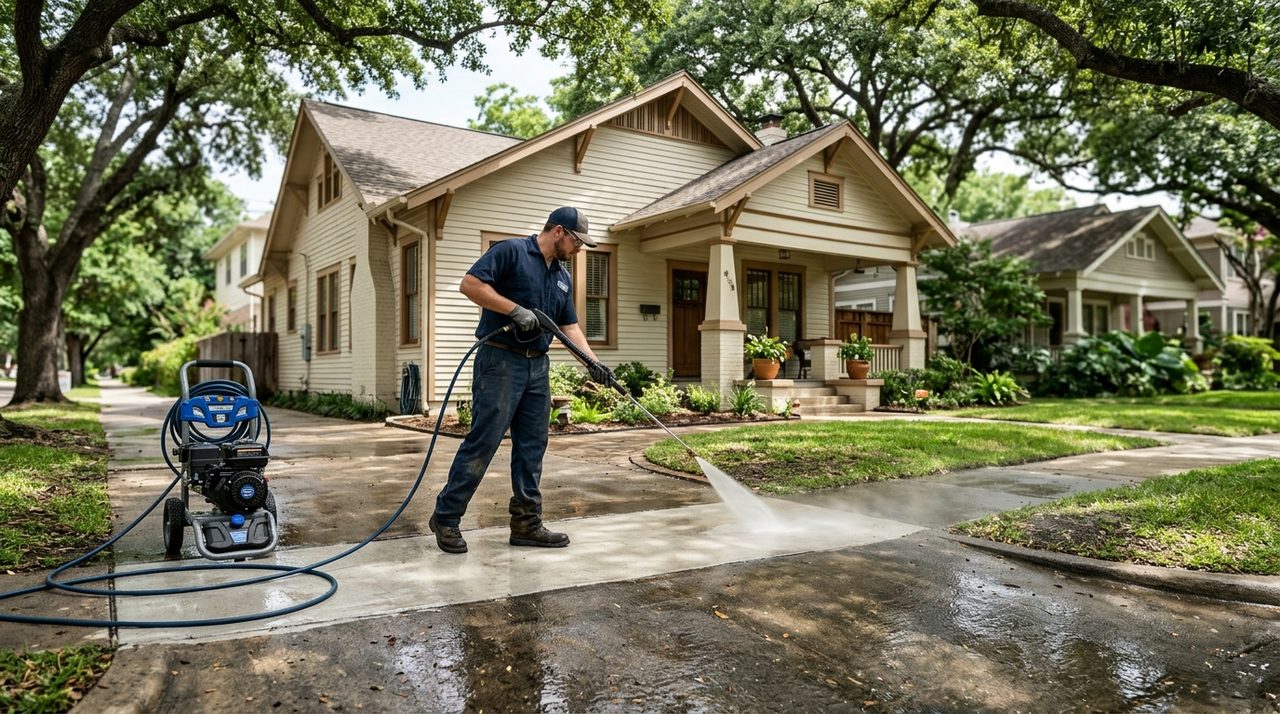
Memorial's block-by-block mix of 1950s–70s ranch homes and post-1990s custom rebuilds along the Buffalo Bayou corridor means exterior surfaces range from porous, decades-old brick and original concrete to fresh stucco and painted Hardie siding — each demanding a different pressure-washing approach. Houston's persistent humidity and the clay-rich Harris County soil beneath these slab-on-grade foundations create a steady cycle of mold, efflorescence, and organic staining that no single visit permanently solves. Before any exterior cleaning, homeowners should also confirm their specific subdivision's deed restrictions through Harris County Clerk records, since ACC review requirements vary lot to lot across this patchwork corridor.
Ranked by verified Google rating × review volume × verification tier. How we rank →
Some highly-rated pros serve Memorial from nearby and may not keep a Memorial street address. Those are listed under "Also serving Memorial" with their real city and distance, so you always know where each business is based.
Highly-rated pros based nearby who cover Memorial. Distance shown from the Memorial area.
Serving Memorial Based in Tanglewood · 0.7 mi away
Serving Memorial Based in Tanglewood · 0.7 mi away
Serving Memorial Based in Tanglewood · 0.8 mi away
Serving Memorial Based in Tanglewood · 0.9 mi away
Serving Memorial Based in Spring Branch · 2 mi away
Serving Memorial Based in Briargrove · 2.2 mi away
Serving Memorial Based in Galleria · 3 mi away
Serving Memorial Based in Bellaire · 3.1 mi away
Serving Memorial Based in Lazybrook / Timbergrove · 3.2 mi away
Serving Memorial Based in Upper Kirby · 3.2 mi away
Why it matters to you
The surviving 1950s–70s ranch homes along this corridor sit on slab-on-grade foundations over Houston's expansive Beaumont clay, which wicks mineral salts upward through mortar joints and original concrete driveways with each wet-dry cycle. The result is white efflorescence chalking across brick faces and red-clay mud staining on driveways that straightforward rinsing cannot lift — a problem compounded on homes that have never had their original concrete replaced.
What a good pro does
A qualified operator will apply a low-concentration acid wash (typically dilute muriatic or phosphoric acid) to efflorescence deposits, let it dwell, then rinse at controlled pressure to avoid damaging the aged mortar joints common in mid-century brick construction. For clay-mud staining on driveways, a hot-water unit with a surface cleaner attachment at 2,500–3,000 PSI — not a raw wand — distributes pressure evenly and avoids spalling the already weathered concrete surface. Texas does not require a state pressure-washing license, but chemical applicators using regulated algaecide or acid products should carry general liability insurance and verify product classifications with the Texas Department of Agriculture if biocides are in the mix.
Sources: City of Houston Permitting Center
Why it matters to you
Memorial's mature live oak and pine canopy — densest on older subdivision lots closest to Buffalo Bayou — keeps siding, driveways, and fences in near-constant shade and moisture, creating prime conditions for Gloeocapsa magma black algae and green mold to recolonize surfaces within six to twelve months of cleaning. The custom rebuilds of the 1990s–2020s are not immune: fiber-cement and stucco facades on newer homes trap organic debris in horizontal trim lines and window surrounds just as readily as original painted brick.
What a good pro does
Effective treatment means low-pressure soft-wash delivery of a sodium hypochlorite-based biocide (typically 1–3% solution) to the affected surface, allowing dwell time before rinsing — not blasting mold off with high pressure, which embeds spores into adjacent surfaces. A post-treatment application of a penetrating biocide sealer on concrete and masonry extends the clean noticeably. Ask operators whether the chemical runoff will be diverted away from Buffalo Bayou storm connections; TCEQ rules prohibit detergent-laden wash water from entering storm drains that discharge to waterways.
Sources: Texas Commission on Environmental Quality, FEMA National Flood Hazard Layer (NFHL)
Why it matters to you
Memorial is not a single HOA community, but many of its constituent subdivisions — including newer townhome clusters and organized civic associations — carry deed restrictions that can prompt written notices for visibly algae-streaked roofs, and the cure windows can be short. The corridor's architectural mix includes both original 3-tab asphalt shingles on retained ranches and newer architectural shingles on 2000s–2020s rebuilds; any shingle older than ten years is particularly vulnerable to granule loss from high-pressure washing.
What a good pro does
Roof cleaning in Memorial should always be soft-wash: low-pressure (under 500 PSI at the nozzle) delivery of a sodium hypochlorite solution that kills Gloeocapsa magma at the root without mechanical abrasion. Homeowners should pull their specific subdivision's deed restrictions from Harris County Clerk records before scheduling work to understand whether ACC pre-approval is required for exterior maintenance — requirements are genuinely inconsistent across this corridor. A soft-wash roof clean on a typical single-story Memorial home runs an estimated $300–$600; two-story custom rebuilds on larger lots will price higher.
Sources: Local HOA / deed restrictions (see area profile), City of Houston Permitting Center
Why it matters to you
Even though most of Memorial maps to FEMA Zone X, the neighborhood is close enough to Buffalo Bayou that flash flooding from events like Harvey (2017) and the May 2024 derecho pushed tannic debris water and wind-driven mud across driveways, patios, and lower-course brick on many blocks. On the original concrete driveways of retained 1950s–70s homes — already porous from decades of use — that organic tannin and mud bakes in under Houston's summer UV and is not removed by standard cold-water rinsing.
What a good pro does
Post-storm driveway and patio cleaning requires a two-step process: chemical pre-treatment with a degreaser or tannin-specific surfactant, followed by hot-water pressure washing at controlled pressure using a surface cleaner bar rather than a direct wand to avoid widening any existing expansion cracks. Budget an estimated 20–40% premium over standard driveway rates for heavy post-storm stain jobs. Operators should contain and properly dispose of chemically treated wash water rather than letting it sheet into street drains, consistent with TCEQ stormwater rules applicable within the City of Houston's incorporated limits.
Sources: Texas Commission on Environmental Quality, FEMA National Flood Hazard Layer (NFHL), City of Houston Permitting Center
Hiring pressure washing in Memorial? Memorial inside the Loop is a corridor of multiple smaller subdivisions rather than one unified neighborhood, meaning deed restrictions, HOA rules, and housing conditions vary block by block. Homeowners deal with a mix of original 1950s–70s ranch homes needing major system updates and newer custom construction from the 1990s–2020s. Proximity to Buffalo Bayou makes drainage management and foundation monitoring critical home service priorities.
Building era
1950s–1970s original stock with significant 1990s–2020s teardown-and-rebuild activity.
Typical style
Original ranch and mid-century traditional homes alongside newer traditional brick, Mediterranean, soft contemporary, modern farmhouse, and fee-simple townhomes.
Foundations
Predominantly slab-on-grade; some pier-and-beam in the oldest remaining structures.
Common systems
Original homes often have galvanized or early copper plumbing, aging R-22 HVAC systems, and 100–150 amp electrical panels; newer rebuilds feature modern PEX plumbing, high-efficiency HVAC, and 200+ amp panels.
What that means for repairs
Teardown-and-rebuild is the dominant renovation pattern, driven by lot values exceeding the value of original structures. Where original homes are retained, whole-house repiping, electrical panel upgrades, and HVAC replacement are the most common major projects.
Permit jurisdiction
City of Houston — Houston Permitting Center.
HOA & deed restrictions
No single area-wide mandatory HOA. The corridor is governed by multiple subdivision-level organizations—some with mandatory HOAs (e.g., specific townhome and condo developments), others with voluntary civic clubs or property owners associations. Deed restrictions are common but must be confirmed per subdivision through Harris County Clerk records.
Historic districts
No City of Houston historic district designation confirmed for the Memorial inside-the-Loop corridor.
Contractor note
Contractors must verify deed restrictions and architectural review requirements on a per-subdivision basis before exterior work begins. Some subdivisions require Architectural Control Committee (ACC) approval for additions, fencing, and material changes.
FEMA flood zone
FEMA Zone X (low flood risk) per official NFHL data. However, the corridor's proximity to Buffalo Bayou means individual parcels closer to the bayou may carry higher risk; homeowners should verify flood zone status at the parcel level, as conditions vary significantly within the corridor.
Hurricane Harvey impact
Specific block-by-block Harvey impact data for the Memorial inside-the-Loop corridor was not confirmed in research. Buffalo Bayou experienced historic flooding during Harvey, and properties nearest the bayou along Memorial Drive were likely affected. Homeowners should check individual property flood history through Harris County Flood Control District records.
Heat & humidity load
Original 1950s–70s homes with aging insulation and single-pane windows place heavy demands on HVAC systems during Houston summers. Slab-on-grade foundations on the expansive clay soils near Buffalo Bayou are susceptible to shifting during summer drought cycles, making foundation monitoring and consistent watering programs important.
Working with contractors here
Contractors working in Memorial inside the Loop most commonly handle full teardown-and-rebuild projects on lots where original ranch homes are being replaced with larger custom homes. For retained original structures, whole-house repiping (replacing galvanized lines), electrical panel upgrades from 100 to 200 amps, and HVAC system replacements are the highest-demand services. The subdivision-by-subdivision deed restriction landscape means contractors must scope exterior projects carefully—confirming setbacks, height limits, and material requirements with the specific neighborhood association before bidding. Drainage and grading work is common given proximity to Buffalo Bayou, and foundation repair contractors see steady demand due to the clay soil conditions and mature tree root systems throughout the corridor.
Local Tip
Always ask for a written estimate before work begins. Texas contractors are required to provide one on jobs over $1,000.
Memorial inside the Loop is a corridor of multiple smaller subdivisions rather than one unified neighborhood, meaning deed restrictions, HOA rules, and housing conditions vary block by block. Homeowners deal with a mix of original 1950s–70s ranch homes needing major system updates and newer custom construction from the 1990s–2020s. Proximity to Buffalo Bayou makes drainage management and foundation monitoring critical home service priorities.
Source: U.S. Census Bureau, ACS 5-Year 2023
Most of Memorial maps to FEMA Zone X (low mapped flood risk), but Houston's flash-flood reality means even low-risk blocks benefit from smart drainage and storm-hardened installs; risk climbs sharply on blocks nearest Buffalo Bayou, where it varies parcel to parcel.
Source: FEMA National Flood Hazard Layer (NFHL). Flood zones vary by parcel — verify your individual FIRM panel.
Sources: City of Houston Permitting CenterTexas Commission on Environmental Quality
Sources: Local HOA / deed restrictions (see area profile)