Closed
619 Youpon Dr, Seabrook, TX 77586
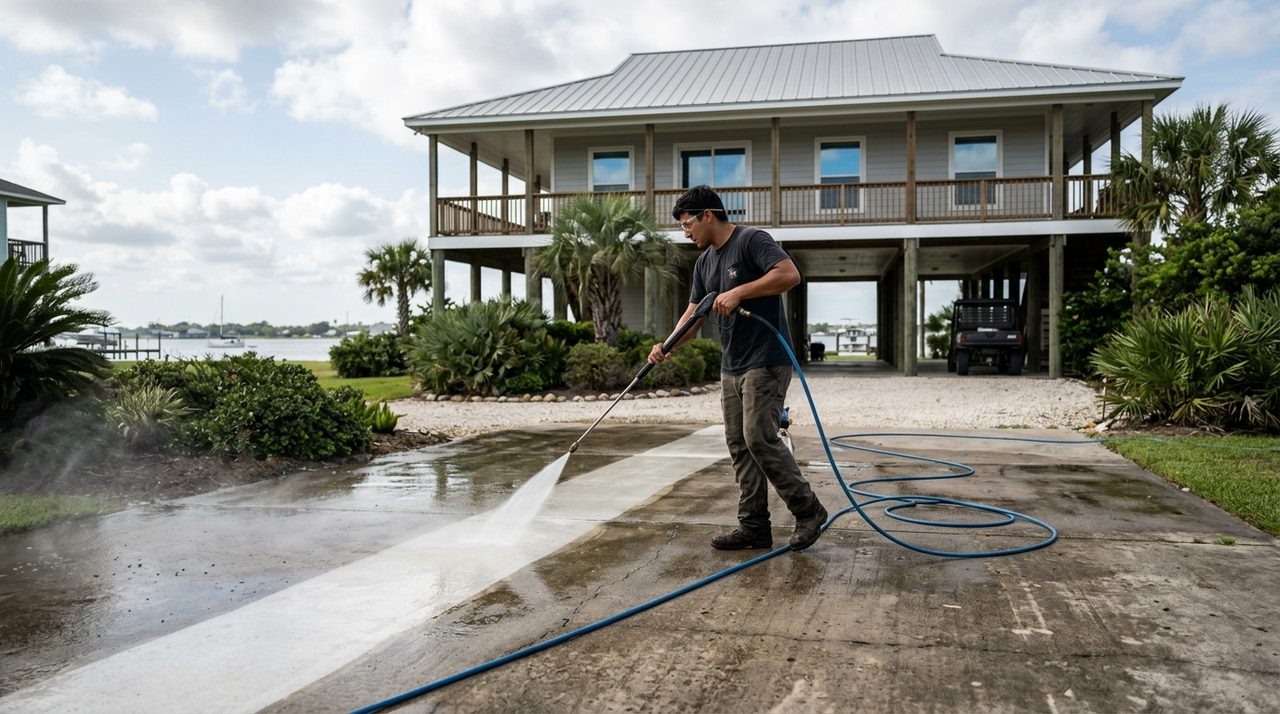
Seabrook sits on Galveston Bay in FEMA Zone AE, where salt air, bayou-adjacent humidity, and recurring storm surge from events like Hurricane Harvey (2017) and Beryl (2024) leave visible staining on nearly every exterior surface year-round. The housing stock spans 1960s waterfront pier-and-pile cottages through 2000s slab-on-grade subdivisions, meaning the right pressure-washing approach — soft-wash on aging shingles, hot-water degreasing on oxidized driveways, flood-line removal on brick siding — varies dramatically block by block. Understanding these layered challenges helps Seabrook homeowners hire correctly and avoid surface damage that accelerates in a coastal environment.
Ranked by verified Google rating × review volume × verification tier. How we rank →
Some highly-rated pros serve Seabrook from nearby and may not keep a Seabrook street address. Those are listed under "Also serving Seabrook" with their real city and distance, so you always know where each business is based.
619 Youpon Dr, Seabrook, TX 77586
1219 Shorewood Dr, Seabrook, TX 77586
Highly-rated pros based nearby who cover Seabrook. Distance shown from the Seabrook area.
Serving Seabrook Based in League City · 2.8 mi away
Serving Seabrook Based in La Porte · 4 mi away
Serving Seabrook Based in League City · 4.1 mi away
Serving Seabrook Based in Clear Lake · 4.1 mi away
Serving Seabrook Based in Clear Lake · 5.2 mi away
Serving Seabrook Based in Dickinson · 5.4 mi away
Serving Seabrook Based in Clear Lake · 5.5 mi away
Serving Seabrook Based in Webster · 5.9 mi away
Why it matters to you
Seabrook's FEMA Zone AE designation means a significant portion of the housing stock — especially the 1960s–1980s waterfront and canal-front homes — has experienced repeated inundation from Harvey, Beryl, and Gulf surge events, leaving distinct bathtub-ring mud lines and tannic staining embedded in porous brick and mortar at flood-water height. Unlike interior damage that gets remediated, these exterior marks are often left untreated and bake into the surface under South Texas UV, making them progressively harder to remove. For homeowners preparing to sell or simply restoring curb appeal after a storm season, these stains are the first thing neighbors and buyers notice.
What a good pro does
A qualified operator will identify the flood-line height before setting pressure, apply a low-pH chemical pre-soak formulated for mineral and organic mud staining, and use controlled soft-wash or mid-pressure rinsing (typically 500–1,200 PSI depending on surface) to lift deposits without eroding aged mortar joints on older brick. Post-storm jobs on flood-marked homes typically carry a 20–40% premium for chemical pre-treatment and extended dwell time — budget accordingly. No City of Seabrook permit is required for residential pressure washing itself, but operators using chemical degreasers must contain and properly dispose of wash water rather than directing runoff into storm drains that flow to Galveston Bay.
Sources: FEMA National Flood Hazard Layer (NFHL), Texas Commission on Environmental Quality
Why it matters to you
Seabrook's position directly on Galveston Bay means homes — particularly those on the waterfront and along Taylor Lake Village-adjacent canals — are exposed to salt-laden onshore breezes year-round, which deposit hygroscopic salt crystals on siding, fascia, and roof surfaces that then trap moisture and turbocharge mold and black algae (Gloeocapsa magma) growth well beyond what inland Houston neighborhoods experience. The census median build year of 1991 places a large share of the stock in the 25–35-year range, where asphalt shingles and wood or hardboard siding have lost much of their original factory-applied protective coatings, leaving them especially hospitable to biological growth. Without post-wash biocide treatment, mold and algae typically recolonize within six months in this coastal microclimate.
What a good pro does
Effective treatment here requires a sodium hypochlorite-based soft-wash solution at appropriate dilution — applied at low pressure (under 100 PSI on roof surfaces) to kill Gloeocapsa magma at the root rather than just blasting off the visible streaks. On siding, a follow-up application of a mold-inhibiting biocide or sealant extends the clean window meaningfully. Texas does not require a state license for pressure washing as a trade, but operators applying algaecide or biocide products that qualify as pesticides under TDA definitions must hold a Texas Department of Agriculture (TDA) pesticide applicator credential — ask any operator treating your roof or siding to confirm their TDA status before they begin.
Why it matters to you
Approximately 16 HOA and POA communities are registered in Seabrook — including Lake Cove Community Association (managed by Goodwin & Company), Seabrook Island HOA, Seascape POA, and Searidge — and many issue written violation notices for algae-stained driveways, discolored fences, and green-streaked exterior siding, often with 30-day cure windows that leave little room for scheduling delays. Because Seabrook is an independent incorporated city and not subject to City of Houston oversight, there is no Houston Permitting Center involvement here; all building-related permits run through the City of Seabrook Building/Permits Department, though routine residential pressure washing does not require a municipal permit. Homeowners who ignore HOA notices risk fines and, in some POAs, forced-remediation charges billed back to the owner.
What a good pro does
Before scheduling a wash, pull your most recent HOA compliance letter and confirm whether the architectural review committee specifies soft-wash methods for roofing — some Seabrook-area CC&Rs restrict high-pressure application on certain roofing materials. A reputable operator will document the work with before-and-after photos you can submit to your HOA as proof of cure. For slab-on-grade subdivision homes (the dominant construction type in Seabrook's post-1990 development), driveways and sidewalks are usually the first surfaces cited; factor in a full-property package (house exterior, driveway, fence) estimated at $500–$900 to resolve multiple line items in one visit.
Sources: Local HOA / deed restrictions (see area profile), City of Houston Permitting Center
Why it matters to you
Seabrook's newer subdivisions — those built from the late 1980s through the 2000s — are predominantly slab-on-grade, and many original concrete driveways are now 20–35 years old, placing them squarely in the age range where surface spalling is common. Winter Storm Uri (February 2021) accelerated micro-fracturing in concrete across the Houston metro, and Seabrook driveways were no exception; the resulting surface porosity makes vehicle oil and tire rubber deposits penetrate deeply rather than sitting on the surface, where standard cold-water rinsing at residential pressure cannot reach them. Salt tracked in from nearby boat launches and marina parking further etches concrete surfaces over time.
What a good pro does
Hot-water pressure washing combined with an alkaline degreaser pre-soak is the correct method for deeply absorbed oil on porous, aged concrete — cold-water equipment alone will not break the bond. Expect a 20–40% cost premium over a basic driveway wash (baseline estimate $150–$350 for up to ~1,000 sq ft) when chemical pre-treatment and hot-water equipment are required. Operators applying degreasers on Seabrook driveways that drain toward storm inlets must comply with TCEQ stormwater rules prohibiting detergent-laden wash water from entering storm drains that outfall to Galveston Bay; ask your operator how they handle containment before work begins.
Sources: Texas Commission on Environmental Quality, FEMA National Flood Hazard Layer (NFHL)
Hiring pressure washing in Seabrook? Seabrook is an incorporated city on Galveston Bay with housing ranging from 1960s waterfront homes to 2000s subdivision development, creating a wide spectrum of home service needs. The coastal location and FEMA AE flood zone designation mean that flood mitigation, elevation considerations, and storm-hardening are central to nearly every major home project. Homeowners should expect subdivision-level HOA requirements that vary block by block and plan for salt-air corrosion on exterior systems.
Building era
1970s–2000s, with some 1960s waterfront homes and ongoing infill.
Typical style
Production suburban traditional (one- and two-story brick or brick-and-siding) with coastal/contemporary elevated homes along waterfront and canal-front areas.
Foundations
Mixed — predominantly slab-on-grade in newer subdivisions; pier-and-beam or pier-and-pile construction common in older waterfront and canal-front homes due to floodplain and storm-surge requirements.
Common systems
Central HVAC systems typical of 1980s–2000s construction (aging units in older homes); copper and CPVC plumbing in newer builds, galvanized possible in 1960s–1970s stock; standard 200-amp electrical panels in newer homes, potential 100-amp in older homes.
What that means for repairs
Flood damage repair and mitigation retrofits are common drivers of renovation activity. Waterfront homes frequently undergo elevation projects, foundation reinforcement, and storm-resistant window/door upgrades. Older homes often need full plumbing repipes and HVAC replacements due to age and salt-air corrosion.
Permit jurisdiction
City of Seabrook Building/Permits Department (incorporated city — not Houston Permitting Center or Harris County).
HOA & deed restrictions
Subdivision-by-subdivision. Many subdivisions have mandatory HOAs/POAs including Seabrook Island HOA, Lake Cove Community Association (managed by Goodwin & Company), Seascape POA, and Searidge. Approximately 16 HOA/condo communities are registered in Seabrook. Some older or fringe areas may have no active HOA but may still have recorded deed restrictions.
Historic districts
No City of Houston historic district designation confirmed. Seabrook is an independent incorporated city and not subject to HAHC oversight.
Contractor note
Contractors must pull permits through the City of Seabrook and should verify subdivision-specific HOA architectural review requirements before starting exterior work. Coastal building codes and floodplain management regulations apply and may require elevation certificates.
FEMA flood zone
FEMA Zone AE (high flood risk) — source: fema_nfhl. Seabrook sits directly on Galveston Bay and is subject to both riverine flooding and coastal storm surge, contributing to its very high hazard risk rating.
Hurricane Harvey impact
The Clear Lake/Bay area of southeast Harris County experienced significant flooding during Hurricane Harvey. Seabrook-specific community hazard data rates overall risk as 'Very High.' However, no publicly available subdivision-level or street-level Harvey flood-extent map for Seabrook was identified. Exact street-by-street impact should be verified through Harris County Flood Control District records and individual property seller's disclosures.
Heat & humidity load
Extreme humidity and salt-air proximity accelerate corrosion on HVAC condensers, metal roofing components, and exterior hardware. HVAC systems run at near-continuous capacity May through September, shortening equipment lifespan. Mold and moisture intrusion in slab-on-grade and pier-and-beam homes require proactive dehumidification and ventilation strategies.
Working with contractors here
Contractors working in Seabrook most commonly handle flood damage restoration, foundation repairs (especially on older pier-and-beam waterfront homes), and HVAC replacements accelerated by salt-air corrosion and heavy summer usage. Roofing and exterior siding projects require wind-rated materials compliant with coastal building codes, and many jobs trigger City of Seabrook floodplain management requirements including elevation certificates. The wide range of housing ages — from 1960s waterfront cottages to 2000s subdivision homes — means scoping should always begin with a thorough assessment of existing systems, as plumbing and electrical standards vary significantly across eras. HOA architectural review adds a layer of approval in many subdivisions, so contractors should confirm HOA requirements before beginning visible exterior modifications.
Local Tip
Always ask for a written estimate before work begins. Texas contractors are required to provide one on jobs over $1,000.
Seabrook is an incorporated city on Galveston Bay with housing ranging from 1960s waterfront homes to 2000s subdivision development, creating a wide spectrum of home service needs. The coastal location and FEMA AE flood zone designation mean that flood mitigation, elevation considerations, and storm-hardening are central to nearly every major home project. Homeowners should expect subdivision-level HOA requirements that vary block by block and plan for salt-air corrosion on exterior systems.
Source: U.S. Census Bureau, ACS 5-Year 2023
Much of Seabrook maps to FEMA Zone AE (high flood risk), so flood-resilient detailing -- elevated equipment, water-tolerant materials, and drainage-first thinking -- is essential here, not optional; risk climbs sharply on blocks nearest Galveston Bay, where it varies parcel to parcel.
Source: FEMA National Flood Hazard Layer (NFHL). Flood zones vary by parcel — verify your individual FIRM panel.
Sources: Local HOA / deed restrictions (see area profile)