Closed
1300 Bay Area Blvd suite 150-37, Houston, TX 77058
Clear Lake's NASA-era subdivisions — mostly 1960s–1980s brick ranch and traditional homes built on expansive coastal-plain clay — have now aged past the point where a garden hose handles exterior upkeep: driveways show decades of efflorescence and oil staining, wood fences are graying fast in the Gulf humidity, and the multiple mandatory HOAs (CLCCA, CLFCA, Reserve at Clear Lake) issue written violation notices with as little as 30 days to cure. This page explains which exterior cleaning problems are most common on Clear Lake's aging slab-on-grade stock, what the right fix actually looks like, and what the job will realistically cost.
Ranked by verified Google rating × review volume × verification tier. How we rank →
Some highly-rated pros serve Clear Lake from nearby and may not keep a Clear Lake street address. Those are listed under "Also serving Clear Lake" with their real city and distance, so you always know where each business is based.
1300 Bay Area Blvd suite 150-37, Houston, TX 77058
18214 Upper Bay Rd #58164, Houston, TX 77058
3819 Deer Grass Ct, Houston, TX 77059
957 E NASA Pkwy number 1150, Houston, TX 77058
Highly-rated pros based nearby who cover Clear Lake. Distance shown from the Clear Lake area.
Serving Clear Lake Based in Webster · 2.7 mi away
Serving Clear Lake Based in Webster · 2.7 mi away
Serving Clear Lake Based in Seabrook · 2.9 mi away
Serving Clear Lake Based in League City · 3 mi away
Serving Clear Lake Based in Webster · 4.6 mi away
Serving Clear Lake Based in Webster · 5 mi away
Why it matters to you
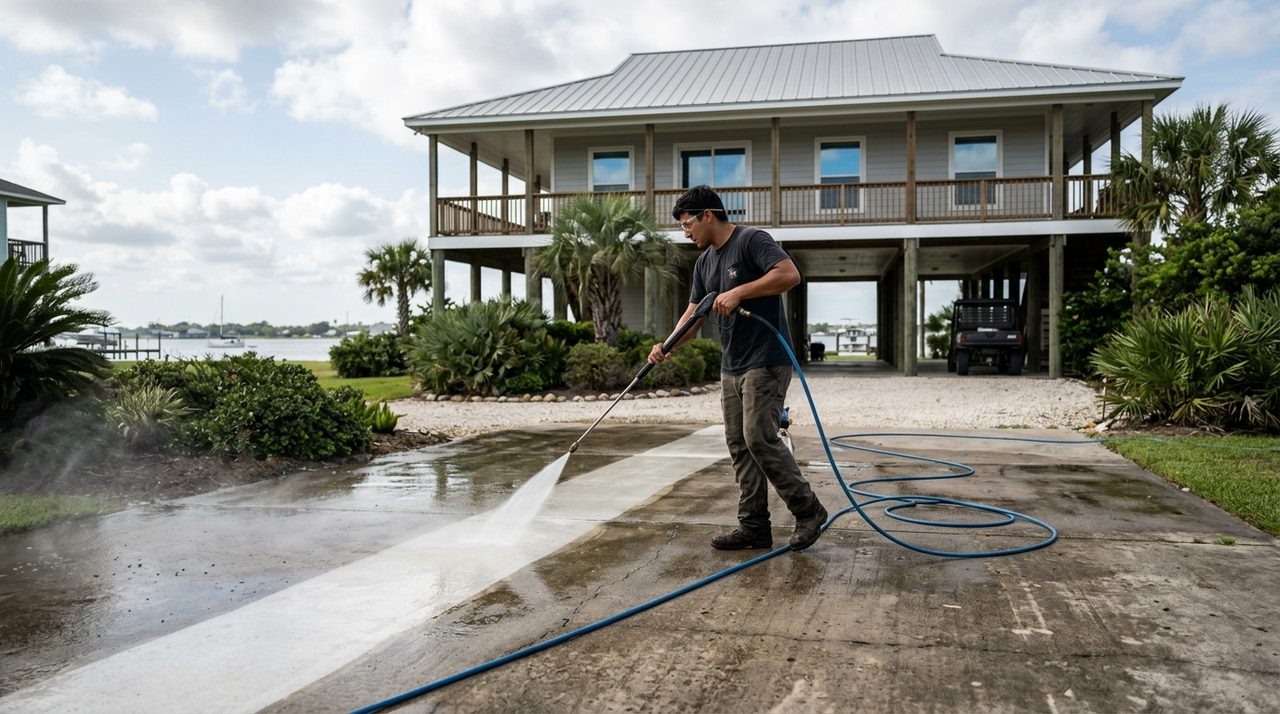
Clear Lake's homes sit directly on Houston Black expansive clay — the same coastal-plain soil that keeps slab-leveling crews busy all over the neighborhood. As that clay wets and dries through Houston's wet seasons, mineral salts wick upward through concrete poured in the 1960s–1980s, leaving white efflorescence deposits and rust-orange clay mud staining across driveway aprons and front walkways. The concrete on these older homes is typically porous and unsealed, so stains bake in under the summer UV and standard cold-water rinsing barely touches them.
What a good pro does
A qualified operator will apply a dilute acid-based efflorescence remover or alkaline degreaser as a dwell-time pre-treatment before any pressurized rinse — hot-water equipment (up to 180°F) is particularly effective on mineral deposits baked into aged concrete. Expect a 20–40% cost premium over a basic rinse job, putting a typical Clear Lake driveway treatment in the $200–$450 estimate range. Texas does not require a pressure-washing license, but operators using chemical pre-treatments at regulated concentrations should hold a Texas Department of Agriculture (TDA) pesticide applicator credential if the product qualifies.
Why it matters to you
Unlike many older inner-Loop Houston neighborhoods, Clear Lake properties fall under mandatory subdivision HOAs — CLCCA, CLFCA, Reserve at Clear Lake, and others — each with its own Architectural Review Committee and deed-restriction enforcement. Algae-stained driveways, green-tinted brick exteriors, and discolored wood fences are among the most commonly cited exterior violations, and cure windows can be as short as 30 days. Because some CC&Rs also specify approved cleaning methods (soft-wash rather than high-pressure on certain surfaces), homeowners need to know their specific association's rules before scheduling work.
What a good pro does
Before booking, confirm which association governs your address — CLCCA and CLFCA cover different street boundaries and have separate ARC guidelines. Get the violation notice in writing and share it with your operator so the scope of work addresses exactly the cited surfaces. City of Houston jurisdiction covers most Clear Lake subdivisions within city limits, so no municipal permit is required for routine residential washing, but ARC pre-approval may still be needed for any surface treatment that alters appearance (such as staining a fence after washing).
Sources: Local HOA / deed restrictions (see area profile), City of Houston Permitting Center
Why it matters to you
A large share of Clear Lake's housing stock was roofed or re-roofed between the 1980s and early 2000s, meaning many shingles are now 20–40 years old and have lost significant granule density. Houston's annual humidity above 75% creates near-perfect conditions for Gloeocapsa magma black algae streaks to accumulate within 2–3 years of any cleaning, and HOA notices frequently cite roof discoloration. The problem is that the same aging shingles most susceptible to algae are also the most vulnerable to granule loss from high-pressure washing — a mistake that can void remaining manufacturer warranty coverage.
What a good pro does
Low-pressure soft-wash (under 500 PSI) with a sodium hypochlorite and surfactant solution is the correct method for asphalt shingle roofs in Clear Lake's climate — it kills Gloeocapsa magma at the source rather than blasting it off mechanically. A post-treatment zinc or copper-based biocide applied to the ridge can slow re-colonization and push the re-cleaning interval past 12 months. Expect a single-story roof soft-wash to run $300–$600 (estimate) in the Clear Lake market; steeper pitches or two-story homes carry additional access costs.
Sources: Local HOA / deed restrictions (see area profile), International Residential Code (as adopted by City of Houston)
Why it matters to you
The 1980s and 1990s subdivisions that make up much of Clear Lake's residential grid were built with treated-pine privacy fencing as the standard lot boundary, and many of those original or replacement fences are now graying, splitting, and developing mold in the gap between seasonal rain and 100°F summer heat. Clear Lake's proximity to Galveston Bay keeps ambient humidity elevated even compared to the rest of Harris County, accelerating the weathering cycle. Left unwashed before re-staining or sealing, the mold and gray oxidation prevent the new finish from bonding, shortening the life of any coating.
What a good pro does
Fence washing in Clear Lake should use 600–1,000 PSI with a fan-tip nozzle — enough to remove mold and oxidation without splintering the weathered pine grain, which fails above 1,200 PSI. A mildewcide solution applied as a pre-soak, followed by a neutralizing rinse, prepares the wood for stain or sealant adhesion. Pricing runs roughly $0.35–$0.65 per linear foot (estimate) for wash-only; bundling the fence wash with a house exterior and driveway into a full-property package typically quotes $500–$900 for an average Clear Lake lot. No City of Houston permit is required for fence washing, but if the fence itself is being replaced post-wash, ARC approval from the applicable HOA is required before work begins.
Sources: Local HOA / deed restrictions (see area profile), City of Houston Permitting Center, Texas Commission on Environmental Quality
Hiring pressure washing in Clear Lake? Clear Lake is a sprawling collection of master-planned subdivisions built primarily from the 1960s through the 1980s during the Johnson Space Center boom. Homeowners face the maintenance demands of aging slab-on-grade ranch and traditional homes—original HVAC, cast-iron drain lines, and galvanized plumbing are common upgrade targets. Multiple mandatory HOAs enforce deed restrictions and architectural review, so contractors and homeowners must account for approval processes before exterior work.
Building era
1960s–1980s (core buildout), with newer infill subdivisions into the 2000s.
Typical style
One- and two-story ranch and traditional brick homes; some Colonial Revival facades in older sections; suburban traditional in 1980s–2000s additions.
Foundations
Predominantly concrete slab-on-grade, consistent with post-1960 Houston suburban construction.
Common systems
Original homes typically have copper or galvanized supply lines, cast-iron drain waste vent, R-22 refrigerant HVAC systems, and older 150–200 amp electrical panels. Homes from the 2000s subdivisions like Reserve at Clear Lake have modern PEX/PVC plumbing and R-410A systems.
What that means for repairs
Kitchen and bathroom remodels are frequent in 1960s–1970s homes. HVAC replacements are common as original systems exceed useful life. Many owners are re-piping from galvanized to PEX and upgrading electrical panels to support modern loads. Slab foundation repair is a recurring need due to expansive clay soils in the coastal plain.
Permit jurisdiction
Houston Permitting Center (City of Houston jurisdiction for most Clear Lake subdivisions within city limits). Some adjacent areas may fall under Harris County Engineering for unincorporated pockets—verify by address.
HOA & deed restrictions
No single area-wide HOA; multiple subdivision-level mandatory HOAs govern most properties. Key associations include Clear Lake City Community Association (CLCCA), Clear Lake Forest Community Association (CLFCA), and Reserve at Clear Lake Community Association. Membership is mandatory within each association's boundaries, with deed-restriction enforcement and architectural review committees.
Historic districts
No City of Houston historic district designation confirmed.
Contractor note
Exterior modifications—roofing materials, fencing, paint colors, and additions—typically require Architectural Review Committee (ARC) approval from the applicable subdivision HOA before permits are pulled. Contractors should confirm which association governs the property and obtain written ARC approval to avoid stop-work orders and violation fines.
FEMA flood zone
FEMA Zone X (low flood risk) per official NFHL data. However, Clear Lake's proximity to Clear Lake (the body of water), Galveston Bay, and local bayou tributaries means localized street-level flooding can occur during extreme rainfall events despite the overall Zone X designation.
Hurricane Harvey impact
Research sources did not document specific Harvey flood impacts for Clear Lake. Broader public reporting indicates parts of Clear Lake experienced significant flooding during Harvey, particularly near bayous and low-lying areas close to the lake and bay, but impact varied street by street. For property-specific Harvey inundation data, check Harris County Flood Control District historical maps and FEMA Harvey inundation records.
Heat & humidity load
Houston's extreme summer heat and humidity stress aging HVAC systems in 1960s–1980s homes, often pushing original or under-capacity units to failure. High humidity also promotes mold in poorly ventilated attics and crawl spaces. The coastal-plain location adds salt air exposure that accelerates corrosion on outdoor HVAC condensers, metal roofing components, and exterior fixtures.
Working with contractors here
The dominant work in Clear Lake involves updating systems in 1960s–1980s slab-on-grade homes: whole-house re-pipes replacing galvanized and cast-iron with PEX and PVC, HVAC changeouts from legacy R-22 systems to modern high-efficiency units, and electrical panel upgrades from 150-amp to 200-amp service. Foundation leveling and mudjacking are steady demand items given the expansive clay soils beneath slabs in this coastal-plain environment. Contractors should expect HOA architectural review requirements on any exterior-facing work—roofing, siding, fencing, and even driveway resurfacing may need pre-approval from the applicable subdivision association. Job scoping should include verifying the specific HOA (CLCCA, CLFCA, Reserve at Clear Lake, etc.) and its current ARC guidelines, as requirements vary by subdivision.
Local Tip
Always ask for a written estimate before work begins. Texas contractors are required to provide one on jobs over $1,000.
Clear Lake is a sprawling collection of master-planned subdivisions built primarily from the 1960s through the 1980s during the Johnson Space Center boom. Homeowners face the maintenance demands of aging slab-on-grade ranch and traditional homes—original HVAC, cast-iron drain lines, and galvanized plumbing are common upgrade targets. Multiple mandatory HOAs enforce deed restrictions and architectural review, so contractors and homeowners must account for approval processes before exterior work.
Source: U.S. Census Bureau, ACS 5-Year 2023
Most of Clear Lake maps to FEMA Zone X (low mapped flood risk), but Houston's flash-flood reality means even low-risk blocks benefit from smart drainage and storm-hardened installs; risk climbs sharply on blocks nearest Clear Lake and Galveston Bay, where it varies parcel to parcel.
Source: FEMA National Flood Hazard Layer (NFHL). Flood zones vary by parcel — verify your individual FIRM panel.
Sources: City of Houston Permitting CenterLocal HOA / deed restrictions (see area profile)
Sources: Local HOA / deed restrictions (see area profile)