Closed
9930 Boudreaux Rd #201, Tomball, TX 77375
Tomball's master-planned subdivisions built from the late 1990s through the 2010s put thousands of residential pools on smaller lots with young or mid-growth tree canopy, intense northwest Harris County sun exposure, and water supplied through Municipal Utility Districts drawing from deep aquifers — a combination that creates specific, predictable chemistry and equipment challenges. Whether your pool sits inside a Villages of NorthPointe HOA that can fine you for cloudy water or on an older Old Town Tomball lot with no deed restrictions at all, understanding how Tomball's hard MUD water, extreme UV load, and active HOA oversight interact will help you get more from every service visit.
Ranked by verified Google rating × review volume × verification tier. How we rank →
9930 Boudreaux Rd #201, Tomball, TX 77375
11701 Holderrieth Rd Unit 210, Tomball, TX 77375
25310 FM2978, Tomball, TX 77375
16340 Farm to Market 2920, Tomball, TX 77377
11701 Holderrieth Rd Unit 210, Tomball, TX 77375
27708 Tomball Pkwy #127, Tomball, TX 77375
25640 Kuykendahl Rd Suite E, Tomball, TX 77375
14320 Farm to Market 2920 A, Tomball, TX 77377
25420 Kuykendahl Rd STE B200, Tomball, TX 77375
27030 Kuykendahl Rd #120, Tomball, TX 77375
Why it matters to you
Most Tomball subdivisions — from Stone Lake to Villages of NorthPointe — are served by Municipal Utility Districts drawing groundwater from the Chicot or Evangeline aquifer, which delivers calcium hardness commonly in the 200–400 ppm range. In northwest Harris County's heat and evaporative summer conditions, that calcium concentrates rapidly on tile grout lines, plaster surfaces, and heat exchanger fins, leaving the chalky white rings that are among the first things an HOA's architectural review committee or a home inspector will flag.
What a good pro does
A qualified service tech should test calcium hardness and total dissolved solids at every visit — not just pH and chlorine — and maintain calcium hardness between 200 and 400 ppm through partial drains and refills with fresh water before scaling becomes structural. Acid washing or tile descaling, when needed, does not require a TDLR pool contractor license for the cleaning itself, but any plumbing work that accompanies it in the City of Tomball or unincorporated Harris County must be permitted through the correct jurisdiction.
Sources: Texas Department of Licensing & Regulation, Municipal permit office (see area profile)
Why it matters to you
Tomball's master-planned subdivision lots are typically modest in size, and the trees planted by production builders in the early 2000s are only now reaching meaningful shade height — meaning most backyard pools sit in full sun from May through September. Houston's UV index regularly hits 10–11 during those months at roughly 30°N latitude, and unstabilized chlorine in an unshaded pool can be fully degraded within four to six hours of a morning service visit, leaving the water unprotected through the hottest part of the afternoon.
What a good pro does
A pro servicing Tomball pools should test cyanuric acid (stabilizer) at least monthly and target the 30–50 ppm range recommended for outdoor pools — enough to shield chlorine from UV without suppressing its sanitizing power. For newer late-1990s and 2000s-era pools that may still have original plumbing configuration, the tech should also confirm the salt chlorinator cell (if present) is sized for actual gallonage, since undersized cells cannot compensate for high UV demand without running the pump excessively.
Why it matters to you
Mandatory HOAs govern the vast majority of Tomball's newer subdivisions, and many — including Villages of NorthPointe and similar communities — explicitly require pool water to be clear enough to see the main drain and the pool to be free of visible algae. These rules are enforced; an HOA violation notice for a green or cloudy pool can result in fines and mandatory remediation on the HOA's timeline. Homeowners who travel for work or extended periods are particularly exposed, because even a week of neglect in a Tomball summer can turn a balanced pool visibly green.
What a good pro does
The most practical protection is a weekly service contract with a written visit log — date, chemical readings, and corrective actions — that you can produce to the HOA's architectural review committee if a complaint is filed. Confirm the service provider can reach your neighborhood on a consistent weekday schedule, since many Tomball HOA rules do not excuse violations on the grounds that a one-time green-pool shock treatment was performed after the fact.
Sources: Local HOA / deed restrictions (see area profile)
Why it matters to you
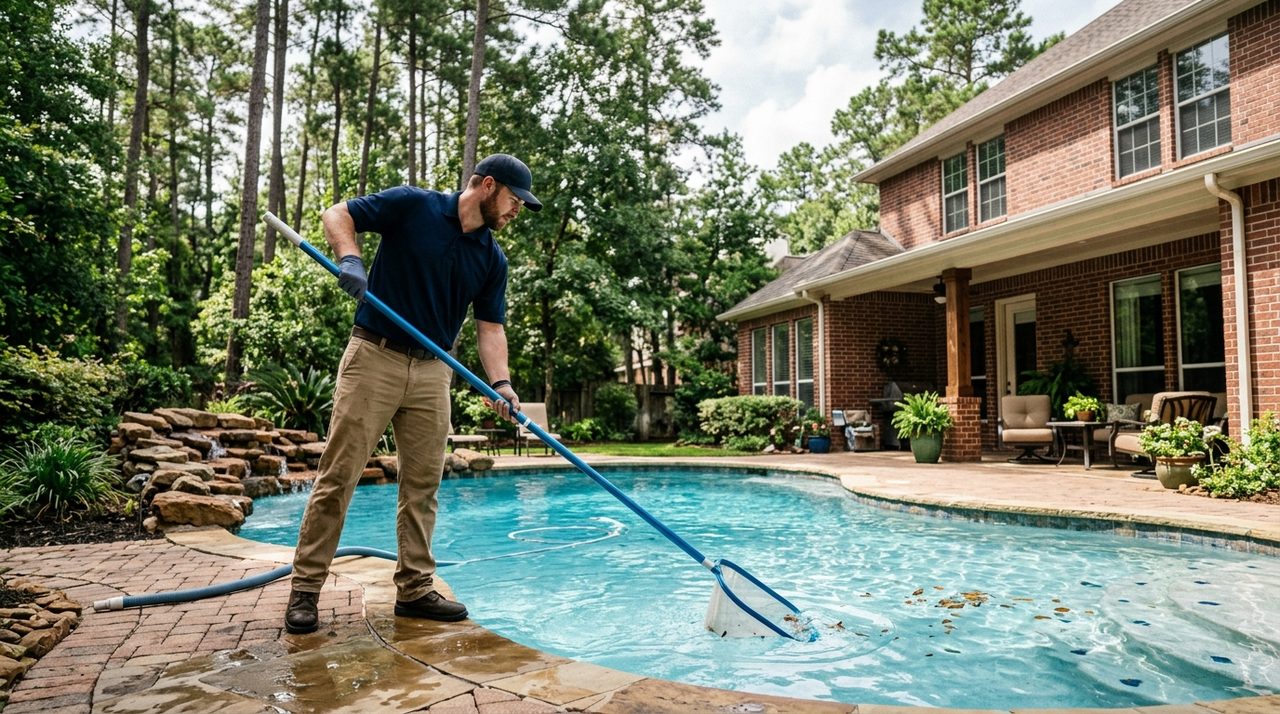
Tomball sits largely in FEMA Zone X — the lowest mapped flood risk category — but that designation covers riverine flooding, not the intense local stormwater runoff that followed Hurricane Beryl in July 2024 and the May 2024 derecho. Both events dropped heavy debris, organic matter, and windblown sediment into northwest Harris County pools, crashing chlorine levels, spiking phosphates, and clouding water even in yards that never took on standing water. Pools surrounded by the oak and pine trees typical of Tomball's older Ole Town-adjacent lots were hit hardest by leaf and pollen load.
What a good pro does
After any named storm or major derecho, treat your pool as a priority within 24–48 hours: net out debris before it sinks and stains plaster, shock to at least 10 ppm free chlorine, and backwash the filter after the water clears. A professional post-storm remediation visit — typically $250–$600 estimated cost depending on severity — is more economical than waiting until algae establishes a biofilm on plaster that requires acid washing to remove.
Sources: FEMA National Flood Hazard Layer (NFHL), Harris County Flood Control District
Hiring pool cleaning in Tomball? Tomball spans a wide range of housing stock, from older 1960s–1980s homes near the historic city core to newer master-planned subdivisions built from the late 1990s onward. Most HOA-governed neighborhoods feature production-builder brick veneer homes on slab-on-grade foundations, meaning foundation monitoring, HVAC maintenance, and roof upkeep are the primary service needs. Contractors should verify whether a property falls within the City of Tomball, an unincorporated Harris County area, or a specific HOA before beginning work.
Building era
Mixed: 1960s–1980s near Old Town Tomball; late 1990s–2010s in master-planned subdivisions.
Typical style
Production-builder Texas Traditional with brick veneer, hip/gable roofs, and attached garages; some older ranch-style homes near the city core.
Foundations
Predominantly slab-on-grade; pier-and-beam limited to pre-1960s or custom/rural construction.
Common systems
Newer subdivisions: central HVAC (often 15–25 years old in late-1990s builds), copper or PEX plumbing, 200-amp electrical panels. Older homes near Old Town: original HVAC systems likely replaced, possible galvanized or cast iron plumbing, older electrical panels that may need upgrading.
What that means for repairs
Older homes near Old Town Tomball see kitchen and bath remodels, re-piping from galvanized to PEX, and electrical panel upgrades. Newer master-planned homes are entering their first major replacement cycles for HVAC systems, water heaters, and roofing.
Permit jurisdiction
Mixed jurisdiction: properties within the City of Tomball require permits through the City of Tomball Building Department; unincorporated Harris County properties require permits through Harris County Engineering. Verify municipal boundaries before pulling permits.
HOA & deed restrictions
Mandatory HOAs/POAs are the norm in modern Tomball-area master-planned subdivisions (e.g., Villages of NorthPointe Community Association, Stone Lake Homeowners Association). Membership attaches to property ownership. Older pockets near Tomball city core may have no organized HOA or voluntary civic clubs. Confirm specific HOA status via Harris County deed records or TREC HOA Management Certificate database.
Historic districts
No City of Houston historic district designation confirmed. Old Town Tomball has some heritage character but no HAHC jurisdiction applies.
Contractor note
Many Tomball-area HOAs require architectural review committee (ARC) approval before exterior modifications. Contractors should confirm HOA approval requirements and verify whether the property is in the City of Tomball or unincorporated Harris County, as permitting processes differ significantly.
FEMA flood zone
FEMA Zone X (low flood risk) per official NFHL data. Some areas near Cypress Creek and local drainage channels may carry higher risk; always verify specific addresses against the Harris County Flood Control District floodplain viewer.
Hurricane Harvey impact
Some parts of the Tomball/North Harris County area experienced Harvey flooding, particularly near creeks and Cypress Creek, but flooding was very localized. Many newer master-planned subdivisions were designed with detention facilities and experienced less structural flooding than older bayou-adjacent areas. Specific street-level flood history should be verified through Harris County Flood Control District records, seller disclosures, and FEMA claim data.
Heat & humidity load
Sustained summer heat puts heavy demand on HVAC systems, especially in late-1990s to early-2000s homes where original units may be nearing end of life. Slab foundations on Houston's expansive clay soils benefit from consistent watering during drought periods to prevent differential settlement. Attic temperatures in single-story brick veneer homes can exceed 150°F, accelerating roofing material degradation.
Working with contractors here
HVAC replacement and maintenance is the most common service call in Tomball's master-planned subdivisions, as many late-1990s and 2000s-era systems are reaching or past their expected lifespan. Foundation repair and monitoring is also significant due to the expansive clay soils common across northwest Harris County. Roofing work is frequent, driven by both age-related wear and periodic hail events. In older Old Town Tomball homes, re-piping from galvanized to PEX and electrical panel upgrades are common jobs. Contractors should always check HOA ARC requirements for exterior work and confirm the correct permit jurisdiction before starting any project.
Local Tip
Always ask for a written estimate before work begins. Texas contractors are required to provide one on jobs over $1,000.
Tomball spans a wide range of housing stock, from older 1960s–1980s homes near the historic city core to newer master-planned subdivisions built from the late 1990s onward. Most HOA-governed neighborhoods feature production-builder brick veneer homes on slab-on-grade foundations, meaning foundation monitoring, HVAC maintenance, and roof upkeep are the primary service needs. Contractors should verify whether a property falls within the City of Tomball, an unincorporated Harris County area, or a specific HOA before beginning work.
Source: U.S. Census Bureau, ACS 5-Year 2023
Most of Tomball maps to FEMA Zone X (low mapped flood risk), but Houston's flash-flood reality means even low-risk blocks benefit from smart drainage and storm-hardened installs.
Source: FEMA National Flood Hazard Layer (NFHL). Flood zones vary by parcel — verify your individual FIRM panel.
Sources: Municipal permit office (see area profile)
Sources: Local HOA / deed restrictions (see area profile)