18535 FM 1488, Magnolia, TX 77355
Best Pool Cleaning in Magnolia, TX
Magnolia's pool market spans two very different worlds: HOA-governed master-planned communities like NorthGrove and Magnolia Reserve — where water clarity and equipment screening rules are enforced — and older ranch homes on unrestricted acreage where pools may have been installed decades ago with no automation or freeze protection. Montgomery County's expansive clay soils, combined with Houston's extreme UV load and hard groundwater drawn from the Evangeline aquifer, create a demanding chemistry and structural environment that pool owners here encounter more acutely than in many inner-loop neighborhoods. Understanding which challenges actually apply to your property and pool era is the real value of this page.
Verified against Google Business data
Updated 2026
See the 5 Pool Cleaning Serving Magnolia 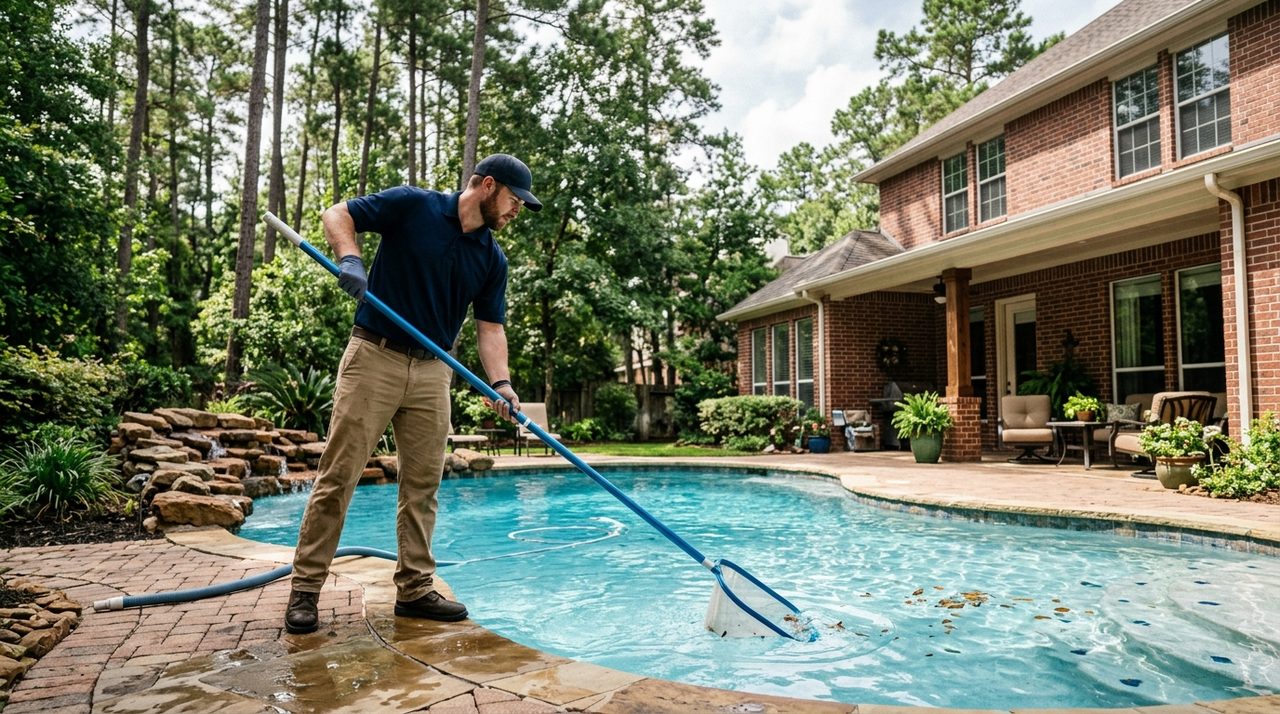
- Median home built
- 2002
- Median home value
- $285,200
- FEMA flood zone
- X (low)
- Typical monthly cleaning cost (est.)
- $150–$250
- Most common local issue
- Calcium scale from MUD/aquifer hard water plus UV-driven chlorine loss on unshaded acreage lots
Ranked by verified Google rating × review volume × verification tier. How we rank →
Some highly-rated pros serve Magnolia from nearby and may not keep a Magnolia street address. Those are listed under "Also serving Magnolia" with their real city and distance, so you always know where each business is based.
Min rating:
5 resultsBased in Magnolia
Closed
32831 TX-249, Pinehurst, TX 77362
Closed
30101 Hazy Hollow Rd, Magnolia, TX 77355
Also serving Magnolia
Highly-rated pros based nearby who cover Magnolia. Distance shown from the Magnolia area.
Closed
Serving Magnolia Based in The Woodlands · 0.3 mi away
Serving Magnolia Based in The Woodlands · 0.8 mi away
Pool Cleaning in Magnolia: What You Should Know
Hard Aquifer Water Builds Calcium Scale Faster on Montgomery County Pools
Why it matters to you
Many Magnolia-area properties — particularly those outside Magnolia city limits on unincorporated Montgomery County parcels — draw water from Municipal Utility Districts tapping the Evangeline or Chicot aquifer, which routinely delivers water with calcium hardness in the 200–400 ppm range. In Magnolia's summer heat, evaporation concentrates that mineral load quickly, leaving chalky white deposits on tile lines, plaster surfaces, and inside heat exchangers. Pools on acreage that rely on private well water can have even higher mineral content with no municipal treatment to moderate it.
What a good pro does
A knowledgeable pool cleaning tech serving Magnolia should test calcium hardness and total dissolved solids at every monthly check — not just pH and chlorine — and manage the Langelier Saturation Index to prevent precipitation before scaling becomes visible. When scaling is already established, professional acid washing or tile bead-blasting can restore surfaces without full replastering; estimates for that service typically run $250–$600 depending on pool size and scale severity. Equipment replacement that involves plumbing or electrical connections may require a permit through Montgomery County Engineering for unincorporated properties or through the City of Magnolia for in-limits addresses — confirm jurisdiction before any repair work begins.
Sources: Municipal permit office (see area profile), Texas Commission on Environmental Quality
Intense UV Index Drains Chlorine Rapidly on Magnolia's Open Acreage Lots
Why it matters to you
Magnolia's older ranch-style acreage properties and many newer master-planned community lots share one trait: minimal mature shade over the pool. Houston's UV index regularly reaches 10–11 from May through September at roughly 30°N latitude, and unstabilized or under-stabilized pool water can lose its entire free chlorine residual within hours of a service visit on a clear afternoon. For Magnolia homeowners whose pools sit in full sun on half-acre or larger lots — common on the acreage tracts that define the older parts of the market — this means visible water quality problems can develop between weekly service visits faster than owners expect.
What a good pro does
A pool pro serving Magnolia's sun-exposed pools should target cyanuric acid (stabilizer) levels in the 40–80 ppm range to slow UV chlorine degradation, and should calibrate dosing to pool volume and typical sun exposure hours rather than applying a one-size schedule. Salt chlorinator systems, popular in newer NorthGrove and Magnolia Reserve builds, help maintain a more continuous chlorine output but still require stabilizer management and cell inspections. Routine weekly service in this environment typically runs $150–$250 per month — the higher end of that range reflects the additional chemical demand of a large, unshaded pool on an acreage lot.
HOA Compliance Documentation Is Non-Negotiable in NorthGrove and Magnolia Reserve
Why it matters to you
NorthGrove, Magnolia Reserve, Magnolia Ridge, and other platted subdivisions in the Magnolia area each operate their own mandatory HOA with deed restrictions that govern pool water clarity, equipment screening, and fence specifications. Unlike properties on unincorporated acreage where homeowners have broad latitude, subdivision pool owners can face HOA fines if water is not clear to the drain — a standard that is easy to miss after a heavy pollen week or a brief equipment failure. Because Magnolia has no area-wide HOA, the specific rules vary by subdivision and must be verified against each community's recorded deed restrictions at the Montgomery County Clerk.
What a good pro does
Pool cleaning professionals familiar with Magnolia's HOA landscape should provide dated service logs and water-test records that homeowners can present to their architectural review committee if a compliance question arises. Before any equipment replacement — pump housing, automation controller, or enclosure screening — the homeowner should confirm whether the change requires HOA architectural committee approval in addition to any applicable permit from the City of Magnolia or Montgomery County Engineering. Keeping documentation of chemical readings and service visits is a simple, zero-cost protection against HOA disputes.
Sources: Local HOA / deed restrictions (see area profile), Municipal permit office (see area profile)
Older Acreage Pools Lack Freeze Guards — And Montgomery County Repair Permits Add a Step
Why it matters to you
Magnolia's 1970s–1990s ranch-style homes on acreage frequently have pools that were built with no automated freeze protection — no freeze guard wired to the pump timer, no insulation on exposed PVC runs, and equipment pads fully open to north winds. Winter Storm Uri (February 2021) cracked pump housings and split plumbing lines across the Houston metro, and Magnolia's position in Montgomery County means temperatures can dip slightly lower than inner-loop Houston neighborhoods, extending the freeze window. An owner of a 1985-era acreage pool near downtown Magnolia faces meaningfully higher freeze risk than a buyer in a 2018 NorthGrove build that likely came with a basic freeze sensor.
What a good pro does
A pool cleaning service visiting an older Magnolia acreage pool in fall should assess whether a freeze guard controller is installed and functional — retrofitting one is a straightforward electrical addition that typically costs far less than the $400–$1,500 or more in pipe and pump repair after a hard freeze event. Any electrical work on pool equipment on an unincorporated Montgomery County parcel requires a permit through Montgomery County Engineering; work on an in-limits Magnolia address goes through the City of Magnolia permit office. TDLR requires that pool and spa contractors performing that level of repair hold a Residential Swimming Pool and Spa Contractor license — ask to see it before authorizing work beyond routine cleaning.
Sources: Texas Department of Licensing & Regulation, Municipal permit office (see area profile)
Pool Cleaning in Magnolia: What You Should Know
Hiring pool cleaning in Magnolia? Magnolia spans a wide range of housing types, from newer master-planned communities like NorthGrove and Magnolia Reserve to older ranch homes and custom builds on rural acreage. Homeowners here face a split landscape: HOA-governed subdivisions with strict approval processes alongside unrestricted parcels where homeowners have broad latitude. Contractors must be comfortable working with both Montgomery County permitting and varied subdivision-specific deed restrictions.
- Housing era
- Mixed — older stock from the 1970s–1990s in the original town area, significant 2000s…
- Foundation
- Predominantly slab-on-grade in post-1980 subdivisions
- Flood zone
- FEMA Zone X (low flood risk) per official NFHL data
- Permits
- City of Magnolia for properties within city limits
Housing stock & systems
Building era
Mixed — older stock from the 1970s–1990s in the original town area, significant 2000s infill, and heavy new construction concentration in the 2010s–2020s in master-planned communities.
Typical style
Texas traditional with brick and stone veneers in newer subdivisions; Craftsman-influenced and modern farmhouse elements in recent builds; ranch-style brick or siding homes on older acreage tracts.
Foundations
Predominantly slab-on-grade in post-1980 subdivisions; pier-and-beam may be found in older or custom acreage homes.
Common systems
Newer homes feature high-efficiency HVAC systems, PEX plumbing, and modern electrical panels; older 1970s–1990s stock may have original HVAC units, copper or CPVC plumbing, and smaller electrical panels that may need upgrades.
What that means for repairs
Older ranch-style homes on acreage are common renovation targets for kitchen and bathroom modernization, HVAC replacement, and electrical panel upgrades. Newer master-planned homes see less renovation but frequent cosmetic upgrades and outdoor living additions.
Permits & restrictions
Permit jurisdiction
City of Magnolia for properties within city limits; Montgomery County Engineering for unincorporated areas and ETJ parcels.
HOA & deed restrictions
No single area-wide HOA. Platted subdivisions each have their own mandatory HOA (e.g., Magnolia Reserve HOA, Magnolia Ridge HOA, NorthGrove HOA). Many acreage parcels and older subdivisions have no HOA. Deed restrictions may still apply on non-HOA lots — check Montgomery County Clerk records for specific parcels.
Historic districts
No historic district designation confirmed. Magnolia is not within the City of Houston and has no known HAHC-designated districts.
Contractor note
Contractors must verify whether a property falls within Magnolia city limits or unincorporated Montgomery County, as permitting requirements and inspections differ. HOA-governed subdivisions often require architectural review committee approval before exterior work begins.
Flood & weather
FEMA flood zone
FEMA Zone X (low flood risk) per official NFHL data. Much of the Magnolia area sits at higher elevations in upstream Montgomery County, away from major bayou floodplains.
Hurricane Harvey impact
No documented widespread structural flooding in the Magnolia area during Hurricane Harvey. None of the major Magnolia HOA or community sources reference Harvey-related rebuilding or large-scale flood damage. Central Montgomery County generally fared better than downstream Harris County bayou corridors, though localized drainage issues on individual properties cannot be ruled out — check specific property history for any claims.
Heat & humidity load
Extended Houston-area summers with high heat and humidity stress HVAC systems year-round. Newer homes with high-efficiency units handle the load well, but older 1970s–1990s stock may need HVAC replacement or duct sealing. Slab foundations on expansive clay soils can shift during summer drought cycles, making foundation monitoring and proper drainage critical.
Working with contractors here
Magnolia's diverse housing stock creates demand for a wide range of services. In newer master-planned communities, contractors frequently handle warranty-related repairs, outdoor living additions (patios, pools, outdoor kitchens), and fence installations that must meet HOA specifications. Older ranch-style homes on acreage generate steady demand for HVAC replacement, roof replacement, electrical panel upgrades, and kitchen/bath remodels. Foundation work is common across all eras due to the expansive clay soils in Montgomery County. Contractors working in HOA subdivisions should budget time for architectural review committee approvals and plan for potentially longer driveways and access considerations on rural acreage properties.
Local Tip
Always ask for a written estimate before work begins. Texas contractors are required to provide one on jobs over $1,000.
About Magnolia
Magnolia spans a wide range of housing types, from newer master-planned communities like NorthGrove and Magnolia Reserve to older ranch homes and custom builds on rural acreage. Homeowners here face a split landscape: HOA-governed subdivisions with strict approval processes alongside unrestricted parcels where homeowners have broad latitude. Contractors must be comfortable working with both Montgomery County permitting and varied subdivision-specific deed restrictions.
- Median year built
- 2002
- Median home value
- $285,200
- Owner-occupied
- 52.3%
- Population
- 3,230
- Housing units
- 1,380
- Median income
- $70,516
Source: U.S. Census Bureau, ACS 5-Year 2023
Flood & storm risk
FEMA Zone XLow flood riskMost of Magnolia maps to FEMA Zone X (low mapped flood risk), but Houston's flash-flood reality means even low-risk blocks benefit from smart drainage and storm-hardened installs.
Source: FEMA National Flood Hazard Layer (NFHL). Flood zones vary by parcel — verify your individual FIRM panel.
Frequently Asked Questions
Do I need a permit from Montgomery County or the City of Magnolia to replace my pool pump or heater?
It depends on where your property sits: homes inside Magnolia city limits pull permits through the City of Magnolia, while the majority of Magnolia addresses on unincorporated acreage or in newer subdivisions fall under Montgomery County Engineering. Equipment swaps like pump motors and heaters are often treated as mechanical replacements that require a permit and inspection in both jurisdictions, so confirm your parcel's status before the technician starts work. Routine chemical cleaning visits do not require any permit under either jurisdiction.
Sources: Municipal permit office (see area profile)Texas Department of Licensing & Regulation
My acreage pool was built in the early 1990s and has no freeze guard. After Uri, what should a Magnolia pool cleaner actually check before next winter?
A technician servicing a pre-2000 acreage pool in Magnolia should verify whether the pump timer has an automated freeze-guard setting (most older analog timers do not), inspect all exposed PVC unions and fittings for hairline cracks left over from Uri, and confirm the heater heat exchanger was not compromised. Because these older pools sit on Montgomery County clay that shifts seasonally, the tech should also look at return and suction line fittings near the shell where movement-related stress cracks are common. Any pipe or electrical repair found during this walkthrough may need a Montgomery County permit if it goes beyond simple part swaps.
Sources: Municipal permit office (see area profile)
Our home is in NorthGrove — does our HOA actually fine us if the pool water isn't clear, and can a cleaning company provide the documentation we'd need?
HOA-governed subdivisions in Magnolia such as NorthGrove and Magnolia Reserve typically require water to be clear and visible to the main drain as a condition of the deed restrictions, and violations can result in written notices and fines issued through the HOA's management company. A professional cleaning service can provide dated visit logs, water-test result records, and chemical treatment invoices that serve as proof of compliance if the HOA requests documentation. Before hiring, ask the company specifically whether they provide written service reports after each visit, since a verbal confirmation is not useful if you need to respond to an HOA notice.
Sources: Local HOA / deed restrictions (see area profile)
Magnolia is mapped FEMA Zone X, so my pool is low flood risk — does that mean storm cleanup is a non-issue here?
Zone X designation means your property is outside the 100-year floodplain, but Magnolia still sees intense flash-flooding and wind events — Hurricane Beryl in July 2024 and the May 2024 derecho both deposited heavy debris across Montgomery County regardless of flood-zone mapping. Post-storm debris, pollen, and sediment can crash sanitizer levels and spike phosphates in any pool, Zone X or not, typically requiring a shock treatment, clarifier dose, and at least one or two filter backwashes before the water is swim-safe. Budget roughly $250–$600 (estimate) for a full green-pool remediation if the pool sat unserviced for a week or more after a major storm.
How often should a Magnolia pool realistically be serviced in winter versus summer, given how mild — but not frost-free — Montgomery County winters are?
In summer (May through September) weekly service is the practical standard in Magnolia: Houston's UV index regularly hits 10–11 and water temperatures stay high enough that algae can establish within days of a missed visit. Winter visits can often stretch to every two weeks when water temperature drops below 60°F and bather load is minimal, but should never stop entirely — Montgomery County does see occasional hard freezes, and a pool left without circulation during a freeze event risks the same pump and pipe damage that devastated metro-area pools during Uri. Ask any prospective service company how they handle freeze-watch nights specifically, including whether they remotely trigger circulation or dispatch a technician.
Does the pool cleaner I hire in Magnolia need a state license, or is anyone allowed to service pool chemistry here?
Texas does not require a state license solely for routine pool cleaning and chemical balancing, so the barrier to entry is low and the quality range among local providers is wide. However, contractors who perform construction work or major repairs on pools — replastering, structural pipe work, equipment pad upgrades — must hold a license from the Texas Department of Licensing and Regulation under the Residential Swimming Pool and Spa Contractor program. If a technician also applies copper-based algaecides or other pesticide-classified treatments, a Texas Department of Agriculture pesticide applicator license may apply. When interviewing services for an older acreage pool in Magnolia that may need repair work alongside cleaning, ask upfront whether the company holds the TDLR contractor license so you are not caught needing a second contractor for anything beyond routine maintenance.
Sources: Texas Department of Licensing & RegulationTexas Commission on Environmental Quality