Open Now
31848 TX-249, Pinehurst, TX 77362
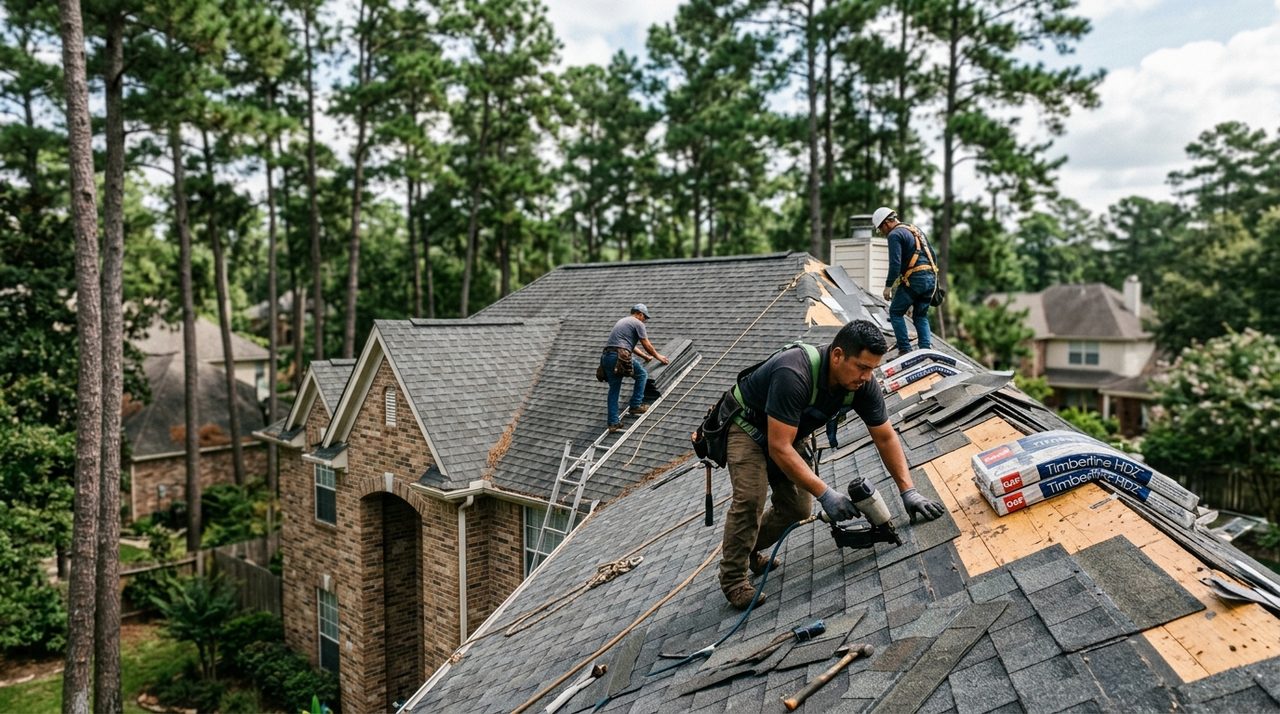
Magnolia, TX sits in Montgomery County where a median build year of 2002 means many roofs are now approaching or past the practical 15–18 year lifespan that Houston's punishing UV load and heat cycling impose on standard architectural shingles — well before their printed warranty dates suggest. Add the May 2024 derecho's 100-mph straight-line winds that tracked across Harris and Montgomery counties, a patchwork of permit jurisdictions split between the City of Magnolia and unincorporated Montgomery County Engineering, and mandatory HOA architectural review in communities like NorthGrove and Magnolia Reserve, and choosing the right roofer here requires more than a low bid.
Ranked by verified Google rating × review volume × verification tier. How we rank →
Some highly-rated pros serve Magnolia from nearby and may not keep a Magnolia street address. Those are listed under "Also serving Magnolia" with their real city and distance, so you always know where each business is based.
31848 TX-249, Pinehurst, TX 77362
1203 Mere Dr, Pinehurst, TX 77362
1302 Coe Rd, Pinehurst, TX 77362
24715 FM 1488 STE 5, Magnolia, TX 77355
Highly-rated pros based nearby who cover Magnolia. Distance shown from the Magnolia area.
Serving Magnolia Based in The Woodlands · 0.1 mi away
Serving Magnolia Based in The Woodlands · 0.2 mi away
Why it matters to you
Magnolia's median home was built in 2002, meaning a large share of the housing stock carries original or first-replacement roofs now aged 20-plus years. Houston's 2,700-plus cooling degree days annually push attic deck temperatures above 160°F, oxidizing asphalt binders and shortening even 30-year architectural shingles to a realistic 15–18 year lifespan. Homeowners in established Magnolia subdivisions and older acreage ranch homes alike are often surprised to find their roofs failing well ahead of the printed warranty.
What a good pro does
A qualified roofer should perform a close-up inspection — not a drive-by assessment — checking for granule loss in gutters, tab brittleness, and ridge cap cracking before storm damage is the trigger. When replacing, specifying a lighter-colored or Energy Star–rated shingle can reduce deck temperatures meaningfully and may qualify for utility rebates under Energy Star cool-roof programs. Full tear-off rather than overlay is strongly advisable on homes where the original deck has never been exposed, so ventilation deficiencies can be corrected at the same time.
Sources: ENERGY STAR / U.S. Dept. of Energy, International Residential Code (as adopted by City of Houston)
Why it matters to you
The May 2024 derecho produced straight-line winds exceeding 100 mph across Montgomery County, and Magnolia's mix of open-canopy master-planned lots (NorthGrove, Magnolia Reserve) and rural acreage tracts offered little natural wind break. Wind uplift tears ridge caps, lifts shingle tabs on low-nail-count installations, and can delaminate field sections — damage that is sometimes invisible from the ground but creates interior leak pathways during subsequent rains. Homes built before the 2006 IRC wind-resistance code updates are particularly vulnerable.
What a good pro does
After any significant wind event, homeowners should request a full roof-plane inspection with photos taken at ridge level and along all hip and rake edges. A reputable contractor will document nail patterns exposed at lifted tabs — inadequate fastening (fewer than 4 nails per shingle, or nails placed outside the nailing zone) is a common finding on pre-2006 Montgomery County homes. Texas has no state roofing license through TDLR, so verifying the contractor's general liability and workers' compensation insurance is the homeowner's primary protection against storm-chaser fraud.
Sources: Texas Windstorm Insurance Association (TWIA), International Residential Code (as adopted by City of Houston), Municipal permit office (see area profile)
Why it matters to you
Magnolia has no single area-wide HOA, but each of its platted master-planned communities maintains its own Architectural Review Committee with mandatory pre-approval for any roofing material or color change. ARC processes in communities across the Houston metro routinely take 10–30 days — a significant problem when a leaking roof needs immediate attention. Choosing a shingle color or upgrading to metal roofing without prior ARC sign-off can result in fines or a forced re-roof at the homeowner's expense, regardless of what the municipality allows.
What a good pro does
Before signing any roofing contract in a Magnolia HOA subdivision, confirm whether the proposed shingle brand, color, and profile appear on the ARC's approved-products list and submit the application the same day damage is discovered. A contractor familiar with Montgomery County HOA timelines will help you file emergency or expedited review requests where the governing documents allow them. For acreage parcels and older Magnolia lots outside a formal HOA, check the Montgomery County Clerk's deed restriction records anyway — restrictions can run with the land even without an active HOA board.
Sources: Local HOA / deed restrictions (see area profile), Municipal permit office (see area profile)
Why it matters to you
Unlike most of the Houston metro where the City of Houston's single permit office governs a large contiguous area, Magnolia homeowners must first determine whether their property sits within the Magnolia city limits or in unincorporated Montgomery County — because the permitting body, inspection schedule, and fee structure differ entirely. A full re-roof or structural deck repair that requires a permit pulled under the wrong jurisdiction creates inspection failures, potential certificate-of-occupancy issues on resale, and insurance complications if a claim later reveals unpermitted work.
What a good pro does
Before any work begins, ask the contractor to confirm your parcel's jurisdiction by address lookup through the City of Magnolia or the Montgomery County Engineering Department — not by assumption based on a neighboring property. A full re-roof on a structurally non-compromised home may or may not require a permit depending on scope and jurisdiction, but deck replacement and structural repairs generally do. Because Texas issues no state roofing license, the contractor's ability to correctly pull permits and pass inspections under your specific jurisdiction is one of the few objective competency signals available to homeowners.
Sources: Municipal permit office (see area profile), International Residential Code (as adopted by City of Houston)
Hiring roofers in Magnolia? Magnolia spans a wide range of housing types, from newer master-planned communities like NorthGrove and Magnolia Reserve to older ranch homes and custom builds on rural acreage. Homeowners here face a split landscape: HOA-governed subdivisions with strict approval processes alongside unrestricted parcels where homeowners have broad latitude. Contractors must be comfortable working with both Montgomery County permitting and varied subdivision-specific deed restrictions.
Building era
Mixed — older stock from the 1970s–1990s in the original town area, significant 2000s infill, and heavy new construction concentration in the 2010s–2020s in master-planned communities.
Typical style
Texas traditional with brick and stone veneers in newer subdivisions; Craftsman-influenced and modern farmhouse elements in recent builds; ranch-style brick or siding homes on older acreage tracts.
Foundations
Predominantly slab-on-grade in post-1980 subdivisions; pier-and-beam may be found in older or custom acreage homes.
Common systems
Newer homes feature high-efficiency HVAC systems, PEX plumbing, and modern electrical panels; older 1970s–1990s stock may have original HVAC units, copper or CPVC plumbing, and smaller electrical panels that may need upgrades.
What that means for repairs
Older ranch-style homes on acreage are common renovation targets for kitchen and bathroom modernization, HVAC replacement, and electrical panel upgrades. Newer master-planned homes see less renovation but frequent cosmetic upgrades and outdoor living additions.
Permit jurisdiction
City of Magnolia for properties within city limits; Montgomery County Engineering for unincorporated areas and ETJ parcels.
HOA & deed restrictions
No single area-wide HOA. Platted subdivisions each have their own mandatory HOA (e.g., Magnolia Reserve HOA, Magnolia Ridge HOA, NorthGrove HOA). Many acreage parcels and older subdivisions have no HOA. Deed restrictions may still apply on non-HOA lots — check Montgomery County Clerk records for specific parcels.
Historic districts
No historic district designation confirmed. Magnolia is not within the City of Houston and has no known HAHC-designated districts.
Contractor note
Contractors must verify whether a property falls within Magnolia city limits or unincorporated Montgomery County, as permitting requirements and inspections differ. HOA-governed subdivisions often require architectural review committee approval before exterior work begins.
FEMA flood zone
FEMA Zone X (low flood risk) per official NFHL data. Much of the Magnolia area sits at higher elevations in upstream Montgomery County, away from major bayou floodplains.
Hurricane Harvey impact
No documented widespread structural flooding in the Magnolia area during Hurricane Harvey. None of the major Magnolia HOA or community sources reference Harvey-related rebuilding or large-scale flood damage. Central Montgomery County generally fared better than downstream Harris County bayou corridors, though localized drainage issues on individual properties cannot be ruled out — check specific property history for any claims.
Heat & humidity load
Extended Houston-area summers with high heat and humidity stress HVAC systems year-round. Newer homes with high-efficiency units handle the load well, but older 1970s–1990s stock may need HVAC replacement or duct sealing. Slab foundations on expansive clay soils can shift during summer drought cycles, making foundation monitoring and proper drainage critical.
Working with contractors here
Magnolia's diverse housing stock creates demand for a wide range of services. In newer master-planned communities, contractors frequently handle warranty-related repairs, outdoor living additions (patios, pools, outdoor kitchens), and fence installations that must meet HOA specifications. Older ranch-style homes on acreage generate steady demand for HVAC replacement, roof replacement, electrical panel upgrades, and kitchen/bath remodels. Foundation work is common across all eras due to the expansive clay soils in Montgomery County. Contractors working in HOA subdivisions should budget time for architectural review committee approvals and plan for potentially longer driveways and access considerations on rural acreage properties.
Local Tip
Always ask for a written estimate before work begins. Texas contractors are required to provide one on jobs over $1,000.
Magnolia spans a wide range of housing types, from newer master-planned communities like NorthGrove and Magnolia Reserve to older ranch homes and custom builds on rural acreage. Homeowners here face a split landscape: HOA-governed subdivisions with strict approval processes alongside unrestricted parcels where homeowners have broad latitude. Contractors must be comfortable working with both Montgomery County permitting and varied subdivision-specific deed restrictions.
Source: U.S. Census Bureau, ACS 5-Year 2023
Most of Magnolia maps to FEMA Zone X (low mapped flood risk), but Houston's flash-flood reality means even low-risk blocks benefit from smart drainage and storm-hardened installs.
Source: FEMA National Flood Hazard Layer (NFHL). Flood zones vary by parcel — verify your individual FIRM panel.
Even in lower-risk Magnolia, TX, a Gulf hurricane can drive 130-mph gusts that peel ridge caps and send shingles airborne, so have a TDLR-licensed roofer apply additional hand-sealing to all perimeter and hip shingles with roofing cement before the season opens. A two-hour prep visit is far less disruptive than a post-storm emergency tarp call when every roofer in Houston is booked. As a Montgomery County community, Magnolia may follow county rather than City of Houston storm rebuild rules.
The May 2024 derecho showed that 80-mph straight-line winds can strip improperly fastened ridge caps from roofs across the Houston metro regardless of flood zone, so have a licensed roofer inspect and hand-nail any ridge shingles that feel loose or show lifted leading edges in Magnolia, TX. A secure ridge cap also prevents the attic air-pressure equalization that accelerates uplift on field shingles during a pressure drop. Confirm the current FEMA panel for your Magnolia parcel — the area maps to Zone X, but adjacent lots can differ.
Even in lower-flood-risk Magnolia, TX, a hard freeze following a rainstorm can trap water under lifted perimeter shingles and expand it into cracks in the decking, a failure mode that became widespread during Uri 2021. Ask a roofer to hand-seal any perimeter shingles showing daylight beneath them before December so freeze-water expansion does not open your deck to spring rains. Confirm the current FEMA panel for your Magnolia parcel — the area maps to Zone X, but adjacent lots can differ.
Sources: FEMA National Flood Hazard Layer (NFHL), Ready.gov -- Hurricanes, CenterPoint Energy -- Storm Center, City of Houston -- Emergency Preparedness, Ready.gov -- Winter Weather, Harris County Flood Control District
Houston-specific estimators to plan your project before you call a pro. All results are planning estimates — a licensed local pro confirms the details on site.
Estimated design wind speed for your zone
Outside the TDI catastrophe area, so a WPI-8 is generally not mandated — but Houston still sees hurricane-force gusts (Beryl, 2024). Insist on properly rated shingles installed to the manufacturer's high-wind nailing pattern (6 nails) and starter strips, or a wind claim can be denied for improper installation.
Find a Houston roofer →This is a planning estimate only — actual requirements depend on an on-site assessment by a licensed Houston pro. Wind-speed zones are approximate; your exact TDI/WPI-8 obligation depends on your address's designation. Verify with the Texas Department of Insurance before contracting.
Disconnect & drain every outdoor hose bib
Remove hoses, drain the spigots, and cover each with an insulated faucet sock. Un-drained hose bibs are the #1 burst point in a Houston freeze.
Insulate exposed pipes in the attic & garage
Wrap any pipe in an unconditioned space (attic runs, garage walls) with foam sleeves. Houston homes rarely insulate these because they only matter a few nights a year — which is exactly why they burst.
Open cabinet doors & keep a pencil-width drip
On hard-freeze nights, open kitchen/bath cabinets so warm air reaches the pipes and let faucets on exterior walls drip to relieve pressure.
Protect the attic/garage water heater & its lines
An attic or garage tank sits in unconditioned space. Insulate the cold-inlet and hot-outlet lines and confirm the emergency drain pan is clear so a leak doesn't reach the ceiling.
This is a planning estimate only — actual requirements depend on an on-site assessment by a licensed Houston pro. If a pipe has already burst, shut off your main water supply and call a licensed Houston plumber immediately — freeze bursts flood fast.
Sources: Municipal permit office (see area profile)
Sources: Local HOA / deed restrictions (see area profile)
Sources: Municipal permit office (see area profile)
Sources: International Residential Code (as adopted by City of Houston)
Sources: Texas Windstorm Insurance Association (TWIA)Local HOA / deed restrictions (see area profile)