Closed
1503 S Medio River Cir, Sugar Land, TX 77478
Sugar Land's 1980s–2000s slab-on-grade homes sit on Fort Bend County's expansive Beaumont clay, where seasonal wet-dry swings in a median-1994-vintage neighborhood translate directly into cracked brick veneer, sticking doors, and perimeter beam voids that compound year after year. Because Sugar Land is an incorporated city with its own Development Services office — not Houston's permitting system — and because virtually every subdivision from First Colony to New Territory runs mandatory HOA architectural review, foundation repair here requires coordinating permits, contractor insurance, and ACC pre-approval before a single pier is pressed. This page explains what drives movement in Sugar Land's specific housing stock and how to evaluate proposals that fit the local regulatory reality.
Ranked by verified Google rating × review volume × verification tier. How we rank →
1503 S Medio River Cir, Sugar Land, TX 77478
2651 Coopers Post Ln, Sugar Land, TX 77478
225 Matlage Way Unit 1383, Sugar Land, TX 77478
15315 Marden Ct, Sugar Land, TX 77478
525 Julie Rivers Dr Suite 380, Sugar Land, TX 77478
104 Industrial Blvd #115, Sugar Land, TX 77478
16701 Creekbend Dr, Sugar Land, TX 77478
14140 Southwest Fwy, Sugar Land, TX 77478
15500 Voss Rd Suite 6, Sugar Land, TX 77498
2915 Monet Dr, Sugar Land, TX 77479
Why it matters to you
Sugar Land's housing stock — median year built 1994 per Census ACS data — sits directly on Fort Bend County's Beaumont clay, one of the most expansive soil formations in North America. The wet winters and baking summers typical of SW Houston cause these clays to swell and shrink repeatedly, lifting one corner of a slab while another settles. Homeowners in communities like Sugar Lakes and Ranch Country often see the same diagonal brick cracks reopen every late summer, a sign that the underlying soil cycle has never been addressed.
What a good pro does
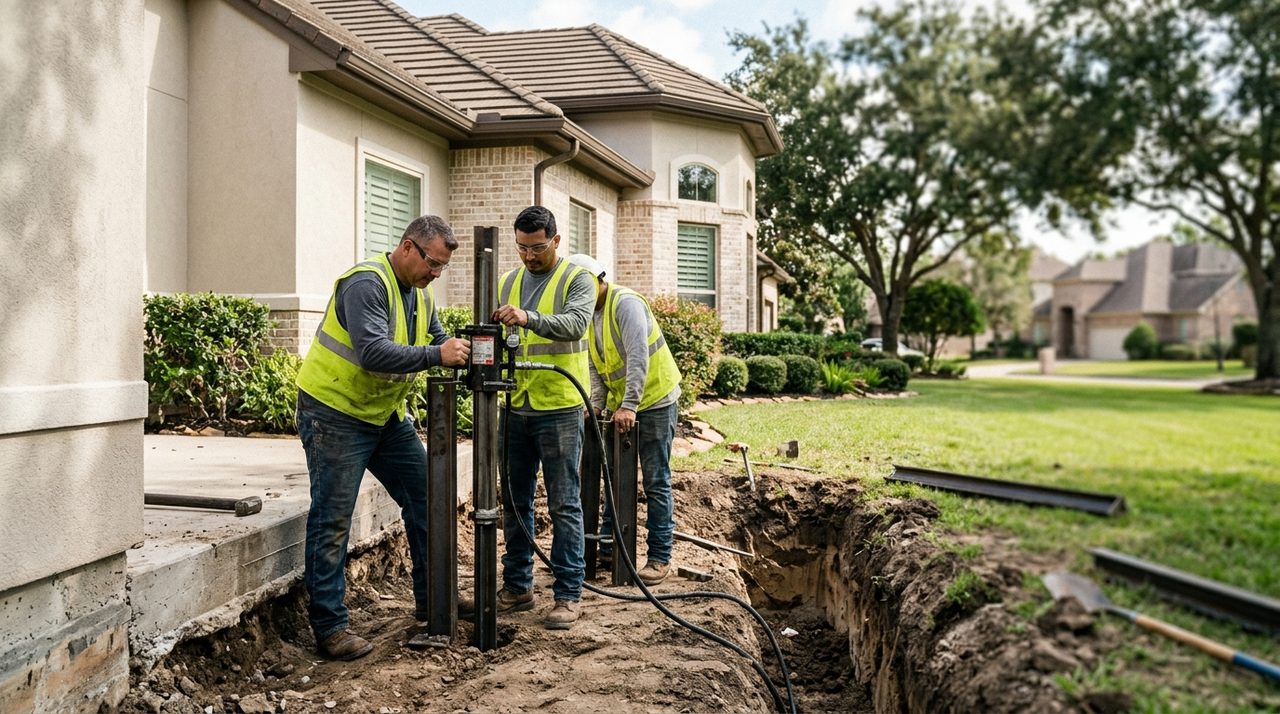
A credible contractor will map crack patterns across all four elevations of your home before recommending any underpinning, distinguishing seasonal cosmetic movement from true structural settlement. On Fort Bend clay, steel push piers driven to load-bearing soil (typically 20–30 feet deep here) offer more reliable long-term stabilization than the pressed concrete pilings common in Sugar Land's 1980s–1990s original construction. The repair requires a permit from the City of Sugar Land Development Services — not City of Houston — and your subdivision's architectural control committee must also approve exterior trenching before work begins.
Sources: Municipal permit office (see area profile), Local HOA / deed restrictions (see area profile), International Residential Code (as adopted by City of Houston)
Why it matters to you
Sugar Land has no city-wide HOA, but mandatory POA or HOA membership is the rule at the subdivision level — First Colony, New Territory, Telfair, and virtually every other master-planned community here each have an architectural control committee that must pre-approve visible exterior modifications. Perimeter foundation work requires trenching 18–24 inches along the beam line, which is plainly visible and, in some deed restrictions, explicitly listed as requiring ACC sign-off. Homeowners who let a contractor begin work without that approval have faced stop-work demands and fines, and undocumented repairs create disclosure complications under the TREC seller's disclosure form at resale.
What a good pro does
Before signing any foundation contract, pull your subdivision's deed restrictions — available from Fort Bend County Clerk records or your HOA management company — and confirm exactly what the ACC requires: typically a written description of scope, a site plan showing pier locations, and sometimes a structural engineer's letter. Build four to six weeks of HOA review time into your project schedule; many Sugar Land committees meet monthly. A contractor familiar with Fort Bend County suburban work will have an ACC submittal packet ready as a standard part of their proposal.
Sources: Local HOA / deed restrictions (see area profile), Municipal permit office (see area profile)
Why it matters to you
Sugar Land's 1980s–early-1990s homes were plumbed with cast-iron drain lines that run beneath the slab. Many of these lines are now 30–40 years old and showing corrosion failures — a problem that Winter Storm Uri (February 2021) intensified when freeze-thaw stress fractured lines that were already weakened. A slow under-slab leak saturates the Beaumont clay directly under the beam, causing localized heave and then settlement as the soil structure deteriorates. Because the movement pattern mimics plain drought-cycle settlement, it is frequently misdiagnosed by foundation contractors who don't test plumbing first.
What a good pro does
Before accepting any foundation repair proposal, commission a standalone hydrostatic plumbing test — a licensed plumber pressurizes the drain system and monitors for pressure loss, which typically costs $250–$400 and is required to be performed by a TSBPE-licensed plumber in Texas. If the test reveals a leak, the under-slab pipe must be repaired or re-routed before any pier work is done; otherwise the foundation will continue to move after the repair. The City of Sugar Land Development Services issues separate permits for structural and plumbing scopes, so confirm both are pulled when needed.
Sources: Texas State Board of Plumbing Examiners, Municipal permit office (see area profile), International Residential Code (as adopted by City of Houston)
Why it matters to you
The older sections of Sugar Land — neighborhoods platted in the late 1970s and early 1980s along US-90A and the original First Colony development — now carry mature live oaks and water oaks with root systems extending well beyond the canopy. On Fort Bend's expansive clay, these roots aggressively draw moisture in the dry months, causing localized slab drop on the tree side that produces the characteristic diagonal cracks running from door corners and window sills. The problem is compounded in subdivisions where deed restrictions designate certain trees as protected heritage specimens, limiting root barrier installation or tree removal as corrective options.
What a good pro does
A thorough foundation evaluation in these older Sugar Land sections should include a canopy-to-foundation distance assessment for every significant tree within 30 feet of the perimeter beam. Where root barriers are feasible (typically a 24–30 inch deep HDPE panel installed 6–10 feet from the foundation), they can interrupt moisture depletion without harming the tree. If the tree is deed-restriction-protected, your contractor should document that constraint in writing and recommend supplemental perimeter irrigation — a soaker hose loop on a timer — as the primary management tool. Any trenching for root barriers requires the same City of Sugar Land permit and HOA ACC review as pier work.
Sources: Local HOA / deed restrictions (see area profile), Municipal permit office (see area profile)
Hiring foundation repair in Sugar Land? Sugar Land is composed of numerous master-planned communities, each governed by its own mandatory HOA or POA with actively enforced deed restrictions. The housing stock is predominantly 1980s–2000s suburban brick construction on slab-on-grade foundations, requiring contractors to navigate both city permitting and subdivision-level architectural review for most exterior projects. Proximity to the Brazos River and Oyster Creek creates localized flood risk despite generally favorable FEMA designations.
Building era
Primarily 1980s–2000s, with newer construction in communities like Telfair from the late 2000s–2010s and older sections dating to the 1970s.
Typical style
Traditional suburban brick homes (1- and 2-story) with brick veneer, composition shingle roofs, and attached garages; variants include Colonial-influenced, Mediterranean-influenced, and transitional brick/stone combinations.
Foundations
Slab-on-grade (standard for post-1970 Fort Bend County suburban construction).
Common systems
Central HVAC systems (many original units in 1980s–1990s homes nearing or past replacement age), copper or CPVC plumbing supply lines, cast iron or PVC drain lines depending on era, 200-amp electrical panels in most homes.
What that means for repairs
Kitchen and bathroom remodels are common in 1980s–1990s homes as original finishes age out. HVAC replacement is a major category given system lifespans. Many homeowners pursue exterior updates (stone accents, roof replacement, garage door upgrades) subject to HOA architectural review and approval.
Permit jurisdiction
City of Sugar Land Development Services (Sugar Land is an incorporated city with its own permitting office).
HOA & deed restrictions
HOA or POA membership is mandatory at the subdivision level across virtually all Sugar Land neighborhoods. Examples include Sugar Lakes POA, Ranch Country Association (POA), New Territory Residential Community Association, and First Colony community associations. Each subdivision enforces its own deed restrictions, architectural standards, and assessment schedules. No single city-wide HOA exists.
Historic districts
No historic district designation confirmed. Sugar Land is an incorporated city in Fort Bend County, outside City of Houston HAHC jurisdiction.
Contractor note
Contractors must obtain permits through the City of Sugar Land and should anticipate HOA architectural review requirements for exterior work. Many subdivisions require pre-approval from the HOA's architectural control committee before visible modifications can begin.
FEMA flood zone
FEMA Zone X (low flood risk) per official NFHL data. However, portions of Sugar Land near the Brazos River, Oyster Creek, and areas behind levee systems may carry higher risk designations at the parcel level. Property-specific FEMA lookups are recommended.
Hurricane Harvey impact
Sugar Land experienced significant flooding in some areas during Hurricane Harvey (2017), particularly in subdivisions near the Brazos River, Oyster Creek, and low-lying areas associated with levee districts. Not all subdivisions were equally affected — some experienced minimal impact while others saw substantial water intrusion. Specific subdivision-level Harvey damage records should be verified through Fort Bend County records.
Heat & humidity load
Extreme summer heat and humidity place heavy demand on HVAC systems, particularly in 1980s–1990s homes with aging equipment. Slab-on-grade foundations on expansive clay soils are susceptible to movement during drought-to-rain cycles, making foundation monitoring and proper drainage maintenance critical. Composition shingle roofs degrade faster under sustained UV exposure.
Working with contractors here
HVAC replacement and repair is among the most common contractor activities in Sugar Land, as many homes from the 1980s–1990s build-out are on their second or third system. Roof replacement is frequent given the age of the housing stock and storm exposure. Foundation repair is a recurring need due to expansive clay soils and seasonal moisture fluctuations. Contractors should budget extra time for HOA architectural review and approval processes, which vary by subdivision and can add weeks to project timelines. Exterior work — including paint colors, fencing, roofing materials, and landscaping — is tightly regulated by deed restrictions, so contractors must confirm approved materials and specifications with the relevant HOA before ordering supplies or beginning work.
Local Tip
Always ask for a written estimate before work begins. Texas contractors are required to provide one on jobs over $1,000.
Sugar Land is composed of numerous master-planned communities, each governed by its own mandatory HOA or POA with actively enforced deed restrictions. The housing stock is predominantly 1980s–2000s suburban brick construction on slab-on-grade foundations, requiring contractors to navigate both city permitting and subdivision-level architectural review for most exterior projects. Proximity to the Brazos River and Oyster Creek creates localized flood risk despite generally favorable FEMA designations.
Source: U.S. Census Bureau, ACS 5-Year 2023
Most of Sugar Land maps to FEMA Zone X (low mapped flood risk), but Houston's flash-flood reality means even low-risk blocks benefit from smart drainage and storm-hardened installs; risk climbs sharply on blocks nearest the Brazos River, where it varies parcel to parcel.
Source: FEMA National Flood Hazard Layer (NFHL). Flood zones vary by parcel — verify your individual FIRM panel.
Houston's flash-flood reality means even low-mapped-risk areas like Sugar Land, TX can see sheet flow accumulate against a foundation during a slow-moving Gulf system, so verify that your perimeter drainage is clear and properly sloped before hurricane season opens. A TDLR-licensed foundation contractor can add or reposition surface drains to intercept runoff before it softens the clay bearing layer beneath your slab. Because Sugar Land drains toward the Brazos River, block-level runoff can differ sharply from the mapped zone.
Hail itself does not crack a concrete foundation, but the insurance repair process — contractors dropping equipment, vibrating compactors near the structure — can disturb marginally stable piers in Sugar Land, TX. Coordinate a brief foundation check with a TDLR-licensed contractor before and after any major roof or exterior repair project that involves heavy equipment operating near your home. Confirm the current FEMA panel for your Sugar Land parcel — the area maps to Zone X, but adjacent lots can differ.
Winter Storm Uri's multi-day freeze caused Houston clay soils to go through freeze-thaw cycling not common in the region, and even low-flood-risk neighborhoods in Sugar Land, TX saw new door-sticking and brick-step cracking appear in the spring following the storm. A post-winter Zip-Level survey establishes whether that movement is seasonal and self-correcting or progressive and in need of pier work before summer drying amplifies the differential. Confirm the current FEMA panel for your Sugar Land parcel — the area maps to Zone X, but adjacent lots can differ.
Sources: FEMA National Flood Hazard Layer (NFHL), Ready.gov -- Hurricanes, CenterPoint Energy -- Storm Center, City of Houston -- Emergency Preparedness, Ready.gov -- Winter Weather, Harris County Flood Control District
Houston-specific estimators to plan your project before you call a pro. All results are planning estimates — a licensed local pro confirms the details on site.
Grouped by mature root aggression & water demand.
Trunk center to the nearest exterior wall.
The root zone likely reaches your foundation's soil during Houston's dry summers, when clay shrinks most. Watch for sticking doors and diagonal cracks, keep soil moisture even with a soaker hose during drought, and have a foundation pro evaluate if you see any movement.
Find a Houston foundation pro →This is a planning estimate only — actual requirements depend on an on-site assessment by a licensed Houston pro. Guidance is based on general species root behavior in expansive clay, not a soil test.
Disconnect & drain every outdoor hose bib
Remove hoses, drain the spigots, and cover each with an insulated faucet sock. Un-drained hose bibs are the #1 burst point in a Houston freeze.
Insulate exposed pipes in the attic & garage
Wrap any pipe in an unconditioned space (attic runs, garage walls) with foam sleeves. Houston homes rarely insulate these because they only matter a few nights a year — which is exactly why they burst.
Open cabinet doors & keep a pencil-width drip
On hard-freeze nights, open kitchen/bath cabinets so warm air reaches the pipes and let faucets on exterior walls drip to relieve pressure.
Protect the attic/garage water heater & its lines
An attic or garage tank sits in unconditioned space. Insulate the cold-inlet and hot-outlet lines and confirm the emergency drain pan is clear so a leak doesn't reach the ceiling.
This is a planning estimate only — actual requirements depend on an on-site assessment by a licensed Houston pro. If a pipe has already burst, shut off your main water supply and call a licensed Houston plumber immediately — freeze bursts flood fast.
Sources: Municipal permit office (see area profile)
Sources: Local HOA / deed restrictions (see area profile)
Sources: FEMA National Flood Hazard Layer (NFHL)Harris County Flood Control District