Closed
729 FM359 Suite B, Richmond, TX 77406
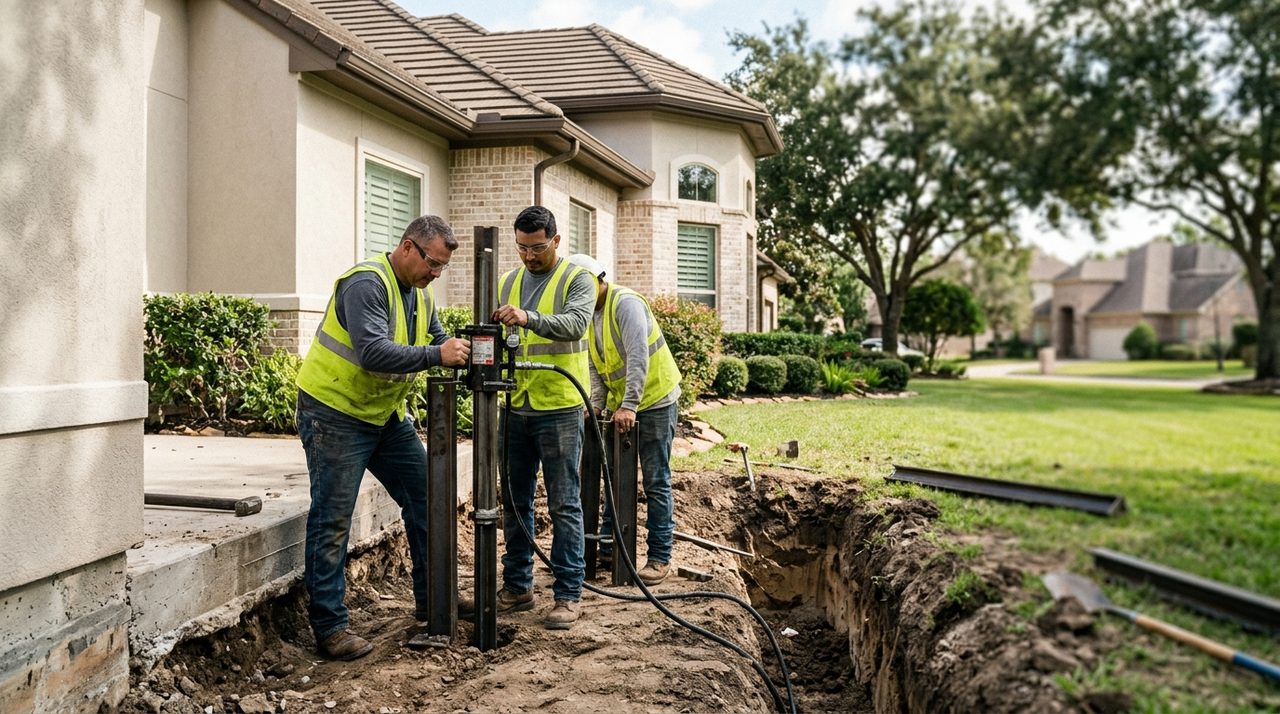
Richmond, TX sits squarely on Fort Bend County's expansive Houston Black clay formation, and the area's dominant housing stock — slab-on-grade tract homes built during the 2000s–2020s master-planned boom in subdivisions like Pecan Grove, Harvest Green, and Long Meadow Farms — is precisely the combination that generates predictable, repeating foundation movement. Before signing any repair contract, homeowners need to understand not just which piers go in the ground, but which permit office signs off on the work (City of Richmond or Fort Bend County Engineering) and whether their subdivision's HOA architectural committee must approve perimeter trenching first.
Ranked by verified Google rating × review volume × verification tier. How we rank →
Some highly-rated pros serve Richmond from nearby and may not keep a Richmond street address. Those are listed under "Also serving Richmond" with their real city and distance, so you always know where each business is based.
729 FM359 Suite B, Richmond, TX 77406
1305 FM359 suite e, Richmond, TX 77406
9103 Turnbull Ln, Rosenberg, TX 77469
716 E Hwy 90 Alt, Richmond, TX 77406
9619 Wildgrove Hollow Dr, Richmond, TX 77406
503 FM359 suite 130-109, Richmond, TX 77406
8102 Running Brook Ln, Richmond, TX 77469
1517 FM359 Suite 400, Richmond, TX 77406
Highly-rated pros based nearby who cover Richmond. Distance shown from the Richmond area.
Serving Richmond Based in Rosenberg · 2.2 mi away
Why it matters to you
The bulk of Richmond's housing stock — tract homes built from the late 1990s through the 2020s in master-planned communities stretching west toward the Brazos — sits on post-tension concrete slabs poured directly over Fort Bend County's expansive Houston Black clay. During the 2022–2023 La Niña drought cycle, these clays baked and pulled away from slab perimeters across the county, leaving foundation beams unsupported. Homeowners in subdivisions like Long Meadow Farms and Harvest Green began seeing stair-step brick cracks and doors that wouldn't latch — classic perimeter-void symptoms that recur every dry season the soaker-hose irrigation is neglected.
What a good pro does
A qualified contractor will probe the perimeter with a moisture meter and camera before recommending piers, because perimeter voids on a post-tension slab sometimes respond to controlled re-hydration and void-fill (polyurethane foam injection, estimated $2,000–$5,000) before steel piers become necessary. If underpinning is warranted, the work requires a permit — from the City of Richmond permit office for homes inside city limits, or from the Fort Bend County Engineering Department for the far larger swath of unincorporated subdivisions surrounding the historic core. Contractors unfamiliar with this split jurisdiction have left Richmond homeowners holding unpermitted repair work that surfaces on resale inspection.
Sources: Municipal permit office (see area profile), Local HOA / deed restrictions (see area profile)
Why it matters to you
Richmond's master-planned communities — Pecan Grove, Greatwood, Old Orchard, Del Webb Sweetgrass, and others — each operate independent HOAs with their own recorded deed restrictions and architectural review committees. Perimeter trenching for steel push piers, mudjacking ports, and polyurethane injection holes are all visible exterior modifications that most of these HOAs classify as requiring architectural committee pre-approval. Homeowners who let contractors start work without that approval have faced stop-work demands, forced restoration costs, and fines — on top of an already expensive foundation job.
What a good pro does
Before scheduling any foundation repair, pull your subdivision's CC&Rs (Texas HOA transparency law now requires associations with 60+ lots to post governing documents publicly) and submit a written architectural review request with the contractor's scope diagram and pier layout. Build at least two to four weeks of committee review time into your project schedule. The contractor should provide a stamped site plan showing pier locations and trench dimensions to satisfy the committee — and should already know that Fort Bend County or City of Richmond permit approval and HOA approval are separate, parallel processes.
Sources: Local HOA / deed restrictions (see area profile), Municipal permit office (see area profile)
Why it matters to you
Richmond's older master-planned phases — Pecan Grove (developed from the early 1980s) and Greatwood (1980s–1990s) — now have mature live oaks and pecan trees with root systems extending well beyond their canopies. On Fort Bend County's clay soil, these roots aggressively extract moisture on one side of a slab during dry months, causing localized shrinkage and a measurable tilt that shows up as interior drywall cracks running diagonally from door corners and as exterior brick gaps that open in summer and close partially in winter. Many of these lots also carry deed-restriction protections on heritage trees that limit aggressive root management options.
What a good pro does
A thorough foundation inspection on a Pecan Grove or Greatwood home should map tree canopies relative to the slab and take differential elevation readings (with a zip-level or optical level) at multiple points, not just at obvious crack locations. If tree-root moisture depletion is confirmed as the primary driver, the first intervention is a perimeter soaker-hose program maintained at consistent soil-moisture levels year-round — before any piers are quoted. If underpinning is ultimately needed, helical piers (estimated $1,500–$2,200 per pier) are sometimes preferred on these older lots because they can be torqued to load-bearing depth without the heavy hydraulic ram equipment that risks damaging surface roots near the perimeter.
Sources: Municipal permit office (see area profile), Local HOA / deed restrictions (see area profile)
Why it matters to you
Richmond's Pecan Grove and early Greatwood homes built in the 1980s and early 1990s typically used cast-iron under-slab drain lines. Winter Storm Uri (February 2021) caused widespread pipe failures across Fort Bend County, and many of those repairs addressed only the interior walls — leaving cracked or offset under-slab segments weeping slowly into the clay. That steady moisture input causes localized heave followed by settlement as soil structure degrades, mimicking drought-induced differential movement. A foundation company diagnosing settlement in a pre-1995 Richmond home without asking about Uri damage and under-slab plumbing condition is skipping a critical step.
What a good pro does
Before executing any repair contract on a Richmond home with cast-iron drain lines, insist on a hydrostatic plumbing test (estimated $250–$400) performed or overseen by a Texas State Board of Plumbing Examiners–licensed plumber. If the test reveals active leaks, those must be repaired by a licensed plumber first — and the repaired section allowed to dry and stabilize — before pier depths and pier counts are finalized. Skipping this sequence and installing piers into soil that is still being saturated by a leaking drain line is one of the most common reasons Richmond homeowners end up with a second foundation repair bill within five years.
Sources: Texas State Board of Plumbing Examiners, Municipal permit office (see area profile)
Hiring foundation repair in Richmond? Richmond encompasses a wide range of housing from historic city-center properties to modern master-planned communities, each with its own HOA and deed restrictions. Homeowners must identify their specific subdivision's governing documents before initiating exterior modifications. The mix of newer construction and rapid growth means contractors frequently handle warranty-era repairs, energy efficiency upgrades, and landscape compliance work.
Building era
Mixed: historic Richmond core dates to pre-1970s; dominant suburban stock built 1980s–2020s, with heaviest construction in the 2000s–2020s across master-planned communities.
Typical style
Traditional suburban brick, brick-and-stone Texas traditional, and contemporary transitional elevations in newer master-planned phases; one- and two-story production homes with front-loaded attached garages.
Foundations
Predominantly slab-on-grade (post-tension concrete) for suburban tract homes; some older historic Richmond homes may have pier-and-beam foundations.
Common systems
Central HVAC (heat pump and gas furnace split systems common), copper and PEX plumbing in newer homes (possible polybutylene in 1980s–early 1990s stock), 200-amp electrical panels standard in post-2000 construction.
What that means for repairs
Kitchen and bathroom remodels are common in 1990s–2000s homes reaching their second-owner cycle. Exterior modifications (fences, patios, driveways, generators) require HOA architectural review in most subdivisions. Older Pecan Grove and Greatwood-era homes often need HVAC replacements and roof upgrades.
Permit jurisdiction
City of Richmond permits office for properties within city limits; Fort Bend County Engineering Department for unincorporated Fort Bend County areas surrounding Richmond.
HOA & deed restrictions
No single mandatory HOA covers all of Richmond. Most master-planned communities (Harvest Green, Old Orchard, Pecan Grove, Greatwood, Long Meadow Farms, Del Webb Sweetgrass, etc.) have mandatory HOAs with recorded deed restrictions and architectural review committees. Some older or rural tracts have no HOA. HOA status is strictly subdivision-by-subdivision.
Historic districts
No City of Houston historic district designation confirmed. Richmond has its own historic downtown area, but formal historic district protections and review processes should be verified with the City of Richmond.
Contractor note
Contractors must determine whether a property is within Richmond city limits or unincorporated Fort Bend County, as permit jurisdiction and inspection requirements differ. Most subdivisions require HOA architectural approval before exterior work begins, and 2026 Texas HOA transparency laws require governing documents to be publicly posted for associations with 60+ lots.
FEMA flood zone
FEMA Zone X (low flood risk) per official NFHL data. Richmond is situated along the Brazos River, and some areas near the river and Rabbs Bayou carry higher flood risk than the Zone X designation of the sampled point; homeowners should verify their specific lot's flood zone.
Hurricane Harvey impact
Hurricane Harvey (2017) caused significant flooding in parts of Fort Bend County, particularly along the Brazos River corridor. The Barker Reservoir controlled releases and Brazos River flooding impacted numerous Richmond-area subdivisions. Specific impact varied greatly by subdivision and proximity to waterways — homeowners should check individual property flood history through Fort Bend County records.
Heat & humidity load
Extreme summer heat and humidity drive heavy HVAC demand across Richmond's slab-on-grade homes. Expansive clay soils common in Fort Bend County cause seasonal foundation movement, increasing demand for foundation inspection and repair services. Newer homes with large roof spans require periodic inspection for heat-related shingle degradation.
Working with contractors here
Contractors in Richmond work across a wide spectrum of housing ages, from 1980s master-planned homes needing full system replacements to brand-new construction warranty work. HVAC replacement and repair is the most consistent demand driver due to the extreme Fort Bend County summers and the aging of 2000s-era equipment. Foundation monitoring and repair are common given the expansive clay soils, particularly for homes built on slab-on-grade foundations. Exterior work — fencing, patio covers, roofing — almost always requires HOA architectural committee pre-approval, so contractors should build submission lead time into project schedules. The split jurisdiction between City of Richmond and unincorporated Fort Bend County means permit requirements and inspection timelines can differ significantly even between adjacent subdivisions.
Local Tip
Always ask for a written estimate before work begins. Texas contractors are required to provide one on jobs over $1,000.
Richmond encompasses a wide range of housing from historic city-center properties to modern master-planned communities, each with its own HOA and deed restrictions. Homeowners must identify their specific subdivision's governing documents before initiating exterior modifications. The mix of newer construction and rapid growth means contractors frequently handle warranty-era repairs, energy efficiency upgrades, and landscape compliance work.
Source: U.S. Census Bureau, ACS 5-Year 2023
Most of Richmond maps to FEMA Zone X (low mapped flood risk), but Houston's flash-flood reality means even low-risk blocks benefit from smart drainage and storm-hardened installs; risk climbs sharply on blocks nearest the Brazos River, where it varies parcel to parcel.
Source: FEMA National Flood Hazard Layer (NFHL). Flood zones vary by parcel — verify your individual FIRM panel.
Houston's flash-flood reality means even low-mapped-risk areas like Richmond, TX can see sheet flow accumulate against a foundation during a slow-moving Gulf system, so verify that your perimeter drainage is clear and properly sloped before hurricane season opens. A TDLR-licensed foundation contractor can add or reposition surface drains to intercept runoff before it softens the clay bearing layer beneath your slab. Confirm the current FEMA panel for your Richmond parcel — the area maps to Zone X, but adjacent lots can differ.
Hail itself does not crack a concrete foundation, but the insurance repair process — contractors dropping equipment, vibrating compactors near the structure — can disturb marginally stable piers in Richmond, TX. Coordinate a brief foundation check with a TDLR-licensed contractor before and after any major roof or exterior repair project that involves heavy equipment operating near your home. As a Fort Bend County community, Richmond may follow county rather than City of Houston storm rebuild rules.
Winter Storm Uri's multi-day freeze caused Houston clay soils to go through freeze-thaw cycling not common in the region, and even low-flood-risk neighborhoods in Richmond, TX saw new door-sticking and brick-step cracking appear in the spring following the storm. A post-winter Zip-Level survey establishes whether that movement is seasonal and self-correcting or progressive and in need of pier work before summer drying amplifies the differential. With a median build year of 1979, the older building stock here is more exposed to hard-freeze damage than newer construction. Confirm the current FEMA panel for your Richmond parcel — the area maps to Zone X, but adjacent lots can differ.
Sources: FEMA National Flood Hazard Layer (NFHL), Ready.gov -- Hurricanes, CenterPoint Energy -- Storm Center, City of Houston -- Emergency Preparedness, Ready.gov -- Winter Weather, Harris County Flood Control District
Houston-specific estimators to plan your project before you call a pro. All results are planning estimates — a licensed local pro confirms the details on site.
Grouped by mature root aggression & water demand.
Trunk center to the nearest exterior wall.
The root zone likely reaches your foundation's soil during Houston's dry summers, when clay shrinks most. Watch for sticking doors and diagonal cracks, keep soil moisture even with a soaker hose during drought, and have a foundation pro evaluate if you see any movement.
Find a Houston foundation pro →This is a planning estimate only — actual requirements depend on an on-site assessment by a licensed Houston pro. Guidance is based on general species root behavior in expansive clay, not a soil test.
Disconnect & drain every outdoor hose bib
Remove hoses, drain the spigots, and cover each with an insulated faucet sock. Un-drained hose bibs are the #1 burst point in a Houston freeze.
Insulate exposed pipes in the attic & garage
Wrap any pipe in an unconditioned space (attic runs, garage walls) with foam sleeves. Houston homes rarely insulate these because they only matter a few nights a year — which is exactly why they burst.
Open cabinet doors & keep a pencil-width drip
On hard-freeze nights, open kitchen/bath cabinets so warm air reaches the pipes and let faucets on exterior walls drip to relieve pressure.
Protect the attic/garage water heater & its lines
An attic or garage tank sits in unconditioned space. Insulate the cold-inlet and hot-outlet lines and confirm the emergency drain pan is clear so a leak doesn't reach the ceiling.
This is a planning estimate only — actual requirements depend on an on-site assessment by a licensed Houston pro. If a pipe has already burst, shut off your main water supply and call a licensed Houston plumber immediately — freeze bursts flood fast.
Sources: Municipal permit office (see area profile)
Sources: Local HOA / deed restrictions (see area profile)
Sources: Municipal permit office (see area profile)