1116 Old Radio Ln #207, Rosenberg, TX 77471
Best Foundation Repair in Rosenberg, TX
Rosenberg's Fort Bend County clay soils rank among the most expansive in the Houston metro, and the city's wide range of housing — from mid-century ranch homes near the historic railroad core to 1990s–2020s production-builder slabs in subdivisions like Oaks of Rosenberg and The Preserve at Rosenberg — means foundation stress shows up differently depending on where you live. With a census median year built of 1994 and a median home value around $218,600, most owners here are sitting on concrete slab-on-grade construction that is directly exposed to seasonal clay movement, drought-cycle perimeter voids, and the subdivision-specific HOA permit hurdles that can slow repair approvals. This page explains the specific foundation failure patterns Fort Bend homeowners encounter, what repair methods actually fit Rosenberg's soil and slab conditions, and how to navigate the City of Rosenberg Building and Permitting Department or Fort Bend County Engineering before any work begins.
Verified against Google Business data
Updated 2026
See the 10 Foundation Repair Serving Rosenberg 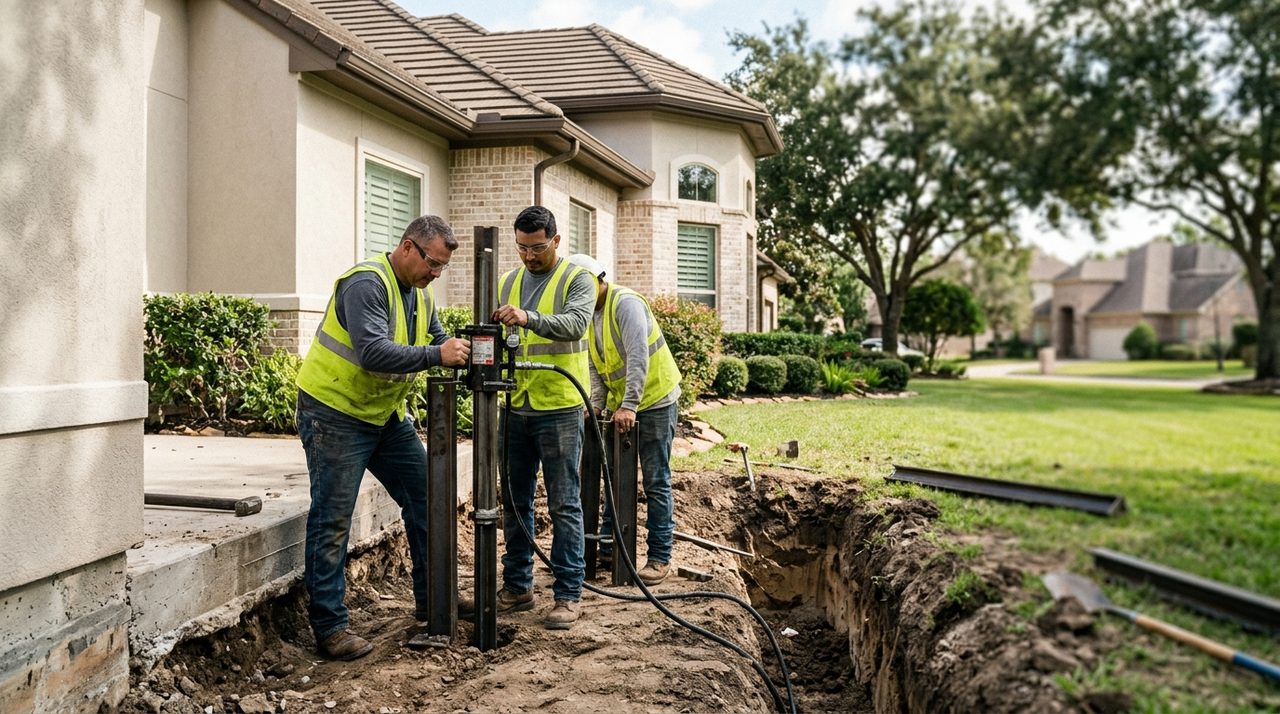
- Median home built
- 1994
- Median home value
- $218,600
- FEMA flood zone
- X (low)
- Typical repair cost (est.)
- $3,500–$25,000 depending on method and pier count
- Most common local issue
- Perimeter void formation from Fort Bend expansive clay drying between wet cycles
Ranked by verified Google rating × review volume × verification tier. How we rank →
Some highly-rated pros serve Rosenberg from nearby and may not keep a Rosenberg street address. Those are listed under "Also serving Rosenberg" with their real city and distance, so you always know where each business is based.
Min rating:
10 resultsBased in Rosenberg
Also serving Rosenberg
Highly-rated pros based nearby who cover Rosenberg. Distance shown from the Rosenberg area.
Closed
Serving Rosenberg Based in Richmond · 4.1 mi away
Open Now
Serving Rosenberg Based in Richmond · 4.6 mi away
Serving Rosenberg Based in Richmond · 5 mi away
Closed
Serving Rosenberg Based in Richmond · 5.1 mi away
Closed
Serving Rosenberg Based in Richmond · 5.4 mi away
Closed
Serving Rosenberg Based in Richmond · 5.5 mi away
Closed
Serving Rosenberg Based in Richmond · 5.6 mi away
Closed
Serving Rosenberg Based in Richmond · 7.7 mi away
Foundation Repair in Rosenberg: What You Should Know
Fort Bend Clay Swells and Shrinks Seasonally Under Your Production-Builder Slab
Why it matters to you
Rosenberg sits squarely on Fort Bend County's Houston Black expansive clay formation. In the 1990s–2020s production-builder subdivisions that make up the bulk of Rosenberg's housing stock — think Oaks of Rosenberg and The Preserve at Rosenberg — slabs were poured directly on this clay with post-tension cables designed to flex, but repeated wet-dry cycles still cause differential movement. You may notice brick veneer cracks above garage doors, interior doors that stick in summer and swing freely in winter, or diagonal drywall cracks at window corners — all classic signs that one section of your slab is moving more than another.
What a good pro does
A qualified inspector should probe the perimeter with a moisture meter and take elevation readings at multiple interior grid points before recommending any repair. For differential settlement of two inches or more, steel push piers driven to load-bearing soil — typically needed at 8 to 16 locations on an average Rosenberg home — are the most durable correction, estimated at $1,200–$1,800 per pier. Work within Rosenberg city limits requires a permit through the City of Rosenberg Building and Permitting Department before any underpinning begins; confirm your parcel's jurisdiction first because properties in unincorporated Fort Bend County permit through Fort Bend County Engineering instead.
Sources: Municipal permit office (see area profile), International Residential Code (as adopted by City of Houston)
Drought-Cycle Perimeter Voids Are Especially Severe on Rosenberg's Open, Lightly Shaded Lots
Why it matters to you
Newer master-planned subdivisions in Rosenberg were developed on formerly flat agricultural land with minimal mature tree canopy. That open exposure accelerates surface evaporation during La Niña drought years like 2022–2023, baking the clay along the slab edge and creating perimeter voids that leave the foundation beam unsupported on one or more sides. Without the shade buffer that mature trees provide, the soil dries faster and deeper than in older, more established Houston neighborhoods, and the typical subdivision spray-irrigation system often underdelivers water right at the foundation edge where it counts most.
What a good pro does
Before committing to piers, have your contractor probe for perimeter void depth using a steel rod — voids greater than one inch along more than 20 percent of the perimeter justify action. Mudjacking or polyurethane foam injection ($800–$5,000 estimated depending on section size) can restore soil contact without full pier underpinning if settlement is shallow and uniform. Equally important: establish a soaker-hose zone 12 to 18 inches from the foundation running on a timer during dry months; this single maintenance step can prevent the next drought cycle from restarting the damage.
Sources: Municipal permit office (see area profile)
Older Core-Area Homes With Cast-Iron Under-Slab Drains Face a Two-Problem Diagnosis
Why it matters to you
Mid-century homes near Rosenberg's historic railroad-era core — those built before roughly 1975 — are likely to have original cast-iron under-slab drain lines that were already aging when Winter Storm Uri hit in February 2021. Many of these homes had visible pipe repairs after Uri, but under-slab sections often cracked and were never replaced. A slow, ongoing leak from one of those lines saturates the clay directly beneath the slab, first causing localized heave and then, as the clay structure breaks down, settlement. Homeowners in this part of Rosenberg sometimes chase foundation symptoms for years without realizing a failed drain line is resetting the problem after every repair.
What a good pro does
Any foundation contractor quoting work on a pre-1980 Rosenberg home should recommend a hydrostatic plumbing pressure test ($250–$400 estimated) before the repair proposal is finalized — if the drain system won't hold pressure, pier installation alone will not stabilize the slab. A licensed plumber (licensed through TSBPE) must perform or directly oversee any under-slab drain repair or re-routing. Once plumbing integrity is confirmed, a foundation contractor can accurately scope the structural correction and pull the appropriate permit through the City of Rosenberg Building and Permitting Department.
Sources: Texas State Board of Plumbing Examiners, Municipal permit office (see area profile)
HOA Architectural Review in Rosenberg's Newer Subdivisions Adds a Required Step Before Any Exterior Foundation Work
Why it matters to you
If your Rosenberg home is governed by the Oaks of Rosenberg Community Association, The Preserve at Rosenberg Community Association, or a similar master-planned HOA, the CC&Rs recorded with Fort Bend County almost certainly require architectural review committee approval before any contractor trenches around your foundation perimeter, stages equipment in the yard, or modifies the finished exterior grade. Skipping this step — even when the City of Rosenberg building permit is already in hand — can result in stop-work notices from the HOA and complicate resale disclosure, since Texas TREC forms require sellers to disclose known foundation movement and repairs.
What a good pro does
Before signing a foundation repair contract, pull your deed from Fort Bend County property records and confirm HOA status; if an association governs your subdivision, submit the contractor's scope of work and site plan to the architectural review committee in writing and get approval documented before work starts. Request that your contractor provide full permit documentation from the City of Rosenberg Building and Permitting Department (or Fort Bend County Engineering for unincorporated parcels) and keep copies with the HOA approval letter — this file becomes a required disclosure attachment if you sell within the next several years.
Sources: Local HOA / deed restrictions (see area profile), Municipal permit office (see area profile), FEMA National Flood Hazard Layer (NFHL)
Foundation Repair in Rosenberg: What You Should Know
Hiring foundation repair in Rosenberg? Rosenberg spans a historic railroad-era core surrounded by modern master-planned subdivisions, creating a wide range of home service needs from aging mid-century systems to newer production-builder homes. Homeowners must verify HOA status, deed restrictions, and flood exposure on a subdivision-by-subdivision basis, as conditions vary significantly across the city. Fort Bend County's expansive clay soils and flat terrain make foundation maintenance and drainage management recurring concerns for all eras of housing.
- Housing era
- Mixed
- Foundation
- Predominantly concrete slab-on-grade in post-1970s construction (inferred from regional practice)
- Flood zone
- FEMA Zone X (low flood risk) — source
- Permits
- City of Rosenberg Building & Permitting Department for properties within city limits
Housing stock & systems
Building era
Mixed: mid-20th century homes near the original city core; 1990s–2020s production homes in surrounding master-planned subdivisions such as Oaks of Rosenberg and The Preserve at Rosenberg.
Typical style
Contemporary production-builder suburban (brick/stone veneer, 1- and 2-story, attached garages) in newer subdivisions; modest ranch and traditional styles in older core areas.
Foundations
Predominantly concrete slab-on-grade in post-1970s construction (inferred from regional practice); older pre-1960s homes near the city core may include pier-and-beam — confirm via Fort Bend CAD or inspection.
Common systems
Newer subdivisions: central HVAC (14+ SEER), copper/PEX plumbing, 200-amp electrical panels. Older core homes: original HVAC units potentially past service life, galvanized or copper plumbing, 100–150 amp panels potentially needing upgrades.
What that means for repairs
Older core-area homes frequently require electrical panel upgrades, re-plumbing from galvanized to PEX/copper, and HVAC replacement. Newer subdivision homes see cosmetic remodeling, patio additions, and fence replacements subject to HOA architectural review.
Permits & restrictions
Permit jurisdiction
City of Rosenberg Building & Permitting Department for properties within city limits; Fort Bend County Engineering for unincorporated areas.
HOA & deed restrictions
Subdivision-specific. Newer master-planned communities such as Oaks of Rosenberg Community Association and The Preserve at Rosenberg Community Association have mandatory HOA/POA membership with recorded CC&Rs. Older inner-Rosenberg neighborhoods may have no HOA or only informal deed-restriction committees. Verify HOA status via deed, Fort Bend County property records, or the City of Rosenberg HOA contact list.
Historic districts
No historic district designation confirmed. Rosenberg's historic downtown area has heritage significance but no formal historic preservation overlay was identified in the research.
Contractor note
Contractors must determine whether a property falls within Rosenberg city limits or unincorporated Fort Bend County, as permit requirements and inspections differ. In HOA-governed subdivisions, architectural review committee approval is typically required before exterior work begins.
Flood & weather
FEMA flood zone
FEMA Zone X (low flood risk) — source: fema_nfhl. Rosenberg is situated near the Brazos River, and localized flooding can occur along tributaries and drainage channels even in Zone X areas. Property-level flood risk should be verified via Fort Bend County Drainage District data.
Hurricane Harvey impact
Fort Bend County experienced severe regional flooding during Hurricane Harvey (2017), but specific street-level or subdivision-level flood data for Rosenberg neighborhoods was not confirmed in available research. Some areas near the Brazos River and low-lying drainage corridors likely experienced impacts, but which platted subdivisions flooded versus stayed dry cannot be stated definitively without FEMA loss data or City of Rosenberg floodplain reports.
Heat & humidity load
Extreme summer heat and humidity drive heavy HVAC demand across all housing eras. Slab-on-grade foundations on Fort Bend County's expansive clay soils are vulnerable to seasonal moisture cycling — prolonged summer drought followed by heavy rain events causes soil shrinkage and swelling that can lead to foundation movement. Proper drainage and foundation watering programs are commonly recommended.
Working with contractors here
Contractors in Rosenberg most commonly handle HVAC servicing and replacement, foundation repair due to expansive clay soils, and re-plumbing of older galvanized systems in the city's mid-century core. In newer master-planned subdivisions, work tends toward warranty-related repairs, fence and patio installations, and exterior modifications that require HOA architectural committee approval before proceeding. Roof replacements following hail and storm events are a steady demand driver across all eras. Contractors should verify permit jurisdiction (city vs. county) and HOA requirements early in the scoping process, as failing to obtain proper approvals can result in project delays and fines.
Local Tip
Always ask for a written estimate before work begins. Texas contractors are required to provide one on jobs over $1,000.
About Rosenberg
Rosenberg spans a historic railroad-era core surrounded by modern master-planned subdivisions, creating a wide range of home service needs from aging mid-century systems to newer production-builder homes. Homeowners must verify HOA status, deed restrictions, and flood exposure on a subdivision-by-subdivision basis, as conditions vary significantly across the city. Fort Bend County's expansive clay soils and flat terrain make foundation maintenance and drainage management recurring concerns for all eras of housing.
- Median year built
- 1994
- Median home value
- $218,600
- Owner-occupied
- 51.3%
- Population
- 39,467
- Housing units
- 15,741
- Median income
- $64,897
Source: U.S. Census Bureau, ACS 5-Year 2023
Flood & storm risk
FEMA Zone XLow flood riskMost of Rosenberg maps to FEMA Zone X (low mapped flood risk), but Houston's flash-flood reality means even low-risk blocks benefit from smart drainage and storm-hardened installs; risk climbs sharply on blocks nearest the Brazos River, where it varies parcel to parcel.
Source: FEMA National Flood Hazard Layer (NFHL). Flood zones vary by parcel — verify your individual FIRM panel.
Houston Storm Readiness in Rosenberg
Hurricane & flooding
Wind-driven rain during a hurricane can saturate soil on the windward side of your home while the leeward side stays dry, creating differential moisture conditions beneath your slab that show up as sticking doors weeks later in Rosenberg, TX. Schedule a Zip-Level elevation reading after any named storm passes so a foundation professional can distinguish normal seasonal movement from storm-induced settlement requiring pier work. As a Fort Bend County community, Rosenberg may follow county rather than City of Houston storm rebuild rules.
Severe storms & hail
Hail itself does not crack a concrete foundation, but the insurance repair process — contractors dropping equipment, vibrating compactors near the structure — can disturb marginally stable piers in Rosenberg, TX. Coordinate a brief foundation check with a TDLR-licensed contractor before and after any major roof or exterior repair project that involves heavy equipment operating near your home. Confirm the current FEMA panel for your Rosenberg parcel — the area maps to Zone X, but adjacent lots can differ.
Ice storms & freezes
In Rosenberg, TX, where mapped flood risk is low, the primary post-freeze foundation threat is not surface water but slab-leak-driven soil saturation — Uri 2021 caused widespread pipe failures that fed water silently under slabs for days before homeowners noticed. After any hard freeze, have a plumber pressure-test your lines first, then schedule a foundation elevation check if any under-slab leak is confirmed. Confirm the current FEMA panel for your Rosenberg parcel — the area maps to Zone X, but adjacent lots can differ.
Sources: FEMA National Flood Hazard Layer (NFHL), Ready.gov -- Hurricanes, CenterPoint Energy -- Storm Center, City of Houston -- Emergency Preparedness, Ready.gov -- Winter Weather, Harris County Flood Control District
Free Rosenberg Tools & Calculators
Houston-specific estimators to plan your project before you call a pro. All results are planning estimates — a licensed local pro confirms the details on site.
Houston Soil & Tree Proximity Risk Calculator
Open full tool & FAQ →Grouped by mature root aggression & water demand.
Trunk center to the nearest exterior wall.
Moderate risk
The root zone likely reaches your foundation's soil during Houston's dry summers, when clay shrinks most. Watch for sticking doors and diagonal cracks, keep soil moisture even with a soaker hose during drought, and have a foundation pro evaluate if you see any movement.
Find a Houston foundation pro →This is a planning estimate only — actual requirements depend on an on-site assessment by a licensed Houston pro. Guidance is based on general species root behavior in expansive clay, not a soil test.
Houston Freeze Prep & Pipe Insulation Checklist
Open full tool & FAQ →Your freeze checklist — 4 tasks
- 1
Disconnect & drain every outdoor hose bib
Remove hoses, drain the spigots, and cover each with an insulated faucet sock. Un-drained hose bibs are the #1 burst point in a Houston freeze.
- 2
Insulate exposed pipes in the attic & garage
Wrap any pipe in an unconditioned space (attic runs, garage walls) with foam sleeves. Houston homes rarely insulate these because they only matter a few nights a year — which is exactly why they burst.
- 3
Open cabinet doors & keep a pencil-width drip
On hard-freeze nights, open kitchen/bath cabinets so warm air reaches the pipes and let faucets on exterior walls drip to relieve pressure.
- 4
Protect the attic/garage water heater & its lines
An attic or garage tank sits in unconditioned space. Insulate the cold-inlet and hot-outlet lines and confirm the emergency drain pan is clear so a leak doesn't reach the ceiling.
This is a planning estimate only — actual requirements depend on an on-site assessment by a licensed Houston pro. If a pipe has already burst, shut off your main water supply and call a licensed Houston plumber immediately — freeze bursts flood fast.
Frequently Asked Questions
Do I need a permit from the City of Rosenberg to have my slab underpinned with steel push piers?
Yes — if your home is within Rosenberg city limits, foundation underpinning work requires a permit through the City of Rosenberg Building & Permitting Department before work begins; if your property falls in unincorporated Fort Bend County, the permit goes through Fort Bend County Engineering instead. Your contractor must confirm which jurisdiction applies early in the process, since the two offices have different inspection protocols and fees. Ask your contractor to show you the issued permit number before any excavation starts — not just a receipt confirming they 'applied.'
Sources: Municipal permit office (see area profile)
My home is a 1990s production-builder slab in Oaks of Rosenberg — is pressed-concrete piling repair still a common fix, or should I expect a different proposal?
Pressed concrete pilings were the dominant Houston-area repair method through the late 1990s and are still offered by some contractors, but many engineers now favor steel push piers for production slabs on Fort Bend clay because push piers can be driven to a verified load-bearing stratum rather than stopping at a set depth. For a typical 1,800–2,400 sq ft slab, a pressed-piling job runs roughly $3,500–$9,000 (estimate), while a steel push-pier job typically runs $10,000–$25,000 depending on pier count — so ask any contractor to specify the method, pier count, and target depth in writing so you can compare proposals on equal terms.
Rosenberg is mostly FEMA Zone X — does low flood risk mean my foundation is less likely to settle after a heavy rain event?
Zone X status means mapped floodplain risk is low, but Fort Bend County's expansive clay soil still absorbs large rain events unevenly, and blocks nearest the Brazos River can see parcel-level risk that the broad Zone X designation doesn't capture. After slow-moving storms like Harvey (2017) or Beryl (2024), even Zone X slabs can experience post-event settlement weeks after water recedes, because prolonged saturation weakens the clay's bearing capacity. If your yard held standing water for more than 48 hours after a major storm, it's worth having a foundation contractor evaluate for settlement rather than assuming Zone X means no risk.
My older core-area Rosenberg home had pipe repairs after Winter Storm Uri — should I get a plumbing test before signing a foundation repair contract?
Absolutely: a hydrostatic plumbing test, which typically costs $250–$400 (estimate), pressurizes your under-slab drain lines and confirms whether slow leaks are saturating the clay beneath your slab and mimicking or compounding settlement. Mid-century homes near Rosenberg's historic railroad core are especially prone to this because original cast-iron under-slab lines are brittle and were frequently cracked — not always fully replaced — during Uri repairs. Any reputable foundation contractor working on a pre-1990 Rosenberg home should recommend this test before attributing movement to soil alone; if they don't mention it, ask them why.
If I live in The Preserve at Rosenberg or another HOA-governed subdivision, do I need HOA approval before a foundation contractor can dig around my perimeter?
In most master-planned Rosenberg subdivisions — including those governed by mandatory community associations with recorded CC&Rs — the architectural review committee (ARC) must approve exterior work that involves visible trenching, pier installation, or equipment staged in the front yard before work begins. Skipping ARC approval can result in fines or a stop-work order from the HOA, independent of any city permit. Confirm your subdivision's specific process by contacting the HOA directly or reviewing the recorded CC&Rs through Fort Bend County property records before your repair is scheduled.
Sources: Local HOA / deed restrictions (see area profile)
What's the best time of year to schedule a foundation inspection or repair in Rosenberg, and how long does a typical job take?
Late fall through early spring — roughly October through March — is generally the most informative time for a foundation inspection in Rosenberg because the clay is transitioning between wet and dry states, making active movement easier to observe and document. Repairs can be completed year-round, but scheduling during the mild season (October–April) avoids the risk of afternoon thunderstorms delaying outdoor pier-installation work. A typical steel push-pier job on a single-family slab runs 1–3 days of active work once permits are in hand, though scheduling inspections and waiting on City of Rosenberg or Fort Bend County permit approval can add 1–3 weeks to the overall timeline — factor that in if you're approaching a home sale deadline.
Sources: Municipal permit office (see area profile)