Closed
20510 FM 1488, Magnolia, TX 77355
Magnolia's Montgomery County clay soils rank among the most expansive in the Houston metro, and the area's wide split between 1970s–1990s ranch homes on acreage and 2010s–2020s master-planned slabs in NorthGrove or Magnolia Reserve means foundation risk profiles vary dramatically from one street to the next. Whether your home is a decades-old brick ranch on an unrestricted rural tract or a newer traditional build governed by a subdivision HOA, understanding how local soil behavior, permit jurisdiction, and pier-selection decisions interact will save you from costly missteps.
Ranked by verified Google rating × review volume × verification tier. How we rank →
Some highly-rated pros serve Magnolia from nearby and may not keep a Magnolia street address. Those are listed under "Also serving Magnolia" with their real city and distance, so you always know where each business is based.
20510 FM 1488, Magnolia, TX 77355
34635 Wright Rd #1023, Pinehurst, TX 77362
19550 Indigo Lake Dr, Magnolia, TX 77355
Highly-rated pros based nearby who cover Magnolia. Distance shown from the Magnolia area.
Serving Magnolia Based in The Woodlands · 3 mi away
Serving Magnolia Based in The Woodlands · 3.4 mi away
Why it matters to you
The expansive Beaumont and Houston Black clay formations that underlie Montgomery County swell and shrink with every wet-dry cycle, and the 1970s–1990s ranch-style homes on acreage tracts in the original Magnolia town area were often built with minimal post-tension reinforcement by today's standards. Homeowners in these older homes frequently see repeating seasonal cracks in brick veneer, sticking interior doors, and uneven tile floors — symptoms that worsen after each La Niña drought year, like 2022–2023, and then shift again when rains return.
What a good pro does
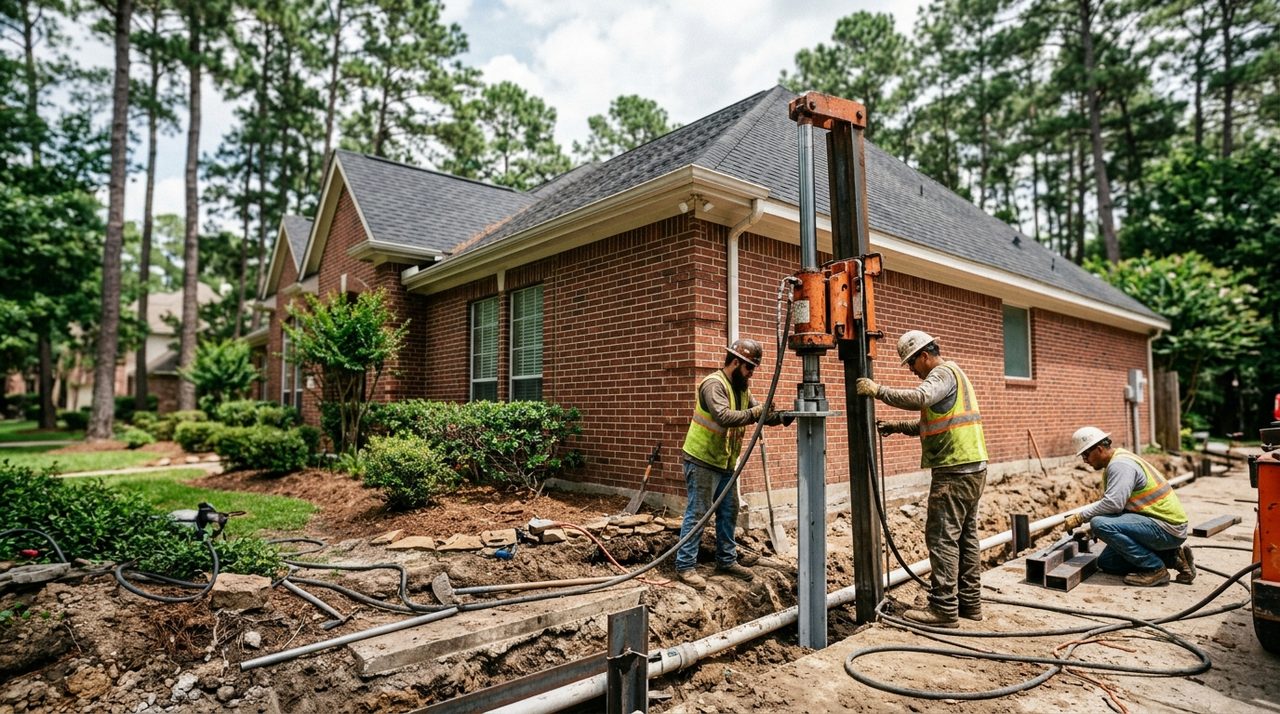
A qualified contractor should document crack patterns across at least two seasons and conduct a site-level moisture assessment before recommending pier placement. For older ranch slabs in the 8,000–20,000 sq ft acreage lot range, steel push piers (estimated $1,200–$1,800 per pier installed, with 8–16 piers typical) are generally more reliable than the legacy pressed concrete pilings common from the 1980s–1990s, which have a known failure rate on active clay. Insist on written depth specifications showing piers are driven to a stable load-bearing stratum, not just to refusal in the shallow clay layer.
Sources: Municipal permit office (see area profile), International Residential Code (as adopted by City of Houston)
Why it matters to you
Many of Magnolia's older ranch homes and early-2000s slab builds used cast-iron under-slab drain lines that became vulnerable during Winter Storm Uri in February 2021. In Montgomery County, a significant number of homes had interior pipe repairs completed cosmetically without addressing cracked under-slab sections. A slow ongoing drain leak directly beneath a slab saturates the clay and can cause localized heave followed by settlement — a pattern that looks identical to soil-driven movement but won't be fixed by piers alone.
What a good pro does
Before signing any foundation repair contract on a Magnolia home built before 2000, invest in a hydrostatic plumbing test (estimated $250–$400) performed by a plumber licensed through the Texas State Board of Plumbing Examiners. If the test reveals under-slab failures, a TSBPE-licensed plumber must perform or oversee the pipe repair scope — foundation contractors cannot legally redirect or repair drain lines. Resolving a plumbing leak first often reduces the apparent settlement and can meaningfully change the pier count and total project cost.
Sources: Texas State Board of Plumbing Examiners, Municipal permit office (see area profile)
Why it matters to you
Magnolia's newer master-planned communities — NorthGrove, Magnolia Reserve, Magnolia Ridge, and others — each carry their own mandatory HOA with architectural review committees that typically require pre-approval before any exterior work begins, including foundation perimeter trenching and pier installation staging areas. Homeowners who allow a contractor to break ground before HOA approval risk stop-work notices that can leave an open trench along the slab edge for weeks, which is itself a moisture-management hazard on active clay.
What a good pro does
Obtain your HOA's ARC application package before soliciting contractor bids, and ask each bidder to provide a site plan and equipment staging diagram you can submit with the application. Most Magnolia subdivision HOAs turn around routine structural approvals in two to four weeks; factor this into your project timeline. Separately, confirm with your contractor whether the work requires a permit through the City of Magnolia (for in-limits parcels) or Montgomery County Engineering (for unincorporated and ETJ lots), since these are different offices with different inspection protocols.
Sources: Local HOA / deed restrictions (see area profile), Municipal permit office (see area profile)
Why it matters to you
Magnolia contractors regularly present homeowners with proposals that differ by thousands of dollars and entirely different pier systems — pressed concrete pilings, steel push piers, or helical piers — without always explaining why one method fits the site. In the newer 2010s–2020s master-planned subdivisions, where slabs are larger and often post-tensioned, pier selection mistakes can void builder warranties or conflict with the original structural design. On older acreage ranch homes, the concern shifts to whether a pressed-piling contractor is recommending a cheaper but lower-capacity system that may require re-repair within a decade.
What a good pro does
Request that each bidder specify pier type, pier count, installation depth, and the load-bearing stratum they are targeting — not just a lump-sum price. Helical piers (estimated $1,500–$2,200 each) are appropriate when push piers cannot reach load-bearing soil due to shallow refusal in loose fill; they are more common on acreage lots with variable soil profiles. For newer slab homes in NorthGrove or Magnolia Reserve, ask whether the contractor has reviewed the original structural engineer's documents before drilling, since post-tensioned slabs require specific pier placement to avoid cable damage. Montgomery County Engineering or the City of Magnolia permit office will require an inspection of underpinning work — confirm your contractor pulls the permit before work starts, not after.
Sources: Municipal permit office (see area profile), International Residential Code (as adopted by City of Houston), Texas Department of Licensing & Regulation
Hiring foundation repair in Magnolia? Magnolia spans a wide range of housing types, from newer master-planned communities like NorthGrove and Magnolia Reserve to older ranch homes and custom builds on rural acreage. Homeowners here face a split landscape: HOA-governed subdivisions with strict approval processes alongside unrestricted parcels where homeowners have broad latitude. Contractors must be comfortable working with both Montgomery County permitting and varied subdivision-specific deed restrictions.
Building era
Mixed — older stock from the 1970s–1990s in the original town area, significant 2000s infill, and heavy new construction concentration in the 2010s–2020s in master-planned communities.
Typical style
Texas traditional with brick and stone veneers in newer subdivisions; Craftsman-influenced and modern farmhouse elements in recent builds; ranch-style brick or siding homes on older acreage tracts.
Foundations
Predominantly slab-on-grade in post-1980 subdivisions; pier-and-beam may be found in older or custom acreage homes.
Common systems
Newer homes feature high-efficiency HVAC systems, PEX plumbing, and modern electrical panels; older 1970s–1990s stock may have original HVAC units, copper or CPVC plumbing, and smaller electrical panels that may need upgrades.
What that means for repairs
Older ranch-style homes on acreage are common renovation targets for kitchen and bathroom modernization, HVAC replacement, and electrical panel upgrades. Newer master-planned homes see less renovation but frequent cosmetic upgrades and outdoor living additions.
Permit jurisdiction
City of Magnolia for properties within city limits; Montgomery County Engineering for unincorporated areas and ETJ parcels.
HOA & deed restrictions
No single area-wide HOA. Platted subdivisions each have their own mandatory HOA (e.g., Magnolia Reserve HOA, Magnolia Ridge HOA, NorthGrove HOA). Many acreage parcels and older subdivisions have no HOA. Deed restrictions may still apply on non-HOA lots — check Montgomery County Clerk records for specific parcels.
Historic districts
No historic district designation confirmed. Magnolia is not within the City of Houston and has no known HAHC-designated districts.
Contractor note
Contractors must verify whether a property falls within Magnolia city limits or unincorporated Montgomery County, as permitting requirements and inspections differ. HOA-governed subdivisions often require architectural review committee approval before exterior work begins.
FEMA flood zone
FEMA Zone X (low flood risk) per official NFHL data. Much of the Magnolia area sits at higher elevations in upstream Montgomery County, away from major bayou floodplains.
Hurricane Harvey impact
No documented widespread structural flooding in the Magnolia area during Hurricane Harvey. None of the major Magnolia HOA or community sources reference Harvey-related rebuilding or large-scale flood damage. Central Montgomery County generally fared better than downstream Harris County bayou corridors, though localized drainage issues on individual properties cannot be ruled out — check specific property history for any claims.
Heat & humidity load
Extended Houston-area summers with high heat and humidity stress HVAC systems year-round. Newer homes with high-efficiency units handle the load well, but older 1970s–1990s stock may need HVAC replacement or duct sealing. Slab foundations on expansive clay soils can shift during summer drought cycles, making foundation monitoring and proper drainage critical.
Working with contractors here
Magnolia's diverse housing stock creates demand for a wide range of services. In newer master-planned communities, contractors frequently handle warranty-related repairs, outdoor living additions (patios, pools, outdoor kitchens), and fence installations that must meet HOA specifications. Older ranch-style homes on acreage generate steady demand for HVAC replacement, roof replacement, electrical panel upgrades, and kitchen/bath remodels. Foundation work is common across all eras due to the expansive clay soils in Montgomery County. Contractors working in HOA subdivisions should budget time for architectural review committee approvals and plan for potentially longer driveways and access considerations on rural acreage properties.
Local Tip
Always ask for a written estimate before work begins. Texas contractors are required to provide one on jobs over $1,000.
Magnolia spans a wide range of housing types, from newer master-planned communities like NorthGrove and Magnolia Reserve to older ranch homes and custom builds on rural acreage. Homeowners here face a split landscape: HOA-governed subdivisions with strict approval processes alongside unrestricted parcels where homeowners have broad latitude. Contractors must be comfortable working with both Montgomery County permitting and varied subdivision-specific deed restrictions.
Source: U.S. Census Bureau, ACS 5-Year 2023
Most of Magnolia maps to FEMA Zone X (low mapped flood risk), but Houston's flash-flood reality means even low-risk blocks benefit from smart drainage and storm-hardened installs.
Source: FEMA National Flood Hazard Layer (NFHL). Flood zones vary by parcel — verify your individual FIRM panel.
Beryl 2024 reminded Houston homeowners that even neighborhoods with low FEMA flood designations experience localized ponding when storm-sewer inlets back up, and that standing water against a foundation for even 12 hours can trigger clay heave in Magnolia, TX. Before the season, confirm your gutters discharge at least five feet from the foundation and that splash blocks direct water toward the street, keeping clay moisture content consistent beneath the slab. As a Montgomery County community, Magnolia may follow county rather than City of Houston storm rebuild rules.
Hail itself does not crack a concrete foundation, but the insurance repair process — contractors dropping equipment, vibrating compactors near the structure — can disturb marginally stable piers in Magnolia, TX. Coordinate a brief foundation check with a TDLR-licensed contractor before and after any major roof or exterior repair project that involves heavy equipment operating near your home. Confirm the current FEMA panel for your Magnolia parcel — the area maps to Zone X, but adjacent lots can differ.
Ice loading from roof accumulation during a hard freeze transfers compressive stress to your foundation corners, and in Magnolia, TX that added load on clay subgrade that has stiffened from cold can create corner settlement that persists after the thaw. A TDLR-licensed foundation contractor should inspect visible brick-to-foundation transitions and interior door frames after any multi-day freeze event, even if no pipe damage occurred. Confirm the current FEMA panel for your Magnolia parcel — the area maps to Zone X, but adjacent lots can differ.
Sources: FEMA National Flood Hazard Layer (NFHL), Ready.gov -- Hurricanes, CenterPoint Energy -- Storm Center, City of Houston -- Emergency Preparedness, Ready.gov -- Winter Weather, Harris County Flood Control District
Houston-specific estimators to plan your project before you call a pro. All results are planning estimates — a licensed local pro confirms the details on site.
Grouped by mature root aggression & water demand.
Trunk center to the nearest exterior wall.
The root zone likely reaches your foundation's soil during Houston's dry summers, when clay shrinks most. Watch for sticking doors and diagonal cracks, keep soil moisture even with a soaker hose during drought, and have a foundation pro evaluate if you see any movement.
Find a Houston foundation pro →This is a planning estimate only — actual requirements depend on an on-site assessment by a licensed Houston pro. Guidance is based on general species root behavior in expansive clay, not a soil test.
Disconnect & drain every outdoor hose bib
Remove hoses, drain the spigots, and cover each with an insulated faucet sock. Un-drained hose bibs are the #1 burst point in a Houston freeze.
Insulate exposed pipes in the attic & garage
Wrap any pipe in an unconditioned space (attic runs, garage walls) with foam sleeves. Houston homes rarely insulate these because they only matter a few nights a year — which is exactly why they burst.
Open cabinet doors & keep a pencil-width drip
On hard-freeze nights, open kitchen/bath cabinets so warm air reaches the pipes and let faucets on exterior walls drip to relieve pressure.
Protect the attic/garage water heater & its lines
An attic or garage tank sits in unconditioned space. Insulate the cold-inlet and hot-outlet lines and confirm the emergency drain pan is clear so a leak doesn't reach the ceiling.
This is a planning estimate only — actual requirements depend on an on-site assessment by a licensed Houston pro. If a pipe has already burst, shut off your main water supply and call a licensed Houston plumber immediately — freeze bursts flood fast.
Sources: Municipal permit office (see area profile)
Sources: Municipal permit office (see area profile)