13003 Murphy Rd Ste: M5, Stafford, TX 77477
Best Carpet Cleaning in Stafford, TX
Stafford's predominantly 1970s–1990s slab-on-grade homes sit on Fort Bend County's expansive Beaumont clay, a combination that makes carpet care more complicated than a basic steam-clean: moisture vapor wicks up through aging concrete slabs, and iron-rich clay tracked in from undeveloped lots bonds stubbornly to synthetic fibers. With a 43-percent owner-occupancy rate and dozens of individual subdivisions — each with its own HOA rules — Stafford homeowners also face lease-turnover and deed-restriction pressures that make getting the cleaning documented correctly just as important as getting the carpet actually clean.
Verified against Google Business data
Updated 2026
See the 10 Carpet Cleaning Serving Stafford 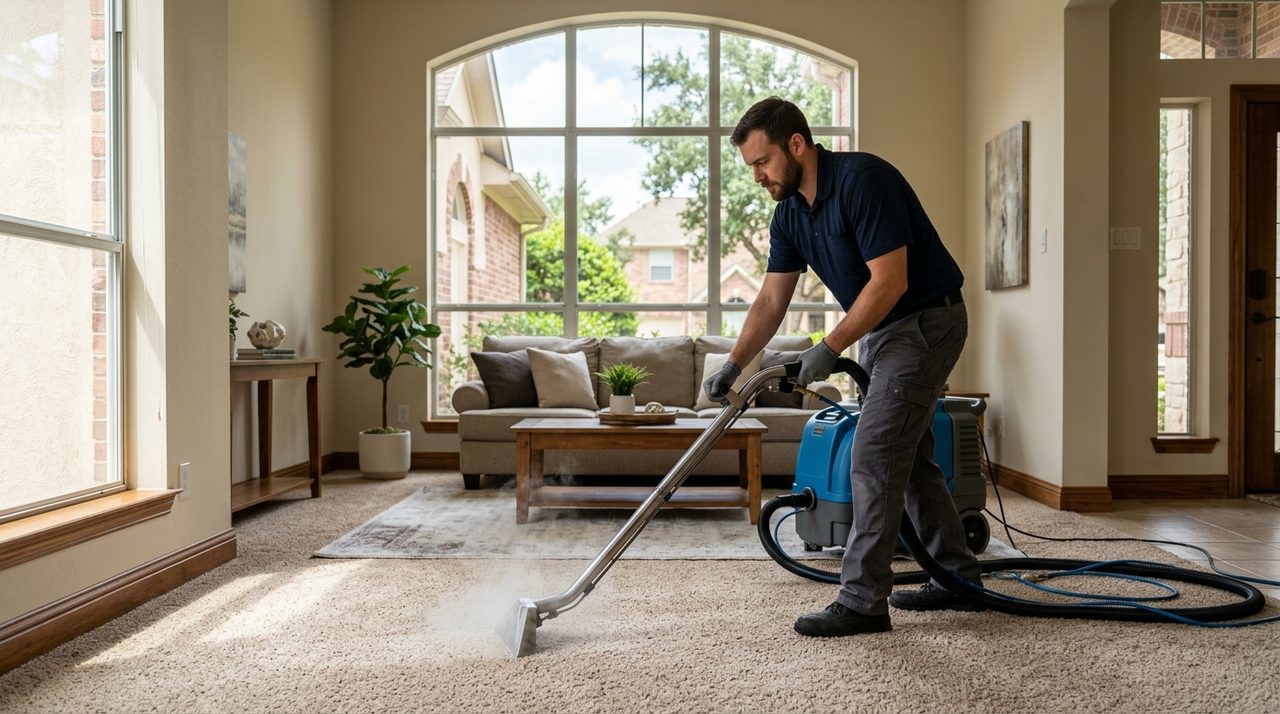
- Median home built
- 1992
- Median home value
- $247,900
- FEMA flood zone
- X (low)
- Typical cost (est.)
- $120–$550
- Most common local issue
- Clay soil tracking + slab moisture wicking in pre-1995 homes
Ranked by verified Google rating × review volume × verification tier. How we rank →
Some highly-rated pros serve Stafford from nearby and may not keep a Stafford street address. Those are listed under "Also serving Stafford" with their real city and distance, so you always know where each business is based.
Min rating:
10 resultsBased in Stafford
12842 Fountaingate Dr, Stafford, TX 77477
Open Now
12300 Southwest Fwy, Stafford, TX 77477
5744 Hwy 6, Missouri City, TX 77459
Also serving Stafford
Highly-rated pros based nearby who cover Stafford. Distance shown from the Stafford area.
Serving Stafford Based in Missouri City · 2.4 mi away
Open Now
Serving Stafford Based in Missouri City · 2.4 mi away
Closed
Serving Stafford Based in Missouri City · 2.9 mi away
Open Now
Serving Stafford Based in Sugar Land · 3 mi away
Serving Stafford Based in Westbury · 3.2 mi away
Closed
Serving Stafford Based in Sugar Land · 3.5 mi away
Carpet Cleaning in Stafford: What You Should Know
Beaumont Clay Tracking Stains Set Deep in Stafford's Older Carpet
Why it matters to you
Stafford sits squarely on the Fort Bend County Beaumont clay series — the same iron-rich, reddish-brown to dark gray clay (Munsell 5YR–10YR range) that characterizes much of SW Houston. Homes built in the 1970s–1990s bulk of Stafford's housing stock often sit adjacent to lots that were graded or re-graded during the construction booms of those decades, leaving exposed clay that is easily tracked inside. Once clay particles are ground past the fiber tips by foot traffic and repeated wet-dry cycles from Houston's storm pattern, a single hot-water extraction pass will not fully lift them.
What a good pro does
A qualified technician should apply a high-alkalinity pre-spray and mechanically agitate the carpet pile before extraction — not rely solely on the wand pass. Ask specifically whether the company uses a rotary agitation tool or a brush rake on heavily trafficked areas; this step separates a thorough clean from a surface rinse. No City of Stafford permit is required for carpet cleaning, so there is no regulatory backstop — vetting the process is entirely up to you as the homeowner.
Slab Moisture Vapor Re-Saturates Pad in Pre-1995 Stafford Homes
Why it matters to you
Because virtually every Stafford home is slab-on-grade construction, concrete moisture vapor transmission (MVT) is a year-round issue — and it is worse in the 1970s–1980s homes that dominate several of the city's original subdivisions, where vapor barriers were thinner or absent by modern standards. After hot-water extraction, the pad can dry from the top while staying damp from below, allowing soil to wick back to fiber tips within 24–48 hours and creating musty odors that homeowners mistake for poor cleaning when the real cause is MVT. Fort Bend County's high-clay geology means the slab is in constant seasonal heave-and-contract cycles that can also crack or separate existing vapor barriers over time.
What a good pro does
Before cleaning, ask the technician to check pad moisture with a probe moisture meter — not just a surface scanner — especially in rooms on the southwest-facing or ground-level slab areas of older homes. Adequate drying requires running your central AC (not just fans) during and after the job to pull humidity below 60 percent RH; in a Stafford summer where outdoor RH regularly exceeds 80 percent, opening windows defeats the purpose. If pad moisture readings are consistently elevated across multiple rooms, pad replacement rather than cleaning alone should be on the table.
Sources: IICRC (water/mold restoration standards), Texas Commission on Environmental Quality
Pet Urine Odors Resurface After Cleaning Due to Houston Hard Water
Why it matters to you
Stafford is served by municipal water blended by the Fort Bend County Municipal Utility Districts and the city itself, with hardness levels that fall in the moderately hard range typical of the Houston metro — roughly 130–180 mg/L as CaCO₃. When hot-water extraction machines use this mineral-laden water without an acidic rinse step, alkaline residue is left behind that reactivates uric acid salt crystals embedded in carpet backing and pad. Stafford's census-median home vintage of 1992 means a significant share of carpet in owner-occupied homes is 10-plus years old, giving pet urine salts years to migrate deep into the backing.
What a good pro does
Effective treatment requires enzyme pretreatment injected sub-surface to the pad level, not just sprayed on the face fiber, followed by an acidic rinse rather than a plain hot-water pass. Budget for the specialty add-on: pet-urine sub-surface treatment typically runs $50–$120 per room above the base cleaning rate in the Houston market. Texas does not require a state occupational license for carpet cleaning, so ask for IICRC Carpet Cleaning Technician certification as the independent benchmark that the company is trained in proper enzyme chemistry and rinse protocols.
HOA Move-Out Documentation Requirements Vary Widely Across Stafford's Subdivisions
Why it matters to you
Stafford has no city-wide HOA, but many of its individual subdivisions — including communities like Grove West — operate mandatory POAs or HOAs with deed restrictions that can include specific carpet-cleaning requirements tied to lease-end or property-sale timelines. With a 57-percent renter or non-owner-occupied share of Stafford housing stock (per ACS 2023 data), lease-turnover demand for documented professional cleaning is high, and some subdivision HOAs or individual lease agreements require IICRC-certified documentation within 24–72 hours of move-out. Homeowners who rely on a non-certified cleaner may find themselves out of compliance or without acceptable paperwork for a deposit dispute.
What a good pro does
Before scheduling, pull your subdivision's deed restrictions from Fort Bend County Clerk records to confirm whether a certification standard is specified — do not assume one subdivision's rules match a neighboring Stafford community's. Request an IICRC-formatted job receipt that identifies the technician's certification number, the method used (hot-water extraction is typically what lease clauses specify), and the square footage treated. Because Stafford is an independent city with its own permit jurisdiction separate from Fort Bend County and the City of Houston, any code-related questions about rental property standards go to the City of Stafford directly, not to county offices.
Sources: IICRC (water/mold restoration standards), Local HOA / deed restrictions (see area profile)
Carpet Cleaning in Stafford: What You Should Know
Hiring carpet cleaning in Stafford? Stafford is an incorporated city in Fort Bend County composed of many individual subdivisions, each with its own HOA rules, deed restrictions, and housing characteristics. The housing stock spans from 1970s ranch homes to 2010s production builds, predominantly slab-on-grade construction on expansive clay soils. Homeowners should verify their specific subdivision's HOA requirements and flood status before scoping any exterior or structural project.
- Housing era
- 1970s–1990s (bulk of existing stock), with newer infill and subdivisions from the 2000s–2010s
- Foundation
- Slab-on-grade (overwhelmingly standard for the era and region
- Flood zone
- FEMA Zone X (low flood risk) per official NFHL data
- Permits
- City of Stafford Permits Department (Stafford is an incorporated city with its own permitting…
Housing stock & systems
Building era
1970s–1990s (bulk of existing stock), with newer infill and subdivisions from the 2000s–2010s.
Typical style
One- and two-story brick veneer ranch homes, traditional and neo-eclectic production builder homes, with some townhomes and garden homes in newer phases.
Foundations
Slab-on-grade (overwhelmingly standard for the era and region; pier-and-beam limited to rare older or custom structures).
Common systems
Central AC with gas furnace; copper or CPVC supply plumbing in older homes transitioning to PEX in newer builds; 1970s–1980s homes may have original galvanized drain lines; electrical panels range from 100-amp in older homes to 200-amp in newer construction.
What that means for repairs
Kitchen and bathroom remodels are common in the 1970s–1990s stock as homeowners update finishes and fixtures. Foundation repair due to expansive clay soil movement is a recurring need. HVAC system replacements are frequent in pre-2000 homes reaching end of equipment life.
Permits & restrictions
Permit jurisdiction
City of Stafford Permits Department (Stafford is an incorporated city with its own permitting authority).
HOA & deed restrictions
No city-wide HOA exists. Many individual subdivisions have mandatory HOAs/POAs (e.g., Grove West Community Association, Inc.) that enforce deed restrictions and architectural standards. Some properties may have no HOA or minimal deed restrictions. Must be confirmed per property via deed records and Fort Bend County Clerk.
Historic districts
No historic district designation confirmed for any area within Stafford.
Contractor note
Contractors must pull permits through the City of Stafford, not Harris County or the City of Houston. Subdivision-level HOA architectural review committees may require pre-approval for exterior modifications, so contractors should confirm HOA requirements before beginning work.
Flood & weather
FEMA flood zone
FEMA Zone X (low flood risk) per official NFHL data. While the broader Fort Bend County area includes Brazos River floodplain zones, the Stafford city center area generally falls outside high-risk flood designations. Property-level verification via FEMA FIRM panels and Fort Bend County floodplain GIS is recommended.
Hurricane Harvey impact
Stafford was not identified as one of the hardest-hit cities during Hurricane Harvey (2017). While Fort Bend County experienced substantial flooding along the Brazos River, the worst-documented impacts were south and southwest of Stafford in Missouri City, Sugar Land, and Richmond/Rosenberg. Specific Stafford streets or subdivisions with repetitive flood losses could not be confirmed from available public records. Buyers and contractors should still check NFIP claims history and seller flood disclosures for individual properties.
Heat & humidity load
Extended Houston-area heat and humidity stress HVAC systems in the aging 1970s–1990s housing stock, making seasonal tune-ups and refrigerant checks essential. Slab foundations on expansive clay soils are vulnerable to differential movement during summer drought cycles, requiring homeowners to maintain consistent watering around foundations. Attic temperatures in single-story ranch homes can exceed 150°F, accelerating roof underlayment and radiant barrier degradation.
Working with contractors here
Foundation monitoring and repair is among the most common contractor engagements in Stafford due to the expansive clay soils and the age of the 1970s–1990s slab-on-grade housing stock. HVAC replacement is a high-demand service as original equipment in older homes reaches 20–30 years of age. Whole-home repiping is increasingly needed in pre-1990s homes with galvanized drain lines or deteriorating copper supply lines. Contractors should note that Stafford is an independent city with its own permitting process, inspection schedules, and code enforcement — not governed by the City of Houston or Fort Bend County for permitting purposes. Job scoping for exterior work must account for subdivision-level HOA architectural standards, which vary significantly across the city.
Local Tip
Always ask for a written estimate before work begins. Texas contractors are required to provide one on jobs over $1,000.
About Stafford
Stafford is an incorporated city in Fort Bend County composed of many individual subdivisions, each with its own HOA rules, deed restrictions, and housing characteristics. The housing stock spans from 1970s ranch homes to 2010s production builds, predominantly slab-on-grade construction on expansive clay soils. Homeowners should verify their specific subdivision's HOA requirements and flood status before scoping any exterior or structural project.
- Median year built
- 1992
- Median home value
- $247,900
- Owner-occupied
- 43%
- Population
- 17,279
- Housing units
- 6,988
- Median income
- $85,910
Source: U.S. Census Bureau, ACS 5-Year 2023
Flood & storm risk
FEMA Zone XLow flood riskMost of Stafford maps to FEMA Zone X (low mapped flood risk), but Houston's flash-flood reality means even low-risk blocks benefit from smart drainage and storm-hardened installs.
Source: FEMA National Flood Hazard Layer (NFHL). Flood zones vary by parcel — verify your individual FIRM panel.
Frequently Asked Questions
Do I need a permit from the City of Stafford to have my carpets professionally cleaned?
No permit is required from the City of Stafford Permits Department for standard carpet cleaning work — the trade is not a licensed or permitted activity in Texas for routine cleaning. However, if a technician identifies water damage that escalates into mold remediation, that work can trigger TDLR licensing requirements under Texas Occupations Code Chapter 1958, which is a separate matter from the cleaning itself. Always confirm the scope of work upfront so you know whether any remediation side of the job requires additional credentials.
My Stafford home was built in the early 1980s and still has the original carpet — should I be worried about anything a standard cleaning won't catch?
Homes in Stafford's 1970s–1990s housing stock often have older slab vapor barriers that allow concrete moisture vapor to saturate the pad from below, and that moisture is invisible to a technician who doesn't probe the pad with a moisture meter before and after cleaning. Ask any company you hire whether they check sub-pad moisture levels; if the pad is already wet from slab vapor transmission, hot-water extraction will extend drying time dramatically and increase the risk of musty odor returning within days. Carpet and pad of that age may also have accumulated years of clay particle abrasion into the backing, which a single extraction pass may not fully address.
My Stafford subdivision's HOA lease addendum says I need a 'professional cleaning receipt' — will any invoice work, or is there a specific format required?
Requirements vary across Stafford's individual subdivisions, and what one HOA like Grove West Community Association accepts may differ from what another requires, so read your specific lease or deed restriction language carefully before booking. Some HOAs or landlords specify IICRC-certified technicians and require an itemized receipt listing the cleaning method, square footage, and date; a generic handwritten receipt from an uncertified cleaner may not satisfy the clause and could put your deposit at risk. Ask the company before they arrive whether they can provide a dated, itemized invoice on company letterhead that documents the cleaning method used.
Sources: Local HOA / deed restrictions (see area profile)
Stafford is in FEMA Zone X, so does that mean I don't have to worry about flood-related carpet contamination after a heavy storm?
Zone X indicates low mapped flood risk on FEMA's official panels, but Houston's flash-flood pattern means even Zone X blocks in Stafford can take on water during extreme rainfall events like those seen across Fort Bend County in recent storm seasons. If any standing water entered your home — even an inch from a backed-up drain or garage breach — IICRC S500 protocols classify the contamination category based on the water source, not your flood zone designation, and Category 2 or 3 water contact generally requires pad replacement rather than cleaning alone. Don't assume Zone X status means a cleaning is always sufficient after storm intrusion; have the technician assess the water source and use a probe meter to determine whether the pad is salvageable.
Sources: IICRC (water/mold restoration standards)FEMA National Flood Hazard Layer (NFHL)
What's the best time of year to schedule a whole-house carpet cleaning in Stafford, and how long should I plan for drying?
Fall and winter months — roughly October through February — give Stafford homes the most favorable drying conditions because outdoor humidity drops from the 85–90% RH common in summer to more manageable levels, and running the central AC or heat actively circulates drier air through the home. A typical 1,500–2,000 square foot slab home in Stafford should plan for 6–12 hours of drying time in cooler weather with fans and HVAC running, but that estimate can stretch to 18–24 hours in summer if the home is not well-ventilated. If you must clean in summer, ask the company whether they bring air movers, since passive drying in a closed Stafford home in July is often insufficient to prevent wicking and odor return.
After Winter Storm Uri, I had water extracted but never replaced the pad in one bedroom — could that still be causing odor issues years later?
Yes — pad that was wetted during Uri's pipe bursts and extracted without replacement can harbor calcium scale from the water, drywall dust that settled during repairs, and residual microbial contamination that reactivates during Stafford's humid summers, releasing musty odors years after the event. IICRC standards recommend pad replacement any time carpet backing or pad reaches saturation from a clean-water pipe burst, and many homeowners who only had emergency extraction in 2021 skipped that step due to contractor backlogs. A moisture probe of the pad and a UV light inspection for residual contamination before booking a cleaning will tell you whether surface cleaning is enough or whether pad replacement is the right first step.