1918 Gray Slate Dr, Missouri City, TX 77489
Best Carpet Cleaning in Missouri City, TX
Missouri City's carpet cleaning picture is shaped by two forces most homeowners don't think about: Fort Bend County's expansive Beaumont-series clay soils pushing moisture vapor up through slab-on-grade foundations into carpet pad year-round, and a patchwork of 24-plus subdivision HOAs whose deed restrictions can require certified professional cleaning documentation on a tight move-out timeline. Understanding these local realities — plus how the city's mixed 1960s-through-2010s housing stock affects carpet condition — will help you avoid wasted money and failed HOA inspections.
Verified against Google Business data
Updated 2026
See the 10 Carpet Cleaning Serving Missouri City 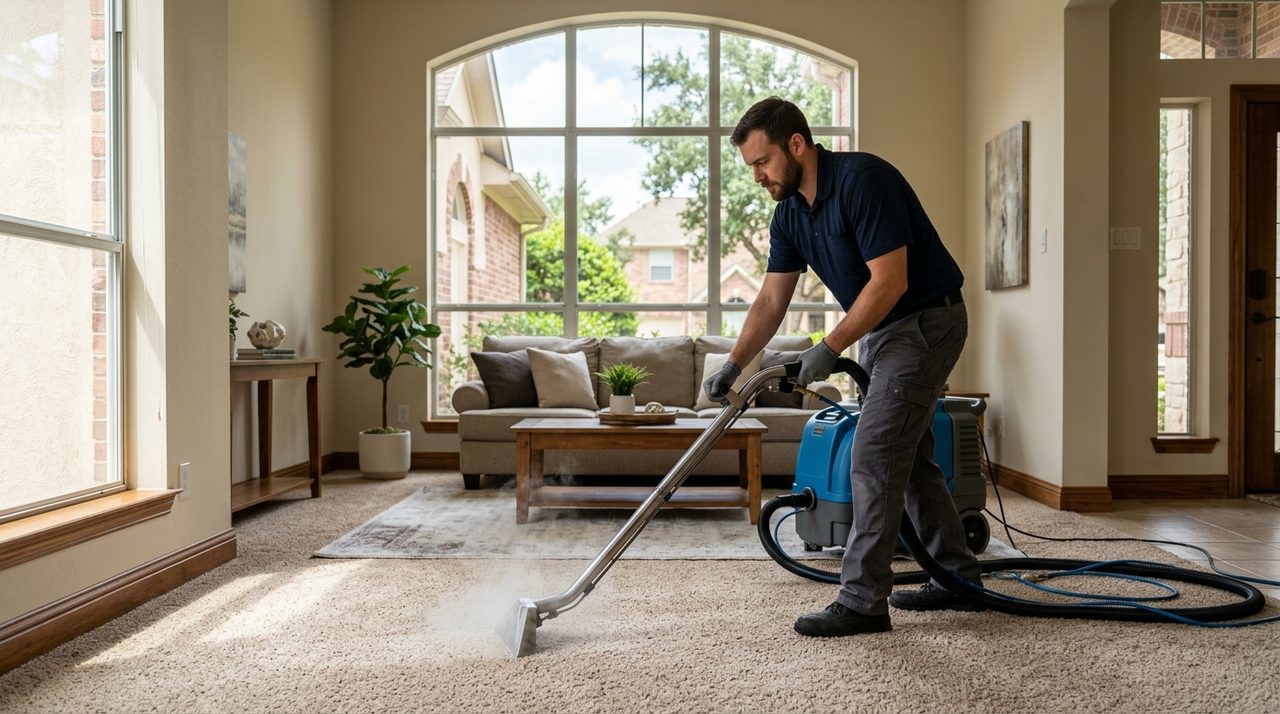
- Median home built
- 1993
- Median home value
- $281,600
- FEMA flood zone
- X (low)
- Typical cost (est.)
- $120–$550
- Most common local issue
- Katy Prairie red-clay tracking stains from Fort Bend County clay soils
Ranked by verified Google rating × review volume × verification tier. How we rank →
Some highly-rated pros serve Missouri City from nearby and may not keep a Missouri City street address. Those are listed under "Also serving Missouri City" with their real city and distance, so you always know where each business is based.
Min rating:
10 resultsBased in Missouri City
Closed
2118 Redcoat Dr, Missouri City, TX 77489
Open Now
2203 Texas Pkwy, Missouri City, TX 77489
Also serving Missouri City
Highly-rated pros based nearby who cover Missouri City. Distance shown from the Missouri City area.
Serving Missouri City Based in Stafford · 1.9 mi away
Serving Missouri City Based in Stafford · 2 mi away
Serving Missouri City Based in Westbury · 2.1 mi away
Open Now
Serving Missouri City Based in Stafford · 3 mi away
Closed
Serving Missouri City Based in Sharpstown · 3.6 mi away
Serving Missouri City Based in Stafford · 3.9 mi away
Serving Missouri City Based in Alief · 4 mi away
Carpet Cleaning in Missouri City: What You Should Know
Fort Bend Clay Soil Tracks Reddish-Brown Stains Deep Into Carpet Fibers
Why it matters to you
Missouri City sits squarely on the iron-rich Beaumont clay series — the same expansive soil that makes foundation repair one of the city's busiest trades. That reddish-brown to dark-gray clay (Munsell 5YR–10YR range) sticks to shoes, accumulates near entry points and garages, and grinds into synthetic carpet fibers during Houston's wet-dry storm cycles. In older core neighborhoods built in the 1960s–1980s — many with original or once-replaced carpet — these stains have often worked their way below the fiber tips into the backing itself, where a single standard extraction pass won't reach them.
What a good pro does
A qualified technician should apply a high-alkalinity pre-spray, mechanically agitate it into the pile with a counter-rotating brush rather than relying on extraction alone, then follow with a hot-water extraction rinse. Estimates for this level of treatment typically run $0.25–$0.40 per square foot — budget $200–$350 for a mid-size Missouri City home with heavy entry-zone traffic. Texas does not require a state occupational license for carpet cleaning, so ask specifically for an IICRC Carpet Cleaning Technician (CCT) credential as your baseline quality check.
Slab Moisture Vapor Re-Wets Pad From Below — Invisible Until It Smells
Why it matters to you
Every Missouri City home is slab-on-grade on Fort Bend County clay, and concrete moisture vapor transmission (MVT) is a persistent reality in this soil type. In the older core neighborhoods — houses built before 1990 with thinner or degraded vapor barriers — MVT can exceed 3 lbs per 1,000 sq ft per 24 hours, slowly saturating the carpet pad from below. A technician who only looks at the surface after hot-water extraction will declare the job done while the pad stays wet, setting the stage for musty odors and mold growth within 24–48 hours in Missouri City's summer humidity, which regularly averages 75–90% RH.
What a good pro does
Insist that the technician probe pad moisture with a penetrating meter before and after cleaning, not just skim the face fiber. If the pad reads wet from below rather than from the cleaning process, the underlying MVT issue needs to be flagged — no amount of surface cleaning resolves vapor-driven wetness. Drying time in older Missouri City homes often needs supplemental air movers and dehumidifiers left on-site for 6–12 hours; this is standard IICRC practice and should be included or quoted separately, not skipped to cut costs.
Pet Urine Odors Come Back Stronger After Cleaning in Older Missouri City Homes
Why it matters to you
Tract-built production homes from the 1980s and 1990s — which make up a large share of Missouri City's older core — frequently still carry original or once-replaced carpet now 10-plus years old. Pet urine salt crystals that have soaked into thick pad layers get reactivated by the heat and alkaline residue from standard hot-water extraction using Houston's moderately hard tap water (typically 130–180 mg/L as CaCO₃ depending on LSGCD blending). The result: an ammonia smell that gets worse two days after cleaning, not better, and frustrates homeowners who paid for a full service.
What a good pro does
Effective pet-urine treatment requires enzyme pretreatment applied to the face fiber AND sub-surface pad flushing, not just a deodorizer additive sprayed during extraction. Budget an additional $50–$120 per affected room above the base cleaning rate. An acidic rinse step at the end neutralizes alkaline residue from Houston's hard water and prevents reactivation of remaining salt crystals. Ask your technician to identify affected zones with a UV light before quoting — any company that skips this diagnostic step is guessing at scope.
HOA Move-Out Deadlines Demand IICRC-Certified Documentation, Not Just a Receipt
Why it matters to you
Missouri City has no city-wide HOA, but at least 24 separate subdivision-level associations — including recorded CCR communities like The Manors Owners Association and Quail Green HOA — operate independently across the city, with deed restrictions recorded in Fort Bend County Clerk records. Many of these communities include lease-end or sale-transfer clauses requiring professional carpet cleaning certification within 24–72 hours of move-out, and some specify IICRC-certified technicians specifically. A receipt from an uncertified operation can fail HOA review, delaying your closing or deposit return.
What a good pro does
Before scheduling, confirm which subdivision HOA governs your address and pull the specific CCR language from Fort Bend County Clerk records — requirements vary between Missouri City's 24-plus associations, and 'professional cleaning' means different things in different CCRs. Request a written certification on company letterhead naming the IICRC credential held by the technician who performed the work, the date, and the square footage cleaned. Same-day or next-day availability for HOA-deadline jobs typically commands a 10–20% scheduling premium over standard pricing; build that into your move-out budget rather than scrambling at the last minute.
Sources: Local HOA / deed restrictions (see area profile), IICRC (water/mold restoration standards)
Carpet Cleaning in Missouri City: What You Should Know
Hiring carpet cleaning in Missouri City? Missouri City spans decades of development, from 1960s-era core neighborhoods to 2010s master-planned communities, creating a wide range of home service needs. Contractors must navigate subdivision-specific deed restrictions and HOA rules that vary significantly across the city. The municipal permitting process is independent from Houston, and Fort Bend County drainage infrastructure differs from Harris County systems.
- Housing era
- Mixed
- Foundation
- Predominantly slab-on-grade, consistent with post-1960s Fort Bend County suburban construction standards
- Flood zone
- FEMA Zone X (low flood risk) per official NFHL data
- Permits
- City of Missouri City Building & Standards Department for properties within city limits
Housing stock & systems
Building era
Mixed: 1960s–1980s in older core areas; 1990s–2010s in newer master-planned sections.
Typical style
One- and two-story brick veneer traditional suburban, with some stucco and siding accents in newer sections; production-builder plans predominate.
Foundations
Predominantly slab-on-grade, consistent with post-1960s Fort Bend County suburban construction standards.
Common systems
Older areas (1960s–1980s): original copper or galvanized plumbing, R-22 HVAC systems nearing or past end of life, older electrical panels (potentially Federal Pacific or Zinsco in 1970s homes). Newer areas (1990s–2010s): PEX or CPVC plumbing, R-410A HVAC, 200-amp electrical service.
What that means for repairs
Older core neighborhoods see significant HVAC replacements, re-plumbing from galvanized to PEX, and kitchen/bath remodels. Newer master-planned homes are beginning first-cycle roof replacements and cosmetic updates. Foundation repair is common in older slab-on-grade homes due to Fort Bend County expansive clay soils.
Permits & restrictions
Permit jurisdiction
City of Missouri City Building & Standards Department for properties within city limits. Some ETJ areas may fall under Fort Bend County engineering.
HOA & deed restrictions
No city-wide mandatory HOA. At least 24 separate HOA/POA/community associations operate at the subdivision level. Many subdivisions (e.g., The Manors Owners Association, Quail Green HOA) have mandatory membership with recorded CCRs. Some older areas may have only recorded deed restrictions with no active HOA. Check Fort Bend County Clerk records for specific lot restrictions.
Historic districts
No historic district designation confirmed. Missouri City is an incorporated city in Fort Bend County, not subject to Houston's HAHC jurisdiction.
Contractor note
Missouri City has its own permitting process separate from Houston and Fort Bend County. Contractors must verify whether the property is inside city limits or in the ETJ, as permit requirements and inspection processes differ. Individual HOA architectural review committees may impose additional approval requirements beyond city permits.
Flood & weather
FEMA flood zone
FEMA Zone X (low flood risk) per official NFHL data. However, Missouri City is large and individual subdivisions may have different flood zone designations, particularly near Oyster Creek and its tributaries. Property-specific FIRMettes should be checked for parcels near waterways.
Hurricane Harvey impact
No specific Harvey 2017 flood impact data was confirmed for Missouri City neighborhoods in the available research. Fort Bend County experienced significant flooding during Harvey, particularly along the Brazos River corridor, but subdivision-level impact in Missouri City varies. Homeowners should check Fort Bend County Drainage District records and individual property disclosure histories for Harvey-specific flood data.
Heat & humidity load
Fort Bend County's expansive clay soils undergo significant seasonal movement, making foundation monitoring critical during prolonged summer drought. Older HVAC systems in 1960s–1980s homes face extreme strain during Houston summers, and R-22 refrigerant phase-out makes replacement more cost-effective than repair. Newer homes with builder-grade HVAC may still underperform in extreme heat if ductwork was poorly sealed during construction.
Working with contractors here
Missouri City's mixed housing stock creates two distinct contractor markets: older core neighborhoods needing whole-system replacements (HVAC, plumbing re-pipes, electrical panel upgrades, and foundation repair) and newer master-planned communities entering their first major maintenance cycle with roof replacements, water heater swaps, and cosmetic remodels. Foundation work is a consistently high-demand service due to expansive clay soils across Fort Bend County, affecting both old and new construction. Contractors should be prepared for subdivision-specific HOA architectural review requirements that may dictate exterior material choices, fence styles, and even work hours. Job scoping should always include a check with the specific HOA management company, as restrictions vary widely between Missouri City's 24+ organized associations.
Local Tip
Always ask for a written estimate before work begins. Texas contractors are required to provide one on jobs over $1,000.
About Missouri City
Missouri City spans decades of development, from 1960s-era core neighborhoods to 2010s master-planned communities, creating a wide range of home service needs. Contractors must navigate subdivision-specific deed restrictions and HOA rules that vary significantly across the city. The municipal permitting process is independent from Houston, and Fort Bend County drainage infrastructure differs from Harris County systems.
- Median year built
- 1993
- Median home value
- $281,600
- Owner-occupied
- 81.4%
- Population
- 75,234
- Housing units
- 27,906
- Median income
- $96,746
Source: U.S. Census Bureau, ACS 5-Year 2023
Flood & storm risk
FEMA Zone XLow flood riskMost of Missouri City maps to FEMA Zone X (low mapped flood risk), but Houston's flash-flood reality means even low-risk blocks benefit from smart drainage and storm-hardened installs.
Source: FEMA National Flood Hazard Layer (NFHL). Flood zones vary by parcel — verify your individual FIRM panel.
Frequently Asked Questions
Does Missouri City require a permit for professional carpet cleaning, or do I need to notify my HOA first?
The City of Missouri City Building & Standards Department does not require a permit for carpet cleaning alone — no trade permit applies to this service anywhere in the Houston metro. What matters more in Missouri City is your subdivision HOA: at least 24 separate associations operate here, and some require advance notice or access scheduling for service vehicles, especially in newer master-planned sections. Check your specific CCRs on file with the Fort Bend County Clerk before booking, because work-hour restrictions or vendor parking rules vary widely between neighborhoods.
Sources: Local HOA / deed restrictions (see area profile)
My Missouri City home was built in the 1970s and still has the original carpet padding. Does the age of the home affect how carpet cleaning goes?
Yes, significantly. Older core Missouri City homes from the 1960s–1980s often sit on slabs with thinner or degraded vapor barriers, meaning Fort Bend County's expansive Beaumont-series clay soils have had decades to push moisture vapor upward into pad and backing. A technician should probe the pad with a moisture meter before hot-water extraction — if sub-slab moisture is already elevated, aggressive steam cleaning can supersaturate the pad and lead to mold or odor within 24–48 hours in Houston's high-humidity climate. In many cases, replacement of the original pad is the better call on homes of this era.
Missouri City is mapped mostly in FEMA Zone X, so should I still worry about flood-related contamination in my carpet after a heavy rain event?
FEMA Zone X means low mapped flood risk, but it does not mean zero flash-flood risk — Fort Bend County's drainage infrastructure handles intense Gulf-moisture rain events differently than Harris County's, and even Zone X streets in Missouri City can see localized sheet flooding during a fast-moving storm. If water from outside entered your home, the IICRC S500 standard classifies water source and contact time to determine whether cleaning is safe or whether pad replacement is required; Category 2 or 3 intrusion (any outdoor or sewage-contact water) typically requires removal, not cleaning, regardless of flood zone designation.
Sources: FEMA National Flood Hazard Layer (NFHL)IICRC (water/mold restoration standards)
What's a realistic timeline and cost estimate for a whole-house carpet cleaning in a newer Missouri City master-planned home, say around 2,000 square feet?
For a newer 1990s–2010s production-builder home in Missouri City with roughly 2,000 square feet of carpet, expect an estimated $300–$500 for standard hot-water extraction, and budget an additional $100–$200 if enzyme pretreatment, deodorizer, or protectant are included. Drying time in Missouri City's humidity is typically 6–12 hours with fans running and AC set to 72°F or cooler — plan to keep foot traffic off carpet for at least half a day. Homes with slab-moisture issues or heavy Fort Bend clay-soil tracking may require a second extraction pass, which some companies charge separately.
Is there a best season to schedule carpet cleaning in Missouri City, or does Houston's heat and humidity make any time of year equally difficult for drying?
October through February is the most favorable window in Missouri City — relative humidity drops closer to 55–65% compared to the 75–90% RH common in summer months, which meaningfully shortens drying time and reduces the risk of wicking and mold growth. Summer scheduling is workable but requires the home's AC to run continuously during and after cleaning; ask the technician whether they use air movers and whether they'll check moisture readings before leaving. Avoid scheduling during Houston's peak tropical storm season (August–September) when you may need windows closed and humidity spikes with approaching storm systems.
My Missouri City subdivision HOA requires a 'professional carpet cleaning receipt' at move-out — will a standard credit card receipt satisfy that, or do I need something specific?
A plain cash or credit receipt almost never satisfies the documentation language in Missouri City subdivision CCRs, which typically use wording like 'professional cleaning by a certified firm.' Ask the company to provide an itemized invoice on company letterhead that includes the technician's IICRC certification number, the cleaning method used (hot-water extraction is the accepted standard), and the date of service. Some of Missouri City's stricter HOAs — including several in The Manors and comparable communities — require the document to be submitted to the HOA management company within 24–72 hours of move-out, so confirm the timeline with your specific association before booking.
Sources: Local HOA / deed restrictions (see area profile)IICRC (water/mold restoration standards)