9001 Spring Branch Dr, Houston, TX 77080
Best Carpet Cleaning in Spring Branch
Spring Branch's 1950s–1960s brick ranch homes sit on concrete slabs over Houston's expansive Beaumont clay series — a combination that creates year-round moisture vapor transmission through the slab into carpet pad long before any visible stain appears. With roughly half the area's housing owner-occupied (52.3%, ACS 2023) and many originals still carrying decades-old carpet installed over thin or degraded vapor barriers, Spring Branch homeowners face carpet-cleaning challenges that are less about storm flooding (FEMA Zone X) and more about what's quietly happening beneath the fiber tips every humid Houston summer. This page explains the three issues that actually drive carpet problems in Spring Branch's vintage ranch stock and what to ask any technician before they park their truck in your driveway.
Verified against Google Business data
Updated 2026
See the 10 Carpet Cleaning Serving Spring Branch 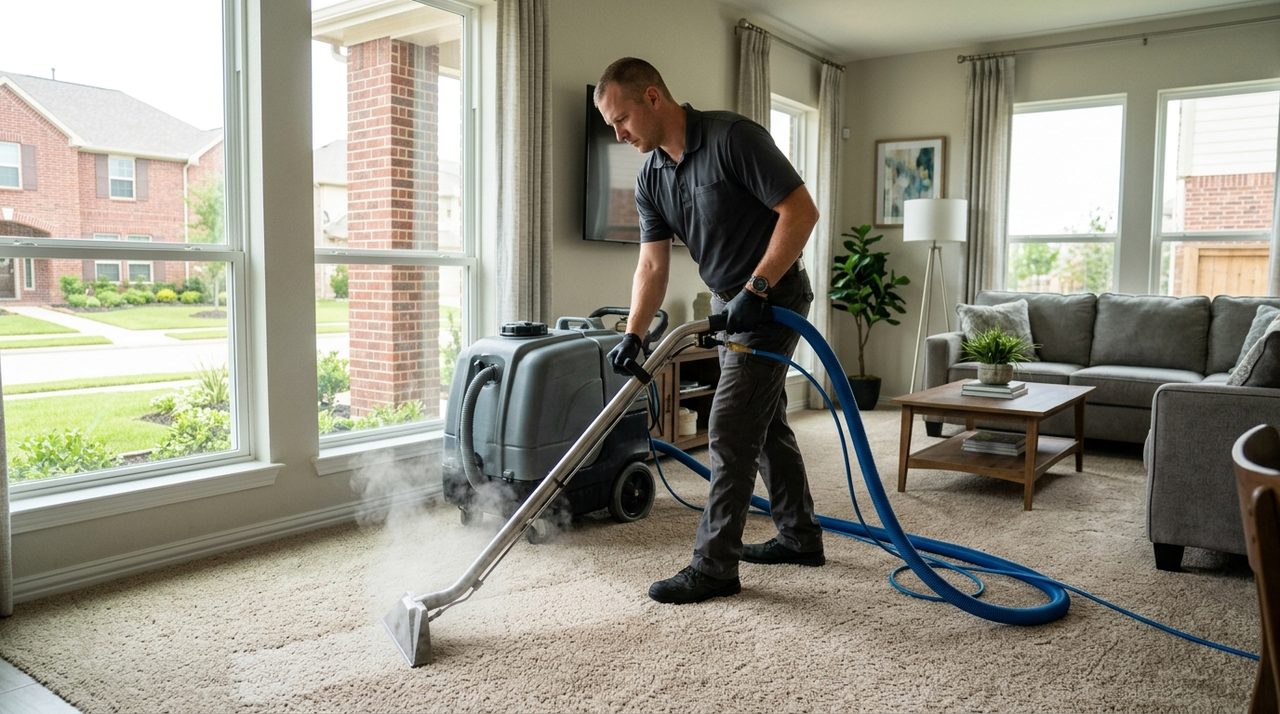
- Median home built
- 1978
- Median home value
- $640,789
- FEMA flood zone
- X (low)
- Typical cost (est.)
- $120–$550
- Most common local issue
- Slab moisture wicking through aged pad in pre-1980 ranch homes
Ranked by verified Google rating × review volume × verification tier. How we rank →
Some highly-rated pros serve Spring Branch from nearby and may not keep a Spring Branch street address. Those are listed under "Also serving Spring Branch" with their real city and distance, so you always know where each business is based.
Min rating:
10 resultsBased in Spring Branch
Closed
12335 Kingsride Ln #343, Houston, TX 77024
Open Now
1956 Upland Dr, Houston, TX 77043
Closed
10110 Westview Dr #1307, Houston, TX 77043
Open Now
1701 Upland Dr, Houston, TX 77043
7026 Old Katy Rd Suite 166, Houston, TX 77024
Also serving Spring Branch
Highly-rated pros based nearby who cover Spring Branch. Distance shown from the Spring Branch area.
Closed
Serving Spring Branch Based in Lazybrook / Timbergrove · 0.3 mi away
Open Now
Serving Spring Branch Based in Lazybrook / Timbergrove · 0.7 mi away
Serving Spring Branch Based in Lazybrook / Timbergrove · 1.5 mi away
Closed
Serving Spring Branch Based in Lazybrook / Timbergrove · 2.1 mi away
Carpet Cleaning in Spring Branch: What You Should Know
Slab Moisture Quietly Saturates Pad in Spring Branch's Oldest Ranch Homes
Why it matters to you
Spring Branch's original 1950s–1960s slab-on-grade homes were built before modern vapor-barrier standards were tightened, and many sit directly on Beaumont clay series soil that holds and releases groundwater through seasonal heave cycles. Concrete moisture vapor transmission in these homes can exceed 3 lbs per 1,000 sq ft per 24 hours, meaning carpet pad gets wet from below — not just from spills or cleaning — and that dampness is invisible until a technician probes beneath the carpet. Homeowners who schedule a routine hot-water extraction and skip the pad-moisture check often find their carpet smells musty within a week of cleaning, not because the technician did poor work on the fiber surface but because the slab itself is contributing ongoing moisture.
What a good pro does
Before any extraction begins, ask the technician to use a pin-type or non-invasive probe moisture meter on the slab and pad in at least two rooms. If pad moisture reads above 15–17%, hot-water extraction alone will worsen the condition by adding more water on top of an already saturated substrate; a qualified technician will recommend air-mover drying of the pad or, in severe cases, pad replacement before cleaning the fiber. Because carpet cleaning itself requires no City of Houston trade permit, there is no regulatory checkpoint here — IICRC certification (specifically the Water Damage Restoration Technician credential) is the practical benchmark that tells you a technician is trained to interpret moisture readings rather than ignore them.
Houston's Hard Water Supercharges Pet Urine Odor in Older Spring Branch Carpet
Why it matters to you
Spring Branch's owner-occupied ranch homes frequently retain original or early-replacement carpet that is 10 or more years old, and pet ownership in these established residential neighborhoods is common. Houston municipal water averages 130–180 mg/L hardness as CaCO₃ depending on blending ratios from the Lone Star Groundwater Conservation District; when a hot-water extraction machine pushes that mineral-rich water through aged carpet, the alkaline residue reactivates dried urine salt crystals left deep in the fiber and backing. The result is that a carpet that smelled tolerable before cleaning can smell noticeably worse within 48 hours as ammonia compounds are re-released during the drying phase — a complaint that puzzles Spring Branch homeowners who paid for a full clean.
What a good pro does
A properly scoped job on a home with pet history starts with an enzyme pretreatment applied 10–15 minutes before extraction — not a deodorizing spray layered on top afterward. For heavy contamination that has reached the pad, sub-surface flushing (a weighted tool that injects and extracts enzyme solution directly into the pad) is required; budget an additional $50–$120 per affected room above the base extraction rate, which is a fair estimate for the Houston market. An acidic rinse step in the final extraction pass neutralizes the alkaline mineral residue from Houston's water supply and prevents the reactivation cycle. No City of Houston permit governs this process, but ask for written documentation of which enzyme product was used — this matters if you are managing the home for a tenant and need records.
Katy Prairie Clay Tracked from Active Teardown Lots Embeds Deep in Ranch-Home Carpet
Why it matters to you
Spring Branch's ongoing teardown-and-rebuild activity — common as lot values support new construction alongside the surviving 1950s stock — means that on any given block, a demolition or new-build site may be generating exposed Beaumont clay and Katy Prairie clay tracked onto sidewalks and driveways. These iron-rich clays have a reddish-brown to dark-gray color (Munsell 5YR–10YR range) and a particle structure that bonds tenaciously to synthetic carpet fibers under Houston's repeated wet-dry storm cycles. Homeowners in Spring Branch who live adjacent to active construction sites often notice dark, gritty traffic lanes in entryways and hallways that resist their own vacuuming — the clay has already been ground below the fiber tip into the backing by foot traffic.
What a good pro does
Standard hot-water extraction run as a single pass over clay-stained traffic lanes is rarely sufficient; a technician should apply a high-alkalinity pre-spray, allow a 5–10 minute dwell time, and agitate mechanically with a counter-rotating brush or hand tool before extraction. A second extraction pass on the most affected areas is typical rather than optional. Spring Branch homeowners near active construction should ask about a pre-vacuum step with a commercial upright before any wet work — removing loose clay particles dry prevents them from turning into muddy slurry that spreads the stain during extraction. Expect standard hot-water extraction pricing ($0.20–$0.40 per sq ft, estimated) to apply to clean areas, with the agitation and pre-spray steps adding modest cost on traffic lanes only.
Post-Uri Pipe-Burst Residue Still Lingers in Unrenovated Spring Branch Interiors
Why it matters to you
Winter Storm Uri (February 2021) ruptured supply and drain lines in a large share of Houston's pre-2000 housing stock; Spring Branch's 1950s–1960s ranch homes with galvanized steel supply lines and cast-iron drains were among the most vulnerable, and contractor backlogs in early 2021 meant many homeowners had emergency water extracted but never completed full pad replacement or professional carpet cleaning before moving furniture back in. Homes that fall into this category — identifiable by their original cast-iron drain plumbing and aging electrical panels, both common unrenovated features in Spring Branch — may still harbor calcium scale deposits, drywall dust from burst-pipe repairs, and microbial contamination embedded in pad and backing that re-releases musty odors each summer as indoor humidity climbs into Houston's 75–90% RH range.
What a good pro does
If you know or suspect your home had pipe-burst water intrusion in Uri and the carpet was never professionally remediated, ask a technician to do a pre-cleaning moisture and microbial check — a visual inspection of the pad at a corner pull-back costs nothing and can confirm whether the pad was ever fully dried. IICRC S500 protocols distinguish clean-water (Category 1) events like pipe bursts from gray- or black-water flooding; a Uri burst that was extracted promptly is Category 1 and the carpet may legitimately be salvageable with thorough hot-water extraction, antimicrobial treatment, and forced drying. Add $75–$200 to the base cleaning estimate (estimated, Houston market range) for antimicrobial application and documentation, which your insurer may still honor under a delayed Uri claim if properly invoiced.
Carpet Cleaning in Spring Branch: What You Should Know
Hiring carpet cleaning in Spring Branch? Spring Branch's housing stock is dominated by 1950s–1960s single-family brick ranch homes on slab foundations, creating consistent demand for foundation repair, re-plumbing, and electrical upgrades. Ongoing teardown-and-rebuild activity means contractors regularly encounter both vintage systems and modern infill construction side by side. Deed restrictions and HOA rules vary subdivision by subdivision, so contractors should verify requirements on a per-project basis.
- Housing era
- Primarily 1950s–1960s, with significant infill and townhome construction from the 2000s onward
- Foundation
- Predominantly concrete slab-on-grade for original 1950s–1960s homes
- Flood zone
- FEMA Zone X (low flood risk) per the official NFHL API
- Permits
- City of Houston — Houston Permitting Center (Spring Branch is within Houston city limits)
Housing stock & systems
Building era
Primarily 1950s–1960s, with significant infill and townhome construction from the 2000s onward.
Typical style
One-story brick ranch houses (original stock); two-story contemporary/transitional homes and townhomes (infill).
Foundations
Predominantly concrete slab-on-grade for original 1950s–1960s homes; some pier-and-beam in earlier or custom structures. Confirm per-property via inspection or appraisal records.
Common systems
Original homes often have galvanized steel or cast-iron drain plumbing, older electrical panels (60–100 amp), and aging central HVAC units. Many properties have been partially updated but may still have legacy piping and wiring. Newer infill homes feature modern PEX plumbing, 200-amp panels, and high-efficiency HVAC systems.
What that means for repairs
Teardown-and-rebuild activity is very common as lot values support new construction. Remaining original homes frequently undergo whole-house renovations including re-plumbing (replacing galvanized lines), electrical panel upgrades, HVAC replacement, and kitchen/bath remodels. Foundation leveling is a recurring need on slab homes due to expansive clay soils.
Permits & restrictions
Permit jurisdiction
City of Houston — Houston Permitting Center (Spring Branch is within Houston city limits).
HOA & deed restrictions
No single area-wide mandatory HOA. Voluntary civic associations (e.g., Spring Branch Civic Association, Spring Branch Oaks Civic Association) cover much of the older residential area. Some platted subdivisions have mandatory HOAs with recorded deed restrictions and mandatory assessments (e.g., Spring Branch Estates, Spring Branch Estates II). At least six mandatory HOAs are registered in the broader Spring Branch area. Deed restrictions are common at the subdivision level but vary by plat—check Harris County Clerk records for each property.
Historic districts
No City of Houston historic district designation confirmed.
Contractor note
Because deed restrictions and HOA requirements vary by subdivision, contractors should confirm any architectural review, fence/accessory structure, and material restrictions before beginning work. The City of Houston permitting process applies to all structural, electrical, plumbing, and mechanical work.
Flood & weather
FEMA flood zone
FEMA Zone X (low flood risk) per the official NFHL API. However, Spring Branch is bisected by several tributaries of White Oak Bayou and Spring Branch Creek, and localized street flooding can still occur during heavy rain events. Property-level flood risk should be verified, especially for lots near drainage channels.
Hurricane Harvey impact
Research did not return specific Harvey damage documentation for this civic-association-defined area of Spring Branch. Broader media and City of Houston reporting indicate that portions of the Spring Branch area experienced significant flooding during Harvey, particularly near bayou tributaries and low-lying streets. Homeowners and contractors should check individual property flood claims history through FEMA and the Harris County Flood Control District for site-specific impact data.
Heat & humidity load
Extended Houston summers with sustained 95°F+ temperatures and high humidity stress aging HVAC systems and accelerate attic insulation degradation in 1950s–1960s ranch homes. Slab-on-grade foundations on expansive clay soils are vulnerable to differential settlement during summer drought cycles. Exterior paint and caulking on older brick veneer homes deteriorate quickly in UV-intense conditions.
Working with contractors here
The most common work in Spring Branch involves updating the mechanical and plumbing systems in 1950s–1960s ranch homes—re-plumbing galvanized supply lines, replacing cast-iron drains, upgrading electrical panels, and installing modern HVAC systems. Foundation repair is a perennial need due to expansive clay soils and slab-on-grade construction. Teardown-and-rebuild projects are frequent, requiring contractors familiar with City of Houston new-construction permitting and lot-specific deed restriction compliance. For renovation jobs on older homes, contractors should budget for potential asbestos abatement (siding, flooring, duct insulation) and lead paint remediation. Scoping should account for the wide variation between unrenovated originals and partially updated homes on the same block.
Local Tip
Always ask for a written estimate before work begins. Texas contractors are required to provide one on jobs over $1,000.
About Spring Branch
Spring Branch's housing stock is dominated by 1950s–1960s single-family brick ranch homes on slab foundations, creating consistent demand for foundation repair, re-plumbing, and electrical upgrades. Ongoing teardown-and-rebuild activity means contractors regularly encounter both vintage systems and modern infill construction side by side. Deed restrictions and HOA rules vary subdivision by subdivision, so contractors should verify requirements on a per-project basis.
- Median year built
- 1978
- Median home value
- $640,789
- Owner-occupied
- 52.3%
- Population
- 157,142
- Housing units
- 65,035
- Median income
- $90,513
Source: U.S. Census Bureau, ACS 5-Year 2023
Flood & storm risk
FEMA Zone XLow flood riskMost of Spring Branch maps to FEMA Zone X (low mapped flood risk), but Houston's flash-flood reality means even low-risk blocks benefit from smart drainage and storm-hardened installs.
Source: FEMA National Flood Hazard Layer (NFHL). Flood zones vary by parcel — verify your individual FIRM panel.
Frequently Asked Questions
Do I need a permit from the City of Houston to have my carpet professionally cleaned in Spring Branch?
No permit is required from the Houston Permitting Center for carpet cleaning alone — it is not a regulated trade under City of Houston building, mechanical, or plumbing codes. The one exception worth knowing is that if your cleaner identifies mold during the job and crosses into mold remediation work, that activity can trigger TDLR licensing requirements under Texas Occupations Code Chapter 1958, which is a state-level rule separate from the city permitting process.
My Spring Branch ranch home was built in 1962 and the carpet has never been replaced — should the technician do anything differently than on a newer home?
Yes, ask specifically that the technician probe the pad moisture before and after extraction using a pin-type moisture meter, because pre-1980 Spring Branch slabs often have thin or deteriorated vapor barriers that allow concrete moisture vapor to saturate the pad from below — a problem that reappears quickly after cleaning if not documented and addressed. If the pad reads above 12–15% moisture after drying, replacement rather than cleaning is the more durable fix. IICRC standards treat elevated sub-floor moisture as a separate remediation condition, not just a cleaning variable.
Spring Branch is FEMA Zone X, so is post-flood carpet cleaning ever a real concern here even without mapped flood risk?
Zone X means Spring Branch carries low mapped flood risk, but Houston's recurring flash-flood events — including runoff from active teardown-and-rebuild lots nearby — can push water through garage doors or low thresholds even in nominally low-risk blocks. If any standing water contacted your carpet, ask the technician to confirm the water category before cleaning: IICRC S500 protocols require pad removal and replacement for Category 2 or 3 water intrusion regardless of flood zone, and cleaning over contaminated pad leaves bacterial residue that no amount of extraction removes.
Sources: IICRC (water/mold restoration standards)FEMA National Flood Hazard Layer (NFHL)
Is there a better season to schedule carpet cleaning in Spring Branch, or does Houston's humidity make timing matter less?
Timing does matter here: Spring Branch's summer months (June through September) routinely hold outdoor relative humidity above 80%, which dramatically slows carpet drying after hot-water extraction and increases the window for mold growth and wicking from the pad — especially in these older ranch homes with limited airflow. Scheduling in late October through February, when RH drops into the 55–65% range, gives carpet the best chance of drying within four to six hours. If you must clean in summer, ask the company to run air movers for at least two hours after extraction and keep your HVAC thermostat at 72°F or below to pull moisture from the air.
My Spring Branch home had a pipe burst during Winter Storm Uri in 2021 — we had the water extracted but never fully replaced the carpet. What should I tell the cleaner now?
Tell the technician the loss date (February 2021), which rooms were affected, and whether the pad was ever replaced, because clean-water pipe-burst losses become Category 3 contamination under IICRC S500 once microbial growth begins — which in Houston's humidity typically happens within 72 hours of a water event. If the pad was never swapped out after Uri, cleaning over it now addresses only the fiber surface while leaving calcium scale, drywall dust, and potential mold in the pad backing, a condition the IICRC classifies as requiring remediation rather than cleaning. A moisture probe reading of the slab beneath that pad is the first diagnostic step before any cleaning quote is accepted.
Some Spring Branch subdivisions have deed restrictions — can an HOA or civic association tell me what type of carpet cleaning I'm required to use or certify?
A handful of Spring Branch's platted subdivisions do carry mandatory HOA deed restrictions (Spring Branch Estates and Spring Branch Estates II are recorded examples), but those restrictions typically govern exterior appearance, not interior cleaning methods — so no subdivision rule is likely to specify hot-water extraction vs. dry cleaning for a routine cleaning. The more common scenario is a lease or sale contract that requires an IICRC-certified cleaning receipt within a set timeframe; confirm the exact requirement in writing before scheduling, because some landlords and buyers' agents in Spring Branch specify IICRC documentation explicitly, and not every company operating in the area carries that credential.
Sources: Local HOA / deed restrictions (see area profile)IICRC (water/mold restoration standards)