Open Now
2200 S Dairy Ashford Rd suite 422, Houston, TX 77077
Westchase's sprawl of 1970s–1990s slab-on-grade homes sits on Harris County's signature expansive black clay, and that combination turns even a minor plumbing failure or flash-flood intrusion into a drawn-out moisture fight: the clay presses against slab edges long after surface water disappears, while aging galvanized or polybutylene supply lines in these pre-2000 homes remain prime candidates for slow leaks and burst failures. Most of the district maps to FEMA Zone X, so flood insurance gaps are common, making documentation and scope discipline especially critical when a loss does occur. This page explains the four restoration challenges that actually define water damage work in Westchase—and what a qualified contractor should do about each one.
Ranked by verified Google rating × review volume × verification tier. How we rank →
Some highly-rated pros serve Westchase from nearby and may not keep a Westchase street address. Those are listed under "Also serving Westchase" with their real city and distance, so you always know where each business is based.
2200 S Dairy Ashford Rd suite 422, Houston, TX 77077
1200 Enclave Pkwy, Houston, TX 77077
Highly-rated pros based nearby who cover Westchase. Distance shown from the Westchase area.
Serving Westchase Based in Alief · 2.1 mi away
Serving Westchase Based in Sharpstown · 2.7 mi away
Serving Westchase Based in Energy Corridor · 3.7 mi away
Serving Westchase Based in Spring Branch · 4 mi away
Serving Westchase Based in Alief · 4.4 mi away
Serving Westchase Based in Tanglewood · 4.5 mi away
Serving Westchase Based in Spring Branch · 4.8 mi away
Serving Westchase Based in Tanglewood · 4.9 mi away
Why it matters to you
Nearly every single-family home in Westchase is slab-on-grade, sitting directly on the high-plasticity Houston Black clay that dominates Harris County. When a supply-line failure or flash-flood event delivers water to the slab perimeter, the clay absorbs and holds that moisture against the foundation edge for weeks—long after the standing water is gone and the floors look dry. In a neighborhood where the median home was built in 1986, bottom plates, wall framing, and drywall at that slab junction have had decades to accumulate minor moisture cycles, meaning a new loss saturates materials that were already compromised.
What a good pro does
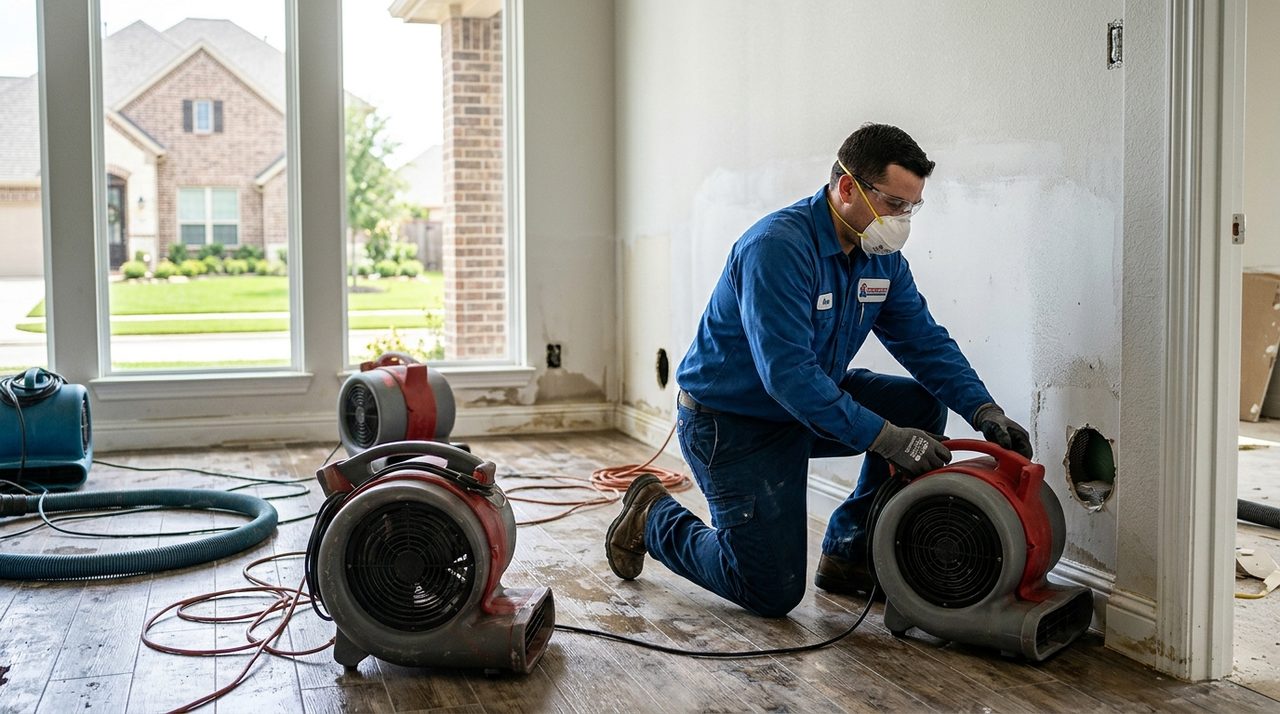
A qualified contractor uses calibrated moisture meters and thermal imaging cameras to map the actual wet boundary in wall cavities and beneath flooring—not just the area that was visibly wet. Structural drying typically requires commercial-grade dehumidifiers and air movers staged specifically for slab-edge zones, with daily readings logged until materials reach regional EMC (equilibrium moisture content) targets per IICRC S500 protocols. Because this work falls under the City of Houston's permit jurisdiction, any resulting structural demolition requires a demolition permit pulled through the Houston Permitting Center before debris removal begins.
Sources: IICRC (water/mold restoration standards), City of Houston Permitting Center
Why it matters to you
A large portion of Westchase's 1970s–1990s housing stock still runs original or first-generation flex duct through unconditioned attic space above the living area. When a supply-line burst, roof leak, or attic HVAC drain-pan overflow saturates that duct insulation, Houston's baseline relative humidity—averaging around 74%—and summer attic temperatures above 120°F create textbook Cladosporium and Aspergillus growth conditions within 48–72 hours. Homeowners in this area frequently restart their air conditioning immediately after a water event to 'dry things out,' which actually pulls humid attic air across still-wet duct insulation and seeds spores throughout the supply system.
What a good pro does
Restoration contractors should scope a duct inspection as a standard line item on any Westchase job where the attic or supply system was exposed to moisture. If flex duct insulation tests above 16% moisture content or shows visible microbial growth, replacement is the IICRC-supported course of action—not surface treatment. Any firm performing mold assessment or remediation in Texas must hold a TDLR-issued Mold Remediation Contractor (MRC) license under Texas Occupations Code Chapter 1958; homeowners should request the license number before work begins.
Sources: IICRC (water/mold restoration standards), Texas Department of Licensing & Regulation
Why it matters to you
Westchase's 1970s–1980s homes commonly contain galvanized steel or polybutylene supply lines—both materials with well-documented failure histories—and many of those same homes have attic-run plumbing that was never insulated after Winter Storm Uri in February 2021. Restoration contractors working on unrelated Westchase projects routinely open walls for a kitchen remodel or slab-repair access point and find dried-then-rewetted drywall cavities with active microbial growth from a Uri-era burst that was patched at the surface but never properly dried. The 31.7% owner-occupancy rate in Westchase (ACS 2023) means a significant share of homes are rentals, where deferred maintenance on pipe systems is more likely.
What a good pro does
Before any restoration scope is finalized, a thorough contractor should probe suspect wall cavities in pre-1990 Westchase homes—particularly around attic penetrations, exterior walls, and under-sink areas where galvanized or polybutylene runs are most common. If live polybutylene or heavily corroded galvanized lines are found, a TSBPE-licensed plumber must complete the re-pipe before structural drying and reconstruction can proceed. The City of Houston requires a plumbing permit for supply-line replacement; the Houston Permitting Center issues those permits and requires a licensed plumber of record.
Sources: Texas State Board of Plumbing Examiners, City of Houston Permitting Center, IICRC (water/mold restoration standards)
Why it matters to you
Westchase has no single umbrella HOA governing the entire district—instead, each of its multiple platted subdivisions may carry its own deed restrictions and architectural review requirements, discoverable only through Harris County deed records. This patchwork means that on one block a homeowner can stage a dumpster and remove water-damaged exterior materials immediately, while a neighbor two streets over in a different subdivision may technically need architectural committee sign-off before visible demo work proceeds. IICRC S500 calls for drying initiation within 24–48 hours of a water event; administrative delays that push past that window can escalate a Category 2 loss (gray water) to a Category 3 (contaminated) classification, dramatically increasing remediation cost.
What a good pro does
Before mobilizing exterior demo equipment, a responsible contractor should pull the subject property's deed from Harris County's real-property records portal to identify any active deed restrictions or HOA covenants. The Westchase Community Association and the Westchase District (a commercial management district) do not govern individual residential lots, but subdivision-level covenants are independently enforceable. Identifying this early—within the first hours of site assessment—lets the contractor pursue any required notices in parallel with interior emergency drying, protecting the drying timeline without waiting on paperwork.
Sources: Local HOA / deed restrictions (see area profile), IICRC (water/mold restoration standards), City of Houston Permitting Center
Hiring water & flood restoration in Westchase? Westchase is a large, mixed-use district near Beltway 8 composed of multiple separately platted subdivisions, each with its own potential HOA and deed restrictions. Housing stock ranges from 1970s–1990s single-family homes to newer multifamily and townhome developments, nearly all built on slab-on-grade foundations. Contractors must verify deed restrictions and HOA rules on a per-subdivision basis, as there is no single umbrella association governing the entire area.
Building era
Primarily 1970s through 1990s, with continued multifamily and townhome development into the 2000s and 2010s.
Typical style
Contemporary suburban: traditional-to-transitional single-family homes, brick or stucco façade garden-style apartments, and townhomes.
Foundations
Slab-on-grade (nearly universal for post-1960s suburban Harris County construction).
Common systems
Central A/C with gas furnace, copper or CPVC plumbing transitioning to PEX in renovations, standard residential electrical panels (100–200 amp). Older 1970s–1980s homes may still have original galvanized supply lines or polybutylene piping requiring replacement.
What that means for repairs
Kitchen and bath remodels are common in aging 1970s–1980s homes. Plumbing re-pipes (replacing galvanized or polybutylene), HVAC system replacements on units past their 20-year lifespan, and slab foundation repair driven by Houston's expansive clay soils are frequent project types.
Permit jurisdiction
City of Houston — Houston Permitting Center.
HOA & deed restrictions
No single area-wide mandatory HOA exists. The Westchase District is a Texas Legislature-created management district focused on commercial improvements, not residential lot governance. The Westchase Super Neighborhood Council is a City of Houston advisory body. A Westchase Community Association (501(c)(4), formed 1974) exists, but its authority over individual residential lots is not clearly documented. Individual subdivisions within the Westchase area may have their own mandatory HOAs — must be verified per subdivision via Harris County deed records.
Historic districts
No City of Houston historic district designation confirmed.
Contractor note
Contractors must confirm which subdivision a property belongs to and check for active deed restrictions and HOA architectural review requirements before beginning exterior work, fencing, or additions. The lack of a single governing HOA means rules vary block by block.
FEMA flood zone
FEMA Zone X (low flood risk) per official NFHL data. Drainage is influenced by local bayous and channels within the Harris County Flood Control system; proximity to specific drainage channels should be verified on a per-property basis.
Hurricane Harvey impact
No Westchase-specific street-level Harvey flood impact documentation was found in available sources. The area is east of the Addicks and Barker Reservoir watersheds and experienced varying levels of impact during Harvey. Flood history should be verified through Harris County Flood Control District records and individual property disclosure for any specific address.
Heat & humidity load
Sustained summer heat puts heavy strain on aging HVAC systems in 1970s–1980s homes; capacitor failures, refrigerant leaks, and compressor burnout are common seasonal calls. Slab-on-grade foundations on Houston's expansive clay soils experience movement during summer drought cycles, leading to door/window sticking and drywall cracks that trigger foundation inspection and repair demand.
Working with contractors here
Westchase keeps contractors busy with the bread-and-butter maintenance demands of aging 1970s–1990s suburban homes: HVAC replacements, whole-house plumbing re-pipes, and slab foundation repair. The area's slab-on-grade construction on expansive clay means foundation work is a recurring need, especially after drought-to-rain cycles. Roof replacements on 20–30-year-old composition shingle roofs are common, and many homeowners are upgrading aging electrical panels to support modern loads. Because Westchase comprises many separate subdivisions, contractors must scope each job with attention to the specific subdivision's deed restrictions and any HOA architectural review — exterior modifications, fence styles, and material choices may vary significantly from one block to the next.
Local Tip
Always ask for a written estimate before work begins. Texas contractors are required to provide one on jobs over $1,000.
Westchase is a large, mixed-use district near Beltway 8 composed of multiple separately platted subdivisions, each with its own potential HOA and deed restrictions. Housing stock ranges from 1970s–1990s single-family homes to newer multifamily and townhome developments, nearly all built on slab-on-grade foundations. Contractors must verify deed restrictions and HOA rules on a per-subdivision basis, as there is no single umbrella association governing the entire area.
Source: U.S. Census Bureau, ACS 5-Year 2023
Most of Westchase maps to FEMA Zone X (low mapped flood risk), but Houston's flash-flood reality means even low-risk blocks benefit from smart drainage and storm-hardened installs.
Source: FEMA National Flood Hazard Layer (NFHL). Flood zones vary by parcel — verify your individual FIRM panel.
Water-restoration companies serving Westchase can install or recommend backflow prevention add-ons on floor drains and advise on contents-elevation strategies that limit category-2 water contact during a tropical event. The May 2024 derecho reminded Houston homeowners that extreme rain is not exclusive to named hurricanes, making year-round readiness essential. Confirm the current FEMA panel for your Westchase parcel — the area maps to Zone X, but adjacent lots can differ.
For homeowners in Westchase: the May 2024 derecho caused widespread roof-deck separation across Houston, and the subsequent rainfall introduced water into attic insulation that retained moisture for weeks — a restoration contractor with desiccant drying equipment can address these attic assemblies that conventional fans cannot reach. Documenting the drying process with daily moisture logs also supports insurance claims for wind-and-water combined losses. In-city Westchase work falls under City of Houston floodplain and permitting rules.
Homes in lower-flood-risk areas of Westchase are not immune to the interior water losses Uri 2021 caused — burst attic supply lines and failed icemaker connections caused extensive drywall and flooring damage regardless of floodplain designation. A water-restoration contractor can extract standing water, remove wet flooring, and place structural drying equipment within the window that prevents a straightforward dryout from escalating to mold remediation. In-city Westchase work falls under City of Houston floodplain and permitting rules.
Sources: FEMA National Flood Hazard Layer (NFHL), Ready.gov -- Hurricanes, CenterPoint Energy -- Storm Center, City of Houston -- Emergency Preparedness, Ready.gov -- Winter Weather, Harris County Flood Control District
Houston-specific estimators to plan your project before you call a pro. All results are planning estimates — a licensed local pro confirms the details on site.
Disconnect & drain every outdoor hose bib
Remove hoses, drain the spigots, and cover each with an insulated faucet sock. Un-drained hose bibs are the #1 burst point in a Houston freeze.
Insulate exposed pipes in the attic & garage
Wrap any pipe in an unconditioned space (attic runs, garage walls) with foam sleeves. Houston homes rarely insulate these because they only matter a few nights a year — which is exactly why they burst.
Open cabinet doors & keep a pencil-width drip
On hard-freeze nights, open kitchen/bath cabinets so warm air reaches the pipes and let faucets on exterior walls drip to relieve pressure.
Protect the attic/garage water heater & its lines
An attic or garage tank sits in unconditioned space. Insulate the cold-inlet and hot-outlet lines and confirm the emergency drain pan is clear so a leak doesn't reach the ceiling.
This is a planning estimate only — actual requirements depend on an on-site assessment by a licensed Houston pro. If a pipe has already burst, shut off your main water supply and call a licensed Houston plumber immediately — freeze bursts flood fast.
Sources: City of Houston Permitting Center
Sources: Texas State Board of Plumbing ExaminersCity of Houston Permitting Center
Sources: IICRC (water/mold restoration standards)Local HOA / deed restrictions (see area profile)