Open Now
10511 Kipp Way St #400, Houston, TX 77099
Alief's roughly 1,400-acre patchwork of 1970s–1990s subdivisions sits in FEMA Zone X500 — outside the 100-year floodplain but well within reach of Houston's intense rain events, meaning homes here flood less predictably than bayou-front properties but still sustain serious water damage when stalled tropical systems dump rain faster than the city's storm drains can move it. Slab-on-grade foundations built on Harris County's expansive black clay soil hold moisture against the slab perimeter for weeks after water recedes, and the area's older galvanized plumbing and aging flex-duct HVAC systems add a second layer of risk that pure flood maps don't capture. This page explains the specific restoration challenges facing Alief homeowners — subdivision-by-subdivision HOA variability, hidden moisture in mid-century walls, and City of Houston permit requirements — so you know what to expect before, during, and after a water event.
Ranked by verified Google rating × review volume × verification tier. How we rank →
Some highly-rated pros serve Alief from nearby and may not keep a Alief street address. Those are listed under "Also serving Alief" with their real city and distance, so you always know where each business is based.
10511 Kipp Way St #400, Houston, TX 77099
4117 Baneway Dr, Houston, TX 77072
Highly-rated pros based nearby who cover Alief. Distance shown from the Alief area.
Serving Alief Based in Westchase · 2.7 mi away
Serving Alief Based in Stafford · 3.5 mi away
Serving Alief Based in Sharpstown · 3.6 mi away
Serving Alief Based in Sugar Land · 4.2 mi away
Serving Alief Based in Sugar Land · 4.2 mi away
Serving Alief Based in Westchase · 4.5 mi away
Serving Alief Based in Sugar Land · 4.7 mi away
Serving Alief Based in Sugar Land · 4.8 mi away
Why it matters to you
Nearly every Alief home sits on a slab-on-grade foundation over Harris County's expansive black clay, which holds water against the slab perimeter for days or weeks after visible pooling disappears. For the area's median 1986-era homes — many with original vapor barriers and minimal slab-edge drainage — this means bottom plates, drywall, and baseboards continue wicking moisture long after homeowners assume the worst is over, dramatically extending the window for mold growth.
What a good pro does
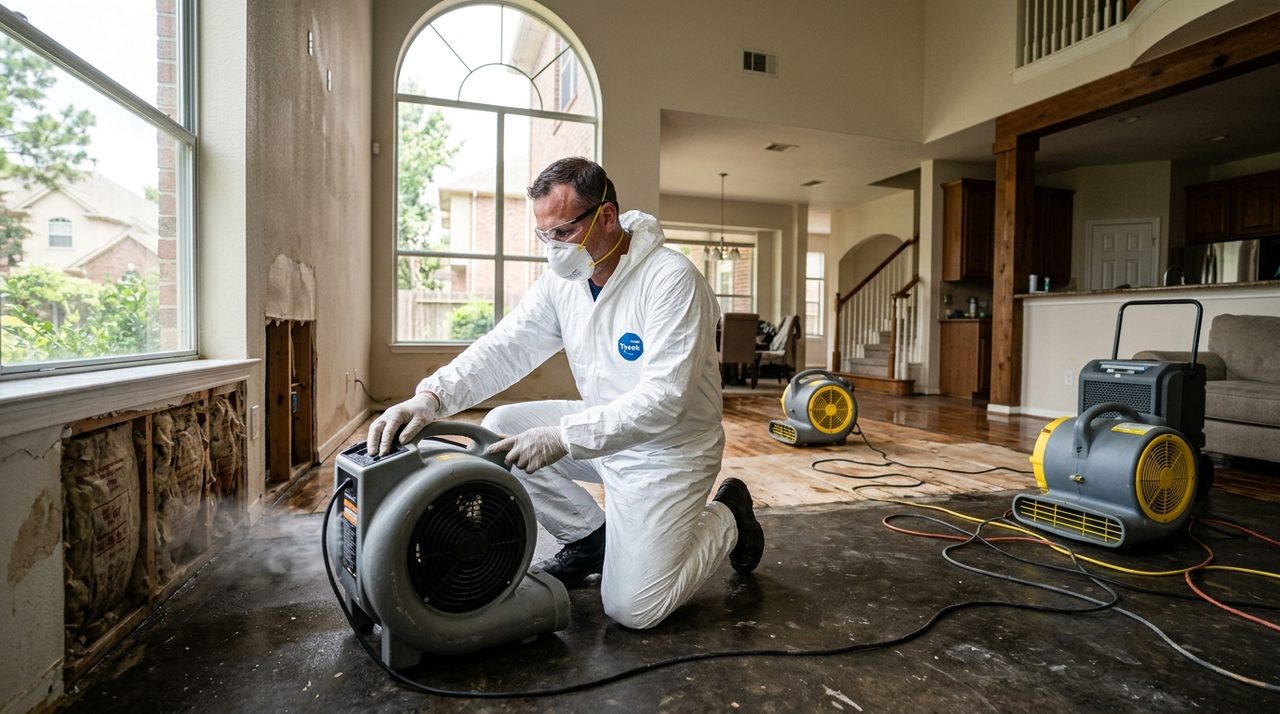
A qualified restoration contractor should deploy calibrated moisture meters and thermal imaging cameras to map the full saturation boundary inside walls and under floor coverings before any drying equipment is placed or removed. IICRC S500 standards set specific drying goals (typically below 16% moisture content in wood assemblies) that must be reached and documented before reconstruction begins — not simply estimated by sight. Ask your contractor for daily drying logs that prove the structure has met those targets.
Sources: IICRC (water/mold restoration standards), Harris County Flood Control District
Why it matters to you
Alief's 1970s–1990s housing stock frequently retains its original flex-duct HVAC systems, many of which run through unconditioned attic space where Houston's average 74% relative humidity and 90°F+ summer temperatures create rapid mold conditions. When floodwater or even heavy wind-driven rain saturates flex-duct insulation wrap, Cladosporium and Aspergillus colonies can establish within 48–72 hours — and because the duct is inside the attic, homeowners often keep running the AC while the contamination spreads through every supply register in the house.
What a good pro does
After any water event that reaches HVAC components, a licensed mold assessment contractor holding a TDLR-issued Mold Assessment Consultant (MAC) credential must inspect and, where warranted, test duct interiors before the system is returned to service. If contaminated flex duct is confirmed, full replacement — not cleaning — is the standard scope under IICRC guidelines; partial duct cleaning on saturated fiberglass insulation does not reliably eliminate the microbial reservoir. Verify your restoration contractor's TDLR license number before signing any contract.
Sources: Texas Department of Licensing & Regulation, IICRC (water/mold restoration standards), Texas Commission on Environmental Quality
Why it matters to you
Alief's older ranch homes, built before attic plumbing insulation was standard practice, were among the properties hit hard when Winter Storm Uri froze unprotected supply lines in February 2021. Many owners patched visible pipe breaks and repainted but never fully dried wall cavities, because the damage was inside walls rather than on the slab surface. Three-plus years later, restoration contractors called for unrelated repairs routinely find residual mold colonies hidden behind undisturbed drywall — a problem that must be remediated before any new repair work can be warranted.
What a good pro does
Before any significant renovation or restoration project in an Alief home that experienced Uri damage, ask the contractor to run a thermal imaging pass over exterior walls, attic knee walls, and cabinet soffits where supply lines run. If anomalies appear, a TDLR-licensed Mold Remediation Contractor (MRC) must scope and complete the remediation before drywall or insulation is re-installed. Any pipe repair work itself requires a TSBPE-licensed plumber, who pulls a separate trade permit through the City of Houston Permitting Center.
Sources: Texas Department of Licensing & Regulation, Texas State Board of Plumbing Examiners, City of Houston Permitting Center
Why it matters to you
Unlike master-planned communities with a single HOA rulebook, Alief's dozens of individual subdivisions each carry their own deed restrictions and governance structures — Park West Community Association has different exterior-work rules than a neighboring civic-club-governed tract, and some blocks have no HOA at all. IICRC S500 calls for drying initiation within 24–48 hours of a water event, but an HOA architectural review requirement for dumpster placement or exterior material removal can consume that entire window, pushing a Category 2 gray-water loss toward Category 3 contamination classification and a much larger remediation scope.
What a good pro does
Before storm season arrives, pull your specific subdivision's deed restrictions through Harris County real property records and confirm whether your HOA or civic club has an architectural review process for emergency exterior work. When a water event does occur, document the flood source and timeline with photos immediately — this evidence supports both the correct water category classification with your insurer and a hardship argument to your HOA for expedited approval. Your restoration contractor should be aware that City of Houston demolition permits are required regardless of HOA status, and those are obtained through the City of Houston Permitting Center.
Sources: Local HOA / deed restrictions (see area profile), IICRC (water/mold restoration standards), City of Houston Permitting Center
Hiring water & flood restoration in Alief? Alief is a large, diverse area in southwest Houston encompassing dozens of individual subdivisions, each with its own governance structure, housing stock, and deed restrictions. Homeowners should verify their specific subdivision's HOA status, deed restrictions, and flood history at the parcel level rather than relying on area-wide generalizations. The moderate flood risk zone and aging housing stock across many tracts drive significant demand for plumbing, foundation, and weatherproofing services.
Building era
Not confirmed at the neighborhood-wide level — varies by subdivision. Many tracts developed from the 1970s through 1990s, but this should be verified tract-by-tract.
Typical style
Not confirmed — Alief includes a mix of single-family ranch-style homes, townhomes, and multi-family units depending on the subdivision.
Foundations
Primarily slab-on-grade, consistent with Houston-area construction norms, but not universally confirmed across all Alief subdivisions.
Common systems
Homes from the 1970s–1990s era typically feature central HVAC systems that may need replacement, copper or galvanized plumbing (older tracts), and electrical panels that may require upgrading to modern standards.
What that means for repairs
Not confirmed at the area-wide level. Given the likely age range of housing stock, common renovation activity likely includes HVAC replacement, re-piping from galvanized to PEX or copper, roof replacement, and kitchen/bath modernization.
Permit jurisdiction
City of Houston Permitting Center (Alief is generally within Houston city limits, though boundary verification is recommended for any specific address).
HOA & deed restrictions
No single area-wide HOA governs Alief. Some subdivisions have mandatory HOAs (e.g., Park West Community Association, Inc.). Others are organized only through civic clubs or the Alief Super Neighborhood Council, which is a community forum, not an HOA. Check Harris County deed records for the specific subdivision.
Historic districts
No City of Houston historic district designation confirmed. No evidence found that any part of Alief requires HAHC Certificates of Appropriateness.
Contractor note
Contractors must verify the specific subdivision's HOA requirements before beginning exterior work, as rules vary dramatically across Alief. Confirm the property is within Houston city limits for correct permitting jurisdiction.
FEMA flood zone
FEMA Zone X500 (moderate flood risk) — source: fema_nfhl. Alief is situated in southwest Houston; proximity to specific bayous or drainage channels should be verified at the parcel level.
Hurricane Harvey impact
Specific Harvey 2017 impact data for Alief was not confirmed through available research. Flood impact varied by subdivision and street; homeowners and contractors should check parcel-level flood history using Harris County Flood Control District tools and FEMA flood claim records rather than relying on area-wide assumptions.
Heat & humidity load
Houston's extreme summer heat and humidity place heavy demand on HVAC systems, particularly in older homes with less efficient equipment. Slab foundations in clay soils are susceptible to movement during prolonged dry spells, and moisture intrusion risks increase during summer storm events.
Working with contractors here
Alief's large geographic footprint and subdivision-by-subdivision variability mean contractors must scope each job individually rather than assuming uniform conditions. Older homes from the 1970s–1980s commonly need re-piping, electrical panel upgrades, and HVAC replacement. Foundation repair is a recurring need given Houston's expansive clay soils and the moderate flood risk designation. Exterior work such as siding, roofing, and fencing may be subject to HOA architectural review in some subdivisions but not others, so pre-job verification is essential. Language diversity in the area may also be a practical consideration for customer-facing contractors.
Local Tip
Always ask for a written estimate before work begins. Texas contractors are required to provide one on jobs over $1,000.
Alief is a large, diverse area in southwest Houston encompassing dozens of individual subdivisions, each with its own governance structure, housing stock, and deed restrictions. Homeowners should verify their specific subdivision's HOA status, deed restrictions, and flood history at the parcel level rather than relying on area-wide generalizations. The moderate flood risk zone and aging housing stock across many tracts drive significant demand for plumbing, foundation, and weatherproofing services.
Source: U.S. Census Bureau, ACS 5-Year 2023
Alief carries FEMA Zone X500 (moderate flood risk): outside the 100-year floodplain but inside the 500-year, so heavy-rain events still reach homes and flood-aware work pays off.
Source: FEMA National Flood Hazard Layer (NFHL). Flood zones vary by parcel — verify your individual FIRM panel.
Pre-storm, arrange for a water-restoration professional to clear and test any sub-slab drainage or interior French-drain systems serving your Alief home, since FEMA Zone X500 in the 500-year floodplain conditions can still deliver several feet of standing water during a slow-moving storm. Identifying extraction access points in advance cuts response time when the 48-hour mold clock starts. Confirm the current FEMA panel for your Alief parcel — the area maps to Zone X500, but adjacent lots can differ.
Wind-driven rain from the May 2024 derecho caused water intrusion through soffit vents and poorly sealed exterior wall penetrations in countless Alief homes that had never previously flooded. A water-restoration contractor can trace moisture migration paths with thermal imaging and place drying equipment specifically where building cavities are retaining water. In-city Alief work falls under City of Houston floodplain and permitting rules.
Ice-storm pipe failures in Alief often go undetected until the thaw, by which point water may have been migrating through wall cavities for 12 to 36 hours — squarely inside the 48-hour mold-growth window defined by the IICRC S520 standard. Scheduling a moisture inspection immediately after any pipe-freeze event, rather than waiting for visible staining, is the single most cost-effective step a homeowner can take. In-city Alief work falls under City of Houston floodplain and permitting rules.
Sources: FEMA National Flood Hazard Layer (NFHL), Ready.gov -- Hurricanes, CenterPoint Energy -- Storm Center, City of Houston -- Emergency Preparedness, Ready.gov -- Winter Weather, Harris County Flood Control District
Houston-specific estimators to plan your project before you call a pro. All results are planning estimates — a licensed local pro confirms the details on site.
Disconnect & drain every outdoor hose bib
Remove hoses, drain the spigots, and cover each with an insulated faucet sock. Un-drained hose bibs are the #1 burst point in a Houston freeze.
Insulate exposed pipes in the attic & garage
Wrap any pipe in an unconditioned space (attic runs, garage walls) with foam sleeves. Houston homes rarely insulate these because they only matter a few nights a year — which is exactly why they burst.
Open cabinet doors & keep a pencil-width drip
On hard-freeze nights, open kitchen/bath cabinets so warm air reaches the pipes and let faucets on exterior walls drip to relieve pressure.
Protect the attic/garage water heater & its lines
An attic or garage tank sits in unconditioned space. Insulate the cold-inlet and hot-outlet lines and confirm the emergency drain pan is clear so a leak doesn't reach the ceiling.
This is a planning estimate only — actual requirements depend on an on-site assessment by a licensed Houston pro. If a pipe has already burst, shut off your main water supply and call a licensed Houston plumber immediately — freeze bursts flood fast.
Sources: City of Houston Permitting Center
Sources: Local HOA / deed restrictions (see area profile)