Serving Westchase Based in Sharpstown · 1.7 mi away
Best Pest Control in Westchase
Westchase's housing stock — mostly 1970s through 1990s slab-on-grade homes built on Harris County's expansive Beaumont clay — creates a specific set of pest vulnerabilities that newer construction or crawlspace-based homes simply don't share: termites exploit post-tension cable sleeves and aging plumbing penetrations, and seasonal clay movement reopens rodent entry points faster than caulk can cure. Because Westchase comprises dozens of separately platted subdivisions rather than one umbrella association, your ability to place exterior bait stations or schedule broadcast lawn treatments may hinge on a deed restriction tucked in Harris County records that your neighbor's property doesn't have — making a pest strategy here more legally layered than almost anywhere else in West Houston.
Verified against Google Business data
Updated 2026
See the 10 Pest Control Serving Westchase 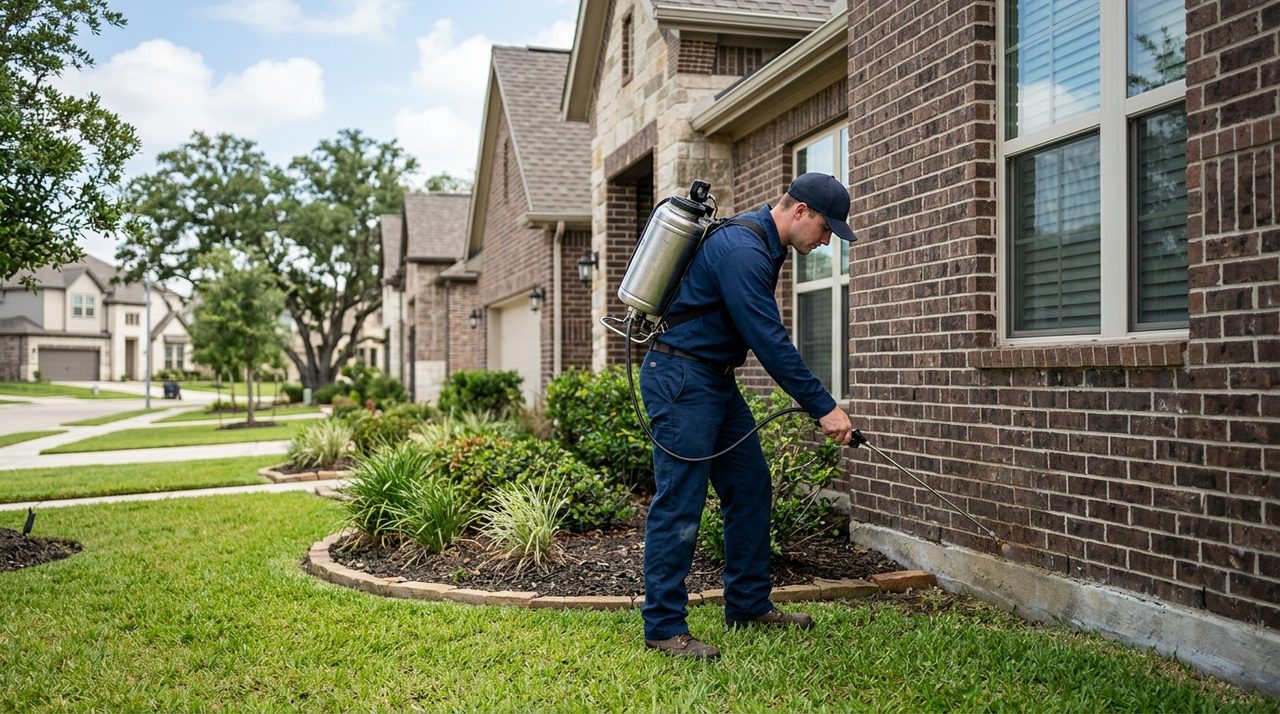
- Median home built
- 1986
- Median home value
- $362,186
- FEMA flood zone
- X (low)
- Typical quarterly service plan (est.)
- $40–$70/visit
- Most common local issue
- Subterranean termites entering through slab joints in 1970s–1990s foundations
Ranked by verified Google rating × review volume × verification tier. How we rank →
Some highly-rated pros serve Westchase from nearby and may not keep a Westchase street address. Those are listed under "Also serving Westchase" with their real city and distance, so you always know where each business is based.
Min rating:
10 resultsAlso serving Westchase
Highly-rated pros based nearby who cover Westchase. Distance shown from the Westchase area.
Open Now
Serving Westchase Based in Briargrove · 3.6 mi away
Closed
Serving Westchase Based in Alief · 3.8 mi away
Open Now
Serving Westchase Based in Briargrove · 3.9 mi away
Open Now
Serving Westchase Based in Alief · 4 mi away
Open Now
Serving Westchase Based in Alief · 4 mi away
Open Now
Serving Westchase Based in Alief · 4 mi away
Closed
Serving Westchase Based in Briargrove · 4.2 mi away
Open Now
Serving Westchase Based in Tanglewood · 4.5 mi away
Closed
Serving Westchase Based in Tanglewood · 4.6 mi away
Pest Control in Westchase: What You Should Know
Termites Riding Expansion Joints in Aging 1970s–1990s Slabs
Why it matters to you
Westchase's characteristic median build year of 1986 means a large share of homes were constructed before modern termiticide pre-treatment protocols became standard — and before post-tension slab design largely closed off the deep expansion joint gaps that Formosan and Reticulitermes termites use as soil-to-wood highways. Houston sits in USDA termite pressure Zone 5, the highest in the continental U.S., and slab-on-grade construction offers no crawlspace buffer: the wood framing sits inches from the clay, which stays moist under the slab year-round. Swarm season runs February through June, and even a modest mulched bed against a 1980s Westchase brick veneer can bridge the termiticide barrier entirely.
What a good pro does
A licensed Texas Structural Pest Control operator (TDLR Certified Applicator endorsement required for termite category work) should perform a full perimeter probe inspection, mapping every plumbing penetration, expansion joint, and weep hole before recommending liquid barrier (Termidor-type, trenched along the foundation) or a monitored bait station program. For a typical Westchase single-family home, liquid barrier runs an estimated $800–$1,800; bait systems typically cost $1,200–$2,000 installed plus a $300–$500 annual monitoring contract. No City of Houston permit is required for liquid termite treatment, but the applicator must hold the correct TDLR category endorsement.
American Cockroaches Migrating Through Cast-Iron Drain Lines
Why it matters to you
Many of Westchase's 1970s and early-1980s single-family homes were built with cast-iron drain lines that are now 40–50 years old — corroded, cracked in places, and riddled with the rough interior surfaces that Periplaneta americana (the large 'waterbug' cockroach) uses as harborage between the city sewer system and your kitchen. On Westchase's flat topography, even modest rain events back up storm drainage long enough to displace roach populations from the sewer infrastructure into residential plumbing penetrations. Interior spraying alone breaks the visible population but not the harborage pressure coming from below the slab.
What a good pro does
An effective treatment combines a drain flush with an appropriately labeled product, boric acid or gel bait placement at floor drain perimeters, and exterior exclusion sealing at slab penetrations and weep holes — all performed by a TDLR-licensed technician working under a Certified Applicator. If the cast-iron lines are confirmed cracked (a sewer scope can verify), the pest issue recurs until the plumbing is relined or replaced; coordinate that scope through the City of Houston Houston Permitting Center if interior drain repair work is warranted. Recurring quarterly service contracts ($40–$70/visit estimated) are the norm because clay soil movement continuously reopens small entry gaps.
Sources: Texas Department of Licensing & Regulation, Harris County Flood Control District
Rodent Entry via Clay-Driven Slab Gaps and Post-Renovation Utility Chases
Why it matters to you
Houston's expansive Beaumont clay can produce seasonal vertical slab movement that opens and reopens gaps at plumbing penetrations and garage door sweeps — gaps that Rattus norvegicus (Norway rat) needs only about a half-inch to exploit. Westchase has seen substantial renovation activity in its aging 1970s–1990s homes, including plumbing re-pipes replacing galvanized and polybutylene lines; those re-pipe projects, when not carefully closed out, leave utility chases through the slab that become persistent rodent corridors. Active construction on the commercial and multifamily parcels interspersed throughout the district also periodically displaces established rodent populations into adjacent residential streets.
What a good pro does
Professional rodent exclusion in Westchase requires physical gap-sealing with copper mesh and hydraulic cement at every identifiable slab penetration, weep hole, and garage threshold — not just snap-trap placement inside. A TDLR-licensed operator should inspect the exterior envelope systematically, paying particular attention to any utility chases opened during recent plumbing or HVAC work. Exclusion plus interior treatment typically runs $400–$900 estimated; if the re-pipe contractor left utility sleeves open, the repair is a plumbing finishing item that requires a City of Houston plumbing permit through the Houston Permitting Center — coordinate before the pest operator seals over the access point.
Subdivision-by-Subdivision Deed Restrictions on Exterior Pest Treatments
Why it matters to you
Because Westchase is not governed by a single umbrella HOA, the rules around exterior bait station placement, fire ant broadcast treatment, and perimeter spray visibility vary — sometimes dramatically — from one platted subdivision to the next. The Westchase Community Association (formed 1974) does not uniformly govern individual residential lots, and the Westchase District itself is a Texas Legislature-created commercial management district with no residential architectural authority; any active deed restrictions come from the original subdivision plat and must be pulled from Harris County deed records for your specific address. A homeowner on one block may be fully unrestricted; a neighbor three streets away may face an HOA architectural review before placing Sentricon stations along the front foundation.
What a good pro does
Before signing a recurring pest control contract that includes exterior bait stations, perimeter spray equipment, or mound treatment on turf visible from the street, verify your subdivision's active deed restrictions through the Harris County Clerk's deed records — a pest control company operating in Westchase routinely should ask for this before scoping exterior work, not after. TDLR licensing governs what the applicator can legally apply statewide; subdivision deed restrictions govern what the homeowner can legally authorize on their lot. If an HOA architectural review is required, get written approval before the first exterior service visit to avoid removal demands later.
Sources: Texas Department of Licensing & Regulation, Local HOA / deed restrictions (see area profile)
Pest Control in Westchase: What You Should Know
Hiring pest control in Westchase? Westchase is a large, mixed-use district near Beltway 8 composed of multiple separately platted subdivisions, each with its own potential HOA and deed restrictions. Housing stock ranges from 1970s–1990s single-family homes to newer multifamily and townhome developments, nearly all built on slab-on-grade foundations. Contractors must verify deed restrictions and HOA rules on a per-subdivision basis, as there is no single umbrella association governing the entire area.
- Housing era
- Primarily 1970s through 1990s, with continued multifamily and townhome development into the 2000s and…
- Foundation
- Slab-on-grade (nearly universal for post-1960s suburban Harris County construction)
- Flood zone
- FEMA Zone X (low flood risk) per official NFHL data
- Permits
- City of Houston — Houston Permitting Center
Housing stock & systems
Building era
Primarily 1970s through 1990s, with continued multifamily and townhome development into the 2000s and 2010s.
Typical style
Contemporary suburban: traditional-to-transitional single-family homes, brick or stucco façade garden-style apartments, and townhomes.
Foundations
Slab-on-grade (nearly universal for post-1960s suburban Harris County construction).
Common systems
Central A/C with gas furnace, copper or CPVC plumbing transitioning to PEX in renovations, standard residential electrical panels (100–200 amp). Older 1970s–1980s homes may still have original galvanized supply lines or polybutylene piping requiring replacement.
What that means for repairs
Kitchen and bath remodels are common in aging 1970s–1980s homes. Plumbing re-pipes (replacing galvanized or polybutylene), HVAC system replacements on units past their 20-year lifespan, and slab foundation repair driven by Houston's expansive clay soils are frequent project types.
Permits & restrictions
Permit jurisdiction
City of Houston — Houston Permitting Center.
HOA & deed restrictions
No single area-wide mandatory HOA exists. The Westchase District is a Texas Legislature-created management district focused on commercial improvements, not residential lot governance. The Westchase Super Neighborhood Council is a City of Houston advisory body. A Westchase Community Association (501(c)(4), formed 1974) exists, but its authority over individual residential lots is not clearly documented. Individual subdivisions within the Westchase area may have their own mandatory HOAs — must be verified per subdivision via Harris County deed records.
Historic districts
No City of Houston historic district designation confirmed.
Contractor note
Contractors must confirm which subdivision a property belongs to and check for active deed restrictions and HOA architectural review requirements before beginning exterior work, fencing, or additions. The lack of a single governing HOA means rules vary block by block.
Flood & weather
FEMA flood zone
FEMA Zone X (low flood risk) per official NFHL data. Drainage is influenced by local bayous and channels within the Harris County Flood Control system; proximity to specific drainage channels should be verified on a per-property basis.
Hurricane Harvey impact
No Westchase-specific street-level Harvey flood impact documentation was found in available sources. The area is east of the Addicks and Barker Reservoir watersheds and experienced varying levels of impact during Harvey. Flood history should be verified through Harris County Flood Control District records and individual property disclosure for any specific address.
Heat & humidity load
Sustained summer heat puts heavy strain on aging HVAC systems in 1970s–1980s homes; capacitor failures, refrigerant leaks, and compressor burnout are common seasonal calls. Slab-on-grade foundations on Houston's expansive clay soils experience movement during summer drought cycles, leading to door/window sticking and drywall cracks that trigger foundation inspection and repair demand.
Working with contractors here
Westchase keeps contractors busy with the bread-and-butter maintenance demands of aging 1970s–1990s suburban homes: HVAC replacements, whole-house plumbing re-pipes, and slab foundation repair. The area's slab-on-grade construction on expansive clay means foundation work is a recurring need, especially after drought-to-rain cycles. Roof replacements on 20–30-year-old composition shingle roofs are common, and many homeowners are upgrading aging electrical panels to support modern loads. Because Westchase comprises many separate subdivisions, contractors must scope each job with attention to the specific subdivision's deed restrictions and any HOA architectural review — exterior modifications, fence styles, and material choices may vary significantly from one block to the next.
Local Tip
Always ask for a written estimate before work begins. Texas contractors are required to provide one on jobs over $1,000.
About Westchase
Westchase is a large, mixed-use district near Beltway 8 composed of multiple separately platted subdivisions, each with its own potential HOA and deed restrictions. Housing stock ranges from 1970s–1990s single-family homes to newer multifamily and townhome developments, nearly all built on slab-on-grade foundations. Contractors must verify deed restrictions and HOA rules on a per-subdivision basis, as there is no single umbrella association governing the entire area.
- Median year built
- 1986
- Median home value
- $362,186
- Owner-occupied
- 31.7%
- Population
- 104,146
- Housing units
- 54,163
- Median income
- $65,848
Source: U.S. Census Bureau, ACS 5-Year 2023
Flood & storm risk
FEMA Zone XLow flood riskMost of Westchase maps to FEMA Zone X (low mapped flood risk), but Houston's flash-flood reality means even low-risk blocks benefit from smart drainage and storm-hardened installs.
Source: FEMA National Flood Hazard Layer (NFHL). Flood zones vary by parcel — verify your individual FIRM panel.
Free Westchase Tools & Calculators
Houston-specific estimators to plan your project before you call a pro. All results are planning estimates — a licensed local pro confirms the details on site.
Houston Subtropical Pest Treatment Planner
Open full tool & FAQ →Your Houston treatment schedule
| Pest | Cadence | Active window |
|---|---|---|
Mosquito control A standard 4-week barrier treatment holds a typical suburban lot through Houston's core mosquito season. | Every 28 days | April – October |
Termite (subterranean) A once-a-year spring inspection is the baseline for a drier, sunnier Houston lot — catch mud tubes and swarmer wings before damage compounds. | Annual inspection | Spring |
General pest guard (roaches, ants, spiders) Houston's year-round warmth means general pests never fully die off — a quarterly perimeter treatment is the standard maintenance rhythm. | Quarterly | Mar · Jun · Sep · Dec |
This is a planning estimate only — actual requirements depend on an on-site assessment by a licensed Houston pro. Texas requires an SPCB-licensed applicator for chemical treatment — ask for the technician's license number.
Frequently Asked Questions
Do pest control companies need a City of Houston permit to treat my Westchase home, or is a TDLR license enough?
Routine pest control service in Westchase falls under the City of Houston's permit jurisdiction, but no separate municipal permit is required for standard interior or exterior treatments — the technician's TDLR Structural Pest Control license and Certified Applicator oversight satisfy the regulatory requirement. Fumigation (full tenting) is the exception: that work requires advance notification to the local fire marshal and may involve additional municipal coordination through the Houston Permitting Center. Always ask the company to show their TDLR license number and the specific category endorsement covering your pest problem before they begin.
My Westchase home was built in 1983 — does that mean it's more likely to have a Formosan termite problem than a newer home nearby?
Yes, meaningfully so. Homes built before roughly 1990 in Harris County predate the routine termiticide pre-treatment of soil under slabs that became standard practice, so your slab has no chemical barrier at the foundation perimeter or under the pour. Combined with aging plumbing penetrations in 1970s–1980s construction that have shifted repeatedly on Houston's expansive Beaumont clay, those entry points are well-established pathways for both Formosan and native subterranean termites, which USDA zone classification places at the highest pressure level in the continental U.S. A licensed termite inspector should probe every expansion joint and plumbing sleeve, not just the perimeter.
Westchase is in FEMA Zone X, so do I still need professional mosquito treatment after a hard rain?
Zone X means mapped flood risk is low, but even minor drainage slowdowns on Westchase's flat clay lots can pool water for 72 hours or more after a heavy storm — enough for Aedes aegypti to complete a breeding cycle. Harris County Mosquito Control District aerial and truck spraying covers public rights-of-way and drainage corridors but does not treat private yards, so that gap falls entirely to homeowners. A barrier spray program targeting vegetation, shaded areas, and any standing-water source runs an estimated $75–$150 per application and is most critical May through October.
Sources: Harris County Flood Control DistrictFEMA National Flood Hazard Layer (NFHL)
Can I place a Sentricon termite bait station in my front yard without HOA approval in Westchase?
There is no single mandatory HOA governing all of Westchase, so your answer depends entirely on which of the area's dozens of separately platted subdivisions your home sits in — rules vary block by block. Pull your deed restrictions through Harris County deed records before installation; some subdivisions prohibit visible equipment in the front yard under architectural control rules while others have no such restriction. If your subdivision does have an active HOA with architectural review, get written approval before the installer sets stations, since removal and reinstallation adds cost and breaks treatment continuity.
Sources: Local HOA / deed restrictions (see area profile)
When is the worst season for fire ants in Westchase, and how often should I be treating?
Fire ant mound activity in Harris County peaks in spring (March–May) and again in early fall (September–October) when soil temperatures are moderate and moisture from rain activates foraging — summer heat actually drives colonies deeper and suppresses visible mounds temporarily, which leads homeowners to undertreat. TAMU Extension recommends a two-step approach for heavy infestations: broadcast bait across the entire yard in spring and fall, followed by individual mound treatments for survivors two weeks later. On Westchase's clay-heavy lots with slow-draining turf, re-infestation from neighboring properties is near-certain, so a seasonal schedule rather than a one-time treatment is the practical standard.
After the derecho in May 2024 blew off part of my soffit, what's the timeline before I need to worry about roof rats or bats getting into my attic?
Roof rats can exploit a gap as small as a half-dollar coin and will investigate new openings within days of storm damage, so the window before colonization is short — typically one to two weeks in a well-canopied Westchase neighborhood where Rattus rattus populations are active year-round. Bats are a separate concern under Texas law: Mexican free-tailed bats cannot be excluded during pupping season (June 1 through July 31) per Texas Parks and Wildlife Department rules, meaning a pest control operator who finds a bat colony must delay exclusion work until August at the earliest. Document all storm damage with photos as soon as it is safe to do so, since your homeowner's insurance policy may cover wildlife exclusion costs tied to a named storm event.