Open Now
Serving West University Based in Braeswood · 0.9 mi away
West University Place sits in FEMA Zone X500—outside the 100-year floodplain but firmly inside the 500-year—meaning heavy Gulf rain events and backed-up Brays Bayou tributaries regularly push stormwater into garages, ground-floor finishes, and the wall cavities of homes ranging from 1930s pier-and-beam bungalows to post-2000 slab-on-grade custom rebuilds. The stakes here are unusually high: with a Census median home value of $1,354,300 and an active teardown-rebuild market, a restoration scope that misses hidden moisture behind premium millwork or under a post-tension slab can cascade into six-figure remediation and reconstruction bills. Every permit for demolition, plumbing repair, and structural drying in West U must run through the City of West University Place's own permit office—not Houston's Permitting Center—a distinction that surprises most contractors and adds scheduling risk for time-sensitive water damage work.
Ranked by verified Google rating × review volume × verification tier. How we rank →
Some highly-rated pros serve West University from nearby and may not keep a West University street address. Those are listed under "Also serving West University" with their real city and distance, so you always know where each business is based.
Highly-rated pros based nearby who cover West University. Distance shown from the West University area.
Serving West University Based in Braeswood · 0.9 mi away
Serving West University Based in Upper Kirby · 1.1 mi away
Serving West University Based in Upper Kirby · 1.1 mi away
Serving West University Based in Tanglewood · 2.2 mi away
Serving West University Based in Galleria · 2.2 mi away
Serving West University Based in Tanglewood · 2.2 mi away
Serving West University Based in Bellaire · 2.4 mi away
Serving West University Based in Midtown · 2.9 mi away
Serving West University Based in Bellaire · 3.3 mi away
Serving West University Based in Tanglewood · 3.7 mi away
Why it matters to you
West University's housing stock spans nearly a century: surviving 1930s–1950s cottages likely sit on pier-and-beam foundations with a true crawl space, while the wave of teardown-rebuilds from the 1980s onward placed slab-on-grade construction on the same blocks. After a heavy rain event—even one short of a declared flood—these two foundation types trap water in completely different locations. In slab homes, floodwater infiltrates the slab perimeter edge and wicks up into bottom plates and drywall for weeks; in pier-and-beam cottages, the crawl space can hold standing water and saturate floor joists and subfloor sheathing for even longer. A technician who assumes the same drying strategy applies across the street is almost certain to miss moisture.
What a good pro does
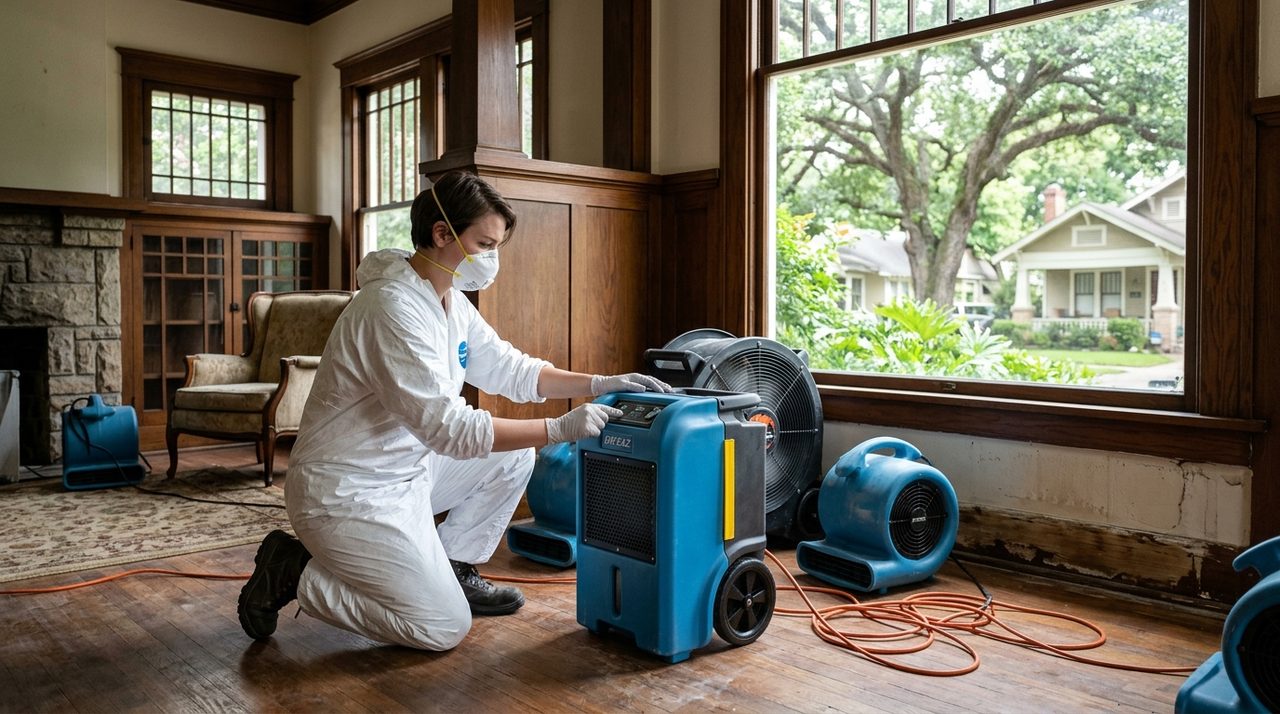
A qualified restoration contractor must verify foundation type before setting equipment—pull permit records from the City of West University Place or hire a structural engineer to confirm if drawings are unavailable. For slab homes, this means deploying desiccant dehumidifiers at the perimeter and using thermal imaging to trace the saturation front inside walls. For pier-and-beam cottages, inspection of the crawl space with a moisture meter across every joist bay is required before any drywall or flooring work begins above. Drying logs must be maintained per IICRC S500 standards to document the extended timeline these soil conditions create.
Sources: IICRC (water/mold restoration standards), Municipal permit office (see area profile)
Why it matters to you
The original bungalows and cottages that survived West University's teardown cycle—roughly the 28% that owner-occupants chose to renovate rather than replace—frequently still carry galvanized steel supply lines that corrode from the inside out. When these lines fail, water doesn't announce itself like a bayou backup; it seeps slowly inside wall cavities, beneath hardwood floors, and into the subfloor for days or weeks before a stain appears on the ceiling or a floor section buckles. Uri-era pipe bursts (February 2021) compounded the problem: many West U homeowners with older plumbing made cosmetic surface repairs but never fully dried wall cavities, leaving residual moisture and microbial growth hidden behind undisturbed original drywall.
What a good pro does
Any restoration contractor working in a pre-1960 West U home should probe for Uri-era secondary damage as part of initial scoping—use a pin-type moisture meter and thermal camera across every exterior wall plane before assuming the claim is limited to the obvious damage. If mold is suspected, Texas law requires that assessment and remediation be handled by a TDLR-licensed Mold Assessment Consultant (MAC) or Mold Remediation Contractor (MRC) respectively. Plumbing repairs exposing corroded galvanized lines require a TSBPE-licensed plumber; the restoration firm typically pulls the demolition permit through the City of West University Place while the plumber pulls a separate trade permit.
Sources: Texas Department of Licensing & Regulation, Texas State Board of Plumbing Examiners, Municipal permit office (see area profile), IICRC (water/mold restoration standards)
Why it matters to you
The post-1980s custom homes that now dominate West University streets—Georgian-influenced two-stories, brick veneer exteriors, complex hipped and gabled rooflines—look like they should be water-tight, but Harvey (2017) and the May 2024 derecho exposed a consistent vulnerability: sustained wind forces water through brick weep holes, window flanges, and soffit vents without producing any visible interior flooding at floor level. In a neighborhood where reconstruction costs run in the $30–$80 per square foot range for affected areas, wall cavity moisture that goes undetected for even a few weeks will require mold remediation on top of the drying and reconstruction bill.
What a good pro does
After any Gulf-track storm or derecho event, a competent restoration contractor should perform a full building envelope scan with a FLIR-class thermal imager, paying particular attention to the intersection of brick veneer and window rough openings and to the underside of soffit vents—the two entry points most commonly breached in West U's two-story custom stock. This is a top-down drying problem, not a bottom-up flood problem, and equipment placement must reflect that. Permits for any structural demolition of sheathing or framing must be pulled through the City of West University Place's permit office before work begins.
Sources: IICRC (water/mold restoration standards), Municipal permit office (see area profile), Harris County Flood Control District
Why it matters to you
Contractors who work primarily in Houston or unincorporated Harris County routinely mis-route restoration permit applications to the City of Houston Permitting Center or Harris County—neither of which has authority inside West University Place's city limits. The City of West University Place runs its own independent building and trade permit office with its own forms, inspection schedule, and turnaround times. Every hour lost to a mis-filed or delayed permit is an hour that saturated drywall, insulation, and bottom plates are actively growing mold: IICRC S500 standards call for drying initiation within 24–48 hours of water intrusion to maintain Category 2 classification and avoid the far more expensive Category 3 full-demo scope.
What a good pro does
Confirm before signing any restoration contract that the firm has pulled permits specifically through the City of West University Place and can name the local inspector cadence. For true emergencies, most jurisdictions—including West U—allow emergency protective work (water extraction, equipment placement, opening wall cavities for airflow) to begin before the permit issues, provided the application is filed simultaneously. Any work touching electrical systems exposed during demo requires a TDLR-licensed electrician pulling a separate permit through the same West U office; do not allow a restoration crew to patch or reconnect electrical without it.
Sources: Municipal permit office (see area profile), IICRC (water/mold restoration standards), Texas Department of Licensing & Regulation, FEMA National Flood Hazard Layer (NFHL)
Hiring water & flood restoration in West University? West University Place is an independent municipality within the Inner Loop featuring a mix of original 1930s–1950s bungalows and larger custom homes built from the 1980s onward as teardown-rebuild cycles reshaped the neighborhood. Homeowners here navigate the city's own permitting process—separate from Houston's—and must account for aging systems in older homes alongside modern construction standards in newer builds. The tree-lined streets and high property values drive demand for premium finishes and careful code compliance.
Building era
Mixed: original homes from 1930s–1950s with significant infill and teardown-rebuild construction from the 1980s–2000s and continuing today.
Typical style
Traditional brick, Georgian/Colonial-influenced, neo-traditional custom homes (2-story), with some remaining early-20th-century bungalows and cottages.
Foundations
Not confirmed from available sources - likely mixed pier-and-beam on older pre-1950s homes and slab-on-grade on newer construction. Verify on a per-property basis.
Common systems
Older homes (1930s–1950s) may have original galvanized or cast-iron plumbing, outdated electrical panels, and window AC or early central HVAC. Newer construction (1980s–present) typically features copper or PEX plumbing, modern electrical, and high-efficiency central HVAC systems.
What that means for repairs
Teardown-and-rebuild activity has been the dominant renovation pattern for decades, replacing smaller original cottages with larger custom homes. Remaining older homes frequently undergo full-gut renovations including electrical rewiring, plumbing replacement, foundation repair, and HVAC modernization to meet current standards and market expectations.
Permit jurisdiction
City of West University Place (independent municipality - own permit office, not City of Houston Permitting Center and not Harris County).
HOA & deed restrictions
No mandatory city-wide master HOA. West U functions as an independent municipality with its own zoning and code enforcement. Individual condo and townhome associations exist (e.g., The Oaks at West University Condominium Association), but most single-family homes have no HOA. Deed restrictions may exist on individual plats—check Harris County Clerk records for specific lots.
Historic districts
No City of Houston historic district designation applies. West University Place is an independent municipality outside Houston city limits, so HAHC Certificates of Appropriateness are not required. West U may have its own local design or zoning controls—check with the City of West University Place directly.
Contractor note
Contractors must pull permits through the City of West University Place, not through Houston or Harris County. West U's own inspectors enforce local codes, and the city's zoning and building requirements may differ from Houston's, so contractors unfamiliar with the jurisdiction should review local ordinances before bidding.
FEMA flood zone
FEMA Zone X500 (moderate flood risk) per official NFHL data. West University Place sits between Brays Bayou to the south and Rice University to the east, with drainage flowing into Harris County Flood Control District channels.
Hurricane Harvey impact
Specific Harvey 2017 flood impact data for West University Place streets was not available in the research provided. The moderate flood risk zone designation and proximity to Brays Bayou suggest potential vulnerability, but confirmed street-level flooding details and repetitive-loss areas should be verified through HCFCD inundation maps and City of West University Place floodplain reports.
Heat & humidity load
Houston's extreme summer heat and humidity stress HVAC systems across all housing eras. Older pier-and-beam homes may experience moisture-related subfloor issues, while the mature tree canopy—a signature feature of West U—creates ongoing gutter maintenance demands and potential root intrusion into aging sewer lines.
Working with contractors here
Contractors in West University most commonly handle full-home renovations and teardown-rebuilds, driven by buyers acquiring older cottages on valuable lots and replacing them with larger custom homes. For surviving 1930s–1950s homes, foundation repair, whole-house repiping (replacing galvanized with copper or PEX), electrical panel upgrades, and HVAC replacement are frequent scopes. Newer 1990s–2000s homes generate demand for roof replacements, exterior paint, and kitchen/bath remodels as they reach their first major maintenance cycles. Job scoping must account for West University Place's independent permitting process, which can differ from Houston's in turnaround times and inspection requirements. The high-end market expectations in West U mean contractors should budget for premium materials and meticulous finish work.
Local Tip
Always ask for a written estimate before work begins. Texas contractors are required to provide one on jobs over $1,000.
West University Place is an independent municipality within the Inner Loop featuring a mix of original 1930s–1950s bungalows and larger custom homes built from the 1980s onward as teardown-rebuild cycles reshaped the neighborhood. Homeowners here navigate the city's own permitting process—separate from Houston's—and must account for aging systems in older homes alongside modern construction standards in newer builds. The tree-lined streets and high property values drive demand for premium finishes and careful code compliance.
Source: U.S. Census Bureau, ACS 5-Year 2023
West University carries FEMA Zone X500 (moderate flood risk): outside the 100-year floodplain but inside the 500-year, so heavy-rain events still reach homes and flood-aware work pays off.
Source: FEMA National Flood Hazard Layer (NFHL). Flood zones vary by parcel — verify your individual FIRM panel.
Pre-storm, arrange for a water-restoration professional to clear and test any sub-slab drainage or interior French-drain systems serving your West University home, since FEMA Zone X500 in the 500-year floodplain conditions can still deliver several feet of standing water during a slow-moving storm. Identifying extraction access points in advance cuts response time when the 48-hour mold clock starts. Confirm the current FEMA panel for your West University parcel — the area maps to Zone X500, but adjacent lots can differ.
Severe thunderstorms drop two to four inches of rain in under an hour regularly across the Houston metro, and in West University that volume can back up through floor drains or HVAC condensate lines into finished spaces even without mapped floodplain exposure. Scheduling a post-storm moisture assessment with an IICRC WRT-certified technician after any significant squall prevents slow saturation from reaching the mold-growth threshold. In-city West University work falls under City of Houston floodplain and permitting rules.
Hard freezes cause polybutylene and CPVC supply lines in West University attics and exterior walls to split, releasing water that travels along ceiling joists and saturates insulation in rooms far from the break. A water-restoration technician using thermal cameras can locate all wet assemblies, not just the obviously damaged ones, and develop a targeted drying plan that prevents secondary losses. In-city West University work falls under City of Houston floodplain and permitting rules.
Sources: FEMA National Flood Hazard Layer (NFHL), Ready.gov -- Hurricanes, CenterPoint Energy -- Storm Center, City of Houston -- Emergency Preparedness, Ready.gov -- Winter Weather, Harris County Flood Control District
Houston-specific estimators to plan your project before you call a pro. All results are planning estimates — a licensed local pro confirms the details on site.
Disconnect & drain every outdoor hose bib
Remove hoses, drain the spigots, and cover each with an insulated faucet sock. Un-drained hose bibs are the #1 burst point in a Houston freeze.
Insulate exposed pipes in the attic & garage
Wrap any pipe in an unconditioned space (attic runs, garage walls) with foam sleeves. Houston homes rarely insulate these because they only matter a few nights a year — which is exactly why they burst.
Open cabinet doors & keep a pencil-width drip
On hard-freeze nights, open kitchen/bath cabinets so warm air reaches the pipes and let faucets on exterior walls drip to relieve pressure.
Protect the attic/garage water heater & its lines
An attic or garage tank sits in unconditioned space. Insulate the cold-inlet and hot-outlet lines and confirm the emergency drain pan is clear so a leak doesn't reach the ceiling.
This is a planning estimate only — actual requirements depend on an on-site assessment by a licensed Houston pro. If a pipe has already burst, shut off your main water supply and call a licensed Houston plumber immediately — freeze bursts flood fast.
Sources: Municipal permit office (see area profile)
Sources: Texas State Board of Plumbing ExaminersMunicipal permit office (see area profile)
Sources: Texas Department of Licensing & RegulationIICRC (water/mold restoration standards)