Open Now
5250 Gulfton St Suite 3A, Houston, TX 77081
Bellaire sits almost entirely within FEMA Zone AE, and the aftermath of Hurricane Harvey — which put much of the city under four or more feet of water in August 2017 — triggered a teardown-and-rebuild wave that reshaped entire blocks of 1950s slab-on-grade ranches into elevated two-story homes. That generational shift means a single street can hold a flood-saturated 1962 ranch with galvanized plumbing and original flex duct next door to a 2020 pier-elevated new build, and restoration contractors must scope each property from scratch rather than applying a one-size approach. Every permitted restoration project runs through the City of Bellaire Building Department — not Houston's permitting center, not Harris County — and an elevation certificate review must precede any scope discussion.
Ranked by verified Google rating × review volume × verification tier. How we rank →
Some highly-rated pros serve Bellaire from nearby and may not keep a Bellaire street address. Those are listed under "Also serving Bellaire" with their real city and distance, so you always know where each business is based.
5250 Gulfton St Suite 3A, Houston, TX 77081
5901 Bellaire Blvd Ste C, Houston, TX 77081
Highly-rated pros based nearby who cover Bellaire. Distance shown from the Bellaire area.
Serving Bellaire Based in Braeswood · 1.2 mi away
Serving Bellaire Based in Tanglewood · 2.2 mi away
Serving Bellaire Based in Tanglewood · 2.3 mi away
Serving Bellaire Based in Tanglewood · 2.4 mi away
Serving Bellaire Based in Sharpstown · 2.6 mi away
Serving Bellaire Based in Upper Kirby · 2.7 mi away
Serving Bellaire Based in Galleria · 2.8 mi away
Serving Bellaire Based in Upper Kirby · 2.9 mi away
Why it matters to you
Because Bellaire maps almost entirely to FEMA Zone AE, the city's older 1950s–60s slab-on-grade ranches have absorbed floodwater not just from Harvey in 2017 but from earlier Tax Day and Memorial Day floods and, for many properties, Beryl in 2024. FEMA Repetitive Loss and Severe Repetitive Loss designations are common on these corridors, meaning your slab edge, bottom plates, and wall cavities may carry cumulative moisture damage from multiple inundation cycles — not just the most recent event. Each successive flood event re-saturates wood framing that never fully dried from the last one, compressing the IICRC S500 drying window and frequently elevating a repair scope into full structural demo.
What a good pro does
A qualified restoration contractor should pull the property's flood claim history through FEMA's NFIP records before finalizing scope, then use thermal imaging and calibrated moisture meters to map cumulative saturation rather than relying solely on the visible flood line. Any restoration work constituting a 'substantial improvement' (generally exceeding 50% of market value) triggers Bellaire's requirement to elevate the structure to meet the 500-year floodplain elevation — confirm current BFE with the City of Bellaire Building Department before scoping reconstruction. Firms performing mold assessment or remediation must hold a TDLR-issued Mold Remediation Contractor license under Texas Occupations Code Chapter 1958.
Sources: FEMA National Flood Hazard Layer (NFHL), Harris County Flood Control District, IICRC (water/mold restoration standards), Texas Department of Licensing & Regulation, Municipal permit office (see area profile)
Why it matters to you
Bellaire's Beaumont-series clay soil — the same expansive black clay that runs through the inner loop — retains standing water against the slab perimeter long after street-level flooding recedes, often for two to four weeks depending on drainage conditions. For the city's surviving slab-on-grade ranches, this means floodwater continues wicking upward through the slab edge and into bottom plates and drywall even after dehumidifiers are set and visible puddles are gone. Homeowners who pull equipment too early based on ambient readings often discover active mold growth behind undisturbed drywall weeks later.
What a good pro does
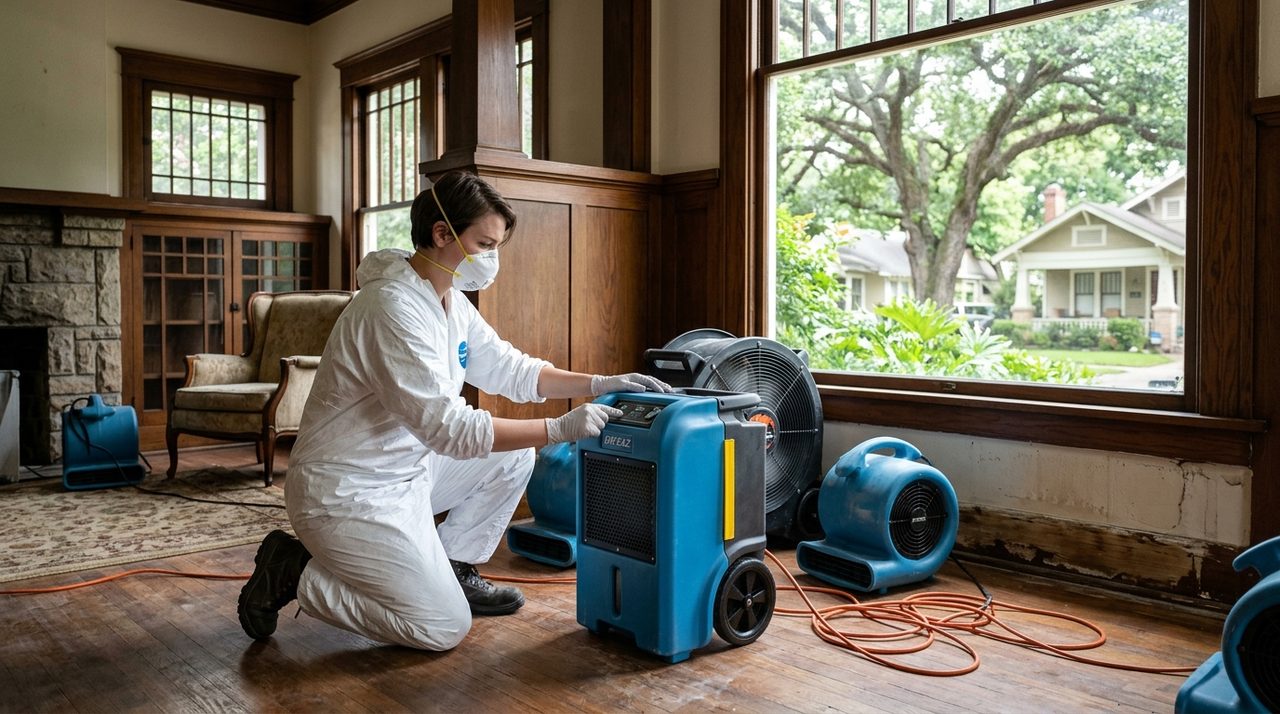
Restoration crews should take daily psychrometric readings at the slab perimeter and compare them against IICRC S500 drying goals — not just center-room humidity — before declaring structural dry-out complete. Drywall and flooring adjacent to exterior walls on slab-on-grade properties should be probed with pin meters or non-destructive moisture scanners at each monitoring visit. The restoration contractor typically pulls the demolition permit through the City of Bellaire Building Department; any plumbing lines exposed during demo require a TSBPE-licensed plumber to pull a separate trade permit through the same office.
Sources: IICRC (water/mold restoration standards), Texas State Board of Plumbing Examiners, Municipal permit office (see area profile)
Why it matters to you
Bellaire's pre-2000 ranch stock — and many 1990s infill builds — commonly used flex duct run through unconditioned attic space or, in the original 1950s–60s construction, under-slab duct chases that directly contact floodwater. When these ducts flood, their fiberglass insulation liner absorbs and holds moisture at the precise temperature and humidity levels (Bellaire's summer ambient averages above 74% RH) needed for Cladosporium and Aspergillus to establish colonies within 48–72 hours. Homeowners sometimes restore and restart HVAC before duct inspection is complete, inadvertently distributing mold spores through the conditioned space.
What a good pro does
Restoration contractors should scope a full duct inspection — including camera inspection of any under-slab duct runs — as part of every Bellaire flood claim involving inundation that reached HVAC equipment or return-air grilles. Flex duct that has been inundated for more than 24 hours is generally not salvageable under IICRC S500 Category 3 protocols and should be replaced rather than dried in place. HVAC duct replacement work requires a licensed HVAC contractor; the restoration firm coordinates this trade pull through the City of Bellaire Building Department as part of the overall project permit, not through Houston Permitting Center.
Sources: IICRC (water/mold restoration standards), Texas Department of Licensing & Regulation, Municipal permit office (see area profile)
Why it matters to you
When Brays Bayou overflows its banks — as it did during Harvey and again with Beryl — the water entering Bellaire homes carries sewage contamination that qualifies the loss as Category 3 (black water) under IICRC S500 standards, requiring demolition of all porous materials to at least 12 inches above the flood line. Insurers occasionally attempt to reclassify the loss as Category 2 gray water to narrow the demo scope and reduce payout, a dispute pattern that is especially common on Bellaire properties along or near the Brays Bayou floodway. This classification difference can mean tens of thousands of dollars in covered demo and reconstruction scope.
What a good pro does
Restoration contractors should document the water source with photographs, Harris County Flood Control District bayou gauge data, and on-site microbial or coliform testing results to establish Category 3 classification in writing before submitting the initial estimate to the insurer. The IICRC S500 standard is the industry-accepted protocol for defining water categories and required remediation scope, and restoration firms should reference it explicitly in all scope documentation. Mold assessment and testing, if ordered as part of the dispute, must be conducted by a TDLR-licensed Mold Assessment Consultant under Texas Occupations Code Chapter 1958.
Sources: IICRC (water/mold restoration standards), Harris County Flood Control District, FEMA National Flood Hazard Layer (NFHL), Texas Department of Licensing & Regulation
Hiring water & flood restoration in Bellaire? Bellaire is an incorporated city almost entirely within the FEMA AE high-risk flood zone, which means elevation requirements, floodplain permitting, and post-Harvey rebuilds dominate the home service landscape. Housing stock ranges from 1950s slab-on-grade ranches to elevated new-construction traditionals, so contractors must be prepared for both legacy and modern systems on the same block. The city runs its own permitting office, and deed restrictions vary by subdivision, making pre-project due diligence essential.
Building era
1950s–1960s (original ranch stock) with a major wave of teardown/rebuild infill from the 1990s–2020s, accelerated after Hurricane Harvey.
Typical style
Traditional brick two-story (newer builds), single-story brick ranch (original 1950s–60s stock), transitional/Mediterranean customs, and remaining bungalows/cottages from the 1920s–1940s.
Foundations
Mixed — older homes are commonly slab-on-grade; post-Harvey new construction and major remodels are typically elevated on pier-and-beam or raised structural piers to meet floodplain requirements.
Common systems
Older ranches: original copper or galvanized plumbing, single-stage HVAC, 100–150 amp electrical panels. Newer builds: PEX plumbing, high-efficiency multi-stage HVAC, 200+ amp panels with whole-home surge protection. Tankless water heaters increasingly standard in post-2010 construction.
What that means for repairs
The dominant renovation activity is full teardown-and-rebuild or substantial elevation of existing structures to comply with the city's requirement that permitted construction be above the 500-year floodplain. Post-Harvey, many 1950s–60s ranches were demolished and replaced with larger two-story homes on elevated foundations.
Permit jurisdiction
City of Bellaire Building Department (Bellaire is an incorporated city with its own permitting office, independent of Houston Permitting Center and Harris County).
HOA & deed restrictions
No single city-wide mandatory HOA. Bellaire is composed of individual subdivisions, each with its own recorded deed restrictions. Some subdivisions have mandatory HOAs with dues and architectural controls; others rely on voluntary civic clubs or deed-restriction committees for enforcement. HOA status is lot-specific — check recorded CC&Rs via Harris County property records.
Historic districts
No City of Houston historic district designation confirmed. Bellaire is an independent incorporated city and does not fall under the Houston Archaeological and Historical Commission (HAHC).
Contractor note
Bellaire's floodplain regulations require an elevation certificate for most permitted work, and new construction or substantial improvements must meet or exceed the 500-year floodplain elevation. Contractors should confirm current BFE requirements and any deed-restriction architectural controls with the Bellaire Building Department before scoping work.
FEMA flood zone
FEMA Zone AE (high flood risk) — source: fema_nfhl. Virtually the entire city of Bellaire sits within the 100-year floodplain. Brays Bayou runs along Bellaire's northern boundary, and localized drainage issues compound flood risk throughout the city.
Hurricane Harvey impact
Hurricane Harvey (2017) caused significant flooding across Bellaire, inundating a large number of homes — particularly the older slab-on-grade ranch stock. The storm accelerated an already-active teardown cycle, with many flooded homes demolished and replaced by elevated new construction. Post-Harvey, the city enforces strict elevation requirements for permitted work, requiring structures to be built above the 500-year floodplain.
Heat & humidity load
Houston's extreme summer heat and humidity stress older HVAC systems in 1950s–60s ranches, many of which have limited insulation and single-pane windows. Elevated pier-and-beam homes require attention to moisture management and ventilation beneath the structure. Seasonal thunderstorms can overwhelm aging drainage infrastructure, making sump pumps and proper grading critical even for elevated homes.
Working with contractors here
Contractors in Bellaire most commonly handle full teardown-and-rebuild projects, structural elevation of existing homes, and flood damage remediation — all driven by the city's AE flood zone status and post-Harvey rebuilding activity. Older 1950s–60s ranches frequently need complete plumbing re-pipes (galvanized-to-PEX), electrical panel upgrades, and HVAC replacement. Because Bellaire is an incorporated city with its own building department, contractors must pull permits through the City of Bellaire rather than Harris County or Houston, and must navigate subdivision-specific deed restrictions that can impose setback, height, and material requirements. Job scoping should always begin with an elevation certificate review and a check of the property's specific deed restrictions and HOA status, as these vary block by block.
Local Tip
Always ask for a written estimate before work begins. Texas contractors are required to provide one on jobs over $1,000.
Bellaire is an incorporated city almost entirely within the FEMA AE high-risk flood zone, which means elevation requirements, floodplain permitting, and post-Harvey rebuilds dominate the home service landscape. Housing stock ranges from 1950s slab-on-grade ranches to elevated new-construction traditionals, so contractors must be prepared for both legacy and modern systems on the same block. The city runs its own permitting office, and deed restrictions vary by subdivision, making pre-project due diligence essential.
Source: U.S. Census Bureau, ACS 5-Year 2023
Much of Bellaire maps to FEMA Zone AE (high flood risk), so flood-resilient detailing -- elevated equipment, water-tolerant materials, and drainage-first thinking -- is essential here, not optional.
Source: FEMA National Flood Hazard Layer (NFHL). Flood zones vary by parcel — verify your individual FIRM panel.
Flood-control upgrades like interior drainage channels and vapor-barrier reinforcement in crawl spaces are worth completing before June 1 if your Bellaire property sits in FEMA Zone AE inside the 100-year floodplain territory. A credentialed restoration firm can assess residual moisture from prior events that could accelerate mold within the 48-hour window a new storm opens. Confirm the current FEMA panel for your Bellaire parcel — the area maps to Zone AE, but adjacent lots can differ.
After any severe thunderstorm drops concentrated rainfall on Bellaire, have a water-restoration professional perform a moisture scan of attic decking and top-floor ceilings, because wind-lifted shingles allow water tracking that is invisible from below until mold colonies are established. Early extraction and targeted structural drying prevent a minor roof breach from escalating into a category-3 contamination claim. In-city Bellaire work falls under City of Houston floodplain and permitting rules.
When hard freezes cause attic supply lines to burst in Bellaire, water runs through insulation and into ceiling assemblies before the homeowner often detects it, and in a high-flood-risk zone the combination of structural moisture and seasonal groundwater makes thorough structural drying especially critical. A licensed restoration firm can deploy multiple dehumidifiers and document drying to IICRC S500 standards for insurance compliance. With a median build year of 1981, the older building stock here is more exposed to hard-freeze damage than newer construction. In-city Bellaire work falls under City of Houston floodplain and permitting rules.
Sources: FEMA National Flood Hazard Layer (NFHL), Ready.gov -- Hurricanes, CenterPoint Energy -- Storm Center, City of Houston -- Emergency Preparedness, Ready.gov -- Winter Weather, Harris County Flood Control District
Houston-specific estimators to plan your project before you call a pro. All results are planning estimates — a licensed local pro confirms the details on site.
Disconnect & drain every outdoor hose bib
Remove hoses, drain the spigots, and cover each with an insulated faucet sock. Un-drained hose bibs are the #1 burst point in a Houston freeze.
Insulate exposed pipes in the attic & garage
Wrap any pipe in an unconditioned space (attic runs, garage walls) with foam sleeves. Houston homes rarely insulate these because they only matter a few nights a year — which is exactly why they burst.
Open cabinet doors & keep a pencil-width drip
On hard-freeze nights, open kitchen/bath cabinets so warm air reaches the pipes and let faucets on exterior walls drip to relieve pressure.
Protect the attic/garage water heater & its lines
An attic or garage tank sits in unconditioned space. Insulate the cold-inlet and hot-outlet lines and confirm the emergency drain pan is clear so a leak doesn't reach the ceiling.
This is a planning estimate only — actual requirements depend on an on-site assessment by a licensed Houston pro. If a pipe has already burst, shut off your main water supply and call a licensed Houston plumber immediately — freeze bursts flood fast.
Sources: Municipal permit office (see area profile)Texas Department of Licensing & Regulation
Sources: FEMA National Flood Hazard Layer (NFHL)Municipal permit office (see area profile)
Sources: FEMA National Flood Hazard Layer (NFHL)IICRC (water/mold restoration standards)
Sources: IICRC (water/mold restoration standards)Local HOA / deed restrictions (see area profile)
Sources: EPA Lead Renovation, Repair and Painting (RRP) RuleTexas Commission on Environmental Quality