Open Now
Serving Third Ward Based in Midtown · 0.9 mi away
Third Ward's water and flood restoration landscape is shaped by a century-long split in housing stock: pre-1960s pier-and-beam bungalows that absorb and retain moisture in ways slab-on-grade construction does not, sitting alongside post-2000 townhomes whose slab edges face the same Houston Black clay saturation that affects every Inner Loop neighborhood. While most of Third Ward maps to FEMA Zone X, parcels nearest Brays Bayou shift risk dramatically from block to block, and Houston's recurring flash-flood events mean even 'low-risk' bungalows on Truxillo or Southmore see interior water regularly. All restoration permits—demo, plumbing, electrical—run through the Houston Permitting Center, and understanding that workflow is critical before the first dehumidifier is placed.
Ranked by verified Google rating × review volume × verification tier. How we rank →
Some highly-rated pros serve Third Ward from nearby and may not keep a Third Ward street address. Those are listed under "Also serving Third Ward" with their real city and distance, so you always know where each business is based.
Highly-rated pros based nearby who cover Third Ward. Distance shown from the Third Ward area.
Serving Third Ward Based in Midtown · 0.9 mi away
Serving Third Ward Based in EaDo · 1.1 mi away
Serving Third Ward Based in Midtown · 1.2 mi away
Serving Third Ward Based in Midtown · 1.4 mi away
Serving Third Ward Based in Midtown · 1.6 mi away
Serving Third Ward Based in Midtown · 1.6 mi away
Serving Third Ward Based in Midtown · 1.8 mi away
Serving Third Ward Based in Midtown · 1.8 mi away
Serving Third Ward Based in Midtown · 1.9 mi away
Serving Third Ward Based in Midtown · 2 mi away
Why it matters to you
The 1920s–1960s frame bungalows that define much of Third Ward's older blocks—along Tierwester, Ennis, and Blodgett—sit on pier-and-beam foundations with a true crawl space beneath the subfloor. When floodwater or sustained heavy rain enters, it pools under the structure, saturating wood joists, sill plates, and subfloor sheathing for days or weeks after the street clears. Unlike slab construction, there is no concrete barrier to slow upward wicking, so wall cavities and bottom plates absorb moisture from below while still appearing dry from inside the living space.
What a good pro does
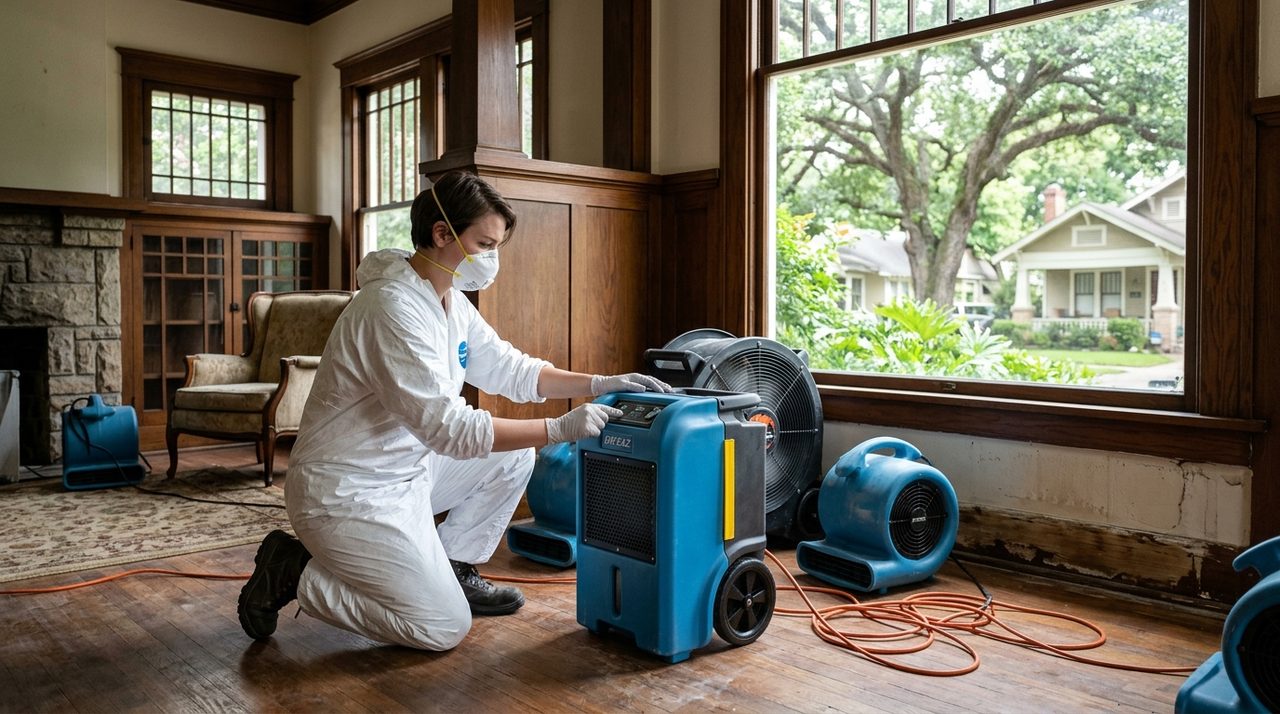
A qualified restoration contractor will use calibrated moisture meters and thermal imaging to map the full moisture column from the crawl space up through the subfloor and into wall cavities before any drying equipment is placed. Drying a pier-and-beam Third Ward bungalow typically requires directed airflow units positioned inside the crawl space simultaneously with interior air movers and dehumidifiers—a multi-day monitored scope, not a one-visit drop-and-leave job. Any structural demo (subfloor replacement, bottom-plate removal) requires a demolition permit through the Houston Permitting Center before work begins.
Sources: IICRC (water/mold restoration standards), City of Houston Permitting Center
Why it matters to you
Third Ward's southern edge runs close to Brays Bayou, and during events like Harvey (2017) or Beryl (2024), bayou overflow carries sewage-contaminated water onto lots along Blodgett and nearby streets—automatically qualifying as Category 3 (black water) under IICRC S500 standards. Category 3 losses require full demolition of all porous materials—drywall, insulation, flooring, bottom plates—to at least 12 inches above the flood line, a far more extensive and expensive scope than a clean-water pipe burst. Insurers sometimes attempt to reclassify bayou-origin losses as Category 2 to reduce the payout, which is both scientifically inaccurate and leaves contaminated materials in the wall assembly.
What a good pro does
Restoration contractors working Brays-adjacent Third Ward blocks should document the water source with photographs, water-origin notes, and on-site testing results at the time of loss, creating a defensible file that supports Category 3 classification through the insurance claim process. HCFCD flood records can corroborate bayou overflow timing for specific storm events, strengthening the scope defense. The full demo required for a Category 3 loss—commonly $15,000–$40,000 in mitigation alone before any reconstruction—must be permitted through the Houston Permitting Center, and the restoration contractor typically pulls the demolition permit while licensed plumbing and electrical sub-trades pull their own.
Sources: IICRC (water/mold restoration standards), Harris County Flood Control District, City of Houston Permitting Center
Why it matters to you
Many of Third Ward's older bungalows still run window units or early-generation central systems with flex duct installed before modern moisture standards; some have supply runs that were retrofitted through the crawl space, placing insulated flex duct directly in the zone where floodwater lingers longest. Once duct insulation absorbs water, Houston's average 74% relative humidity and summer temperatures above 90°F create ideal conditions for Aspergillus and Cladosporium growth within 48–72 hours—well before most homeowners realize the HVAC system is compromised. Running a contaminated system spreads spores through every room in the house.
What a good pro does
Any restoration scope on a Third Ward bungalow that experienced more than 24 hours of inundation should include a documented HVAC duct inspection, with moisture readings taken at the air handler and at multiple duct terminations. Flex duct with confirmed moisture retention typically cannot be dried in place and must be replaced; attempting to salvage saturated duct insulation is a recognized cause of chronic post-restoration mold complaints. Any firm performing mold assessment or remediation in Texas must hold a TDLR-issued Mold Assessment Consultant or Mold Remediation Contractor license under Texas Occupations Code Chapter 1958—homeowners should verify that credential before signing any mold scope contract.
Sources: IICRC (water/mold restoration standards), Texas Department of Licensing & Regulation, Texas Commission on Environmental Quality
Why it matters to you
The post-2000 townhome developments scattered across Third Ward—particularly the attached two- and three-story units near UH and TSU—commonly carry small, project-specific mandatory HOAs governing shared driveways, exterior finishes, and common areas. When a townhome unit suffers water damage requiring exterior access—window flange removal, soffit replacement after wind-driven rain intrusion from events like the May 2024 derecho, or dumpster placement for gut-out debris—those HOA architectural rules technically apply even in an emergency. Delay in initiating drying past the 24–48 hour window identified in IICRC S500 can escalate a Category 2 gray-water loss into a Category 3 contamination scenario.
What a good pro does
Before placing equipment or breaking out any exterior material on a Third Ward townhome, the restoration contractor should identify whether a project-specific HOA governs the property and contact the HOA management directly to obtain written emergency authorization—most HOA documents include an emergency provision that bypasses standard review timelines. Simultaneously, the demolition permit application should be filed with the Houston Permitting Center so structural demo can begin the moment access is cleared. Documenting the exact hour drying equipment was placed and the hour any HOA delay was resolved protects the homeowner if an insurer later disputes the mold remediation scope as preventable.
Sources: IICRC (water/mold restoration standards), Local HOA / deed restrictions (see area profile), City of Houston Permitting Center
Hiring water & flood restoration in Third Ward? Third Ward presents contractors with a split housing stock: early 20th-century pier-and-beam bungalows requiring foundation, plumbing, and electrical upgrades alongside modern slab-on-grade townhomes with contemporary systems. Proximity to Brays Bayou means flood-related remediation and drainage work remain ongoing concerns. The absence of a single mandatory HOA simplifies permitting but project-specific HOAs on newer townhome developments may impose architectural and material requirements.
Building era
1920s–1960s legacy homes with significant 2000s–2020s infill townhome construction.
Typical style
Early 20th-century frame bungalows and cottages; contemporary 2- to 3-story townhomes with attached garages; some student-oriented multifamily near UH and TSU.
Foundations
Mixed — older bungalows predominantly pier-and-beam; newer townhomes and infill predominantly slab-on-grade.
Common systems
Older homes: galvanized or cast-iron plumbing, 60–100 amp electrical panels, window units or aging central HVAC. Newer townhomes: PEX or copper plumbing, 200 amp panels, modern central HVAC with multi-zone capability.
What that means for repairs
Gut renovations and full-system upgrades of pre-1960s bungalows are common as the neighborhood gentrifies. Electrical panel upgrades, re-plumbing from galvanized to PEX, and pier-and-beam foundation leveling are frequent scopes. Newer townhomes see comparatively less renovation but occasional warranty-period repairs and cosmetic upgrades.
Permit jurisdiction
Houston Permitting Center (City of Houston).
HOA & deed restrictions
No single mandatory HOA covers the neighborhood. Multiple voluntary civic clubs operate including Canfield Oaks Civic Association, Third Ward is Home Civic Club, and University Village Civic Club. Newer townhome and condo developments commonly have small, project-specific mandatory HOAs governing shared driveways and common areas.
Historic districts
No City of Houston historic district designation confirmed for Third Ward as a whole. Individual structures may have landmark status — check HAHC records for specific addresses.
Contractor note
Houston has no citywide zoning, so building controls depend on subdivision-level deed restrictions that vary block by block. Contractors working on older homes should verify whether the lot is in a deed-restricted subdivision before proposing accessory structures or lot modifications.
FEMA flood zone
FEMA Zone X (low flood risk) per official NFHL data. However, Third Ward sits directly north of Brays Bayou and includes low-lying areas near bayou tributaries and older storm sewer infrastructure, which can create localized flooding risk not fully captured by Zone X designation.
Hurricane Harvey impact
Third Ward lies within the broader Brays Bayou watershed, which experienced significant flooding during Hurricane Harvey in 2017. However, no neighborhood-specific documentation was found quantifying the extent of Harvey damage or identifying specific flooded streets within Third Ward. Property-level Harvey impact should be verified through FEMA Harvey inundation layers, Harris County Flood Control District mapping tools, and seller's disclosure for any individual address.
Heat & humidity load
Older pier-and-beam bungalows with aging insulation and single-pane windows face extreme summer cooling loads; HVAC systems in these homes are frequently undersized or failing. High humidity under pier-and-beam homes can accelerate subfloor rot and encourage pest infestations. Newer townhomes perform better thermally but three-story designs can struggle with uneven cooling between floors, making multi-zone HVAC balancing a common summer service call.
Working with contractors here
Contractors in Third Ward most commonly handle two categories of work: full-system renovations of pre-1960s bungalows and routine maintenance on post-2000 townhomes. On older homes, pier-and-beam foundation leveling, galvanized plumbing replacement, electrical panel upgrades from 60 to 200 amps, and HVAC installation are the most frequent scopes. Newer townhomes generate calls for HVAC zone balancing, minor foundation settling on slab construction, and cosmetic remodels. Proximity to Brays Bayou means flood damage remediation—including drywall removal, mold treatment, and flooring replacement—remains a recurring need after heavy rain events. Job scoping should account for the wide variance in building age and condition even within a single block, and contractors should verify project-specific HOA requirements on newer developments before beginning exterior work.
Local Tip
Always ask for a written estimate before work begins. Texas contractors are required to provide one on jobs over $1,000.
Third Ward presents contractors with a split housing stock: early 20th-century pier-and-beam bungalows requiring foundation, plumbing, and electrical upgrades alongside modern slab-on-grade townhomes with contemporary systems. Proximity to Brays Bayou means flood-related remediation and drainage work remain ongoing concerns. The absence of a single mandatory HOA simplifies permitting but project-specific HOAs on newer townhome developments may impose architectural and material requirements.
Source: U.S. Census Bureau, ACS 5-Year 2023
Most of Third Ward maps to FEMA Zone X (low mapped flood risk), but Houston's flash-flood reality means even low-risk blocks benefit from smart drainage and storm-hardened installs; risk climbs sharply on blocks nearest Brays Bayou, where it varies parcel to parcel.
Source: FEMA National Flood Hazard Layer (NFHL). Flood zones vary by parcel — verify your individual FIRM panel.
Water-restoration companies serving Third Ward can install or recommend backflow prevention add-ons on floor drains and advise on contents-elevation strategies that limit category-2 water contact during a tropical event. The May 2024 derecho reminded Houston homeowners that extreme rain is not exclusive to named hurricanes, making year-round readiness essential. Because Third Ward drains toward Brays Bayou, block-level runoff can differ sharply from the mapped zone.
Straight-line winds exceeding 80 mph, as recorded during the 2024 derecho, broke seals on sliding glass doors and drove water into flooring assemblies throughout Third Ward neighborhoods with no prior flood history. Contact a licensed Texas restoration firm — TDLR regulates their mold-assessment and remediation work — to inspect and dry any affected areas before summer humidity accelerates microbial growth. Confirm the current FEMA panel for your Third Ward parcel — the area maps to Zone X, but adjacent lots can differ.
A hard freeze in Third Ward can split a single supply line and deposit 50 or more gallons of water into a ceiling assembly before a homeowner locates the shutoff, and that volume requires more than fans and open windows to dry safely. Texas law under TDLR requires mold assessors and remediators to hold specific licenses, so verify your restoration contractor's credentials before you need them under emergency conditions. With a median build year of 1983, the older building stock here is more exposed to hard-freeze damage than newer construction. Because Third Ward drains toward Brays Bayou, block-level runoff can differ sharply from the mapped zone.
Sources: FEMA National Flood Hazard Layer (NFHL), Ready.gov -- Hurricanes, CenterPoint Energy -- Storm Center, City of Houston -- Emergency Preparedness, Ready.gov -- Winter Weather, Harris County Flood Control District
Houston-specific estimators to plan your project before you call a pro. All results are planning estimates — a licensed local pro confirms the details on site.
Disconnect & drain every outdoor hose bib
Remove hoses, drain the spigots, and cover each with an insulated faucet sock. Un-drained hose bibs are the #1 burst point in a Houston freeze.
Insulate exposed pipes in the attic & garage
Wrap any pipe in an unconditioned space (attic runs, garage walls) with foam sleeves. Houston homes rarely insulate these because they only matter a few nights a year — which is exactly why they burst.
Open cabinet doors & keep a pencil-width drip
On hard-freeze nights, open kitchen/bath cabinets so warm air reaches the pipes and let faucets on exterior walls drip to relieve pressure.
Protect the attic/garage water heater & its lines
An attic or garage tank sits in unconditioned space. Insulate the cold-inlet and hot-outlet lines and confirm the emergency drain pan is clear so a leak doesn't reach the ceiling.
This is a planning estimate only — actual requirements depend on an on-site assessment by a licensed Houston pro. If a pipe has already burst, shut off your main water supply and call a licensed Houston plumber immediately — freeze bursts flood fast.
Sources: City of Houston Permitting Center
Sources: IICRC (water/mold restoration standards)FEMA National Flood Hazard Layer (NFHL)
Sources: Local HOA / deed restrictions (see area profile)IICRC (water/mold restoration standards)