Open Now
3222 Burke Rd #109, Pasadena, TX 77504
South Houston's 1950s–1970s slab-on-grade homes sit squarely in FEMA Zone AE, and the community has absorbed multiple catastrophic flood events — including Harvey in 2017 and Beryl in 2024 — that pushed bayou and street water across entire blocks of ranch-style houses. The expansive Beaumont clay beneath these aging slabs holds floodwater against foundation edges long after streets drain, creating hidden moisture problems that outlast the visible damage by weeks. Permits for any restoration work here must run through the City of South Houston's own building department, not the City of Houston's permitting center — a distinction that can delay your insurance claim close-out if your contractor gets it wrong.
Ranked by verified Google rating × review volume × verification tier. How we rank →
Some highly-rated pros serve South Houston from nearby and may not keep a South Houston street address. Those are listed under "Also serving South Houston" with their real city and distance, so you always know where each business is based.
3222 Burke Rd #109, Pasadena, TX 77504
8121 Broadway St Suite 108, Houston, TX 77061
1418 Spencer Hwy ste a5, South Houston, TX 77587
4111 Fairmont Pkwy ste 121, Pasadena, TX 77504
12300 Gulf Fwy suite 517, Houston, TX 77034
3321 Westside Dr Suite A106, Pasadena, TX 77504
3810 Juniper, Houston, TX 77087
Highly-rated pros based nearby who cover South Houston. Distance shown from the South Houston area.
Serving South Houston Based in Pasadena · 2.9 mi away
Serving South Houston Based in Pearland · 6.5 mi away
Serving South Houston Based in Deer Park · 6.6 mi away
Why it matters to you
South Houston's median home was built in 1969 on a conventional slab-on-grade sitting directly on Beaumont Black clay — the same expansive soil that makes foundation repair so routine here. When Harvey or Beryl floodwater covers the slab, that clay absorbs and retains moisture against the foundation perimeter for weeks, continuing to wick into bottom plates and drywall cavities well after the standing water disappears. Homeowners who see dry floors on day three are often looking at still-saturated wall framing at the base of every exterior wall.
What a good pro does
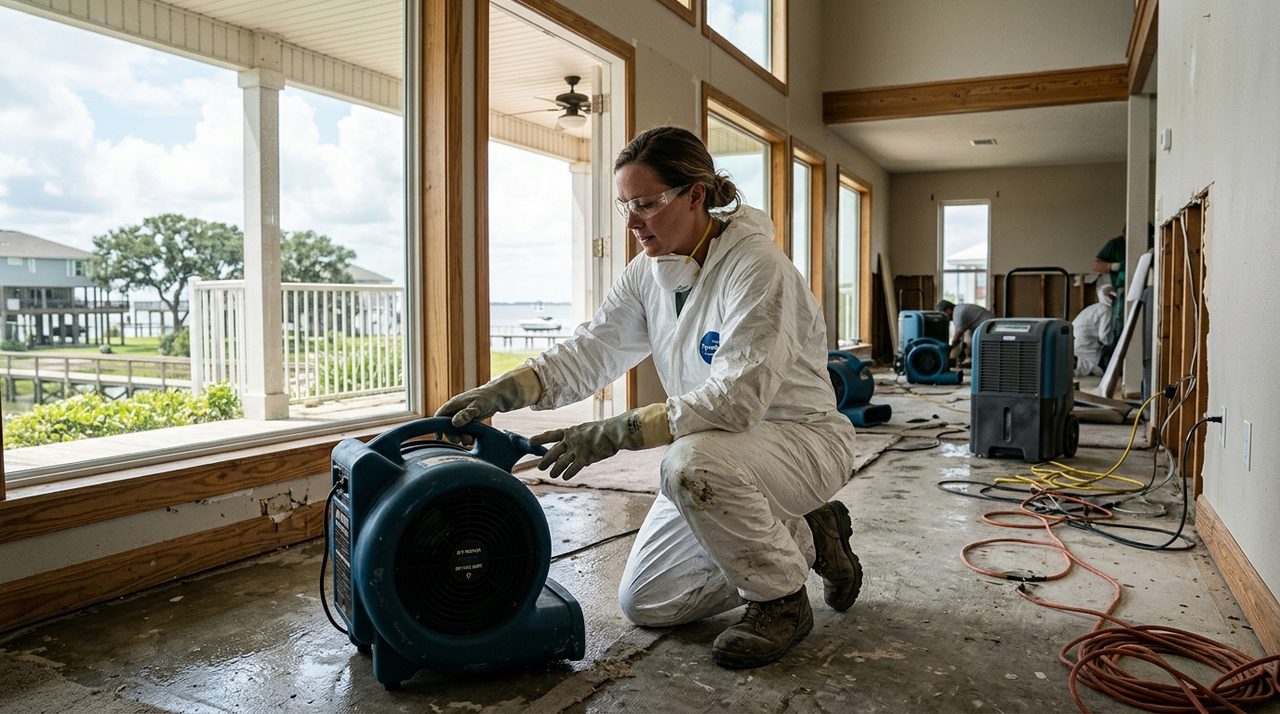
A qualified restoration contractor uses calibrated moisture meters and thermal imaging cameras to map hidden saturation behind baseboards and inside wall cavities before any drying equipment is staged. IICRC S500 drying protocols for slab-on-grade homes require dehumidifier and air-mover placement that addresses lateral wicking from the slab edge — not just top-down drying. Given South Houston's demonstrated history of repeat AE-zone flooding, documentation of each drying log is critical for supporting future insurance scope negotiations.
Sources: IICRC (water/mold restoration standards), FEMA National Flood Hazard Layer (NFHL), Harris County Flood Control District
Why it matters to you
South Houston's postwar housing stock was built well before modern duct standards, and most of these homes still run original or early-replacement flex duct through unconditioned attic space. When floodwater enters a home and the AC system continues to cycle — or restarts before drying is complete — the fiberglass batt insulation wrapped around flex duct absorbs moisture and holds it at temperatures that support rapid Aspergillus and Cladosporium growth within 48 to 72 hours. The median home value here of $176,100 means homeowners are especially sensitive to remediation costs that balloon because duct contamination was not caught early.
What a good pro does
Restoration contractors should inspect all accessible ductwork with a borescope camera and take surface samples at return-air boots and flex-duct joints as part of the initial scope — not as an afterthought. Any firm performing mold remediation must hold a TDLR-issued Mold Remediation Contractor (MRC) license under Texas Occupations Code Chapter 1958. If duct replacement is required, the new installation must be permitted through the City of South Houston's building department, not routed through Houston's permitting center, which does not have jurisdiction here.
Sources: Texas Department of Licensing & Regulation, IICRC (water/mold restoration standards), Municipal permit office (see area profile)
Why it matters to you
South Houston's combined storm and sanitary sewer infrastructure, typical of its postwar construction era, means that any street or bayou overflow carries sewage contamination — making it Category 3 black water under IICRC S500 standards. This classification requires demolition of all porous materials (drywall, insulation, flooring, bottom plates) to at least 12 inches above the flood line. Insurers occasionally attempt to reclassify Harris County street flooding as Category 2 gray water to reduce the required demo scope and limit their payout — a dispute that is especially common in South Houston given the high frequency of repetitive flood claims.
What a good pro does
Restoration contractors should collect water samples at entry points and document the flood source — street overflow, overland flow from adjacent lots, or direct bayou backflow — with photographs and written notes at the time of first inspection. FEMA Repetitive Loss designation on AE-zone parcels in South Houston supports the Category 3 argument because it establishes a documented pattern of bayou-contaminated inundation. These records must be preserved throughout the claim process, as they form the evidentiary backbone of any scope dispute with an adjuster.
Sources: IICRC (water/mold restoration standards), FEMA National Flood Hazard Layer (NFHL), Texas Commission on Environmental Quality
Why it matters to you
South Houston is a fully incorporated municipality surrounded by southeast Harris County, and its building department operates entirely independently of the City of Houston's permitting center. Structural demolition, plumbing line repairs, and electrical panel work exposed during flood restoration all require separate trade permits — and mis-routing an application to Houston's online portal means your permit is simply never issued, stalling the Certificate of Completion that most homeowners need to close out their insurance claim. Adjacent parcels along South Houston's city limits may fall under Harris County Engineering or even Pasadena's ETJ, so jurisdiction must be confirmed at the parcel level before any bid is finalized.
What a good pro does
Before pulling any permit, a responsible restoration contractor confirms the municipal boundary at the specific property address — not the ZIP code or mailing address, both of which can be misleading in this patchwork area. The City of South Houston's building department issues the demolition permit; TSBPE-licensed plumbers and TDLR-licensed electricians pull their own trade permits for any plumbing or electrical scope exposed during demo. Homeowners should request copies of all issued permits and final inspections, since insurers increasingly require permit documentation before releasing reconstruction funds.
Sources: Municipal permit office (see area profile), Texas State Board of Plumbing Examiners, Texas Department of Licensing & Regulation
Hiring water & flood restoration in South Houston? South Houston is a small incorporated city surrounded by southeast Harris County, with a housing stock dominated by 1950s–1970s slab-on-grade homes that face persistent flood risk and foundation movement on expansive clay soils. Homeowners here must prioritize drainage improvements, flood damage mitigation, and aging system upgrades. The patchwork of deed-restricted subdivisions and non-HOA blocks means contractor permitting runs through the City of South Houston rather than Houston's permitting center.
Building era
Primarily 1950s–1970s with some pre-war stock and later infill.
Typical style
Ranch-style and traditional suburban detached single-family homes; some smaller post-war cottages and bungalows in older plats.
Foundations
Predominantly slab-on-grade; limited pier-and-beam in pre-1950 structures.
Common systems
Original galvanized or early copper plumbing in older homes; aging central AC systems often undersized by modern standards; 100-amp electrical panels common in 1950s–1960s builds, many needing upgrade to 200-amp service.
What that means for repairs
Foundation repair and re-leveling are frequent due to expansive clay soils. Post-Harvey flood remediation drove significant interior gut-and-rebuild activity. Electrical panel upgrades and re-plumbing with PEX or copper are common as original systems age out.
Permit jurisdiction
City of South Houston Permitting (separate incorporated city — not Houston Permitting Center). Unincorporated parcels in surrounding SE Harris County fall under Harris County Engineering.
HOA & deed restrictions
No city-wide mandatory HOA identified. The area is a patchwork of deed-restricted subdivisions and non-HOA blocks with some voluntary civic clubs. Specific HOA status must be confirmed through Harris County Clerk deed restriction records or the Texas HOA registry at hoa.texas.gov.
Historic districts
No City of Houston historic district designation confirmed. South Houston is a separate incorporated municipality with no known local historic district overlay.
Contractor note
Contractors must obtain permits through the City of South Houston's own building department, not the City of Houston. Confirm municipal jurisdiction at the parcel level, as adjacent properties may fall under Harris County or Pasadena ETJ depending on exact location.
FEMA flood zone
FEMA Zone AE (high flood risk) per official NFHL data. The area sits in low-lying southeast Harris County near major drainage channels and bayous, contributing to elevated flood exposure during heavy rain events.
Hurricane Harvey impact
Southeast Harris County, including the South Houston and Pasadena corridor, experienced significant street and structure flooding during Hurricane Harvey (2017). Harris County Flood Control District sources confirm widespread inundation in the area, though a detailed street-by-street damage summary specific to the City of South Houston was not located in public records. Given the AE flood zone designation and regional flood patterns, substantial residential flood damage is strongly indicated.
Heat & humidity load
High heat and humidity stress aging HVAC systems in 1950s–1970s homes, many of which have inadequate insulation and single-pane windows. Standing water from summer thunderstorms exacerbates foundation movement on clay soils and creates conditions for mold growth in flood-damaged or poorly ventilated structures.
Working with contractors here
The most common contractor work in South Houston involves foundation repair, flood damage restoration, and drainage improvement — all driven by the AE flood zone designation and expansive clay soils beneath aging slab foundations. HVAC replacement is frequent as original systems in 1950s–1970s homes reach end of life, and many homeowners simultaneously upgrade insulation and ductwork. Electrical panel upgrades from 100-amp to 200-amp service are a routine scope item on renovation projects. Contractors should budget for potential mold remediation discovery during interior remodels, especially in homes that took Harvey flooding. Because South Houston is its own municipality, job scoping should confirm permit jurisdiction before bidding — the city's building department has its own inspection requirements separate from Houston or Harris County.
Local Tip
Always ask for a written estimate before work begins. Texas contractors are required to provide one on jobs over $1,000.
South Houston is a small incorporated city surrounded by southeast Harris County, with a housing stock dominated by 1950s–1970s slab-on-grade homes that face persistent flood risk and foundation movement on expansive clay soils. Homeowners here must prioritize drainage improvements, flood damage mitigation, and aging system upgrades. The patchwork of deed-restricted subdivisions and non-HOA blocks means contractor permitting runs through the City of South Houston rather than Houston's permitting center.
Source: U.S. Census Bureau, ACS 5-Year 2023
Much of South Houston maps to FEMA Zone AE (high flood risk), so flood-resilient detailing -- elevated equipment, water-tolerant materials, and drainage-first thinking -- is essential here, not optional.
Source: FEMA National Flood Hazard Layer (NFHL). Flood zones vary by parcel — verify your individual FIRM panel.
Flood-control upgrades like interior drainage channels and vapor-barrier reinforcement in crawl spaces are worth completing before June 1 if your South Houston, TX property sits in FEMA Zone AE inside the 100-year floodplain territory. A credentialed restoration firm can assess residual moisture from prior events that could accelerate mold within the 48-hour window a new storm opens. Much of the housing stock predates modern wind codes (median build year 1969), so retrofits matter more here. As a Harris County community, South Houston may follow county rather than City of Houston storm rebuild rules.
Straight-line winds from Houston's frequent squall lines can drive water under exterior door thresholds and through weep holes into block or brick veneer in South Houston, TX, saturating insulation in areas that standard air movement cannot dry. A licensed restoration firm with a calibrated moisture meter and low-grain refrigerant dehumidifiers can document and resolve these intrusions before your next storm season adds to existing hidden moisture. Confirm the current FEMA panel for your South Houston parcel — the area maps to Zone AE, but adjacent lots can differ.
Freeze-related water losses in South Houston, TX homes typically affect multiple floors simultaneously as water follows pipe runs downward through wall assemblies, requiring a restoration strategy that addresses vertical moisture migration rather than just visible surface damage. Engage a water-restoration contractor with commercial drying equipment and psychrometric tracking before a re-freeze event catches the structure with unresolved saturation. With a median build year of 1969, the older building stock here is more exposed to hard-freeze damage than newer construction. Confirm the current FEMA panel for your South Houston parcel — the area maps to Zone AE, but adjacent lots can differ.
Sources: FEMA National Flood Hazard Layer (NFHL), Ready.gov -- Hurricanes, CenterPoint Energy -- Storm Center, City of Houston -- Emergency Preparedness, Ready.gov -- Winter Weather, Harris County Flood Control District
Houston-specific estimators to plan your project before you call a pro. All results are planning estimates — a licensed local pro confirms the details on site.
Disconnect & drain every outdoor hose bib
Remove hoses, drain the spigots, and cover each with an insulated faucet sock. Un-drained hose bibs are the #1 burst point in a Houston freeze.
Insulate exposed pipes in the attic & garage
Wrap any pipe in an unconditioned space (attic runs, garage walls) with foam sleeves. Houston homes rarely insulate these because they only matter a few nights a year — which is exactly why they burst.
Open cabinet doors & keep a pencil-width drip
On hard-freeze nights, open kitchen/bath cabinets so warm air reaches the pipes and let faucets on exterior walls drip to relieve pressure.
Protect the attic/garage water heater & its lines
An attic or garage tank sits in unconditioned space. Insulate the cold-inlet and hot-outlet lines and confirm the emergency drain pan is clear so a leak doesn't reach the ceiling.
This is a planning estimate only — actual requirements depend on an on-site assessment by a licensed Houston pro. If a pipe has already burst, shut off your main water supply and call a licensed Houston plumber immediately — freeze bursts flood fast.
Sources: Municipal permit office (see area profile)
Sources: IICRC (water/mold restoration standards)Texas Department of Licensing & Regulation
Sources: FEMA National Flood Hazard Layer (NFHL)Harris County Flood Control District