Open Now
4227 Allen-Genoa Rd, Pasadena, TX 77504
South Houston's housing stock — mostly 1950s–1970s slab-on-grade ranches with median build year 1969 — means a large share of homes are running original or single-replacement AC systems that were never sized for today's cooling loads, and many sit in FEMA Zone AE where outdoor condensers face real flood exposure every heavy rain season. Permits for any equipment replacement or new installation must be pulled through the City of South Houston's own building department, not Houston's Permitting Center, a distinction that trips up contractors unfamiliar with this small incorporated city. If your system is struggling through summer, leaking refrigerant, or was touched by Harvey floodwaters, this page explains what's actually driving those problems in this specific ZIP code.
Ranked by verified Google rating × review volume × verification tier. How we rank →
4227 Allen-Genoa Rd, Pasadena, TX 77504
1212 Illinois St, South Houston, TX 77587
6734 Rupley Cir, Houston, TX 77087
6815 Easthaven Blvd SUITE C-100, Houston, TX 77017
11665 Fuqua St, Houston, TX 77034
8940 Hollock St, Houston, TX 77075
615 Kansas Ave, South Houston, TX 77587
1714 Houston Blvd, South Houston, TX 77587
Galveston Rd, Houston, TX 77034
512 Minnesota St, South Houston, TX 77587
Why it matters to you
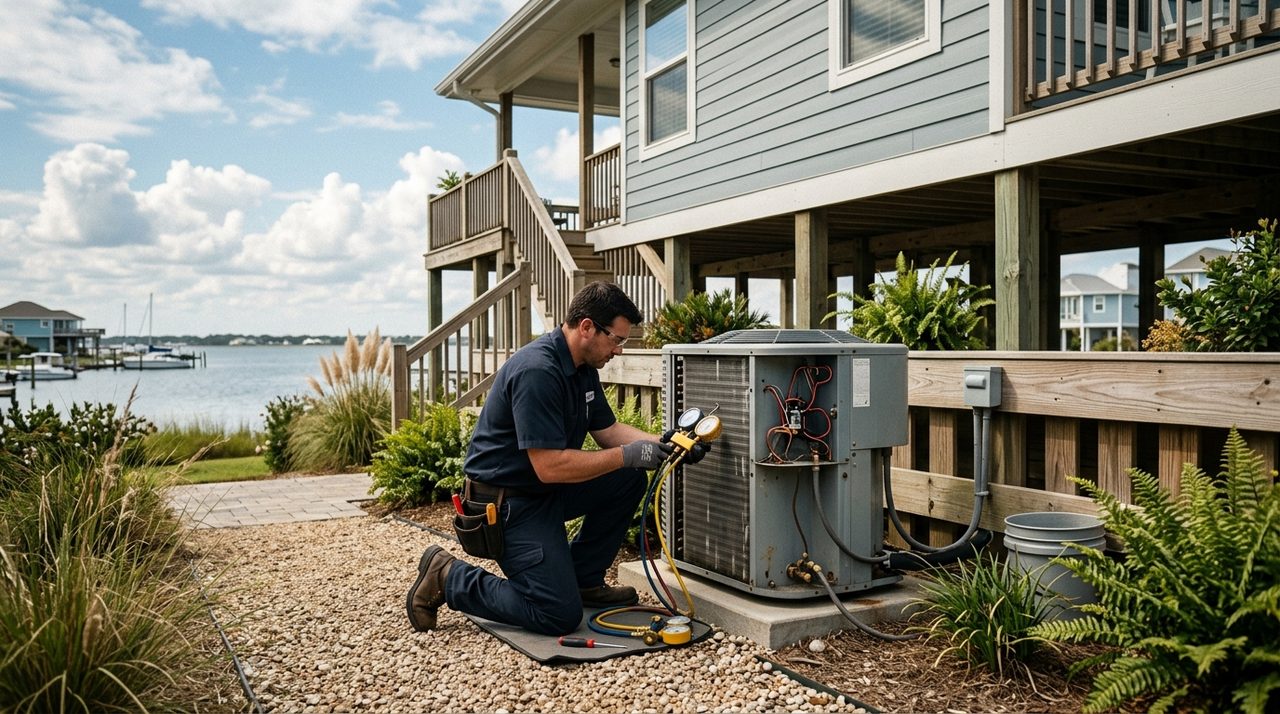
South Houston is largely mapped in FEMA Zone AE, the highest-risk flood designation, and the flat southeast Harris County terrain means even moderate rain events can push standing water across the concrete pads where condenser units sit. When Harvey (2017) and subsequent storms inundated these neighborhoods, outdoor units submerged in floodwater suffered rapid corrosion of copper coils and electrical components in Houston's salt-humid air — damage that often didn't fully manifest until the following cooling season. A home with a median build year of 1969 is also far more likely to have a condenser at original grade level rather than elevated on a raised platform.
What a good pro does
A qualified technician should inspect the condenser coil, contactor, capacitor, and disconnect box for corrosion evidence any time a unit has been submerged or splash-flooded, not just when it stops running. Replacement units in Zone AE lots should be mounted on code-compliant elevated pads — a detail your contractor should document on the permit application filed with the City of South Houston's building department. Post-flood condenser replacement estimates typically run $3,500–$6,500 for a 3-ton unit installed and permitted, and that permit fee ($75–$250 estimated) is paid to South Houston, not to Houston's One-Stop portal.
Sources: FEMA National Flood Hazard Layer (NFHL), Municipal permit office (see area profile), Texas Windstorm Insurance Association (TWIA)
Why it matters to you
A substantial portion of South Houston's 1950s–1970s homes are on their second or third AC system, and many of those replacement units — installed in the 1990s through mid-2000s — run R-22 refrigerant, which the EPA banned from new production as of January 2020. With roughly 54% owner-occupancy and median home values around $176,100, many South Houston homeowners have deferred full replacement hoping to stretch an aging R-22 system, but reclaimed R-22 now runs $80–$150 per pound in the Houston market, making even a small refrigerant leak repair economically irrational compared to replacement. Winter Storm Uri (2021) cracked refrigerant lines and split drain pans across thousands of southeast Houston homes, and deferred repairs from that event are still surfacing as slow leaks in aging R-22 systems.
What a good pro does
Before authorizing an R-22 top-off, ask your technician to run a full leak test and provide a written cost comparison between recharging and replacing. A 3-ton R-410A split system replacement in South Houston typically runs $5,500–$9,500 installed and permitted — often far less than two or three R-22 recharge visits at $600–$1,500 each. Any replacement requires a mechanical permit pulled by a TDLR-licensed contractor through the City of South Houston's building department; homeowners cannot self-pull mechanical permits for HVAC work in this jurisdiction.
Sources: Texas Department of Licensing & Regulation, Municipal permit office (see area profile), EPA Lead Renovation, Repair and Painting (RRP) Rule
Why it matters to you
South Houston's slab-on-grade construction — the standard for virtually every home built in Harris County after 1950 — means there is no crawl space to absorb an overflowing condensate drain pan; that water goes directly onto the slab and into flooring, drywall, and the expansive Beaumont clay beneath. Houston's 90%-plus relative humidity for much of the year keeps evaporator coils running wet continuously, and the air handlers common in these postwar homes were often installed in tight interior closets without secondary drain pans or floor drains. Homes that took Harvey interior flooding are at heightened risk because mold already present in the air handler cavity accelerates biological clogging of condensate lines.
What a good pro does
Condensate drain clearing — one of the most common service calls in southeast Houston — typically costs $95–$225 and should be done at least once per year before cooling season, not reactively after overflow. A thorough technician will also treat the pan with biocide tablets, inspect the secondary drain line, and flag any air handler cabinet showing mold staining from previous flooding. If your home had interior Harvey flooding and the air handler was not fully replaced afterward, request an internal coil inspection — mold in the evaporator section is not always visible from the access panel.
Sources: FEMA National Flood Hazard Layer (NFHL), Texas Department of Licensing & Regulation
Why it matters to you
The high-plasticity Houston Black clay beneath South Houston's slabs expands significantly after rain and shrinks during dry stretches — a cycle that causes differential slab movement and is the primary reason foundation repair and re-leveling are among the most common contractor calls in this neighborhood. For HVAC systems, the same movement stresses refrigerant line sets that run from the air handler through or along the slab to the outdoor unit; original 1970s copper line sets in these homes have already experienced decades of flex, and kinked or micro-cracked lines are a leading source of slow refrigerant leaks that are easy to misdiagnose as compressor wear. Settled concrete equipment pads on the exterior also tilt or crack as the soil beneath them moves, potentially stressing the refrigerant and electrical connections at the condenser.
What a good pro does
When diagnosing a recurring refrigerant leak on a system installed in a 1960s or 1970s South Houston home, a thorough technician should inspect the full length of the line set — not just the service valves — for kinks, oil staining, or insulation damage that signals movement-related stress. Replacing line sets during a full system swap (adding roughly $300–$600 to the job estimate) is nearly always worth it on original 50-year-old installations. Outdoor pad leveling is a simple fix often overlooked; a pad tilted more than a few degrees stresses the refrigerant connections and can void equipment warranties.
Sources: FEMA National Flood Hazard Layer (NFHL), Municipal permit office (see area profile), Texas Department of Licensing & Regulation
Hiring ac repair in South Houston? South Houston is a small incorporated city surrounded by southeast Harris County, with a housing stock dominated by 1950s–1970s slab-on-grade homes that face persistent flood risk and foundation movement on expansive clay soils. Homeowners here must prioritize drainage improvements, flood damage mitigation, and aging system upgrades. The patchwork of deed-restricted subdivisions and non-HOA blocks means contractor permitting runs through the City of South Houston rather than Houston's permitting center.
Building era
Primarily 1950s–1970s with some pre-war stock and later infill.
Typical style
Ranch-style and traditional suburban detached single-family homes; some smaller post-war cottages and bungalows in older plats.
Foundations
Predominantly slab-on-grade; limited pier-and-beam in pre-1950 structures.
Common systems
Original galvanized or early copper plumbing in older homes; aging central AC systems often undersized by modern standards; 100-amp electrical panels common in 1950s–1960s builds, many needing upgrade to 200-amp service.
What that means for repairs
Foundation repair and re-leveling are frequent due to expansive clay soils. Post-Harvey flood remediation drove significant interior gut-and-rebuild activity. Electrical panel upgrades and re-plumbing with PEX or copper are common as original systems age out.
Permit jurisdiction
City of South Houston Permitting (separate incorporated city — not Houston Permitting Center). Unincorporated parcels in surrounding SE Harris County fall under Harris County Engineering.
HOA & deed restrictions
No city-wide mandatory HOA identified. The area is a patchwork of deed-restricted subdivisions and non-HOA blocks with some voluntary civic clubs. Specific HOA status must be confirmed through Harris County Clerk deed restriction records or the Texas HOA registry at hoa.texas.gov.
Historic districts
No City of Houston historic district designation confirmed. South Houston is a separate incorporated municipality with no known local historic district overlay.
Contractor note
Contractors must obtain permits through the City of South Houston's own building department, not the City of Houston. Confirm municipal jurisdiction at the parcel level, as adjacent properties may fall under Harris County or Pasadena ETJ depending on exact location.
FEMA flood zone
FEMA Zone AE (high flood risk) per official NFHL data. The area sits in low-lying southeast Harris County near major drainage channels and bayous, contributing to elevated flood exposure during heavy rain events.
Hurricane Harvey impact
Southeast Harris County, including the South Houston and Pasadena corridor, experienced significant street and structure flooding during Hurricane Harvey (2017). Harris County Flood Control District sources confirm widespread inundation in the area, though a detailed street-by-street damage summary specific to the City of South Houston was not located in public records. Given the AE flood zone designation and regional flood patterns, substantial residential flood damage is strongly indicated.
Heat & humidity load
High heat and humidity stress aging HVAC systems in 1950s–1970s homes, many of which have inadequate insulation and single-pane windows. Standing water from summer thunderstorms exacerbates foundation movement on clay soils and creates conditions for mold growth in flood-damaged or poorly ventilated structures.
Working with contractors here
The most common contractor work in South Houston involves foundation repair, flood damage restoration, and drainage improvement — all driven by the AE flood zone designation and expansive clay soils beneath aging slab foundations. HVAC replacement is frequent as original systems in 1950s–1970s homes reach end of life, and many homeowners simultaneously upgrade insulation and ductwork. Electrical panel upgrades from 100-amp to 200-amp service are a routine scope item on renovation projects. Contractors should budget for potential mold remediation discovery during interior remodels, especially in homes that took Harvey flooding. Because South Houston is its own municipality, job scoping should confirm permit jurisdiction before bidding — the city's building department has its own inspection requirements separate from Houston or Harris County.
Local Tip
Always ask for a written estimate before work begins. Texas contractors are required to provide one on jobs over $1,000.
South Houston is a small incorporated city surrounded by southeast Harris County, with a housing stock dominated by 1950s–1970s slab-on-grade homes that face persistent flood risk and foundation movement on expansive clay soils. Homeowners here must prioritize drainage improvements, flood damage mitigation, and aging system upgrades. The patchwork of deed-restricted subdivisions and non-HOA blocks means contractor permitting runs through the City of South Houston rather than Houston's permitting center.
Source: U.S. Census Bureau, ACS 5-Year 2023
Much of South Houston maps to FEMA Zone AE (high flood risk), so flood-resilient detailing -- elevated equipment, water-tolerant materials, and drainage-first thinking -- is essential here, not optional.
Source: FEMA National Flood Hazard Layer (NFHL). Flood zones vary by parcel — verify your individual FIRM panel.
In South Houston, TX, where FEMA Zone AE inside the 100-year floodplain puts ground-level HVAC equipment at direct risk, have a licensed HVAC technician raise your condenser pad to at least 24 inches above grade before hurricane season — the same measure that saved many units during Harvey 2017. Flood-rated disconnect boxes and waterproof condenser covers add a second layer of protection. Much of the housing stock predates modern wind codes (median build year 1969), so retrofits matter more here. As a Harris County community, South Houston may follow county rather than City of Houston storm rebuild rules.
In South Houston, TX, the May 2024 derecho demonstrated that 80-mph straight-line winds can topple outdoor condenser units even where FEMA Zone AE inside the 100-year floodplain is the more familiar concern — verify anchor bolts and pad integrity after every significant wind event, not just hurricane season. A quick post-storm tilt check costs nothing; a seized compressor from running unlevel can exceed $2,000 in repairs. Confirm the current FEMA panel for your South Houston parcel — the area maps to Zone AE, but adjacent lots can differ.
Freeze-protect your condensate drain line before a hard-freeze warning reaches South Houston, TX; a blocked drain from ice backup can overflow the secondary pan, drip into FEMA Zone AE inside the 100-year floodplain-saturated ceiling drywall, and trigger a mold issue within days of the thaw. Heat-trace tape on the last 12 inches of the drain stub-out is an inexpensive fix a licensed HVAC technician can install in under an hour. With a median build year of 1969, the older building stock here is more exposed to hard-freeze damage than newer construction. Confirm the current FEMA panel for your South Houston parcel — the area maps to Zone AE, but adjacent lots can differ.
Sources: FEMA National Flood Hazard Layer (NFHL), Ready.gov -- Hurricanes, CenterPoint Energy -- Storm Center, City of Houston -- Emergency Preparedness, Ready.gov -- Winter Weather, Harris County Flood Control District
Houston-specific estimators to plan your project before you call a pro. All results are planning estimates — a licensed local pro confirms the details on site.
Living space you want cooled (400–10,000 sq ft).
Recommended nominal size
Estimated cooling load
This is a planning estimate only — actual requirements depend on an on-site assessment by a licensed Houston pro. Houston's humidity and long cooling season make an oversized unit a common, costly mistake — it short-cycles and never dehumidifies. A licensed contractor confirms sizing with a full Manual J calculation.
Disconnect & drain every outdoor hose bib
Remove hoses, drain the spigots, and cover each with an insulated faucet sock. Un-drained hose bibs are the #1 burst point in a Houston freeze.
Insulate exposed pipes in the attic & garage
Wrap any pipe in an unconditioned space (attic runs, garage walls) with foam sleeves. Houston homes rarely insulate these because they only matter a few nights a year — which is exactly why they burst.
Open cabinet doors & keep a pencil-width drip
On hard-freeze nights, open kitchen/bath cabinets so warm air reaches the pipes and let faucets on exterior walls drip to relieve pressure.
Protect the attic/garage water heater & its lines
An attic or garage tank sits in unconditioned space. Insulate the cold-inlet and hot-outlet lines and confirm the emergency drain pan is clear so a leak doesn't reach the ceiling.
This is a planning estimate only — actual requirements depend on an on-site assessment by a licensed Houston pro. If a pipe has already burst, shut off your main water supply and call a licensed Houston plumber immediately — freeze bursts flood fast.
Sources: Municipal permit office (see area profile)Texas Department of Licensing & Regulation
Sources: ENERGY STAR / U.S. Dept. of Energy
Sources: Texas Department of Licensing & RegulationMunicipal permit office (see area profile)FEMA National Flood Hazard Layer (NFHL)Texas Windstorm Insurance Association (TWIA)
Sources: Local HOA / deed restrictions (see area profile)Municipal permit office (see area profile)