Open Now
11111 Jones Rd W, Houston, TX 77065
Jersey Village sits almost entirely within FEMA Zone AE, straddling White Oak Bayou and its tributaries, and its 1960s–1980s slab-on-grade brick homes took repeated punches from Harvey in 2017 and Beryl in 2024 — with the same structures flooded multiple times in a single decade. Understanding what that repeated saturation does to a 50-year-old concrete slab, galvanized plumbing, and original flex ductwork is the difference between a surface fix and a restoration that actually holds. Because Jersey Village is its own incorporated city, every demolition, electrical, and plumbing permit tied to your flood claim routes through the City of Jersey Village's permit office — not Houston, not Harris County.
Ranked by verified Google rating × review volume × verification tier. How we rank →
11111 Jones Rd W, Houston, TX 77065
10646 W Little York Rd # 320, Houston, TX 77041
6830 N Eldridge Pkwy #208, Houston, TX 77041
11116 W Little York Rd Suite 3, Houston, TX 77041
13735 FM 529, Houston, TX 77041
11875 W Little York Rd Suite 1001, Houston, TX 77041
10633 W Little York Rd Ste 250, Houston, TX 77041
17350 TX-249 Ste 220 #10793, Houston, TX 77064
13202 Weiman Rd, Houston, TX 77041
8872 Fallbrook Dr, Houston, TX 77064
Why it matters to you
Because so much of Jersey Village maps to FEMA Zone AE along White Oak Bayou and its local tributaries, many homes here are on FEMA Repetitive Loss or Severe Repetitive Loss rolls — meaning they flooded in Harvey (2017) and again in Beryl (2024), sometimes with additional events in between. Each successive flood drives water deeper into the slab edge and bottom plates of these 1960s–1980s ranch homes, and Houston Black clay soil holds that moisture against the foundation perimeter long after visible water is gone, compounding structural saturation that a single-event drying scope will miss entirely.
What a good pro does
A qualified restoration contractor should pull HCFCD flood history and any prior claim documentation before scoping the job, then use calibrated moisture meters and thermal imaging across the full perimeter to detect legacy saturation from previous events — not just the most recent one. Under IICRC S500 standards, Category 3 water (bayou overflow, which carries combined sewer contamination during major storms) requires demolition of all porous materials at least 12 inches above the flood line; that standard applies to every flood event, not just the first one, and the scope must reflect accumulated damage rather than treating the home as if it were freshly dry.
Sources: Harris County Flood Control District, IICRC (water/mold restoration standards), FEMA National Flood Hazard Layer (NFHL)
Why it matters to you
Jersey Village's housing stock was built almost entirely on conventional slab-on-grade foundations before post-tension techniques became standard, and there is no crawl space to buffer or ventilate. When floodwater from White Oak Bayou or local storm drainage backs into these homes, it infiltrates the slab edge and wicks upward into the original wood bottom plates and drywall for weeks — long after your interior looks dry to the eye. The expansive clay soils characteristic of this part of Harris County act like a sponge against the outside of the slab, keeping the foundation perimeter wet and extending the effective drying timeline dramatically compared to newer construction.
What a good pro does
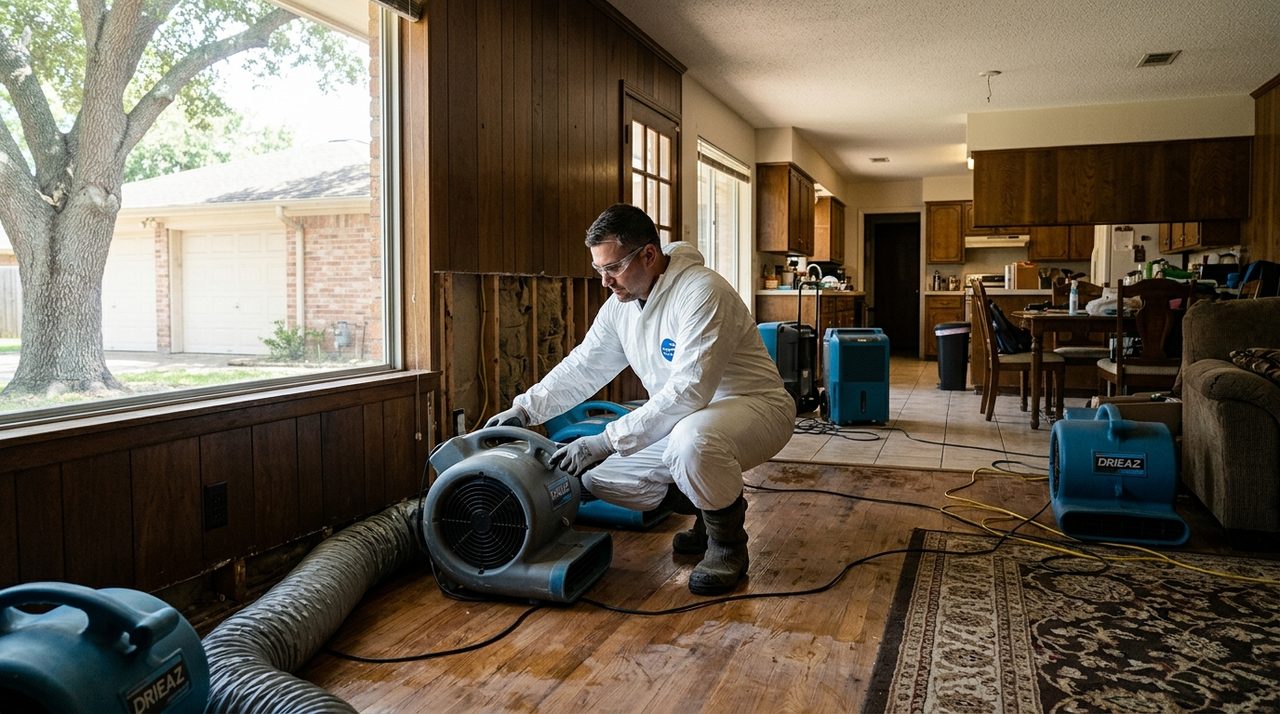
Restoration professionals working in Jersey Village should plan for extended drying timelines — often 5 to 10 days of active structural drying rather than the 3-day baseline that may apply in other regions — and must document daily psychrometric readings to satisfy both IICRC S500 protocols and insurance carrier documentation requirements. Desiccant or refrigerant dehumidifiers must be sized for Houston's ambient 74% relative humidity, not generic national specs, and bottom-plate moisture readings should drive the decision to demo rather than visual inspection alone.
Sources: IICRC (water/mold restoration standards), FEMA National Flood Hazard Layer (NFHL)
Why it matters to you
Many Jersey Village homes built in the 1960s through 1980s still carry their original or early-replacement flex duct systems, and some older configurations run supply ducts through unconditioned attic space or even near-slab chases. When floodwater enters — as it did for a significant portion of the city during Harvey and again during Beryl — the fiberglass batt insulation wrapped around flex duct absorbs moisture and retains it even after the interior is dried down. At Jersey Village's summer ambient conditions (90°F-plus, relative humidity above 70%), Aspergillus and Cladosporium colonies can establish within 48 to 72 hours of initial wetting, turning the duct system into a distribution network for mold spores throughout the living space.
What a good pro does
Any restoration scope on a Jersey Village home that experienced more than 24 hours of inundation should include a dedicated duct inspection using moisture readings and, where warranted, borescope imaging before the HVAC system is restarted. If insulation shows moisture retention or microbial growth is present, full duct replacement is the correct scope — not spot patching. Any firm performing mold assessment or remediation in Texas must hold a TDLR-issued Mold Assessment Consultant (MAC) or Mold Remediation Contractor (MRC) license under Texas Occupations Code Chapter 1958; homeowners should verify that credential before any mold-related work begins.
Sources: Texas Department of Licensing & Regulation, IICRC (water/mold restoration standards), Texas Commission on Environmental Quality
Why it matters to you
Jersey Village is an incorporated city with its own building codes, inspection staff, and permit office, fully independent of the Houston Permitting Center and Harris County. Homeowners and their contractors who default to pulling permits through Houston's online portal — a common mistake given Jersey Village's location within the greater Houston metro — will find those permits invalid, which can void insurance certificates of completion and trigger stop-work orders mid-restoration. Structural demolition, any plumbing work on the galvanized or copper lines common in these 1960s–1980s homes, and any electrical work uncovered during demo all require separate permits through the city's own system.
What a good pro does
Before any restoration work begins, confirm that your contractor has worked specifically with the City of Jersey Village permit office and understands its inspection cadence and submittal requirements. The restoration contractor typically pulls the demolition permit directly; TSBPE-licensed plumbers and TDLR-licensed electricians must each pull their own trade permits through the city. Delaying this step — or mis-routing paperwork — can hold up the Certificate of Completion your insurance carrier needs to close the claim, adding weeks to an already difficult recovery.
Sources: Municipal permit office (see area profile), Texas State Board of Plumbing Examiners, Texas Department of Licensing & Regulation
Hiring water & flood restoration in Jersey Village? Jersey Village is an independent municipality with a housing stock predominantly built between the 1960s and 1980s, featuring ranch-style and traditional brick homes on concrete slab foundations. Homeowners face significant flood risk due to proximity to White Oak Bayou and tributaries, making drainage, foundation maintenance, and flood mitigation among the most critical home service needs. The city handles its own code enforcement and permitting, so contractors must work through the City of Jersey Village rather than Houston or Harris County offices.
Building era
1960s–1980s, with some later infill construction.
Typical style
Ranch-style and traditional two-story brick homes with attached garages; suburban production architecture typical of northwest Houston.
Foundations
Slab-on-grade (dominant); pier-and-beam may exist on rare older or custom structures but is not documented.
Common systems
Original homes likely have copper or galvanized steel plumbing (transitioning to CPVC/PEX in later builds), R-22 refrigerant HVAC systems nearing or past end of life, and 100–200 amp electrical panels. Many systems in this era are candidates for full replacement.
What that means for repairs
Kitchen and bathroom remodels are common as homeowners update 40–60-year-old finishes. Re-piping from galvanized to PEX, HVAC upgrades to modern refrigerant systems, and flood-related restoration work (raised electrical panels, moisture-resistant materials) are frequent renovation drivers.
Permit jurisdiction
City of Jersey Village Permitting (independent municipality – permits are not issued through Houston Permitting Center or Harris County).
HOA & deed restrictions
No mandatory city-wide HOA for core Jersey Village neighborhoods; property standards are enforced through city code enforcement and deed restrictions. The Park at Jersey Village HOA exists but appears to be a separate, newer subdivision not located in the traditional Jersey Village city limits. Specific section-level deed restrictions may exist but were not confirmed in public records.
Historic districts
No City of Houston historic district designation confirmed. Jersey Village is an independent city and not subject to HAHC review.
Contractor note
Contractors must obtain permits through the City of Jersey Village, which has its own building codes, inspections, and zoning requirements separate from both Houston and Harris County. Familiarity with the city's specific permit process and code enforcement standards is essential.
FEMA flood zone
FEMA Zone AE (high flood risk) — source: fema_nfhl. Jersey Village is situated near White Oak Bayou and associated tributaries, placing much of the community in a designated high-risk floodplain with base flood elevations established.
Hurricane Harvey impact
Jersey Village is in a bayou-adjacent northwest Harris County area that experienced flooding during Hurricane Harvey, though a precise street-by-street damage assessment specific to the City of Jersey Village was not confirmed in available public records. The White Oak Bayou corridor and tributaries in this area flooded significantly. Homeowners should check HCFCD flood layers, FEMA FIRM maps, and property-level flood loss history (CLUE reports) for individual address risk.
Heat & humidity load
Houston's extreme summer heat and humidity place heavy demand on aging HVAC systems common in 1960s–80s homes, often triggering emergency repairs or full system replacements. Slab foundations in clay-heavy soils can shift with summer drought cycles, and prolonged moisture from summer storms combined with Zone AE flood risk can lead to mold, moisture intrusion, and recurring drainage issues.
Working with contractors here
Contractors in Jersey Village most commonly work on HVAC replacement, re-piping, foundation repair, and flood damage restoration driven by the aging 1960s–80s housing stock and high flood risk. Slab foundation repair is a frequent need as expansive clay soils shift seasonally, and many homes still have original galvanized plumbing requiring full re-pipes. Flood mitigation work—including raising electrical panels, installing sump systems, and replacing flood-damaged drywall and flooring with moisture-resistant materials—is a significant segment of the local market. Because Jersey Village is an incorporated city with its own permitting authority, contractors unfamiliar with the area should budget time for the city's specific inspection and permit processes rather than defaulting to Houston or Harris County procedures. Roofing and exterior work on 40–60-year-old brick veneer homes is also common, particularly after severe weather events.
Local Tip
Always ask for a written estimate before work begins. Texas contractors are required to provide one on jobs over $1,000.
Jersey Village is an independent municipality with a housing stock predominantly built between the 1960s and 1980s, featuring ranch-style and traditional brick homes on concrete slab foundations. Homeowners face significant flood risk due to proximity to White Oak Bayou and tributaries, making drainage, foundation maintenance, and flood mitigation among the most critical home service needs. The city handles its own code enforcement and permitting, so contractors must work through the City of Jersey Village rather than Houston or Harris County offices.
Source: U.S. Census Bureau, ACS 5-Year 2023
Much of Jersey Village maps to FEMA Zone AE (high flood risk), so flood-resilient detailing -- elevated equipment, water-tolerant materials, and drainage-first thinking -- is essential here, not optional.
Source: FEMA National Flood Hazard Layer (NFHL). Flood zones vary by parcel — verify your individual FIRM panel.
Contact a licensed water-restoration company now to verify that any previous flood remediation in Jersey Village, TX was performed to IICRC S500 standards and left no hidden saturation in wall cavities. Beryl 2024 demonstrated that AE-zone homes with unresolved prior water intrusion suffered dramatically faster structural degradation when re-flooded. Confirm the current FEMA panel for your Jersey Village parcel — the area maps to Zone AE, but adjacent lots can differ.
After any severe thunderstorm drops concentrated rainfall on Jersey Village, TX, have a water-restoration professional perform a moisture scan of attic decking and top-floor ceilings, because wind-lifted shingles allow water tracking that is invisible from below until mold colonies are established. Early extraction and targeted structural drying prevent a minor roof breach from escalating into a category-3 contamination claim. Confirm the current FEMA panel for your Jersey Village parcel — the area maps to Zone AE, but adjacent lots can differ.
When hard freezes cause attic supply lines to burst in Jersey Village, TX, water runs through insulation and into ceiling assemblies before the homeowner often detects it, and in a high-flood-risk zone the combination of structural moisture and seasonal groundwater makes thorough structural drying especially critical. A licensed restoration firm can deploy multiple dehumidifiers and document drying to IICRC S500 standards for insurance compliance. Confirm the current FEMA panel for your Jersey Village parcel — the area maps to Zone AE, but adjacent lots can differ.
Sources: FEMA National Flood Hazard Layer (NFHL), Ready.gov -- Hurricanes, CenterPoint Energy -- Storm Center, City of Houston -- Emergency Preparedness, Ready.gov -- Winter Weather, Harris County Flood Control District
Houston-specific estimators to plan your project before you call a pro. All results are planning estimates — a licensed local pro confirms the details on site.
Disconnect & drain every outdoor hose bib
Remove hoses, drain the spigots, and cover each with an insulated faucet sock. Un-drained hose bibs are the #1 burst point in a Houston freeze.
Insulate exposed pipes in the attic & garage
Wrap any pipe in an unconditioned space (attic runs, garage walls) with foam sleeves. Houston homes rarely insulate these because they only matter a few nights a year — which is exactly why they burst.
Open cabinet doors & keep a pencil-width drip
On hard-freeze nights, open kitchen/bath cabinets so warm air reaches the pipes and let faucets on exterior walls drip to relieve pressure.
Protect the attic/garage water heater & its lines
An attic or garage tank sits in unconditioned space. Insulate the cold-inlet and hot-outlet lines and confirm the emergency drain pan is clear so a leak doesn't reach the ceiling.
This is a planning estimate only — actual requirements depend on an on-site assessment by a licensed Houston pro. If a pipe has already burst, shut off your main water supply and call a licensed Houston plumber immediately — freeze bursts flood fast.
Sources: Municipal permit office (see area profile)
Sources: IICRC (water/mold restoration standards)FEMA National Flood Hazard Layer (NFHL)
Sources: Texas State Board of Plumbing ExaminersMunicipal permit office (see area profile)
Sources: Texas Department of Licensing & RegulationFEMA National Flood Hazard Layer (NFHL)