Open Now
10015 Windfern Rd, Houston, TX 77064
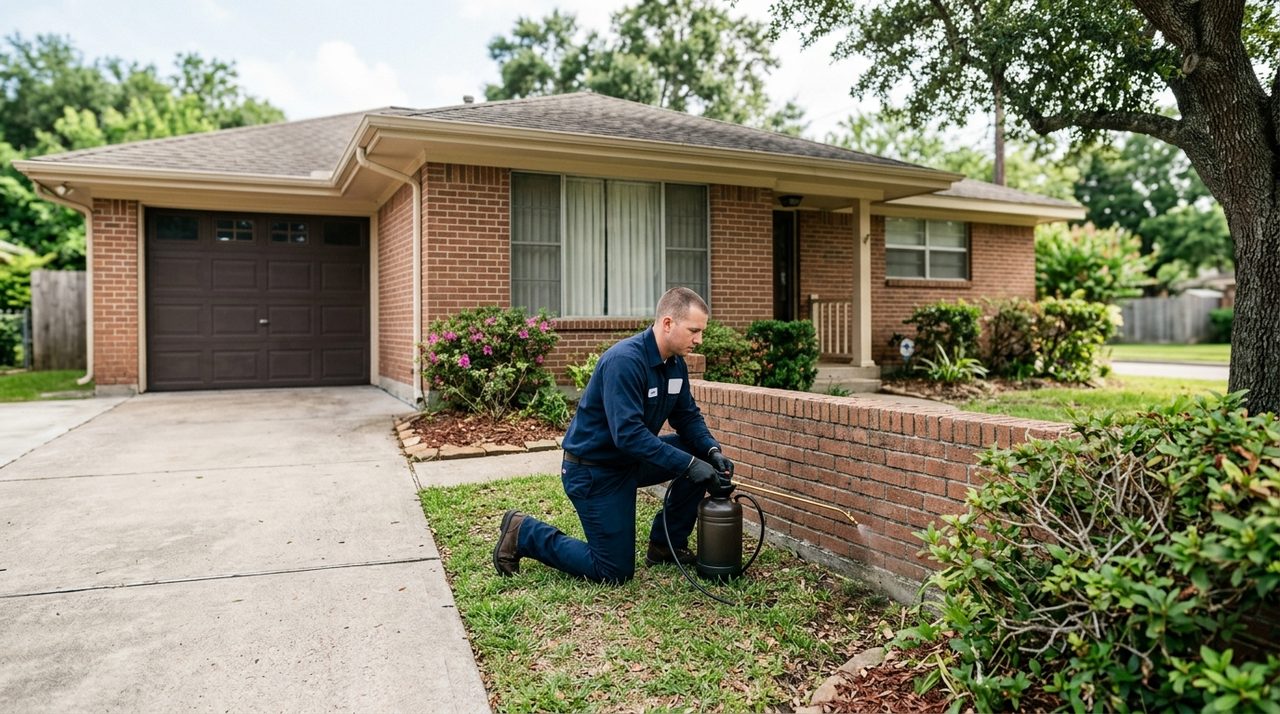
Jersey Village's 1960s–1980s slab-on-grade brick ranch homes sit squarely in FEMA Zone AE along White Oak Bayou's corridor — a combination that makes this independent city one of northwest Harris County's most demanding environments for pest control. Seasonal flooding saturates the expansive clay soil, opens slab-settling gaps, and drives pests from storm sewers directly into aging galvanized and cast-iron plumbing penetrations that the original builders never sealed for modern pest exclusion standards. If your home took on water during Harvey or Beryl and you haven't had a post-remediation pest inspection, this page explains exactly what to look for and what a licensed Texas pest control operator should do about it.
Ranked by verified Google rating × review volume × verification tier. How we rank →
Some highly-rated pros serve Jersey Village from nearby and may not keep a Jersey Village street address. Those are listed under "Also serving Jersey Village" with their real city and distance, so you always know where each business is based.
10015 Windfern Rd, Houston, TX 77064
10900 Brittmoore Park Dr D, Houston, TX 77041
10920 North Sam Houston Pkwy W Suite 500, Houston, TX 77064
5829 W Sam Houston Pkwy N, Houston, TX 77041
4310 Brittmoore Rd, Houston, TX 77041
11210 Steeplecrest Dr, Houston, TX 77065
Highly-rated pros based nearby who cover Jersey Village. Distance shown from the Jersey Village area.
Serving Jersey Village Based in NW Houston · 0.7 mi away
Serving Jersey Village Based in NW Houston · 1.1 mi away
Serving Jersey Village Based in NW Houston · 1.3 mi away
Why it matters to you
Jersey Village homes built in the 1960s and 1970s commonly retain original galvanized steel or cast-iron drain lines that have corroded and separated at joints beneath the slab. When White Oak Bayou backs up and storm sewers surcharge — a near-annual event in this FEMA Zone AE city — Periplaneta americana is hydraulically displaced from the sewer system and finds its way into living spaces through floor drains, weep holes in the exterior brick veneer, and the unshrouded plumbing sleeves that 50-year-old production builders left unsealed in kitchen and bath slabs. Interior perimeter spraying alone does not break this cycle.
What a good pro does
A TDLR-licensed pest control operator with a general household pest endorsement should perform a slab-penetration audit, apply a gel bait and residual dust treatment inside drain voids, and install exterior weep-hole screens at every course of the brick veneer — a detail that matters enormously on Jersey Village's traditional brick ranch exteriors. Ongoing quarterly perimeter treatment with a long-residual pyrethroid is the minimum maintenance protocol; after any significant bayou flood event, request a targeted re-treatment rather than waiting for the next scheduled visit.
Sources: Texas Department of Licensing & Regulation, Harris County Flood Control District, FEMA National Flood Hazard Layer (NFHL)
Why it matters to you
Houston sits in USDA Termite Pressure Zone 5 — the highest classification in the continental United States — and Jersey Village's housing stock is concentrated in exactly the era (1960s–1980s) that predates mandatory termiticide pre-treatment under slab pours. That means the concrete slabs in most of the city's original ranch-style homes have no chemical barrier at the soil interface. Coptotermes formosanus, the aggressive Formosan species, exploits the expansion joints and post-tension cable sleeves common in these older slabs as direct soil-to-wood pathways, and the heavy mulching that many Jersey Village yards use against foundation edges accelerates soil moisture retention that termites favor.
What a good pro does
For a 1970s ranch-style home in Jersey Village, a TDLR-licensed termite operator (Category 7 endorsement required) should recommend either a full liquid barrier treatment — Termidor-type products applied to the soil at the slab perimeter and through drilled penetrations — estimated at $800–$1,800 depending on linear footage, or a Sentricon-type bait station installation at $1,200–$2,000 with an annual monitoring contract. Given the AE flood zone, confirm that the treating company's monitoring protocol accounts for stations that may be submerged or shifted after a bayou flood event; bait matrix must be inspected and replaced post-inundation.
Sources: Texas Department of Licensing & Regulation, FEMA National Flood Hazard Layer (NFHL)
Why it matters to you
Jersey Village's position along White Oak Bayou tributaries means that after any significant storm — including the July 2024 Beryl event and the recurring Harris County Flood Control District (HCFCD)-tracked overbank flows — low-lying yards hold standing water for 72 hours or longer on the area's heavy Houston Black clay soil, which drains extremely slowly. That standing water is prime habitat for Aedes aegypti and Culex quinquefasciatus breeding. Harris County Mosquito Control District aerial spraying covers public rights-of-way but does not treat private residential lots, leaving homeowners with a direct responsibility for their own yard.
What a good pro does
During and after mosquito season (April–October in Jersey Village), a TDLR-licensed pest operator should apply a BTi-based larvicide to any standing water or slow-draining yard areas that persist after rain, combined with a permethrin-based barrier spray to shrub and ground-cover perimeters where adult mosquitoes rest during the day. Monthly applications averaging $75–$150 per visit are typical for this level of service. Homeowners should also flag clay soil drainage problems to their pest operator — source reduction (eliminating breeding sites) is more effective than any spray program alone.
Sources: Texas Department of Licensing & Regulation, Harris County Flood Control District, FEMA National Flood Hazard Layer (NFHL)
Why it matters to you
Houston's expansive Beaumont/Houston Black clay soil causes measurable seasonal slab movement that cyclically opens and re-opens gaps around utility penetrations and garage slab edges. In Jersey Village, this chronic movement is compounded by the number of homes that underwent pipe repairs and moisture remediation after Harvey (2017) and again after Beryl (2024) — work that frequently left utility chases and subfloor penetrations improperly resealed once contractors demobilized. Rattus norvegicus (Norway rat) and Mus musculus readily exploit these openings, and the brick weep holes in Jersey Village's characteristic ranch-style exteriors provide additional low-to-grade entry points.
What a good pro does
Effective rodent exclusion in Jersey Village starts with a physical inspection of every plumbing penetration, garage door sweep, and exterior weep hole — not just interior snap-trap placement. A TDLR-licensed operator with a rodent endorsement should use copper mesh and fire-rated caulk at all slab penetrations identified as entry points, install door sweeps or brush seals on garage entries, and confirm that any post-Harvey or post-Beryl utility repair openings were properly closed. Interior bait station placement (tamper-resistant, essential in homes with children or pets) should be paired with exterior perimeter exclusion; rodent control without exclusion is a repeating expense on Jersey Village's clay-shifting slabs.
Sources: Texas Department of Licensing & Regulation, FEMA National Flood Hazard Layer (NFHL), Harris County Flood Control District
Hiring pest control in Jersey Village? Jersey Village is an independent municipality with a housing stock predominantly built between the 1960s and 1980s, featuring ranch-style and traditional brick homes on concrete slab foundations. Homeowners face significant flood risk due to proximity to White Oak Bayou and tributaries, making drainage, foundation maintenance, and flood mitigation among the most critical home service needs. The city handles its own code enforcement and permitting, so contractors must work through the City of Jersey Village rather than Houston or Harris County offices.
Building era
1960s–1980s, with some later infill construction.
Typical style
Ranch-style and traditional two-story brick homes with attached garages; suburban production architecture typical of northwest Houston.
Foundations
Slab-on-grade (dominant); pier-and-beam may exist on rare older or custom structures but is not documented.
Common systems
Original homes likely have copper or galvanized steel plumbing (transitioning to CPVC/PEX in later builds), R-22 refrigerant HVAC systems nearing or past end of life, and 100–200 amp electrical panels. Many systems in this era are candidates for full replacement.
What that means for repairs
Kitchen and bathroom remodels are common as homeowners update 40–60-year-old finishes. Re-piping from galvanized to PEX, HVAC upgrades to modern refrigerant systems, and flood-related restoration work (raised electrical panels, moisture-resistant materials) are frequent renovation drivers.
Permit jurisdiction
City of Jersey Village Permitting (independent municipality – permits are not issued through Houston Permitting Center or Harris County).
HOA & deed restrictions
No mandatory city-wide HOA for core Jersey Village neighborhoods; property standards are enforced through city code enforcement and deed restrictions. The Park at Jersey Village HOA exists but appears to be a separate, newer subdivision not located in the traditional Jersey Village city limits. Specific section-level deed restrictions may exist but were not confirmed in public records.
Historic districts
No City of Houston historic district designation confirmed. Jersey Village is an independent city and not subject to HAHC review.
Contractor note
Contractors must obtain permits through the City of Jersey Village, which has its own building codes, inspections, and zoning requirements separate from both Houston and Harris County. Familiarity with the city's specific permit process and code enforcement standards is essential.
FEMA flood zone
FEMA Zone AE (high flood risk) — source: fema_nfhl. Jersey Village is situated near White Oak Bayou and associated tributaries, placing much of the community in a designated high-risk floodplain with base flood elevations established.
Hurricane Harvey impact
Jersey Village is in a bayou-adjacent northwest Harris County area that experienced flooding during Hurricane Harvey, though a precise street-by-street damage assessment specific to the City of Jersey Village was not confirmed in available public records. The White Oak Bayou corridor and tributaries in this area flooded significantly. Homeowners should check HCFCD flood layers, FEMA FIRM maps, and property-level flood loss history (CLUE reports) for individual address risk.
Heat & humidity load
Houston's extreme summer heat and humidity place heavy demand on aging HVAC systems common in 1960s–80s homes, often triggering emergency repairs or full system replacements. Slab foundations in clay-heavy soils can shift with summer drought cycles, and prolonged moisture from summer storms combined with Zone AE flood risk can lead to mold, moisture intrusion, and recurring drainage issues.
Working with contractors here
Contractors in Jersey Village most commonly work on HVAC replacement, re-piping, foundation repair, and flood damage restoration driven by the aging 1960s–80s housing stock and high flood risk. Slab foundation repair is a frequent need as expansive clay soils shift seasonally, and many homes still have original galvanized plumbing requiring full re-pipes. Flood mitigation work—including raising electrical panels, installing sump systems, and replacing flood-damaged drywall and flooring with moisture-resistant materials—is a significant segment of the local market. Because Jersey Village is an incorporated city with its own permitting authority, contractors unfamiliar with the area should budget time for the city's specific inspection and permit processes rather than defaulting to Houston or Harris County procedures. Roofing and exterior work on 40–60-year-old brick veneer homes is also common, particularly after severe weather events.
Local Tip
Always ask for a written estimate before work begins. Texas contractors are required to provide one on jobs over $1,000.
Jersey Village is an independent municipality with a housing stock predominantly built between the 1960s and 1980s, featuring ranch-style and traditional brick homes on concrete slab foundations. Homeowners face significant flood risk due to proximity to White Oak Bayou and tributaries, making drainage, foundation maintenance, and flood mitigation among the most critical home service needs. The city handles its own code enforcement and permitting, so contractors must work through the City of Jersey Village rather than Houston or Harris County offices.
Source: U.S. Census Bureau, ACS 5-Year 2023
Much of Jersey Village maps to FEMA Zone AE (high flood risk), so flood-resilient detailing -- elevated equipment, water-tolerant materials, and drainage-first thinking -- is essential here, not optional.
Source: FEMA National Flood Hazard Layer (NFHL). Flood zones vary by parcel — verify your individual FIRM panel.
Houston-specific estimators to plan your project before you call a pro. All results are planning estimates — a licensed local pro confirms the details on site.
| Pest | Cadence | Active window |
|---|---|---|
Mosquito control A standard 4-week barrier treatment holds a typical suburban lot through Houston's core mosquito season. | Every 28 days | April – October |
Termite (subterranean) A once-a-year spring inspection is the baseline for a drier, sunnier Houston lot — catch mud tubes and swarmer wings before damage compounds. | Annual inspection | Spring |
General pest guard (roaches, ants, spiders) Houston's year-round warmth means general pests never fully die off — a quarterly perimeter treatment is the standard maintenance rhythm. | Quarterly | Mar · Jun · Sep · Dec |
This is a planning estimate only — actual requirements depend on an on-site assessment by a licensed Houston pro. Texas requires an SPCB-licensed applicator for chemical treatment — ask for the technician's license number.
Sources: Harris County Flood Control District
Sources: Texas Department of Licensing & RegulationFEMA National Flood Hazard Layer (NFHL)