Open Now
14639 Fallbrook Dr Suite 100, Cypress, TX 77429
Cypress is an unincorporated swath of Harris County where subdivision after subdivision of 1980s–2000s slab-on-grade homes sits on the same expansive Beaumont clay that holds floodwater against slab edges long after a storm passes — even when FEMA maps the area as Zone X. The combination of aging polybutylene and CPVC plumbing in pre-2000 production homes, mandatory HOA review requirements in nearly every platted subdivision, and Harris County Engineering Department permitting (not the City of Houston) creates a restoration process with more moving parts than homeowners typically expect.
Ranked by verified Google rating × review volume × verification tier. How we rank →
Some highly-rated pros serve Cypress from nearby and may not keep a Cypress street address. Those are listed under "Also serving Cypress" with their real city and distance, so you always know where each business is based.
14639 Fallbrook Dr Suite 100, Cypress, TX 77429
13380 Telge Rd Ste 802, Cypress, TX 77429
18618 Fern St, Cypress, TX 77429
16698 House Hahl Rd Ste OW1320, Cypress, TX 77433
12010 Woodworth Dr, Cypress, TX 77429
12622 Rifleman Trail, Cypress, TX 77429
13702 Jarvis Rd, Cypress, TX 77429
17774 Cypress Rose Hill Rd #1500, Cypress, TX 77429
12507 Woodworth Dr #400, Cypress, TX 77429
Highly-rated pros based nearby who cover Cypress. Distance shown from the Cypress area.
Serving Cypress Based in Jersey Village · 1.9 mi away
Why it matters to you
Cypress subdivisions from the 1980s and 1990s — think neighborhoods near FM 1960 and Cypress Creek — are built on the same Houston Black clay that absorbs and holds water against slab perimeters for days to weeks after a flash flood or broken supply line. Even a Zone X address is not immune: Harris County's flat topography means localized street flooding and overland sheet flow routinely enter garages and push under slab edges. Because there is no crawl space buffer in any of these production builds, moisture wicks directly into bottom plates, drywall, and flooring from below, continuing after the visible water is gone.
What a good pro does
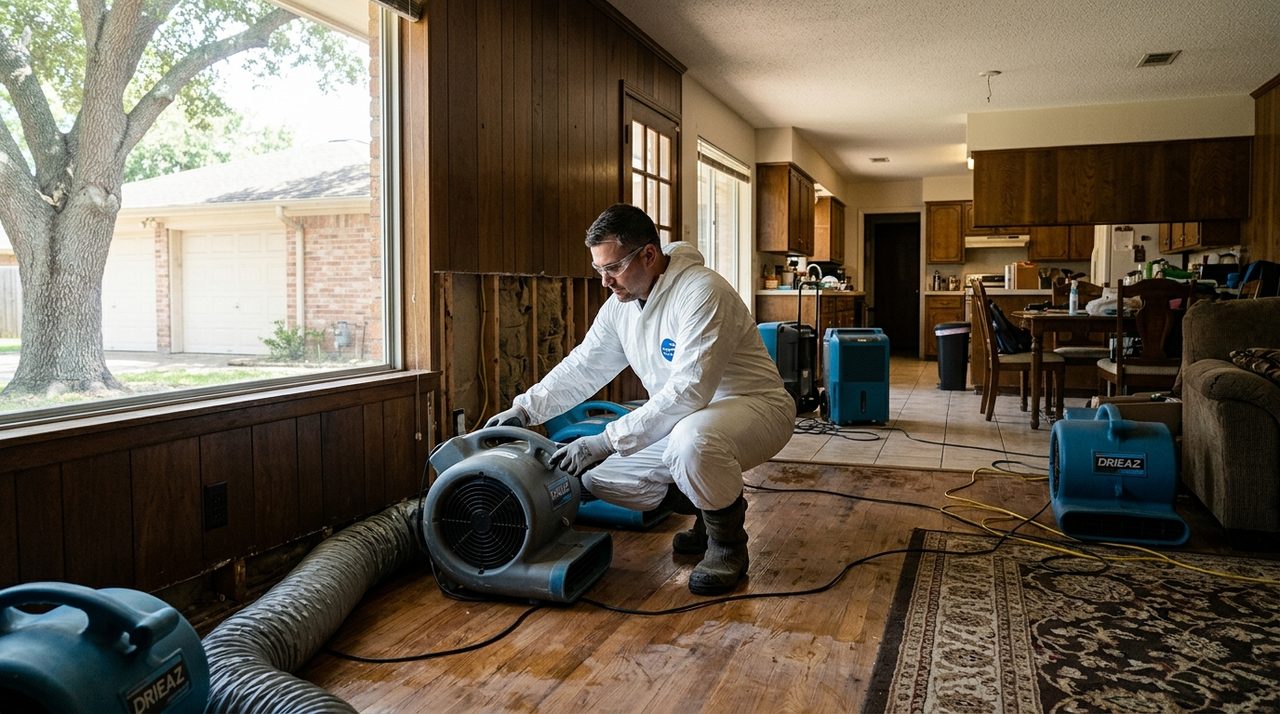
A qualified contractor will use calibrated moisture meters and thermal imaging cameras to map the drying front inside wall cavities and along the slab perimeter before equipment is ever removed. IICRC S500 standards set specific dryness targets (psychrometric baselines) that must be reached and documented — not just estimated by sight. Expect a drying period of five to ten days in summer months given Cypress's high ambient humidity, and insist on daily moisture logs to confirm progress before any wall closure begins.
Sources: IICRC (water/mold restoration standards), Harris County Flood Control District
Why it matters to you
A large portion of Cypress's housing stock was built between 1982 and 1999, when builder-grade air handlers with flex duct runs through unconditioned attic space were standard. When floodwater enters these homes — or when a supply line bursts inside a wall and runs undetected — the fiberglass insulation jacketing flex duct absorbs moisture and retains it even after the air handler resumes operation. Houston's average outdoor relative humidity above 70% and summer attic temperatures well above 120°F create Aspergillus and Cladosporium growth conditions within 48 to 72 hours of saturation, per EPA guidance on mold.
What a good pro does
Restoration contractors working in pre-2000 Cypress homes should scope a duct inspection as part of every structural drying assessment, not as an optional add-on. If flex duct insulation shows moisture readings above baseline or any visible microbial growth, replacement is the correct call — cleaning flex duct insulation is not reliable. Any firm performing mold assessment or remediation in Texas must hold a TDLR-issued Mold Remediation Contractor (MRC) or Mold Assessment Consultant (MAC) license under Texas Occupations Code Chapter 1958; ask to see it before work begins.
Sources: IICRC (water/mold restoration standards), Texas Department of Licensing & Regulation, Texas Commission on Environmental Quality
Why it matters to you
Cypress's 1980s and early-1990s production homes were commonly plumbed with polybutylene supply lines — a material recalled for its tendency to fail without warning — and early CPVC, which becomes brittle with age. Winter Storm Uri in February 2021 caused pipe bursts across unincorporated Harris County neighborhoods in this era of construction, many in attic-routed supply runs that were uninsulated. A significant number of Cypress homeowners patched surface damage but never fully dried wall cavities, and restoration contractors called in today for an unrelated water event routinely find residual microbial growth behind undisturbed drywall that pre-dates the current claim.
What a good pro does
Before closing any wall cavity after a water loss, a competent contractor will probe adjacent stud bays and attic framing with a pin-type moisture meter calibrated for wood, specifically checking areas around attic plumbing and any walls adjacent to exterior corners where Uri-era freezing was most severe. If mold is found, remediation must precede reconstruction and requires a TDLR-licensed MRC. Plumbing line repairs or repipes require a TSBPE-licensed plumber pulling a separate Harris County trade permit — the restoration contractor's demo permit does not cover plumbing work.
Sources: Texas Department of Licensing & Regulation, Texas State Board of Plumbing Examiners, IICRC (water/mold restoration standards)
Why it matters to you
Nearly every platted Cypress subdivision — from Lakewood Forest to Cypress Creek Crossing to the Villages of Cypress Lakes — operates an independent HOA with an architectural review committee (ARC) that technically governs exterior modifications, dumpster placement, and re-cladding material choices. Simultaneously, all structural demolition, plumbing, and electrical work after a flood event must be permitted through the Harris County Engineering Department, not the City of Houston, since Cypress is unincorporated. IICRC S500 calls for drying initiation within 24 to 48 hours of water entry; a Category 2 loss can escalate to Category 3 contamination status if demo is delayed waiting on approvals.
What a good pro does
On day one, a restoration contractor familiar with Cypress should file for the Harris County demolition permit electronically and simultaneously send written emergency-notification letters to the subdivision HOA documenting the water event and requesting expedited review under hardship provisions — many ARCs have them but do not advertise the process. Dumpster placement on the driveway (not the street or turf) typically falls within homeowner rights without ARC pre-approval in most deed restriction documents; confirm your specific subdivision's language before the crew arrives. Keeping a written timeline of every permit submission and HOA communication is essential documentation if an insurance scope dispute arises later.
Sources: IICRC (water/mold restoration standards), Local HOA / deed restrictions (see area profile), Municipal permit office (see area profile)
Hiring water & flood restoration in Cypress? Cypress is an unincorporated area composed of dozens of separately platted subdivisions, each with its own HOA and deed restrictions. The housing stock spans from late-1970s ranch-style homes near FM 1960 to brand-new construction along the Grand Parkway, meaning contractors encounter a wide range of system ages and maintenance needs. Slab foundations, production-style builds, and HOA-regulated exteriors define the home services landscape here.
Building era
Late 1970s through 2020s, with concentrations in the 1980s–2000s era.
Typical style
Production suburban traditional and ranch-influenced one- and two-story homes; newer master-planned communities feature transitional and modern traditional facades with brick or brick-and-siding exteriors.
Foundations
Slab-on-grade (overwhelmingly dominant given post-1960s suburban construction; pier-and-beam is rare and limited to custom builds).
Common systems
Older 1980s–1990s homes: original builder-grade HVAC (10–15 SEER), copper or CPVC plumbing, and 100–200 amp electrical panels. 2000s–2010s homes: higher-efficiency HVAC, PEX plumbing, 200 amp panels. Homes from the 1970s–1980s may still have galvanized drain lines or polybutylene supply lines.
What that means for repairs
Kitchen and bath remodels are common in 1980s–1990s homes as original finishes age out. HVAC replacements are frequent in homes over 15 years old. Exterior updates often require HOA architectural review and approval before work begins.
Permit jurisdiction
Harris County Engineering Department (unincorporated area - not within City of Houston or any incorporated city limits).
HOA & deed restrictions
Mandatory HOAs are the norm in most platted subdivisions. Each subdivision operates independently (e.g., Lakewood Forest Fund, Cypress Creek Crossing HOA, Cypress Oaks North HOA, Villages of Cypress Lakes West). Older rural pockets and acreage tracts may have voluntary civic clubs or no organized association. Approximately 77% of Houston metro listings carry a mandatory HOA fee, and Cypress is explicitly cited as a high-HOA area.
Historic districts
No City of Houston historic district designation confirmed. Cypress is unincorporated Harris County with no known historic preservation overlays.
Contractor note
Contractors must pull permits through Harris County for structural, electrical, plumbing, and mechanical work. Nearly all subdivisions require HOA architectural committee approval for exterior modifications, fencing, roofing material changes, and paint colors before work begins.
FEMA flood zone
FEMA Zone X (low flood risk) per official NFHL data. Cypress Creek and its tributaries run through portions of the area, and specific parcels near waterways may carry higher flood designations — property-level FEMA lookups are recommended for homes near Cypress Creek, Faulkey Gully, or retention basins.
Hurricane Harvey impact
Not confirmed from provided research with subdivision-level specificity. Cypress Creek corridor flooding during Harvey (2017) impacted portions of the area, particularly homes in low-lying sections near creeks and bayous. Homeowners should check individual property flood claim history through FEMA and Harris County Flood Control District records.
Heat & humidity load
Prolonged 95°F+ heat and high humidity stress HVAC systems heavily; older 1980s–1990s units frequently fail during peak summer. Slab-on-grade foundations on expansive clay soils experience seasonal movement during summer drought cycles, leading to crack repair and foundation leveling demand. Exterior caulking and weatherproofing degrade quickly in UV and humidity.
Working with contractors here
Contractors in Cypress most commonly handle HVAC replacements and repairs, as the wide range of home ages means systems from the 1980s through the 2010s are cycling through end-of-life. Roof replacements are a major category, driven by storm damage and aging composition shingles, with HOA requirements often dictating material and color specifications. Plumbing repipes — especially replacing polybutylene or aging CPVC in 1980s–1990s homes — are a steady source of work. Foundation repair is common given the expansive clay soils and slab construction. Contractors should budget time for HOA architectural review submissions and Harris County permitting, as both processes can add lead time before work can commence.
Local Tip
Always ask for a written estimate before work begins. Texas contractors are required to provide one on jobs over $1,000.
Cypress is an unincorporated area composed of dozens of separately platted subdivisions, each with its own HOA and deed restrictions. The housing stock spans from late-1970s ranch-style homes near FM 1960 to brand-new construction along the Grand Parkway, meaning contractors encounter a wide range of system ages and maintenance needs. Slab foundations, production-style builds, and HOA-regulated exteriors define the home services landscape here.
Source: U.S. Census Bureau, ACS 5-Year 2023
Most of Cypress maps to FEMA Zone X (low mapped flood risk), but Houston's flash-flood reality means even low-risk blocks benefit from smart drainage and storm-hardened installs.
Source: FEMA National Flood Hazard Layer (NFHL). Flood zones vary by parcel — verify your individual FIRM panel.
Water-restoration companies serving Cypress, TX can install or recommend backflow prevention add-ons on floor drains and advise on contents-elevation strategies that limit category-2 water contact during a tropical event. The May 2024 derecho reminded Houston homeowners that extreme rain is not exclusive to named hurricanes, making year-round readiness essential. Confirm the current FEMA panel for your Cypress parcel — the area maps to Zone X, but adjacent lots can differ.
For homeowners in Cypress, TX: the May 2024 derecho caused widespread roof-deck separation across Houston, and the subsequent rainfall introduced water into attic insulation that retained moisture for weeks — a restoration contractor with desiccant drying equipment can address these attic assemblies that conventional fans cannot reach. Documenting the drying process with daily moisture logs also supports insurance claims for wind-and-water combined losses. Confirm the current FEMA panel for your Cypress parcel — the area maps to Zone X, but adjacent lots can differ.
Ice accumulation on exterior pipe chases and uninsulated attic runs caused widespread freeze-and-burst events across Cypress, TX during Uri 2021, and the resulting water losses required IICRC-trained technicians with commercial dehumidifiers to dry out wall and ceiling cavities that building materials alone could not off-gas. Confirming you have a preferred restoration contractor's number before a freeze forecast arrives eliminates critical delays when crews are in high demand across the metro. Confirm the current FEMA panel for your Cypress parcel — the area maps to Zone X, but adjacent lots can differ.
Sources: FEMA National Flood Hazard Layer (NFHL), Ready.gov -- Hurricanes, CenterPoint Energy -- Storm Center, City of Houston -- Emergency Preparedness, Ready.gov -- Winter Weather, Harris County Flood Control District
Houston-specific estimators to plan your project before you call a pro. All results are planning estimates — a licensed local pro confirms the details on site.
Disconnect & drain every outdoor hose bib
Remove hoses, drain the spigots, and cover each with an insulated faucet sock. Un-drained hose bibs are the #1 burst point in a Houston freeze.
Insulate exposed pipes in the attic & garage
Wrap any pipe in an unconditioned space (attic runs, garage walls) with foam sleeves. Houston homes rarely insulate these because they only matter a few nights a year — which is exactly why they burst.
Open cabinet doors & keep a pencil-width drip
On hard-freeze nights, open kitchen/bath cabinets so warm air reaches the pipes and let faucets on exterior walls drip to relieve pressure.
Protect the attic/garage water heater & its lines
An attic or garage tank sits in unconditioned space. Insulate the cold-inlet and hot-outlet lines and confirm the emergency drain pan is clear so a leak doesn't reach the ceiling.
This is a planning estimate only — actual requirements depend on an on-site assessment by a licensed Houston pro. If a pipe has already burst, shut off your main water supply and call a licensed Houston plumber immediately — freeze bursts flood fast.
Sources: Municipal permit office (see area profile)
Sources: IICRC (water/mold restoration standards)Municipal permit office (see area profile)
Sources: Local HOA / deed restrictions (see area profile)IICRC (water/mold restoration standards)
Sources: IICRC (water/mold restoration standards)Texas Department of Licensing & Regulation